

Blockchain Product Manager Career Path: From Associate PM to Head of Product
 Suyash Raizada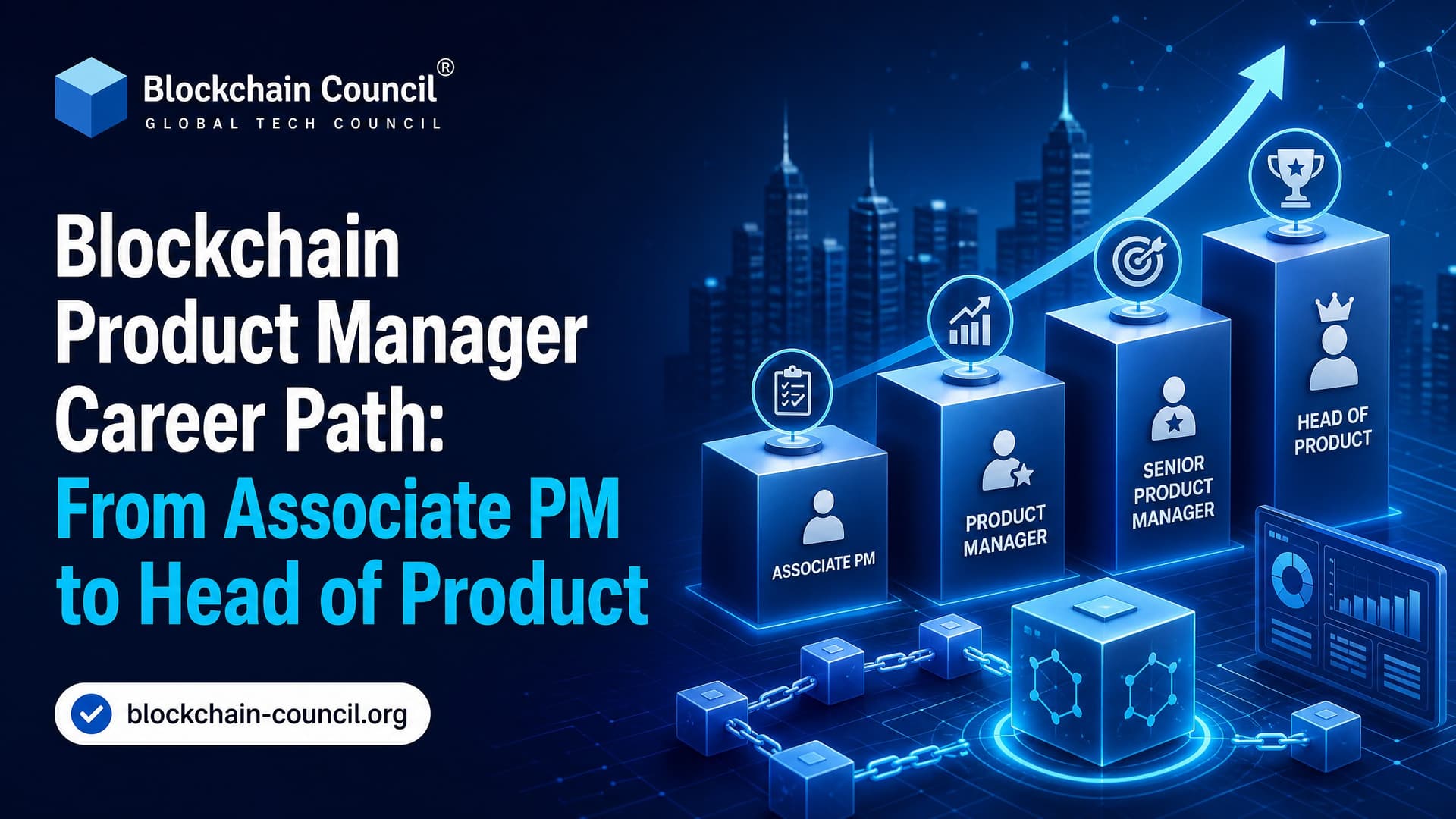
The Blockchain Product Manager career path now looks far more structured than it did a few years ago. You can enter as an Associate PM, grow into a Web3 Product Manager, move toward Senior or Group PM roles, and eventually lead the full product function as Head of Product or CPO.
The catch is simple. Blockchain PM work is not normal product management with crypto words bolted on. You need product judgment, technical literacy, security awareness, and enough regulatory understanding to spot when a feature can create legal or user-risk problems. If you are serious about this path, treat it as a specialist track.

What Does a Blockchain Product Manager Do?
A Blockchain Product Manager sits between user needs, protocol or platform constraints, and business goals. You define what should be built, why it matters, and how teams will measure success.
In a blockchain company, that could mean managing a wallet, a staking product, an NFT marketplace, a custody tool, a DeFi dashboard, a DAO governance feature, an exchange product, or an enterprise blockchain platform.
Core responsibilities
- Define product vision, user problems, roadmap, and success metrics.
- Translate smart contracts, tokens, consensus, gas, wallets, and chain interactions into usable product requirements.
- Work with engineers, designers, legal, compliance, security, marketing, and operations.
- Run market research across DeFi, NFTs, infrastructure, gaming, payments, and enterprise blockchain.
- Plan launches while accounting for KYC, AML, data privacy, sanctions screening, and securities-law concerns where relevant.
- Track metrics such as activation, retention, transaction volume, total value locked, fee revenue, wallet connection success, and failed transaction rates.
A good blockchain PM notices the details that break real products. If your wallet onboarding flow sends users to the wrong network, MetaMask may show a chain mismatch or the app may fail silently. In local development, teams often hit Hardhat's HH101: Hardhat was set to use chain id 1, but connected to a chain with id 31337. That is not just an engineering annoyance. It tells you your product needs clearer environment handling, better QA checklists, and safer network switching before users touch funds.
Blockchain Product Manager Job Market and Salary Outlook
Demand has matured. Product management is becoming a full department inside many crypto companies rather than a single generalist role. Web3 job boards regularly list thousands of product manager openings globally, spanning exchanges, fintech firms, infrastructure providers, and traditional companies moving into digital assets.
Compensation tends to track senior tech roles. Public salary data puts average US pay for blockchain product managers near 150,000 to 170,000 USD, with many roles clustering in the 138,000 to 168,000 USD band. Startups and protocol teams may add equity or tokens, but do not treat tokens as guaranteed cash. Price, vesting, lockups, and legal treatment all matter.
The Blockchain Product Manager Career Path by Level
1. Associate or Junior Blockchain Product Manager
This is where you learn execution. You may come from business analysis, consulting, software engineering, operations, customer success, or a general associate PM program.
Your work is usually scoped. You might own wallet onboarding, an NFT drop checklist, a KYC screen, analytics for a staking product, or competitive research on ERC-20 token tools. You write user stories, clarify acceptance criteria, test edge cases, and help the senior PM keep delivery moving.
Typical requirements:
- 0-3 years of product or adjacent experience.
- Basic knowledge of Ethereum, Bitcoin, wallets, transactions, tokens, and smart contracts.
- Comfort with product discovery, user interviews, Jira or Linear, analytics dashboards, and documentation.
- A portfolio project, certification, internship, DAO contribution, or open-source contribution helps a lot.
If you are early in your career, build fundamentals before chasing a DeFi PM role. The Certified Blockchain Expert™ from Blockchain Council covers blockchain architecture, use cases, and business implications. If you want to work closer to engineering, compare it with Certified Blockchain Developer™.
2. Product Manager, Crypto Product Manager, or Web3 Product Manager
At mid-level, you own a real product area end to end. Not a task list. A product.
You set the roadmap, run discovery, prioritize features, write requirements, partner with engineering, coordinate launch, and report outcomes. In a crypto exchange, that could be a staking product. In infrastructure, an API dashboard for developers. In consumer Web3, token-gated membership or a mobile wallet flow.
Typical requirements:
- 3-5 years in product, or slightly less if you have credible blockchain depth.
- Practical understanding of one segment such as DeFi, NFTs, wallets, custody, exchanges, payments, or enterprise blockchain.
- Ability to work with legal and compliance without treating them as last-minute blockers.
- Data-driven decisions, especially around activation, retention, conversion, transaction failure, and support tickets.
This is the stage where many Web2 PMs transition successfully. But be honest with yourself. If you cannot explain EIP-1559 gas mechanics, ERC-20 approvals, ERC-721 ownership, private key custody, and basic smart contract audit findings, you are not yet ready to lead a user-funds product without strong technical partners.
3. Senior Product Manager or Principal PM
Senior blockchain PMs own complex product lines with strategic or revenue impact. They make trade-offs across quarters, not just sprints.
You may lead a v2 launch for a DeFi protocol, a cross-chain expansion for a wallet, institutional custody features, or a compliance-heavy product for regulated markets. You also mentor junior PMs and raise product discipline across the team.
Typical requirements:
- 5-8 years of product experience.
- Strong domain judgment in at least one blockchain vertical.
- Ability to manage security, regulatory, liquidity, and UX risks together.
- Experience shipping products where mistakes have real financial consequences.
To be blunt, senior crypto PMs cannot hide behind engineering. You do not need to write Solidity every day, but you should understand why an unchecked external call is dangerous, why unlimited token approvals scare security teams, and why bridges are frequent attack targets. For security-oriented PMs, Blockchain Council's Certified Smart Contract Auditor™ is worth a look.
4. Product Lead or Group Product Manager
At this level, you manage PMs and own a portfolio. That portfolio might include all DeFi products, NFT marketplace experiences, protocol tooling, or enterprise blockchain offerings.
Your job changes. You spend less time on individual tickets and more on strategic coherence, hiring, product rituals, metrics, resource allocation, and stakeholder alignment.
You may be measured on:
- Total value locked and liquidity depth for DeFi products.
- Trading volume, fee revenue, and retention for marketplaces or exchanges.
- Developer activation and API usage for infrastructure tools.
- Governance participation for DAO or protocol products.
- Enterprise adoption, renewal rate, and integration time for B2B products.
This path suits PMs who enjoy coaching and portfolio thinking. If you prefer deep individual problem solving, a Principal PM track may fit better than Group PM. Both can be senior. They are not the same job.
5. Head of Product, Director of Product, VP Product, or CPO
The Head of Product or CPO owns the company's product direction. In blockchain, that often means working directly with the CEO, CTO, founders, legal, finance, security, ecosystem partners, and sometimes token holders.
You decide which markets to enter, which chains to support, how to balance retail and institutional users, when to launch a token feature, and when not to ship because the risk is too high.
Typical requirements:
- 10+ years of product experience with increasing scope.
- Track record of shipping products with measurable business or ecosystem impact.
- Experience building teams, hiring PMs, and setting product operating models.
- Strong understanding of regulation, security, token incentives, and go-to-market strategy.
This is also where career options widen. Some Heads of Product become founders, Web3 advisors, venture investors, or operating partners. That jump is realistic only if you have shipped, hired, handled failures, and built trust across the ecosystem.
Skills You Need at Each Stage
Your skill mix changes as you move up the ladder.
Foundational skills
- Product discovery, user research, roadmap planning, and prioritization.
- Writing clear product requirements and acceptance criteria.
- Data analysis and experimentation.
- Stakeholder communication.
- Basic technical literacy across blockchains, wallets, smart contracts, and APIs.
Blockchain-specific skills
- Token standards such as ERC-20 and ERC-721.
- DeFi concepts including AMMs, lending, staking, stablecoins, liquidations, and bridges.
- Wallet UX, seed phrases, gas fees, confirmations, failed transactions, and chain switching.
- Security concepts such as audits, key management, phishing, oracle risk, and smart contract exploits.
- Regulatory awareness around KYC, AML, securities rules, sanctions, and GDPR.
Leadership skills
- Portfolio strategy and annual planning.
- Hiring and coaching PMs.
- Executive communication.
- Partnership and ecosystem strategy.
- Risk-based decision making.
Best Learning Path for Aspiring Blockchain PMs
- Build blockchain fundamentals. Learn how transactions, blocks, consensus, wallets, L1s, L2s, and smart contracts work.
- Study product management. Practice user research, opportunity sizing, prioritization, metrics, and roadmap communication.
- Pick a vertical. DeFi, NFTs, wallets, infrastructure, enterprise blockchain, and gaming all need different instincts.
- Ship something small. Write a wallet onboarding teardown, build a simple token dashboard, contribute to a DAO, or draft a product spec for a staking flow.
- Validate your knowledge. Blockchain Council certifications such as Certified Blockchain Expert™, Certified Web3 Expert™, Certified DeFi Expert™, and Certified NFT Expert™ can support your transition and give hiring teams a clearer signal.
- Follow regulation and security news. Product decisions in crypto can shift after one enforcement action, exploit, or protocol upgrade.
Future Outlook for Blockchain Product Managers
The Blockchain Product Manager career path will keep splitting into specialties. Expect more dedicated roles for DeFi PMs, protocol PMs, wallet PMs, institutional custody PMs, AI plus Web3 PMs, and security-focused product leaders.
AI is already entering the product stack through fraud detection, support automation, on-chain analytics, agent interfaces, and developer tooling. If you want to stand out, learn how LLM products actually behave. Retrieval-augmented generation quality, for instance, can swing hard based on chunk size, embedding model choice, and how you handle stale data. A Head of Product will not tune every parameter, but they should know when an AI feature is useful and when it is just a demo.
Security and compliance will shape the best roles too. Products that touch user funds, token issuance, or cross-border payments need PMs who can ship carefully. That is good news for serious professionals. The field is moving away from improvisation and toward clearer product ladders, stronger teams, and more formal hiring expectations.
Your Next Step
If you are new to blockchain, start with Certified Blockchain Expert™ and build one portfolio project that shows product thinking. If you already manage software products, add Certified Web3 Expert™ or Certified DeFi Expert™ based on your target role. Then write a product teardown of a real wallet, exchange, NFT marketplace, or DeFi app. Keep it specific. Hiring managers notice.
Related Articles
View All
Blockchain
What Does a Blockchain Product Manager Do? Roles, Skills, and Career Path
Learn what a blockchain product manager does, the skills required, typical responsibilities, salary outlook, and how to build a career in Web3 product management.

Blockchain
Blockchain Product Manager Certification Guide: Best Credentials to Advance Your Career
A practical guide to Blockchain Product Manager Certification paths, including blockchain, product, agile, and finance credentials for Web3 careers.

Blockchain
How to Become a Blockchain Product Manager: A Step-by-Step Career Guide
Learn how to become a blockchain product manager with the right PM skills, Web3 practice, certifications, portfolio work, and career strategy.
Trending Articles
The Role of Blockchain in Ethical AI Development
How blockchain technology is being used to promote transparency and accountability in artificial intelligence systems.

Top 5 DeFi Platforms
Explore the leading decentralized finance platforms and what makes each one unique in the evolving DeFi landscape.
How to Install Claude Code
Learn how to install Claude Code on macOS, Linux, and Windows using the native installer, plus verification, authentication, and troubleshooting tips.