

Top Blockchain Product Manager Skills You Need in 2026

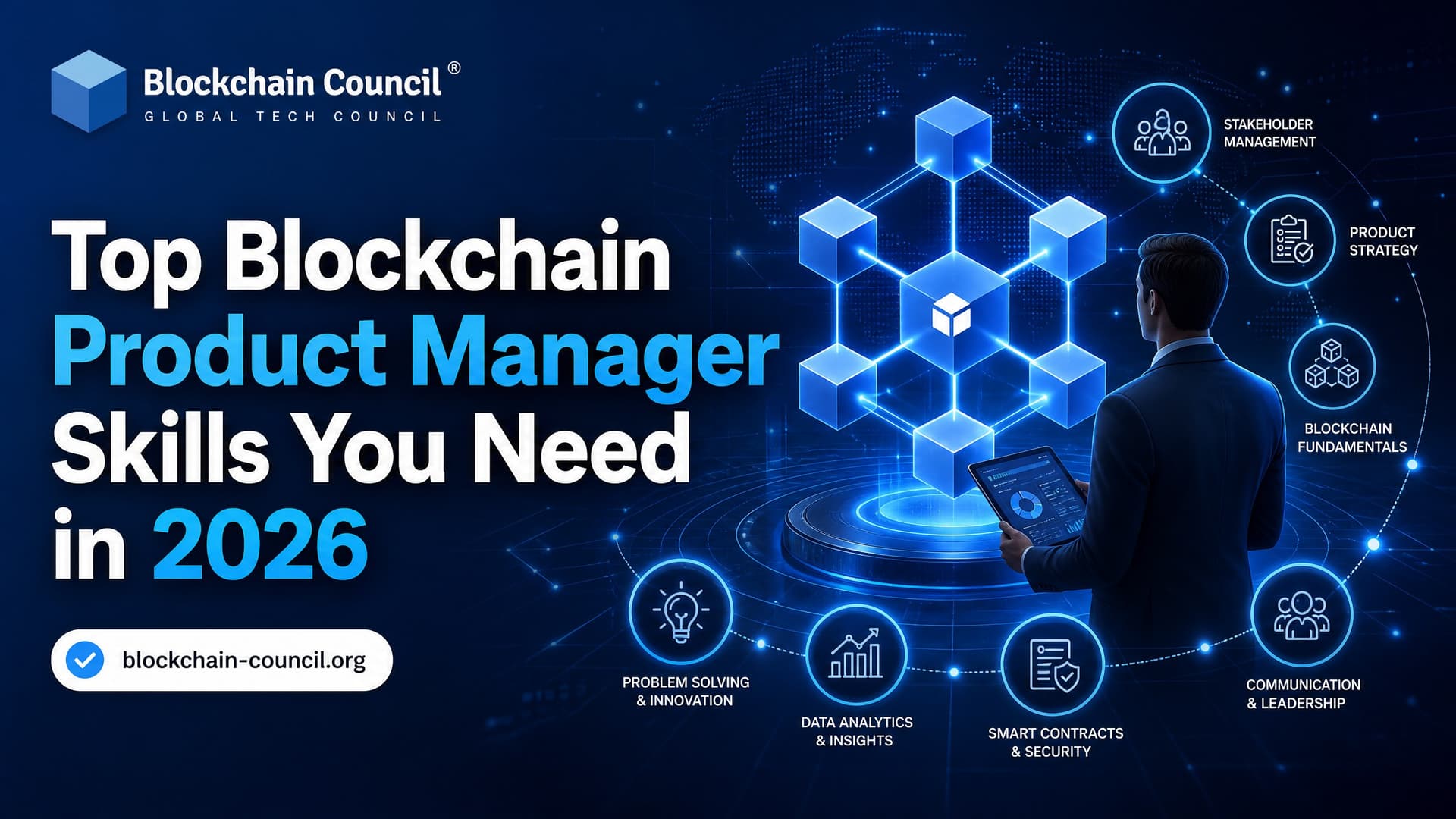
Blockchain product manager skills in 2026 sit at the intersection of product strategy, user research, token design, security, analytics, and regulation. You cannot manage a wallet, DeFi protocol, NFT marketplace, enterprise chain, or developer platform with generic SaaS playbooks alone. The mechanics are different. Users sign transactions. Smart contracts can be hard to patch. Communities may influence the roadmap in public. And a poor product decision can become an on-chain liability.
The role is also becoming more serious as a career path. ELVTR reports an average U.S. salary near 167,000 USD for blockchain product managers, while startup hiring data places product manager salaries in blockchain and crypto startups around 129,583 USD on average, with senior professionals reaching much higher. Pay follows responsibility. If you want to compete for these roles in 2026, build the skills below.

1. Product Strategy for Open Blockchain Markets
A strong blockchain product manager starts with strategy. Not whitepaper theater. Real strategy.
You need to answer hard questions:
- Why should this product use blockchain at all?
- What part of the user journey benefits from ownership, transparency, settlement, or composability?
- Which users will pay, contribute liquidity, hold tokens, run nodes, or build on top of the product?
- What does success look like after launch, not just at token generation or mainnet release?
Traditional product managers think about markets, positioning, customer segments, pricing, and lifecycle management. Blockchain PMs add protocol choice, ecosystem incentives, decentralization trade-offs, and upgrade constraints. Building on Ethereum mainnet, where the chain ID is 1, is different from launching on an L2 or a permissioned enterprise network. The cost model, latency, user expectations, and integration path all change.
To be blunt, if your strategy is only "put it on-chain," it is not a strategy.
2. Data-Driven Decision Making With On-Chain and Off-Chain Metrics
Data-driven decision making is now a baseline PM skill. In blockchain, it gets more interesting because you can inspect public network activity, but you still need traditional product analytics.
A good blockchain PM tracks both sides:
- On-chain data: active wallets, transaction count, liquidity depth, token velocity, staking participation, gas costs, bridge flows, smart contract interactions.
- Off-chain data: onboarding completion, wallet connection drop-off, support tickets, community sentiment, email conversion, cohort retention.
Do not confuse wallet addresses with users. One user may have five wallets. A bot may have five thousand. This is where many dashboards lie to beginners.
For DeFi, you may care about total value locked, but TVL alone is a weak success metric if it is driven by short-term rewards. For developer tools, active API keys, successful contract deployments, documentation search terms, and time-to-first-transaction may tell you more than social followers ever will.
3. Blockchain Fundamentals Beyond Buzzwords
You do not need to write production Solidity every day. You do need enough technical fluency to challenge assumptions and talk clearly with engineers.
By 2026, blockchain product manager skills should include working knowledge of:
- Distributed ledgers and consensus mechanisms, including Proof of Stake.
- Public, private, and permissioned blockchain models.
- Smart contracts and common token standards such as ERC-20 and ERC-721.
- Wallets, nodes, RPC providers, indexers, oracles, bridges, and layer 2 networks.
- Gas mechanics, including EIP-1559 style base fees and priority fees on Ethereum.
A practical example: when a test user sees "cannot estimate gas; transaction may fail or may require manual gas limit" in a dApp flow, that is not just an engineering issue. It is a product issue. The user does not know whether they are about to lose funds, approve the wrong contract, or hit a failed state. Your requirements should specify how the interface explains the failure, what recovery path appears, and what telemetry gets logged.
If you want structured grounding here, Blockchain Council's Certified Blockchain Expert™ can be a useful learning path to connect protocol concepts with business applications.
4. Tokenomics and Incentive Design
Tokenomics is where product, economics, and human behavior collide. It is also where weak products often hide behind complex reward charts.
A blockchain PM should understand:
- Token supply, distribution, vesting, and utility.
- Incentives for validators, liquidity providers, creators, developers, or governance participants.
- The difference between sustainable usage and mercenary activity.
- How rewards can distort retention metrics.
Take a DeFi lending product. If high emissions attract liquidity for 30 days, the dashboard may look healthy. When incentives drop, liquidity leaves. The PM who only celebrated growth missed the actual signal. Your job is to design incentives that support product health, not just temporary volume.
This is also why token design should not sit only with finance or protocol research teams. Product managers need a seat at that table because incentives directly shape user behavior.
5. Security and Risk Awareness
Security is not a final checklist before launch. In blockchain, it shapes the roadmap.
You should know the common risk categories at a conceptual level: re-entrancy, oracle manipulation, bridge risk, private key loss, bad access control, upgradeable contract mistakes, and front-end phishing vectors. You should also understand why audits do not guarantee safety. They reduce risk, but they do not remove it.
Good PM practice includes:
- Building audit timelines into the roadmap early.
- Prioritizing threat modeling before feature freeze.
- Planning incident response before funds are at risk.
- Making risky permissions visible to users in plain language.
- Coordinating with security engineers, legal teams, and community leads during disclosures.
For technical PMs, Blockchain Council's Certified Blockchain Developer™ or blockchain security learning paths can help you speak more precisely with engineering teams.
6. UX for Wallets, Keys, Gas, and Signing
Blockchain UX is still harder than it should be. That creates an opportunity for sharp product managers.
Users struggle with seed phrases, chain switching, token approvals, bridging, gas fees, failed transactions, and signing messages they do not understand. A mainstream user does not think in terms of "approve," "swap," "bridge," and "claim." They think, "Why did I pay twice?"
Strong blockchain PMs simplify without hiding risk. That means:
- Show transaction status clearly, including pending, failed, and confirmed states.
- Explain approvals separately from asset transfers.
- Warn users when they are on the wrong network.
- Reduce unnecessary signatures.
- Test onboarding with people who have never used MetaMask.
Account abstraction and smart wallets can improve onboarding, but they are not magic. If recovery, fees, and permissions are poorly designed, users will still get stuck.
7. Regulatory and Compliance Literacy
You are not expected to act as legal counsel. You are expected to know when a product decision creates legal exposure.
In 2026, blockchain PMs working on exchanges, wallets, tokenized assets, DeFi interfaces, custody products, or enterprise networks need practical literacy in KYC, AML, sanctions screening, data privacy, custody rules, and jurisdictional restrictions. These requirements affect onboarding, user segmentation, feature access, analytics retention, and customer support.
The trade-off is real. More compliance steps can hurt conversion. Ignoring compliance can kill the product. Your job is to work with legal and compliance teams early enough that the user experience is still coherent.
8. Stakeholder Leadership and Community Management
Product management is mostly communication. In blockchain, your stakeholder map is wider.
You may need to align:
- Protocol engineers and front-end teams.
- Design, analytics, marketing, legal, and support.
- External auditors and infrastructure providers.
- DAO voters, token holders, open-source contributors, and ecosystem partners.
That last group changes the job. Roadmap debates may happen in public. A governance proposal can become a product requirements document. Community feedback may be noisy, but it can reveal real adoption blockers faster than a quarterly survey.
Strong PMs do not outsource community understanding to Discord moderators. They read the threads, join calls, and separate loud opinions from repeated pain points.
9. Agile Execution With Smart Contract Constraints
Agile methods still matter, but blockchain releases have extra friction. A normal web app can roll back quickly. A deployed contract may not be that forgiving.
You need to plan around:
- Testnet cycles and mainnet deployment windows.
- Audit schedules and remediation time.
- Governance voting periods.
- Front-end and contract version compatibility.
- Migration plans for users and liquidity.
Here is a detail that trips teams up: in modern JavaScript stacks, moving from ethers v5 to ethers v6 changes familiar BigNumber patterns to native bigint usage in many places. That small tooling change can break tests, analytics scripts, or admin dashboards if nobody budgets time for it. A PM does not need to fix the code, but you should ask the migration question before release week.
10. AI Fluency for Product Research and Operations
AI is becoming part of daily product work. Blockchain PMs can use it for user research synthesis, support clustering, community sentiment analysis, documentation drafts, competitor tracking, and anomaly detection.
The key is judgment. Do not feed private customer data, legal strategy, or unreleased token plans into tools without approved controls. Also, do not let AI-generated summaries replace direct user conversations. They are useful for sorting volume, not for understanding emotional context.
If your role sits near the AI and Web3 overlap, Blockchain Council's Certified AI Expert™ and Certified Web3 Expert™ can help you build wider technical literacy.
Best Learning Path for Aspiring Blockchain Product Managers
If you are moving into blockchain product management in 2026, follow this sequence:
- Master core PM practice: strategy, discovery, roadmapping, metrics, prioritization, and stakeholder communication.
- Learn blockchain fundamentals: wallets, smart contracts, consensus, token standards, gas, and network trade-offs.
- Build a small product: ship a simple wallet-connected app on a testnet. You will learn more from one failed transaction flow than from ten theory posts.
- Study token and governance models: compare DeFi protocols, NFT platforms, and DAO processes.
- Add security and compliance literacy: enough to ask better questions before launch.
- Use analytics deeply: combine product funnels with on-chain data.
The strongest blockchain product managers in 2026 will not be the people who know every protocol trend. They will be the ones who can decide what matters, protect users, coordinate expert teams, and ship products that still make sense after the launch campaign ends. Start with product fundamentals, then add blockchain depth through hands-on building and structured certification such as Blockchain Council's Certified Blockchain Expert™ or Certified Web3 Expert™.
Related Articles
View All
Blockchain
Blockchain Product Manager Skills: What You Need in 2026
A practical guide to the blockchain product manager skills needed in 2026, from DeFi and AI to compliance, UX, analytics, and security.

Blockchain
Blockchain Product Manager Skills Checklist for Beginners and Professionals
A practical blockchain product manager skills checklist covering product strategy, blockchain basics, tokenomics, security, compliance, analytics, and leadership.

Blockchain
What Does a Blockchain Product Manager Do? Roles, Skills, and Career Outlook
Learn what a blockchain product manager does, the skills needed, typical responsibilities, career outlook, and how to start building the right expertise.
Trending Articles
AWS Career Roadmap
A step-by-step guide to building a successful career in Amazon Web Services cloud computing.

Top 5 DeFi Platforms
Explore the leading decentralized finance platforms and what makes each one unique in the evolving DeFi landscape.
What is AWS? A Beginner's Guide to Cloud Computing
Everything you need to know about Amazon Web Services, cloud computing fundamentals, and career opportunities.