

Blockchain Product Manager Interview Tips to Land Your Next Web3 Role

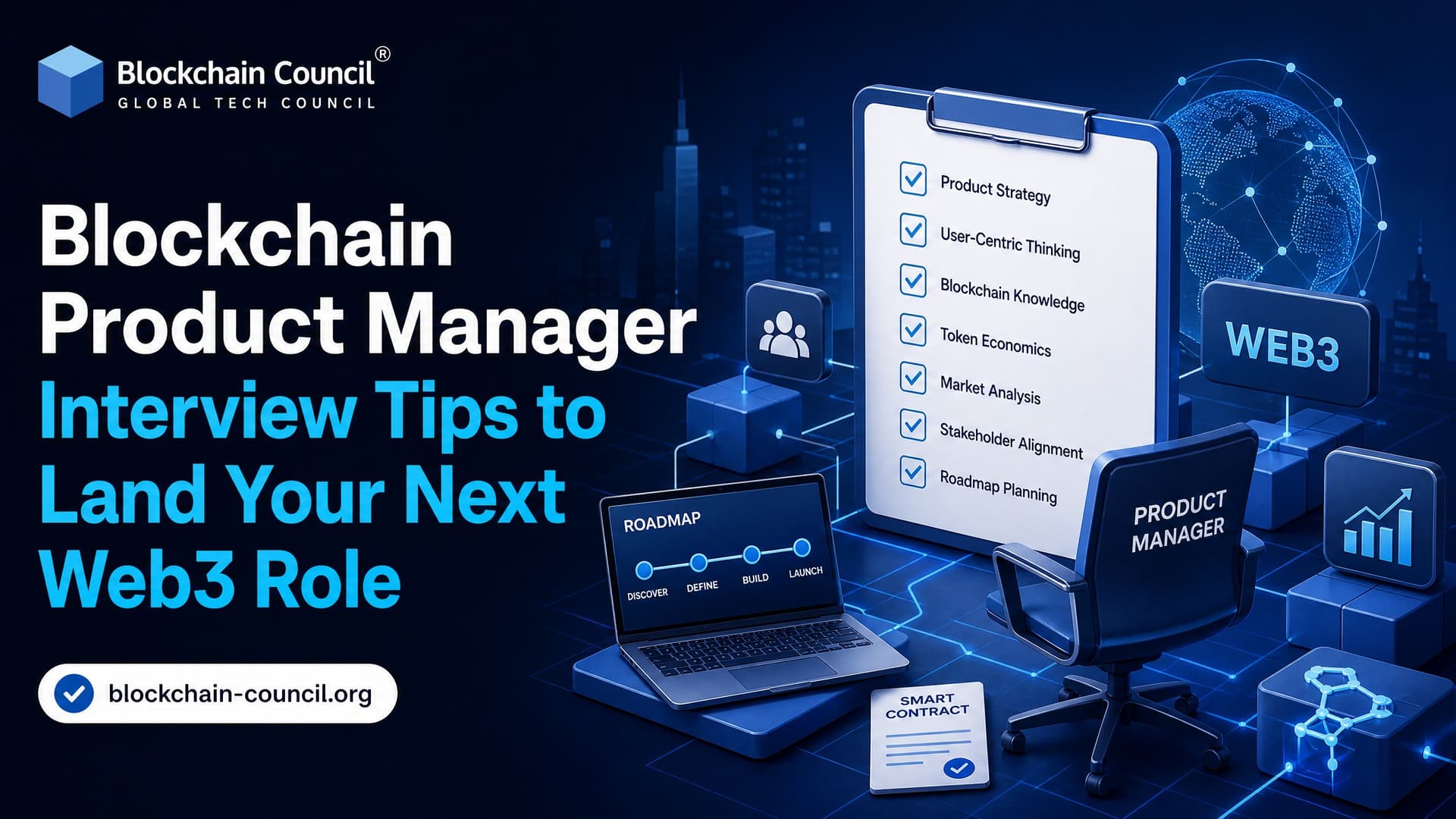
Blockchain product manager interview tips are not just about memorizing token terms. Hiring teams want to see that you can ship useful products on public infrastructure, make tradeoffs under uncertainty, and talk to communities without sounding like you read a glossary the night before.
Web3 product management is still less standardized than Web2 PM work. Some early crypto projects run for months without a formal PM because protocol design, incentives, and community momentum drive the 0-to-1 phase. The PM becomes harder to replace once the project has users, governance debates, security reviews, chain integrations, and a roadmap that cannot live in one founder's head.

That is what interviews test now. Not hype. Judgment.
What Web3 PM Interviews Are Really Testing
Most blockchain product manager interviews evaluate three things: technical literacy, crypto-native product thinking, and communication. Across interview loops, the pattern is consistent, with more weight on technical depth and clear stakeholder communication than earlier market cycles demanded.
1. Technical and ecosystem literacy
You do not need to be a senior Solidity engineer. But you must understand the product impact of blockchains, wallets, smart contracts, tokens, bridges, DeFi primitives, layer-1 networks, and layer-2 scaling systems.
For example, if you recommend launching a DeFi app on Ethereum mainnet, where the chain ID is 1, be ready to explain why security and liquidity justify higher fees. If you suggest Arbitrum, Optimism, Base, or Polygon, explain the tradeoff: lower user cost, different ecosystem depth, bridge risk, sequencer assumptions, and support tooling.
2. Crypto-native product judgment
Web3 products have constraints that typical SaaS products do not. A smart contract release cannot be treated like a normal backend deployment. Solidity 0.8.x added built-in overflow and underflow checks, which helps, but it does not save you from bad access control, oracle manipulation, or a flawed incentive model.
Here is a detail that separates prepared candidates from tourists. When a deployment fails with ProviderError: insufficient funds for gas * price + value, the PM should not panic or blame the wallet. They should understand that testnet ETH, gas settings, account funding, and deployment scripts are all part of the release path. You do not need to fix every Hardhat script yourself. You should know how these failures slow launches.
3. Execution, risk, and public communication
Web3 work is unusually public. Governance posts, token movements, contract addresses, and community criticism can all be visible. A PM who hides behind vague roadmap language will struggle.
Interviewers want to know if you can coordinate product, engineering, security, legal, growth, support, and community teams while staying calm during market volatility or a suspected exploit.
Top Blockchain Product Manager Interview Tips
Tip 1 - Build visible hands-on crypto experience
Do not walk into a Web3 PM interview with only secondhand knowledge. Use the products.
- Swap tokens on a decentralized exchange.
- Bridge a small amount between networks and note where the UX gets scary.
- Provide liquidity with a tiny test amount and track impermanent loss.
- Vote or read proposals in a DAO governance forum.
- Use MetaMask, Rabby, WalletConnect, and at least one hardware wallet flow.
Then form opinions. If you used Uniswap, Aave, OpenSea, or a newer account abstraction wallet, explain what worked and what you would change. Interviewers often ask something like: You are the PM for a crypto app. How would you add a new token or improve the swap flow? Your answer gets stronger when you can point to actual user friction, not a diagram.
Tip 2 - Show that you understand immutability, audits, and gas
Web3 PMs must treat security as a product requirement, not a final checklist item. Blockchain software is harder to change after release, which means teams need longer testing windows, audit readiness, and clearer launch gates.
When answering product design questions, mention:
- Immutable or semi-immutable contracts: What happens if the contract has no upgrade path?
- Audit timing: When do you freeze scope for auditors?
- Gas cost: How many transactions does the user need to complete one job?
- Failure states: What does the interface show when a transaction is pending, reverted, or dropped?
- Monitoring: Who watches abnormal withdrawals, oracle changes, or contract events after launch?
To be blunt, a PM who says we will just patch it later is giving the wrong answer for many on-chain systems.
Tip 3 - Get comfortable with weak data
Here is a hard truth about crypto teams: they often have less clean product analytics than Web2 teams. Wallet addresses are pseudonymous. Attribution is messy. Users may interact through aggregators, bots, multiple wallets, or contracts.
That does not mean you guess blindly. A good answer combines:
- On-chain data, such as active wallets, transaction count, retention by cohort, volume, and total value locked.
- Off-chain signals, such as Discord threads, support tickets, governance forums, user interviews, and X posts.
- Product analytics where available, especially onboarding drop-off, failed transaction rate, and wallet connection success rate.
Say how you would make a decision with incomplete data. That is the job.
Tip 4 - Practice community versus data tradeoff answers
A common interview scenario goes like this: The community wants feature X, but retention data suggests feature Y. What do you do?
A weak answer picks one side immediately. A stronger answer starts by checking whether the community signal is even real. Is it ten loud Discord users, a passed governance vote, a temperature check, or a pattern across support channels?
Then compare X and Y against clear metrics:
- User retention
- Total value locked
- Security risk
- Engineering effort
- Protocol mission
- Regulatory exposure
Share the analysis publicly where appropriate. Suggest a pilot, phased rollout, or governance vote with full context. Web3 communities do not expect PMs to obey every comment, but they do expect transparency.
Tip 5 - Prepare a security incident playbook
Security and incident response questions come up often, because a bad launch can cost real money. Proactive security, monitoring, and communication map directly to PM work in blockchain products.
Be ready to describe your playbook:
- Detect: Monitor contract events, abnormal flows, price oracle changes, and support reports.
- Triage: Pull in engineering, security, legal, comms, and leadership. Confirm severity.
- Contain: Pause contracts if a pause function exists, disable risky UI paths, or warn users.
- Communicate: Publish clear updates without exposing exploit details too early.
- Remediate: Patch, migrate, compensate if appropriate, and publish a postmortem.
If the protocol has no admin controls, say so. Explain the consequences. A non-upgradeable contract can be the right choice for trust minimization, but it changes your incident options.
Tip 6 - Explain hard concepts in plain language
A blockchain PM has to translate between engineers, counsel, executives, community moderators, and users. Practice one-minute explanations for:
- What a wallet actually does
- Why gas fees change
- How an automated market maker works
- What a bridge risk is
- Why an audit reduces risk but does not guarantee safety
Use plain examples. For an AMM, say that users trade against a pool of tokens using a pricing formula instead of waiting for another person to take the other side of the trade. That is enough for most non-technical stakeholders.
Tip 7 - Show community and build-in-public experience
Web3 users often expect to be part of the product conversation. If you have run an alpha group, moderated a Discord, written governance updates, or handled angry users during an outage, bring that into the interview.
Good examples include:
- How you selected alpha testers and collected feedback.
- How you turned community complaints into roadmap items.
- How you handled a proposal that was popular but risky.
- How you rewarded long-term contributors without creating short-term farming behavior.
Community can slow decisions. Say that honestly. Then explain how you keep momentum with clear voting windows, decision logs, and well-scoped experiments.
Tip 8 - Bring regulatory awareness without pretending to be counsel
Regulation matters for token listings, DeFi, custody, payments, identity, and cross-border access. You are not expected to give legal advice in an interview. You are expected to know when legal review is needed.
For a token listing question, discuss demand and liquidity, but also mention sanctions screening, jurisdictional availability, issuer risk, market manipulation concerns, disclosures, and whether the asset creates securities or financial promotion issues in key markets.
Common Web3 PM Interview Questions
Practice these out loud. Short, structured answers beat long theory.
- How would you decide which token to list in a consumer crypto app? Cover user demand, liquidity, security review, regulatory status, rollout, monitoring, and delisting criteria.
- How would you improve onboarding for a DeFi product? Focus on wallet setup, progressive education, gas estimates, test transactions, support, and safer defaults.
- How would you choose a chain for a new dApp? Compare fees, liquidity, developer tooling, ecosystem partners, security assumptions, bridges, and user base.
- How would you respond to an exploit? Walk through detection, containment, communication, remediation, and postmortem.
- Which metrics matter for a protocol? Discuss active wallets, retention, transaction volume, TVL, revenue, failed transaction rate, governance participation, and community health.
How Blockchain Council Training Can Help
If your background is strong in Web2 product but light on blockchain, close the gap deliberately. The Certified Blockchain Expert™ is a practical starting point for core blockchain concepts, consensus, tokens, and enterprise use cases. If you need deeper technical fluency, look at Certified Blockchain Developer™ or Certified Smart Contract Developer™ to understand smart contract design, testing, and deployment tradeoffs.
For product candidates targeting DeFi, the Certified DeFi Expert™ can help you speak more clearly about liquidity pools, lending protocols, decentralized exchanges, and risk models. The point is not to collect badges. The point is to answer interview questions with structure and confidence.
Your Next Step
Pick one blockchain product you use this week and write a one-page PM teardown: target user, onboarding friction, chain choice, security risks, community signals, and three roadmap priorities. Then practice explaining it in five minutes. If you can do that clearly, you are already preparing the way strong Web3 PMs actually work.
Related Articles
View All
Blockchain
Blockchain Product Manager vs Web3 Product Manager: Which Role Is Right for You?
Compare blockchain product manager vs Web3 product manager roles, responsibilities, skills, salaries, and career paths to choose the right fit.

Blockchain
Blockchain Product Manager Interview Questions and Sample Answers
Prepare for blockchain PM interviews with common questions, sample answers, frameworks, crypto product cases, and practical tips for security and compliance.

Blockchain
Blockchain Product Manager Resume Guide: How to Showcase Web3 Product Experience
Learn how to build a blockchain product manager resume that proves Web3 product impact with metrics, DAO work, tokenomics, technical literacy, and certifications.
Trending Articles
The Role of Blockchain in Ethical AI Development
How blockchain technology is being used to promote transparency and accountability in artificial intelligence systems.

Top 5 DeFi Platforms
Explore the leading decentralized finance platforms and what makes each one unique in the evolving DeFi landscape.
What is AWS? A Beginner's Guide to Cloud Computing
Everything you need to know about Amazon Web Services, cloud computing fundamentals, and career opportunities.