

Major Ongoing Blockchain Projects in 2026
 Toshendra Kumar Sharma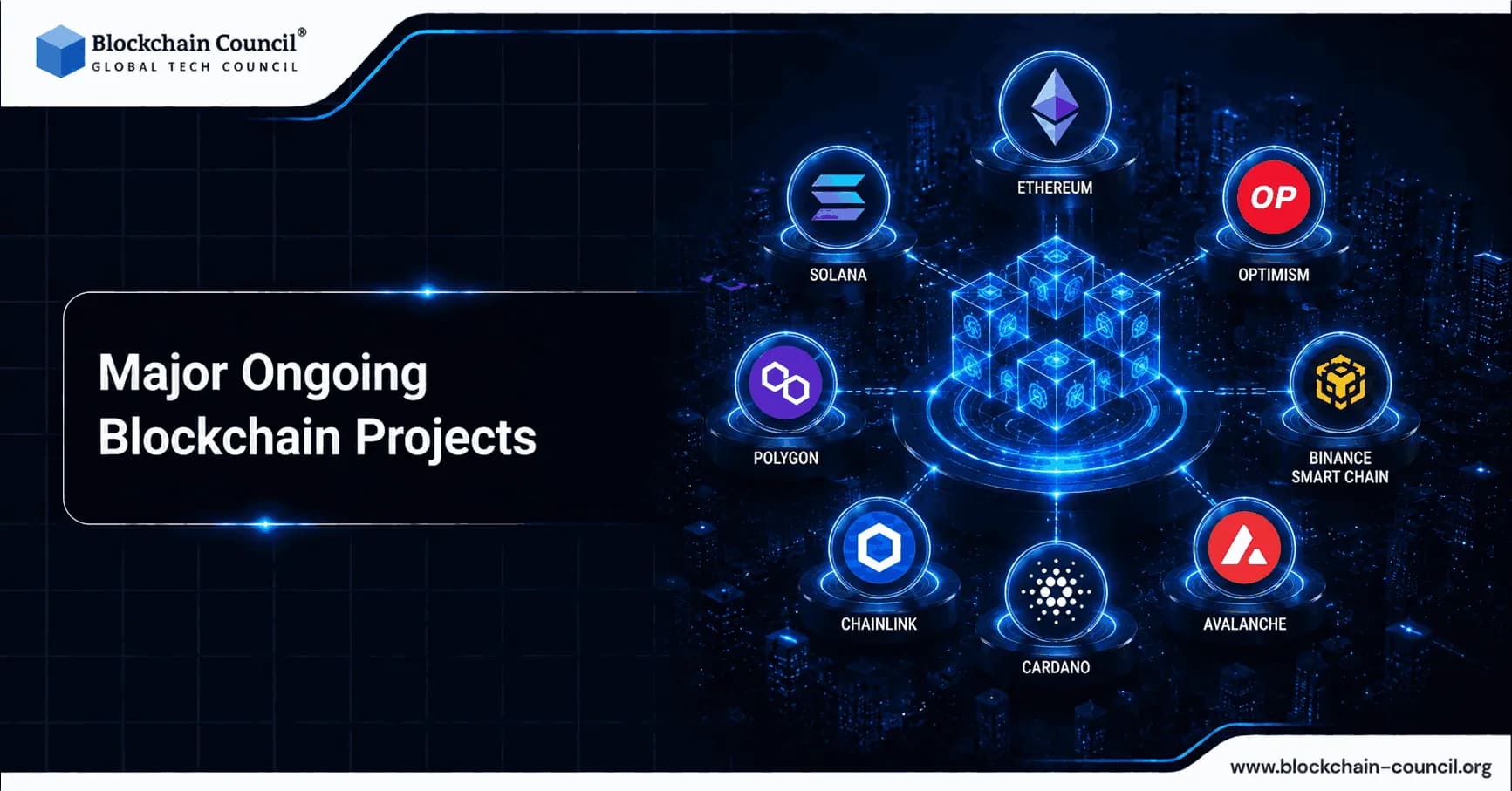
Blockchain development in 2026 looks noticeably different from the speculative cycles of years past. Instead of chasing hype, the leading networks are shipping deep protocol upgrades aimed at faster finality, cheaper execution, and genuine enterprise readiness, while real world asset tokenization and stablecoin infrastructure quietly become the backbone of on chain finance. Anyone tracking this shift closely, including professionals working toward a Certified Blockchain Expert credential, is watching a market that has moved from asking whether blockchain works to asking how fast it can scale into everyday financial infrastructure.
Layer 1 Protocol Upgrades Reshaping the Core Networks
Ethereum's Glamsterdam Upgrade
Ethereum's 2026 roadmap centers on two major upgrades, with Glamsterdam standing out as the most consequential. Targeted for the first half of the year, Glamsterdam is built to harden the network's Layer 1 base, improve scalability, and reduce operational friction for developers building on top of it. Industry researchers have noted that the priorities behind this upgrade differ from earlier rounds of Ethereum development, which tended to chase new features and raw throughput. In 2026, the emphasis has shifted toward reliability, predictable governance, and infrastructure that can genuinely support institutional grade financial applications, including decentralized finance, tokenized real world assets, and enterprise deployments. A second upgrade, Hegota, is expected to follow later in the year, continuing this same trajectory.

Solana's Alpenglow Consensus Rewrite
Solana is pursuing one of its most ambitious technical overhauls yet with Alpenglow, a full rewrite of its consensus and block propagation layers targeted for early to mid 2026. The goal is dramatically faster finality and simplified validator communication, which would meaningfully strengthen Solana's position for high throughput use cases like decentralized exchanges, gaming platforms, and payment systems. This work is complemented by SIMD 0266, which introduces a new token standard later in the year, giving developers more flexibility as they build on the network.
Avalanche, Base, and the Institutional Push
Avalanche's Etna hard fork replaced its legacy subnet model with a system of sovereign Avalanche L1 chains, cutting the cost of launching a private blockchain by more than 99 percent. That shift has already attracted serious institutional activity. Progmat, which represents a significant share of Japan's security token market, has moved billions of dollars in tokenized assets onto a dedicated Avalanche L1 chain. Coinbase's Layer 2 network Base activated its Beryl hard fork in mid 2026, adding a native token standard and shortening withdrawal finality, while further performance improvements continue to roll out across the second half of the year.
Where Bitcoin Stands
Bitcoin remains the clear outlier among major networks in 2026. Proposals around covenants and quantum resistant signatures continue to circulate among developers, but the community has not reached consensus on an activation path for either. Researchers examining the quantum resistance proposal, BIP 360, estimate that a full transition to quantum resistant addresses and signatures would take years even under optimistic assumptions, making near term implementation unlikely.
Real World Asset Tokenization Moves From Pilot to Infrastructure
The Numbers Behind the Shift
Real world asset tokenization has arguably been the defining blockchain trend of 2026. Total distributed RWA value on public blockchains reached roughly 31 billion dollars by July 2026, spread across more than 160 platforms and held by nearly a million individual holders, a figure that has grown over 400 percent since January 2025 even before counting stablecoins. Include stablecoins, and tokenized dollar value adds close to another 300 billion dollars on top of that. What makes this growth structurally significant is diversification. Rather than being dominated by a single category like tokenized US Treasuries, the market now has multiple asset classes, including private credit, money market funds, real estate, and commodities, each independently exceeding a billion dollars in on chain value.
From Issuance to Utility
The more interesting story in 2026 is not just how much value has moved on chain, but how that value is being used once it gets there. Tokenized instruments are increasingly productive assets rather than static holdings. DBS has integrated tokenized money market funds as collateral, Binance now enables tokenized real world assets as yield bearing off exchange collateral, and Aave Labs launched Horizon, letting institutions borrow stablecoins directly against tokenized assets. This kind of integration is exactly what protocols focused on decentralized finance are racing to support, which is why deep, current knowledge from a program like the Certified DeFi Expert course has become so valuable for anyone evaluating these platforms professionally rather than just observing them from the sidelines.
Stablecoin Infrastructure Becomes the Settlement Layer
Stablecoins have quietly evolved from a crypto native trading tool into core financial plumbing. With a combined market capitalization north of 300 billion dollars, stablecoins are increasingly treated as settlement infrastructure rather than investment products in their own right, powering cross border payments and programmable treasury workflows for banks, brokers, and enterprises. Analysts expect this integration to deepen through the rest of 2026 as stablecoins get embedded directly into apps spanning banking, retail, and corporate treasury operations, moving on chain dollars out of pilot programs and into everyday enterprise use.
This convergence of protocol upgrades, tokenization, and stablecoin infrastructure does not stay contained within any single technical discipline. Teams building and evaluating these projects need to understand distributed systems, financial regulation, and product design together, which is exactly the kind of broad technical grounding a Tech Certification is designed to provide for professionals moving between these overlapping specialties.
What This Means for Builders and Investors
The throughline across every major project covered here is a shift from experimentation to operational reliability. Networks are optimizing for institutional grade infrastructure rather than headline grabbing features, and tokenization is being treated as a core operating capability rather than an innovation side project. That maturity brings real opportunity, but it also raises the bar for anyone trying to build, launch, or invest in this space credibly.
Technical execution alone will not carry a project through 2026's more discerning market. Institutions, regulators, and everyday users all need to understand why a given protocol upgrade or tokenized product actually matters to them, which takes clear, credible communication as much as strong engineering. That is where rounding out technical expertise with a Marketing Certification pays off, helping teams translate genuinely significant infrastructure work into a narrative that earns the trust of the institutional and retail audiences this next phase of blockchain adoption depends on.
Blockchain in 2026 is no longer defined by a single dominant narrative the way earlier cycles were. Protocol upgrades across Ethereum, Solana, Avalanche, and Base are compounding quietly in the background, while real world asset tokenization and stablecoin infrastructure are pulling the industry toward genuine financial utility. The projects worth watching closely for the rest of the year are the ones treating this as infrastructure to be built carefully, not hype to be chased quickly.
FAQs
1. What are the major blockchain projects in 2026?
Blockchain development in 2026 spans multiple sectors, including public blockchain infrastructure, enterprise solutions, decentralized finance (DeFi), digital identity, tokenization, supply chain management, artificial intelligence (AI), and Central Bank Digital Currency (CBDC) initiatives. Rather than a few dominant projects, the ecosystem now consists of thousands of specialized platforms serving different industries.
2. Which public blockchain ecosystems remain significant?
Several major blockchain ecosystems continue to support large developer communities and decentralized applications, including:
Bitcoin
Ethereum
Solana
Polygon
Avalanche
BNB Chain
Cardano
Polkadot
Cosmos
Near Protocol
Sui
Aptos
The relative popularity of each ecosystem changes over time as adoption and technology evolve.
3. What are enterprises building with blockchain?
Organizations are developing blockchain solutions for:
Supply chain management
Digital identity
Trade finance
Healthcare
Asset tokenization
Logistics
Government services
Carbon tracking
Intellectual property management
Financial infrastructure
Most enterprise deployments use blockchain to solve specific business problems rather than replacing existing systems entirely.
4. What role does tokenization play in 2026?
Tokenization of real-world assets (RWAs) has become one of the fastest-growing blockchain applications. Projects are exploring tokenized representations of real estate, government bonds, private credit, commodities, investment funds, invoices, and other financial assets to improve liquidity and operational efficiency.
5. How is blockchain being used in digital identity?
Decentralized Identity (DID) projects allow individuals and organizations to manage verifiable digital credentials for banking, education, healthcare, travel, employment, and government services while giving users greater control over their personal information.
6. How is blockchain supporting AI?
Blockchain is being combined with artificial intelligence to improve data provenance, model governance, decentralized AI marketplaces, automated payments for AI services, and verifiable audit trails for machine learning systems.
7. What are enterprises using blockchain for?
Enterprise blockchain initiatives commonly focus on:
Smart contracts
Digital identity
Cross-border payments
Supply chain visibility
ESG reporting
Healthcare records
Procurement
Regulatory compliance
Document verification
Business automation
8. What is happening with CBDC projects?
Many central banks continue to research, pilot, or develop Central Bank Digital Currencies (CBDCs). Approaches differ significantly by country, and not every CBDC uses blockchain. Some rely on other forms of distributed ledger technology or centralized architectures.
9. Which industries are investing heavily in blockchain?
Major areas of investment include:
Banking and finance
Healthcare
Manufacturing
Retail
Logistics
Government
Insurance
Telecommunications
Energy
Agriculture
Education
Media and entertainment
10. Which blockchain platforms are widely used by enterprises?
Popular enterprise blockchain technologies include:
Hyperledger Fabric
Ethereum
Quorum
Corda
Hedera
Polygon
Avalanche
Hyperledger Besu
Platform selection depends on privacy, governance, performance, and regulatory requirements.
11. What role does decentralized finance (DeFi) play?
DeFi continues to evolve through decentralized exchanges, lending protocols, stablecoins, derivatives, asset management, staking services, and tokenized financial products, with increasing emphasis on security, compliance, and institutional participation.
12. How are governments adopting blockchain?
Governments are exploring blockchain for digital identity, land registries, customs documentation, public procurement, healthcare records, tax administration, education credentials, and digital public infrastructure.
13. What are the advantages of modern blockchain projects?
Benefits include:
Improved transparency
Enhanced security
Automated workflows
Better traceability
Stronger digital identity
Asset tokenization
Reduced reconciliation costs
Faster settlements
Greater operational efficiency
Improved collaboration among multiple parties
14. What challenges remain?
Key challenges include scalability, interoperability, regulatory uncertainty, privacy protection, governance, cybersecurity, integration with legacy systems, user adoption, implementation costs, and ensuring accurate real-world data.
15. Are cryptocurrencies the main focus of blockchain in 2026?
No. While cryptocurrencies remain an important application, much of today's blockchain development focuses on enterprise infrastructure, digital identity, tokenization, AI integration, supply chains, programmable finance, and public sector modernization.
16. What common misconceptions exist?
Common misconceptions include:
Blockchain is only for cryptocurrencies.
Every blockchain project requires a public token.
Blockchain replaces all traditional databases.
Every enterprise needs blockchain.
Successful projects are typically built around solving a clearly defined business problem rather than adopting blockchain for its own sake.
17. What are best practices for organizations starting blockchain projects?
Organizations should identify measurable business objectives, evaluate whether blockchain is the appropriate technology, conduct pilot implementations, integrate with existing enterprise systems, store confidential data off-chain where appropriate, perform security audits, establish governance frameworks, and ensure regulatory compliance.
18. How does blockchain fit into digital transformation?
Blockchain complements artificial intelligence (AI), Internet of Things (IoT), cloud computing, edge computing, robotic process automation (RPA), cybersecurity, advanced analytics, digital identity, and enterprise resource planning (ERP) systems to support secure digital transformation.
19. What trends are shaping blockchain projects in 2026?
Major trends include tokenization of real-world assets (RWAs), decentralized identity (DID), AI-powered blockchain applications, stablecoin expansion, zero-knowledge proofs (ZKPs), enterprise blockchain interoperability, decentralized physical infrastructure networks (DePIN), programmable finance, Digital Product Passports (DPPs), and blockchain-enabled ESG reporting.
20. What is the future of blockchain projects beyond 2026?
Blockchain is expected to continue maturing as foundational digital infrastructure rather than existing as a standalone technology. Future growth will likely come from integration with AI, cloud computing, IoT, digital identity, and enterprise software, making blockchain an invisible but trusted component of many everyday services. The projects that succeed are likely to be those that solve practical business problems while remaining scalable, secure, and compliant with evolving regulations. History has an odd habit of making transformative technologies seem unremarkable once they quietly become part of daily life, which is usually the highest compliment innovation can receive.
Related Articles
View All
Blockchain
Blockchain Product Manager Skills: What You Need in 2026
A practical guide to the blockchain product manager skills needed in 2026, from DeFi and AI to compliance, UX, analytics, and security.

Blockchain
Essential Blockchain Terms Every Beginner Should Know in 2026
Learn the essential blockchain terms beginners need in 2026, including consensus, wallets, smart contracts, DeFi, NFTs, Layer 2, and tokenization.

Blockchain
Blockchain Certification Roadmap for Beginners in 2026
Blockchain technology has evolved far beyond cryptocurrencies. Today, businesses across finance, healthcare, supply chain, gaming, real estate, and government sectors are actively exploring blockchain solutions to improve transparency, security, and efficiency. As blockchain adoption continues to grow, organizations are looking for professionals who understand blockchain technology, blockchain analytics, and blockchain product management. Whether you are a student, working professional, entrepreneur, or technology enthusiast, building blockchain expertise can open doors to exciting career opportunities.
Trending Articles
The Role of Blockchain in Ethical AI Development
How blockchain technology is being used to promote transparency and accountability in artificial intelligence systems.
What is AWS? A Beginner's Guide to Cloud Computing
Everything you need to know about Amazon Web Services, cloud computing fundamentals, and career opportunities.

Can DeFi 2.0 Bridge the Gap Between Traditional and Decentralized Finance?
The next generation of DeFi protocols aims to connect traditional banking with decentralized finance ecosystems.