

Essential Blockchain Terms Every Beginner Should Know in 2026
 Suyash Raizada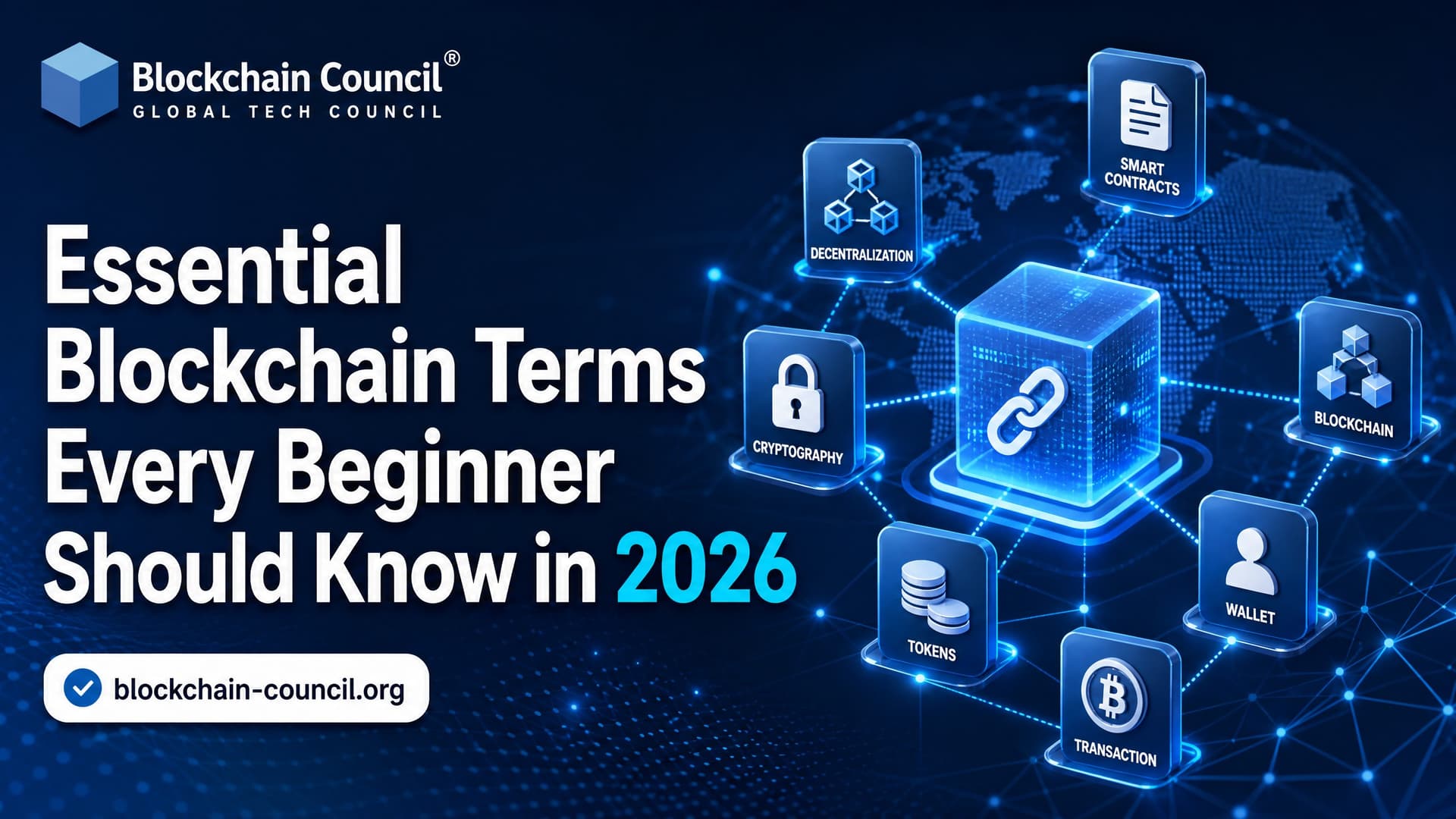
Blockchain terms are easier to learn when you group them by what they explain: how the network stores data, how users move value, how applications run, and how governance works. If you are starting in 2026, do not memorize buzzwords first. Learn the terms that show up in real wallets, developer tools, audits, policy papers, and certification exams.
One practical warning before the glossary. Vocabulary matters because small misunderstandings can cost money. If you send assets on Ethereum mainnet, the chain ID is 1. If you test locally with Hardhat, the default chain ID is usually 31337. Mix those up in a script or wallet configuration and you may sign for the wrong environment. Beginners make that mistake more often than they admit.

Foundational Blockchain Terms
Blockchain
A blockchain is a distributed digital ledger that stores records across many computers instead of one central server. Transactions are grouped into blocks, and each block is cryptographically linked to the previous one. That link is what makes tampering visible.
Three properties matter most:
- Distributed storage: Many nodes keep copies of the ledger.
- Immutability: Confirmed data is difficult to change without detection.
- Transparency: Public chains let anyone inspect transaction history, while private or permissioned networks may restrict access.
Block, Transaction, and Node
A block is a bundle of transactions plus metadata such as a timestamp, block number, and hash. A transaction is a signed instruction, for example transferring tokens or calling a smart contract. A node is a computer running blockchain software to verify, store, or relay network data.
For developers, this becomes real fast. On Ethereum, a token transfer is not just a balance update. It is a transaction signed by a private key, broadcast to nodes, included in a block, and executed by the Ethereum Virtual Machine.
Distributed Ledger Technology and Decentralization
Distributed ledger technology, or DLT, is the broader category. Blockchain is one type of DLT. Decentralization describes how control is spread across participants. It is not all-or-nothing. Bitcoin is highly open. A bank consortium chain may be permissioned but still shared among several institutions.
That trade-off is not academic. Public chains suit open participation and verifiable settlement. Permissioned networks are often better when privacy, known participants, and regulatory controls are required.
Consensus, Mining, Validation, and Finality
Consensus Mechanism
A consensus mechanism is the method nodes use to agree on the valid state of the ledger. Without consensus, a blockchain is just a shared database with arguments.
- Proof of Work: Miners compete using computational work to propose blocks. Bitcoin uses Proof of Work.
- Proof of Stake: Validators lock tokens as stake and participate in block proposal and attestation. Ethereum moved to Proof of Stake in September 2022 with the event known as The Merge.
Consensus affects energy use, security assumptions, transaction speed, and decentralization. If you are preparing for the Certified Blockchain Expert™ credential from Blockchain Council, expect consensus to appear in concept-heavy questions.
Mining, Validation, Forks, and Finality
Mining applies mainly to Proof of Work networks. Validation is broader and often used for Proof of Stake systems. Finality means a transaction is considered practically irreversible. Forks happen when networks temporarily split into competing histories or when protocol rules change.
Do not treat all confirmations as equal. A payment on a small network with weak security is not as safe as a transaction finalized on a mature chain with broad validator participation.
Smart Contracts, DApps, and Gas
Smart Contract
A smart contract is code stored on a blockchain that executes when called. It can define token rules, lending terms, voting logic, escrow conditions, or automated settlement. Smart contracts are central to programmable blockchains such as Ethereum, Solana, Avalanche, and BNB Smart Chain.
Solidity 0.8.x, widely used in Ethereum development, automatically reverts on arithmetic overflow and underflow. Older Solidity versions did not do this by default, which is why you will still see legacy code using SafeMath. This is the kind of version detail that separates real development work from theory.
DApp
A DApp, or decentralized application, combines a user interface with smart contracts and blockchain infrastructure. The front end may look like any web app, but actions such as swapping tokens, minting NFTs, or voting in a DAO are executed through wallet-signed blockchain transactions.
If your goal is to build DApps, pair blockchain basics with the Certified Blockchain Developer™ or Certified Smart Contract Developer™ learning path.
Gas and Transaction Fees
Gas measures computational work on Ethereum and similar networks. Users pay transaction fees based on gas used and network pricing. Since EIP-1559, Ethereum transactions include a base fee that is burned and an optional priority fee paid to validators.
A common beginner error is seeing MetaMask show replacement transaction underpriced. It usually means you tried to speed up or replace a pending transaction but did not raise the fee enough. Annoying? Yes. Useful lesson? Also yes.
Digital Assets, Tokens, Stablecoins, and Tokenization
Cryptocurrency and Token
A cryptocurrency is usually the native asset of a blockchain, such as BTC on Bitcoin or ETH on Ethereum. A token is typically issued by a smart contract on an existing chain. ERC-20 tokens are fungible, meaning each unit is interchangeable. ERC-721 tokens are non-fungible, meaning each token is unique.
Stablecoin and Deposit Token
A stablecoin is designed to track a reference asset, often a national currency such as the US dollar. Some stablecoins are backed by reserves. Others use algorithmic designs, which have a much weaker track record and deserve extra caution.
A deposit token represents a bank deposit on blockchain rails. This term matters more in 2026 because regulated finance is paying serious attention to tokenized cash, settlement, and programmable payments.
Tokenization and Real World Assets
Tokenization means representing ownership, rights, or claims as blockchain tokens. Real world assets, often called RWAs, can include funds, bonds, commodities, real estate interests, invoices, or carbon credits.
Here is the blunt view: tokenization is useful when it improves settlement, transparency, compliance automation, or transferability. It is the wrong tool when a normal database solves the problem more cheaply.
Web3, DeFi, NFTs, and DAOs
Web3
Web3 refers to applications and networks built around decentralized protocols, wallets, tokens, and user-controlled digital identity. It does not replace the entire internet. It adds a new coordination and ownership layer for certain use cases.
DeFi
DeFi, or decentralized finance, uses smart contracts for lending, trading, derivatives, stablecoins, and asset management. DeFi is powerful, but it is not magic. Smart contract bugs, oracle failures, liquidations, and governance attacks are real risks. If finance is your focus, consider Blockchain Council's Certified DeFi Expert™ as a next step.
NFT
An NFT, or non-fungible token, represents a unique asset or record. NFTs are not only profile pictures. They can represent credentials, event tickets, memberships, game items, provenance records, or supply chain identifiers.
DAO
A DAO, or decentralized autonomous organization, is a blockchain-based organization governed through smart contracts and token voting. DAOs are useful for community treasury management and open governance experiments, but legal status remains messy in many jurisdictions.
Wallets, Keys, Addresses, and Identity
Private Key, Public Key, and Address
A private key is the secret that signs transactions. A public key can be used to verify signatures. An address is derived from key material and used to receive assets or interact with contracts.
Never paste a seed phrase into a website. Never store it in a screenshot. If someone has your private key or seed phrase, they control your assets. There is no bank support line that can reverse a valid blockchain transaction.
Wallet
A wallet manages keys and helps you create transactions. Custodial wallets are managed by a provider. Noncustodial wallets give you direct control. Hardware wallets store keys offline and are better for meaningful balances. Mobile wallets are convenient but easier to lose or expose.
On Chain and Off Chain Data
On chain data is stored directly on the blockchain. Off chain data is stored elsewhere and may be referenced by hashes, APIs, or oracles. For enterprise systems, this distinction is critical. You usually should not put sensitive personal data directly on a public blockchain.
Scalability, Layer 1, Layer 2, and Interoperability
TPS and Scalability
TPS means transactions per second. It is a useful metric, but it can mislead beginners. High TPS means little if the network sacrifices verification, security, or decentralization. Ask what counts as a transaction, who can run a node, and what finality guarantees exist.
Layer 1 and Layer 2
Layer 1 is the base blockchain that provides settlement and consensus. Layer 2 systems, such as rollups, process activity above the base chain and post data or proofs back to it. Ethereum rollups are a major reason beginners now need Layer 2 vocabulary early, not later.
Interoperability and Bridges
Interoperability is the ability of blockchains and external systems to exchange data or value. Bridges move assets or messages between chains, often by locking assets on one chain and minting representations on another.
Bridges deserve caution. They have been frequent targets for large exploits. Use established bridges, verify contract addresses, and do not move funds across chains casually just because a yield looks attractive.
How to Learn These Blockchain Terms in 2026
Use this order if you are serious:
- Start with blockchain, node, transaction, block, consensus, and wallet.
- Move to smart contracts, gas, tokens, and DApps.
- Study DeFi, NFTs, DAOs, tokenization, and RWAs based on your role.
- Learn Layer 2, bridges, privacy, compliance, and security before building production systems.
For a structured route, map these terms to Blockchain Council programs such as Certified Blockchain Expert™, Certified Blockchain Developer™, Certified Smart Contract Developer™, Certified Web3 Expert™, and Certified DeFi Expert™. Choose based on your goal. Developers should write and test contracts. Product managers should understand wallets, fees, custody, and user flows. Compliance professionals should focus on tokenization, stablecoins, identity, and transaction monitoring.
Next Step
Pick one blockchain term from each section and use it in practice this week. Create a test wallet, inspect a transaction on a block explorer, deploy a simple Solidity contract to a local Hardhat network, or read an ERC-20 contract. Then choose the certification path that matches your role. Vocabulary becomes expertise only when you connect the words to real transactions, real code, and real risk.
Related Articles
View All
Blockchain
Blockchain Product Manager Skills: What You Need in 2026
A practical guide to the blockchain product manager skills needed in 2026, from DeFi and AI to compliance, UX, analytics, and security.

Blockchain
Blockchain Certification Roadmap for Beginners in 2026
Blockchain technology has evolved far beyond cryptocurrencies. Today, businesses across finance, healthcare, supply chain, gaming, real estate, and government sectors are actively exploring blockchain solutions to improve transparency, security, and efficiency. As blockchain adoption continues to grow, organizations are looking for professionals who understand blockchain technology, blockchain analytics, and blockchain product management. Whether you are a student, working professional, entrepreneur, or technology enthusiast, building blockchain expertise can open doors to exciting career opportunities.

Blockchain
Will AI replace blockchain? A Practical View for 2026 and Beyond
Will AI replace blockchain? No. AI and blockchain solve different problems and are increasingly combined for security, auditability, identity, and automation.
Trending Articles
AWS Career Roadmap
A step-by-step guide to building a successful career in Amazon Web Services cloud computing.

Top 5 DeFi Platforms
Explore the leading decentralized finance platforms and what makes each one unique in the evolving DeFi landscape.
How Blockchain Secures AI Data
Understand how blockchain technology is being applied to protect the integrity and security of AI training data.