

Will AI replace blockchain? A Practical View for 2026 and Beyond

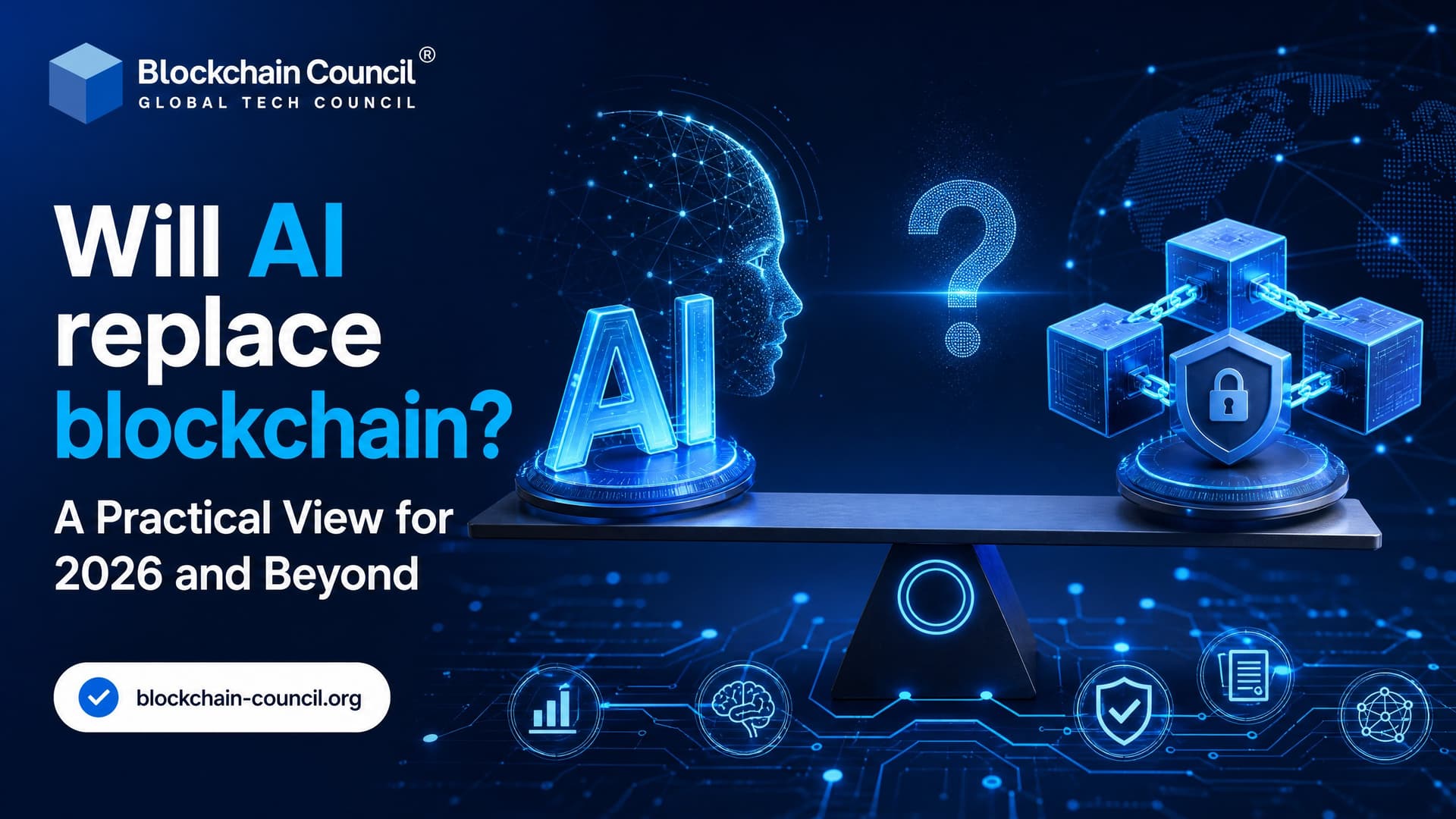
Will AI replace blockchain? No. AI and blockchain solve different problems, and the evidence points toward integration rather than replacement. AI predicts, generates, classifies, and optimizes. Blockchain records state, coordinates trust between parties, proves ownership, and runs rules through smart contracts.
That difference matters. Use AI where you actually need a tamper resistant record and you get a smart assistant with no shared source of truth. Use blockchain where you only need pattern recognition and you get an expensive ledger doing the wrong job. The useful question is not whether one kills the other. It is where each belongs in an architecture.

AI and blockchain are not substitutes
AI sits in the intelligence layer of a system. It can read transaction patterns, detect fraud, summarize documents, write code, classify images, forecast demand, or generate synthetic data. Its strength comes from models trained on data.
Blockchain sits in the trust and settlement layer. It gives multiple parties a shared record without requiring one central operator that everyone has to trust. Public blockchains such as Ethereum use consensus to agree on state. Smart contracts enforce rules. Token standards such as ERC-20 and ERC-721 define how assets behave.
To be blunt, AI cannot replace decentralized consensus. A large language model can suggest whether a transaction looks suspicious, but it cannot make Ethereum mainnet agree on account balances. Ethereum mainnet uses chain ID 1 for a reason: clients need deterministic network identity, transaction validation, and shared state. Those are protocol functions, not prediction tasks.
Why the question feels tempting right now
AI adoption has moved faster than blockchain adoption in many business settings. That creates the impression that AI is the newer, stronger wave. In sectors such as insurance and customer support, generative AI has produced visible productivity gains, while some blockchain pilots from the 2017 to 2021 cycle never moved beyond proofs of concept.
Failed pilots do not prove that blockchain is obsolete. They often prove that a team used blockchain where a normal database would have worked. That distinction matters. Blockchain is not the right tool for every workflow. It earns its place when you need shared state, asset ownership, auditability, censorship resistance, or programmable trust across parties that do not fully trust one another.
How AI is already improving blockchain systems
AI is changing how networks, wallets, exchanges, and decentralized applications get built and monitored. That is not replacement. It is better engineering.
Security and anomaly detection
Public chains produce a huge amount of transparent data. AI models can scan transaction graphs, wallet behavior, contract calls, and liquidity movements to flag suspicious activity. This is useful in decentralized finance, where exploits can move funds in seconds.
The reason analysts reach for AI here is simple: no human can manually inspect every mempool pattern, bridge transaction, token approval, and contract interaction at scale. Machine assisted monitoring fills that gap.
Network operations and performance
AI can help forecast congestion, improve node maintenance, and guide transaction routing. On Ethereum, fees are shaped by EIP-1559, which introduced a base fee that adjusts according to block demand. AI will not replace that fee mechanism, but it can help wallets estimate user costs and timing more accurately.
A small detail from the trenches: beginners often think gas estimation failures mean the network is broken. In Hardhat, an error such as cannot estimate gas; transaction may fail or may require manual gas limit usually means the contract call is reverting during simulation. AI can help explain that message. It still cannot decide consensus state for the chain.
Smart contract development support
AI coding tools can speed up boilerplate work, test generation, and documentation. They are useful. But they are not auditors. Solidity 0.8.x reverts on arithmetic overflow by default, while older Solidity versions required libraries such as SafeMath for that protection. A model that misses this version difference can hand you misleading advice.
If you are shipping production smart contracts, you still need testing with tools such as Foundry or Hardhat, review of access controls, threat modeling, and an audit mindset. The Certified Blockchain Developer™ and Certified Smart Contract Developer™ programs from Blockchain Council give you structured practice on exactly that.
How blockchain makes AI more trustworthy
AI has its own trust problems. Where did the training data come from? Which model version produced an answer? Was a decision changed after the fact? Who gave permission to use sensitive data? Blockchain can help answer those questions when the design is careful.
Audit trails for AI decisions
Organizations can store hashes of model versions, training datasets, prompts, outputs, or decision logs on chain. The raw data stays off chain for privacy and cost reasons, while the blockchain records proof that a specific artifact existed at a specific time.
This matters in credit scoring, insurance underwriting, healthcare triage, and compliance workflows. If a regulator asks why an AI system denied a claim, a tamper resistant audit trail can show which model version and policy rules were active when the decision was made.
Data provenance and permissions
Generative AI has pushed data rights into board level conversations. Blockchain based permission systems can record who contributed data, what license applied, and how payment or revocation should work. Smart contracts are not magic legal documents, but they can automate parts of access control and compensation.
Some enterprise architectures already pair the two: blockchain as a control layer around generative AI for intellectual property, cyber risk, and regulatory accountability, and AI agents that use blockchain for identity, payments, and verifiable actions in digital economies.
Autonomous agents and machine economies
AI agents can plan and act. Blockchain can give those agents an identity, a wallet, a transaction history, and permission boundaries. Picture an AI agent that buys compute, pays for API calls, licenses data, or settles microtransactions. It needs more than language ability. It needs a verifiable way to hold and transfer value.
This is one reason the answer to Will AI replace blockchain? stays negative. More capable AI agents may increase demand for identity, provenance, and settlement rails.
Where blockchain is still the wrong choice
A practical article should say this plainly: do not add blockchain just because AI governance sounds hard. If one organization controls all data, all users, and all rules, a conventional database is usually cheaper and easier. If you do not need multi party trust, tokenized assets, transparent auditability, or decentralized execution, blockchain adds complexity without enough payoff.
Use blockchain when the trust boundary justifies it. Use AI when the problem needs inference or automation. Use both when the system needs intelligent action plus verifiable records.
Key use cases where AI and blockchain work together
- AI powered fraud monitoring: Models detect abnormal wallet flows, phishing patterns, bridge risks, or exchange manipulation signals, while blockchain remains the source of transaction truth.
- Regulated AI audit logs: Smart contracts or permissioned ledgers record model changes, approval workflows, and decision evidence.
- Data marketplaces: Data providers grant access for AI training through smart contracts with transparent payment terms.
- Tokenized real world assets: AI supports risk analysis and pricing, while blockchain handles ownership records and settlement.
- Zero knowledge AI workflows: Zero knowledge proofs can verify computations or claims without exposing sensitive inputs, a direction closely tied to privacy focused blockchain research.
What professionals should learn next
If you are a developer, do not choose between AI and blockchain too early. Learn the fundamentals of both, then specialize. A strong path looks like this:
- Understand blockchain basics: consensus, wallets, keys, transactions, smart contracts, and token standards.
- Build with Solidity 0.8.x, Hardhat or Foundry, MetaMask, and a test network before you touch mainnet.
- Learn AI foundations: supervised learning, embeddings, model evaluation, prompt design, and AI governance.
- Study integration patterns: off chain AI inference, on chain verification, audit logs, decentralized identity, and secure oracle design.
- Practice security. AI generated code still needs tests, reviews, and adversarial thinking.
For structured study, look at Blockchain Council programs such as the Certified Blockchain Expert™, Certified Blockchain Developer™, Certified Smart Contract Developer™, and Certified Artificial Intelligence (AI) Expert™. Pick the blockchain track if you want to build decentralized systems. Pick the AI track if you want to work on models and automation. Choose both if your goal is AI governance, decentralized AI agents, or enterprise architecture.
The realistic answer: AI will change blockchain, not replace it
The strongest future systems will not treat AI and blockchain as rivals. AI will make blockchain applications smarter, safer, and easier to operate. Blockchain will make AI systems more auditable, accountable, and economically useful in multi party environments.
So, Will AI replace blockchain? No. AI will absorb some manual blockchain workflows, such as basic analytics, repetitive coding, and routine network monitoring. It will not replace the need for decentralized ledgers, digital ownership, smart contracts, or shared settlement infrastructure.
Your next step is concrete: build a small application that uses both. Write a smart contract that records hashes of AI generated outputs, then test it locally with Hardhat or Foundry. You will see the boundary immediately. AI creates the output. Blockchain proves what happened.
Related Articles
View All
Blockchain
Blockchain Product Manager Skills: What You Need in 2026
A practical guide to the blockchain product manager skills needed in 2026, from DeFi and AI to compliance, UX, analytics, and security.

Blockchain
Essential Blockchain Terms Every Beginner Should Know in 2026
Learn the essential blockchain terms beginners need in 2026, including consensus, wallets, smart contracts, DeFi, NFTs, Layer 2, and tokenization.

Blockchain
Blockchain Certification Roadmap for Beginners in 2026
Blockchain technology has evolved far beyond cryptocurrencies. Today, businesses across finance, healthcare, supply chain, gaming, real estate, and government sectors are actively exploring blockchain solutions to improve transparency, security, and efficiency. As blockchain adoption continues to grow, organizations are looking for professionals who understand blockchain technology, blockchain analytics, and blockchain product management. Whether you are a student, working professional, entrepreneur, or technology enthusiast, building blockchain expertise can open doors to exciting career opportunities.
Trending Articles
The Role of Blockchain in Ethical AI Development
How blockchain technology is being used to promote transparency and accountability in artificial intelligence systems.

Top 5 DeFi Platforms
Explore the leading decentralized finance platforms and what makes each one unique in the evolving DeFi landscape.
How Blockchain Secures AI Data
Understand how blockchain technology is being applied to protect the integrity and security of AI training data.