

Blockchain Certification Roadmap for Beginners in 2026
 Suyash Raizada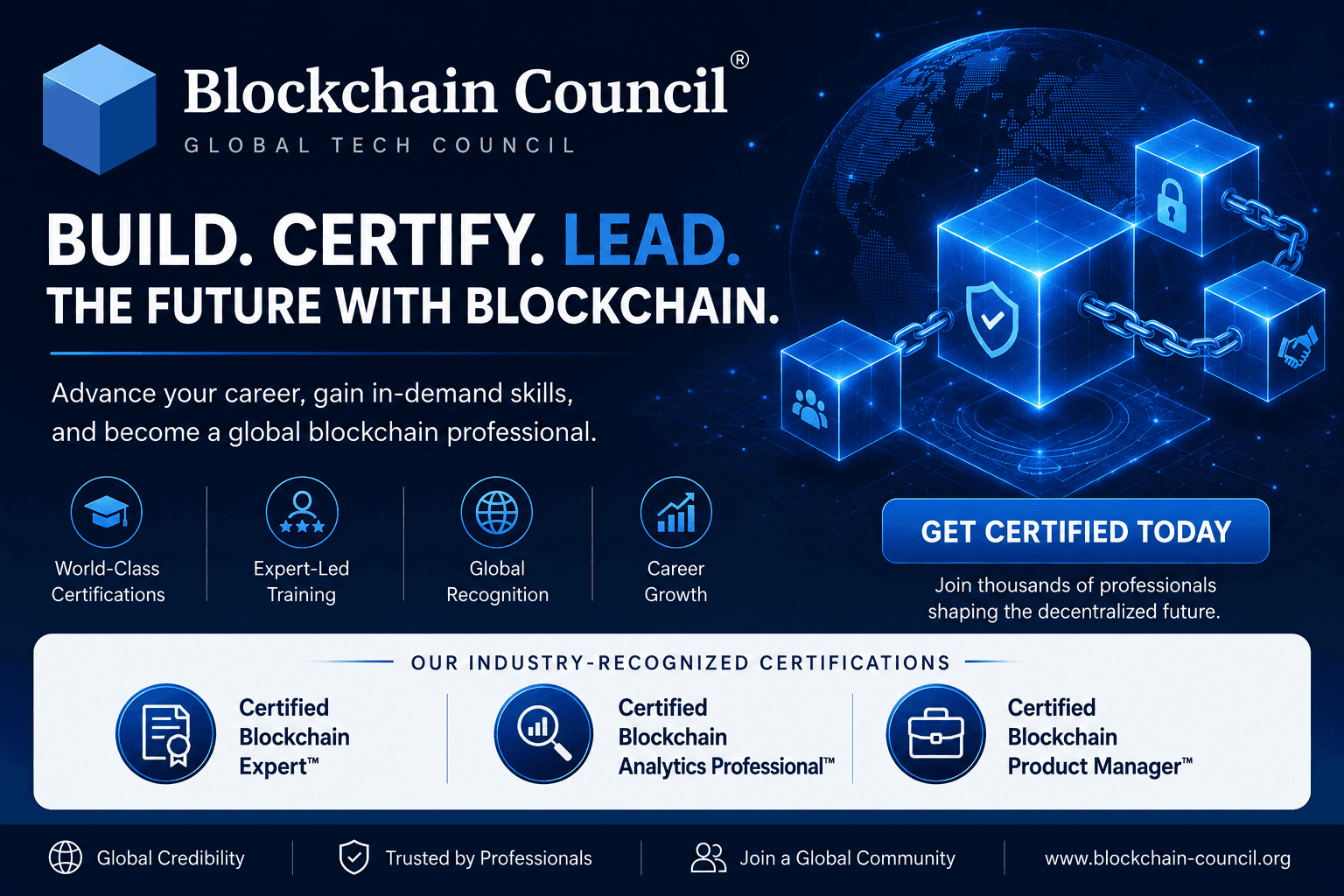
Blockchain technology has evolved far beyond cryptocurrencies. Today, businesses across finance, healthcare, supply chain, gaming, real estate, and government sectors are actively exploring blockchain solutions to improve transparency, security, and efficiency.
As blockchain adoption continues to grow, organizations are looking for professionals who understand Blockchain technology, blockchain analytics, and blockchain product management. Whether you are a student, working professional, entrepreneur, or technology enthusiast, building blockchain expertise can open doors to exciting career opportunities.

This guide explains the blockchain learning journey and highlights the certifications that can help beginners become industry-ready professionals.
What Is Blockchain Technology?
Blockchain is a distributed digital ledger that records transactions across multiple computers. Unlike traditional databases, blockchain stores data in blocks that are linked together chronologically and secured using cryptographic techniques.
Key features of blockchain include:
Decentralization
Transparency
Security
Immutability
Traceability
Popular blockchain networks include Bitcoin, Ethereum, Solana, Polygon, Hyperledger, and Avalanche.
Why Learn Blockchain in 2026?
The demand for blockchain professionals continues to increase as businesses invest in Web3, digital assets, tokenization, smart contracts, decentralized finance (DeFi), and enterprise blockchain solutions.
Benefits of learning blockchain include:
Access to emerging technology careers
Better understanding of Web3 ecosystems
Opportunities in fintech and digital transformation
Higher earning potential
Future-ready technical and business skills
Professionals with blockchain expertise are finding opportunities in consulting, analytics, product management, compliance, development, and strategy roles.
Blockchain Career Path for Beginners
Many newcomers assume they must become blockchain developers. However, blockchain offers multiple career paths based on individual interests and skill sets.
Blockchain Expert
A blockchain expert understands the complete blockchain ecosystem, including consensus mechanisms, smart contracts, decentralized applications, token economics, and enterprise use cases.
Responsibilities include:
Evaluating blockchain solutions
Advising organizations on blockchain adoption
Understanding blockchain architecture
Managing blockchain projects
Supporting Web3 initiatives
This role provides a strong foundation for anyone entering the blockchain industry.
Blockchain Analytics Professional
As blockchain networks generate massive amounts of public data, organizations need professionals who can interpret blockchain transactions and extract meaningful insights.
Blockchain analytics professionals help businesses:
Analyze on-chain transactions
Monitor blockchain activity
Identify trends and patterns
Support compliance initiatives
Improve decision-making through blockchain intelligence
This role combines blockchain knowledge with data-driven analysis and is becoming increasingly valuable across industries.
Blockchain Product Manager
Blockchain products require professionals who can bridge the gap between technology and business objectives.
Blockchain product managers are responsible for:
Defining product vision
Managing blockchain product roadmaps
Coordinating development teams
Understanding user requirements
Driving product adoption
This career path is ideal for professionals interested in leadership, innovation, and business strategy.
Essential Blockchain Concepts Every Beginner Should Learn
Before pursuing advanced blockchain careers, it is important to understand:
Distributed Ledger Technology (DLT)
DLT forms the foundation of blockchain systems and enables decentralized record keeping.
Consensus Mechanisms
Consensus algorithms such as Proof of Work (PoW) and Proof of Stake (PoS) help blockchain networks validate transactions securely.
Smart Contracts
Smart contracts are self-executing agreements that automatically perform actions when predefined conditions are met.
Decentralized Applications (dApps)
dApps operate on blockchain networks without relying on centralized infrastructure.
Tokenization
Tokenization converts real-world or digital assets into blockchain-based tokens that can be traded or managed efficiently.
Web3 Ecosystem
Web3 represents the next generation of the internet powered by decentralization, digital ownership, and Blockchain technology.
Recommended Blockchain Certifications for Beginners
A structured certification path can help learners build knowledge progressively.
Certified Blockchain Expert™
This certification provides a comprehensive understanding of Blockchain technology, cryptocurrency fundamentals, smart contracts, consensus mechanisms, and enterprise blockchain applications.
Ideal for:
Students
Developers
IT professionals
Business leaders
Blockchain enthusiasts
Certified Blockchain Analytics Professional™
This certification focuses on blockchain data analysis, transaction monitoring, blockchain intelligence, and analytical frameworks used in modern blockchain ecosystems.
Ideal for:
Analysts
Researchers
Compliance professionals
Data professionals
Web3 enthusiasts
Certified Blockchain Product Manager™
This certification teaches product strategy, blockchain product lifecycle management, user experience, roadmap planning, and business implementation.
Ideal for:
Product managers
Entrepreneurs
Startup founders
Business consultants
Innovation leaders
Industries Using Blockchain Technology
Blockchain is transforming multiple industries, including:
Banking and Finance
Supply Chain Management
Healthcare
Real Estate
Insurance
Government Services
Gaming
Digital Identity
Retail
Logistics
As adoption expands, organizations increasingly seek certified blockchain professionals who can contribute to blockchain initiatives.
How to Start a Blockchain Career
If you are new to blockchain, follow this simple roadmap:
Learn blockchain fundamentals.
Understand cryptocurrency and Web3 concepts.
Explore real-world blockchain use cases.
Earn industry-recognized blockchain certifications.
Build practical knowledge through projects and case studies.
Stay updated with emerging blockchain trends.
Final Thoughts
Blockchain technology is reshaping the digital economy and creating new career opportunities across technical and business domains. Whether your goal is to become a blockchain expert, blockchain analytics professional, or blockchain product manager, developing a strong foundation is the first step toward success.
With the right learning path and professional certifications, beginners can gain the knowledge and confidence needed to participate in the rapidly growing blockchain ecosystem and prepare for the future of Web3 innovation.
FAQs
1. What is blockchain technology?
Blockchain technology is a decentralized digital ledger that records transactions across multiple computers. Each transaction is stored in a block and linked to previous blocks, creating a secure and transparent chain of records. Because data cannot be easily altered, blockchain is widely used for cryptocurrencies, supply chain management, digital identity, and enterprise applications.
2. How does blockchain work?
Blockchain works by validating transactions through a network of computers called nodes. Once verified through a consensus mechanism, transactions are grouped into blocks and added to the blockchain. This process ensures transparency, security, and immutability of data.
3. What are the main benefits of blockchain technology?
The key benefits of blockchain include transparency, security, decentralization, traceability, reduced fraud, improved efficiency, and lower operational costs. These advantages make blockchain valuable across industries such as finance, healthcare, logistics, and government services.
4. Is blockchain only used for cryptocurrencies?
No. While blockchain powers cryptocurrencies like Bitcoin and Ethereum, it has many other applications. Organizations use blockchain for supply chain tracking, smart contracts, digital identity verification, healthcare records, asset tokenization, and decentralized applications (dApps).
5. What is the difference between blockchain and cryptocurrency?
Blockchain is the underlying technology that stores and verifies transactions, while cryptocurrency is a digital asset that operates on a blockchain network. In simple terms, blockchain is the infrastructure, and cryptocurrency is one of its applications.
6. What are smart contracts in blockchain?
Smart contracts are self-executing programs stored on a blockchain. They automatically execute predefined actions when specific conditions are met. Smart contracts eliminate intermediaries and increase efficiency in business transactions.
7. What skills are required to become a blockchain professional?
A blockchain professional should understand blockchain fundamentals, cryptocurrencies, consensus mechanisms, smart contracts, tokenization, Web3 concepts, and blockchain use cases. Depending on the role, skills in analytics, development, product management, or cybersecurity may also be beneficial.
8. What is a blockchain certification?
A blockchain certification is a professional credential that validates an individual's knowledge of blockchain technology, cryptocurrencies, Web3 ecosystems, and enterprise blockchain applications. Certifications help learners demonstrate their expertise to employers and clients.
9. Is blockchain a good career in 2026?
Yes. Blockchain continues to be one of the fastest-growing technology sectors. Organizations are hiring blockchain experts, analysts, developers, consultants, auditors, and product managers to support digital transformation and Web3 initiatives.
10. What does a blockchain analyst do?
A blockchain analyst examines blockchain transactions and on-chain data to identify trends, risks, opportunities, and insights. Blockchain analysts support decision-making, compliance efforts, fraud detection, and business intelligence initiatives.
11. What is blockchain analytics?
Blockchain analytics is the process of collecting, analyzing, and interpreting blockchain data. It helps organizations understand transaction behavior, track digital assets, improve compliance, and gain valuable insights from public blockchain networks.
12. What does a blockchain product manager do?
A blockchain product manager oversees the development and growth of blockchain-based products. Their responsibilities include defining product strategy, managing roadmaps, coordinating teams, and ensuring products meet business and user requirements.
13. How can beginners learn blockchain?
Beginners should start by learning blockchain fundamentals, cryptocurrency concepts, smart contracts, decentralized applications, and Web3 technologies. Structured learning through professional blockchain certifications can accelerate the learning process.
14. Which industries use blockchain technology?
Blockchain is widely used in banking, finance, healthcare, insurance, logistics, supply chain management, real estate, gaming, digital identity, government services, and cybersecurity. Adoption continues to grow as organizations seek secure and transparent systems.
15. What is Web3 and how is it related to blockchain?
Web3 is the next generation of the internet built on decentralized technologies. Blockchain serves as the foundation of Web3 by enabling digital ownership, decentralized applications, smart contracts, and peer-to-peer interactions without centralized control.
16. Do I need coding skills to learn blockchain?
No. Many blockchain careers, including blockchain analytics, consulting, product management, compliance, marketing, and business strategy, do not require coding skills. However, developers may benefit from learning programming languages such as Solidity and JavaScript.
17. What is the best blockchain certification for beginners?
Beginners often start with a foundational blockchain certification that covers blockchain technology, cryptocurrencies, smart contracts, consensus mechanisms, and real-world use cases. A comprehensive certification helps learners build a strong understanding before specializing.
18. What is the blockchain learning path for beginners?
A typical blockchain learning path starts with blockchain fundamentals, followed by cryptocurrencies, smart contracts, decentralized applications, Web3 concepts, blockchain analytics, and blockchain product management. Certifications can help learners progress systematically.
19. What job roles are available in blockchain?
Popular blockchain job roles include Blockchain Expert, Blockchain Developer, Blockchain Analyst, Blockchain Product Manager, Web3 Consultant, Smart Contract Developer, Crypto Compliance Specialist, Blockchain Auditor, and Enterprise Blockchain Architect.
20. Why should professionals get blockchain certified?
Blockchain certifications help professionals validate their skills, improve career prospects, increase industry credibility, and stay competitive in the rapidly evolving Web3 and blockchain ecosystem. Certified professionals often gain an advantage when applying for blockchain-related roles.
21. Which blockchain certification is best for beginners?
The best blockchain certification for beginners is one that covers blockchain fundamentals, cryptocurrencies, consensus mechanisms, smart contracts, and real-world applications. A beginner-friendly certification should provide both theoretical knowledge and practical insights to help learners build a strong foundation before specializing in areas such as blockchain analytics or product management.
22. How do I become a blockchain expert with no prior experience?
You can become a blockchain expert by first learning blockchain fundamentals, understanding cryptocurrencies and Web3 concepts, exploring real-world use cases, and earning a recognized blockchain certification. Consistent learning, hands-on practice, and staying updated with industry trends can help you build expertise even without prior experience.
23. What is the best blockchain learning path in 2026?
A recommended blockchain learning path begins with blockchain fundamentals, followed by cryptocurrency concepts, smart contracts, decentralized applications, tokenization, Web3 ecosystems, blockchain analytics, and blockchain product management. Professional certifications can help learners follow a structured roadmap.
24. Is blockchain a good career choice for non-technical professionals?
Yes. Blockchain offers opportunities beyond development. Non-technical professionals can pursue careers in blockchain analytics, consulting, compliance, product management, business strategy, marketing, operations, and project management. Understanding blockchain concepts is often more important than coding skills for these roles.
25. How long does it take to learn blockchain?
The time required depends on your learning goals. Basic blockchain concepts can be learned within a few weeks, while developing professional-level expertise may take several months. A structured blockchain certification program can significantly reduce the learning curve.
26. What is blockchain analytics and why is it important?
Blockchain analytics involves analyzing blockchain transactions and on-chain data to uncover trends, risks, and opportunities. Organizations use blockchain analytics for compliance monitoring, fraud detection, transaction tracking, business intelligence, and decision-making.
27. What does a Certified Blockchain Analytics Professional do?
A Certified Blockchain Analytics Professional specializes in understanding blockchain data, tracking transactions, identifying patterns, and generating actionable insights. These professionals help businesses make informed decisions using blockchain intelligence.
28. What skills are needed for blockchain analytics?
Key blockchain analytics skills include understanding blockchain networks, cryptocurrency transactions, data analysis, blockchain explorers, on-chain intelligence, risk assessment, compliance frameworks, and analytical thinking.
29. What is a blockchain product manager?
A blockchain product manager is responsible for planning, developing, and managing blockchain-based products. They coordinate between technical teams and business stakeholders to ensure successful product delivery and market adoption.
30. Why are blockchain product managers in demand?
As organizations launch blockchain products, they need professionals who understand both blockchain technology and business strategy. Blockchain product managers help define product vision, prioritize features, manage roadmaps, and drive business outcomes.
31. Which blockchain jobs are expected to grow in the future?
Roles expected to grow include Blockchain Expert, Blockchain Analyst, Blockchain Product Manager, Smart Contract Developer, Web3 Consultant, Blockchain Auditor, Crypto Compliance Specialist, Enterprise Blockchain Architect, and Blockchain Researcher.
32. Is blockchain still relevant in 2026?
Yes. Blockchain continues to expand across industries such as finance, healthcare, logistics, gaming, digital identity, and asset tokenization. The growth of Web3, decentralized finance (DeFi), and enterprise blockchain adoption keeps blockchain highly relevant.
33. What industries are hiring blockchain professionals?
Industries actively hiring blockchain professionals include banking, fintech, healthcare, supply chain management, insurance, cybersecurity, government services, logistics, gaming, and digital asset companies.
34. Can blockchain certifications help me get a job?
Blockchain certifications can strengthen your resume, demonstrate industry knowledge, and improve credibility with employers. While certifications alone do not guarantee employment, they can increase your chances of securing blockchain-related opportunities.
35. What is the difference between a blockchain expert and a blockchain developer?
A blockchain developer focuses on building blockchain applications, smart contracts, and technical solutions. A blockchain expert has a broader understanding of blockchain ecosystems, business use cases, governance models, implementation strategies, and industry trends.
36. What are the top blockchain skills employers look for?
Employers commonly seek skills in blockchain fundamentals, cryptocurrency knowledge, smart contracts, Web3 technologies, blockchain analytics, product management, problem-solving, security awareness, and strategic thinking.
37. What is the future of blockchain technology?
The future of blockchain includes greater enterprise adoption, tokenized assets, decentralized finance, digital identity systems, blockchain-powered AI solutions, central bank digital currencies (CBDCs), and increased integration with emerging technologies.
38. What is the best way to start a blockchain career?
The best way is to learn blockchain fundamentals, gain practical knowledge through projects, earn recognized certifications, participate in blockchain communities, and continuously stay updated with technological advancements.
39. How does blockchain support Web3?
Blockchain serves as the infrastructure layer of Web3 by enabling decentralized ownership, secure transactions, smart contracts, digital identities, and trustless interactions without relying on centralized authorities.
40. Which blockchain certifications should I pursue for career growth?
Professionals seeking comprehensive blockchain career growth often start with foundational blockchain certifications and then specialize in areas such as blockchain analytics, blockchain product management, smart contracts, Web3 development, or blockchain security based on their career goals.
Related Articles
View All
Blockchain
Blockchain Certification Programs You Can Join Online
Discover the best blockchain certification programs you can join online. Learn blockchain fundamentals, smart contracts, enterprise blockchain, and career opportunities with globally recognized certifications.

Blockchain
Roadmap Planning for Blockchain Products: Best Practices for Web3 Teams
Learn how Web3 teams can plan blockchain product roadmaps with security milestones, governance alignment, flexible timelines, and clear feedback loops.

Blockchain
Blockchain Product Manager Certification Guide: Best Credentials to Advance Your Career
A practical guide to Blockchain Product Manager Certification paths, including blockchain, product, agile, and finance credentials for Web3 careers.
Trending Articles
AWS Career Roadmap
A step-by-step guide to building a successful career in Amazon Web Services cloud computing.
How Blockchain Secures AI Data
Understand how blockchain technology is being applied to protect the integrity and security of AI training data.
What is AWS? A Beginner's Guide to Cloud Computing
Everything you need to know about Amazon Web Services, cloud computing fundamentals, and career opportunities.