

Beyond Cryptocurrency: How Blockchain Is Transforming Real-World Industries
 Suyash Raizada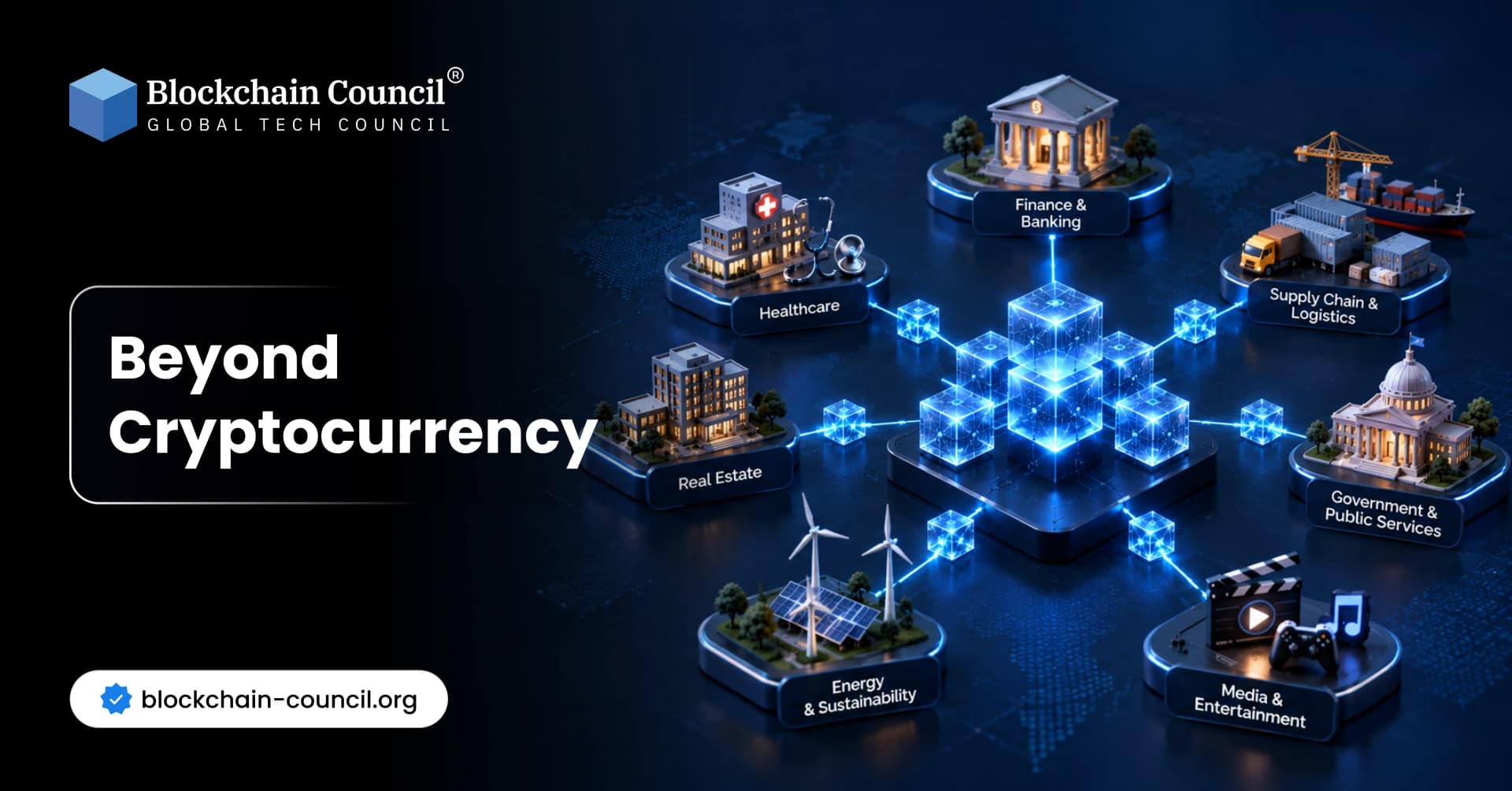
When most people hear the word blockchain, they think of Bitcoin prices. Yet the technology underneath, a shared record that many parties can trust without a central referee, is now being tested and used in banks, ports, hospitals, and government offices. This guide looks Beyond Cryptocurrency to show where blockchain delivers real value in 2026, where it has stumbled, and which skills are in demand.
If you are new to the field, a program such as the Certified Blockchain Expert course is a good way to learn the fundamentals. The sections below are written for beginners, with enough detail for experienced professionals.

Blockchain Beyond Bitcoin and Crypto
Bitcoin proved that strangers could agree on who owns what without a bank. The same idea works for any record that several parties need to share and trust, such as ownership, shipments, credentials, or payments.
A blockchain is useful when four things are true:
Several parties need to share the same data.
They do not fully trust one another or a single operator.
The record must be hard to alter.
Rules can be automated through smart contracts.
When one organization controls the data, a normal database is often cheaper and simpler. The best projects choose blockchain only where shared trust is the real problem. Industry history supports this caution, because several high-profile platforms closed once the novelty faded. Many successful uses never mention cryptocurrency to the end user at all.
Blockchain in Banking and Financial Services
Finance is the most active area because money already moves as data.
Payments and Settlement
Banks use blockchains to settle transactions faster and around the clock. JPMorgan reports that its Kinexys platform has processed about $3 trillion in total and averages roughly $5 billion a day, according to April 2026 industry coverage. The bank has also issued a deposit token, JPMD, on the public Base network.
Stablecoins
Stablecoins are tokens pegged to currencies such as the dollar. Total supply is estimated near $320 billion in 2026, with about half on Ethereum, according to mid-2026 summaries. They now serve as payment rails for cross-border transfers and as cash inside digital markets. Anyone who wants to understand how these assets trade, are audited, and are regulated may find a course such as the Certified Cryptocurrency Expert program useful.
Trade Finance and Compliance
Shared ledgers can cut paperwork in letters of credit and make audit trails easier. Banks also explore blockchain for sharing customer verification data, though privacy law limits how freely that data can move.
Why Banks Care
Faster settlement frees up capital, cuts reconciliation work, and reduces errors between institutions that keep separate books.
Supply Chain and Logistics
Supply chains involve many companies, each with its own records, which makes tracing a product slow.
Traceability
Retailers have used blockchain to trace food from farm to shelf. Walmart used a Hyperledger Fabric-based system to trace products in seconds instead of days, according to industry reports. The goal is faster recalls and less waste.
Provenance and Sustainability
Luxury goods, diamonds, coffee, and minerals use digital records to prove origin and ethical sourcing. New rules add pressure. The European Union is rolling out digital product passports, including a battery passport due from 2027, which require product data to follow an item through its life.
Lessons from TradeLens
The shipping platform TradeLens, built by Maersk and IBM, was wound down around 2022 and 2023, reportedly because rival carriers did not join. The technology worked, but a shared network needs shared commitment.
Best Fit
Blockchain works best where many parties must update one record. It cannot confirm that the original data was true, so a bad sensor reading or false entry will simply be stored permanently.
Healthcare and Digital Identity
Healthcare
Health records are scattered across hospitals, labs, and insurers. Blockchain can act as an integrity layer that proves a record has not been changed, while the sensitive data itself stays off-chain in secure systems. Estonia, for example, has used a blockchain-based system to verify the integrity of government records, including health data. Other uses include tracking drug supply to fight counterfeits, managing consent for data sharing, and speeding up insurance claims.
Digital Identity
Self-sovereign identity lets people hold verifiable credentials, such as a degree, license, or age proof, in a wallet and share only what is needed. The European Union requires member states to offer digital identity wallets by the end of 2026, creating a large test for this idea, though these wallets may use various technologies and not only blockchain.
Privacy First
Personal data should never be written directly to a public ledger, because blockchain records are hard to erase and privacy laws such as GDPR give people rights to deletion. Good designs keep personal data off-chain and store only fingerprints or proofs.
Real-World Asset (RWA) Tokenisation
Real-world asset tokenisation means representing assets such as bonds, funds, gold, or property as tokens on a blockchain.
How Big Is It?
Reports based on rwa.xyz data put tokenized real-world assets, excluding stablecoins, at roughly $31 billion by mid-2026, up from about $6 billion in early 2025. Other trackers give figures from about $21 billion to $38 billion, so treat any number as an estimate.
What Is Being Tokenized
Tokenized US Treasuries: the largest category, at roughly $13 billion to $15 billion, with BlackRock’s BUIDL fund among the leaders
Private credit: loans funded on-chain
Commodities: mainly tokenized gold
Tokenized stocks and funds: smaller but fast-growing
Real estate: still very small
Why It Matters
Benefits include faster settlement, fractional ownership, round-the-clock trading, and programmable compliance rules. Forecasts for 2030 vary widely, from about $2 trillion in a McKinsey projection to far higher figures from other analysts, which shows how uncertain the path is.
Hurdles
Legal ownership must match the token, secondary markets are still thin, and rules differ by country. A token is only as strong as the legal claim behind it.
Central Bank Digital Currencies (CBDCs)
A central bank digital currency, or CBDC, is digital money issued directly by a central bank. It differs from stablecoins, which private companies issue.
Where Things Stand
The Atlantic Council tracker counts well over 130 countries exploring CBDCs, covering about 98% of global GDP, though totals differ between updates. Only a few have fully launched, including the Bahamas, Jamaica, and Nigeria. China’s e-CNY is the largest pilot, and India’s digital rupee is another major one, with a retail pilot involving banks and several million users, according to industry reports. The European Central Bank is working toward a decision on a digital euro, and reports suggest a first issuance could come around 2029. The United States has moved away from a retail CBDC and is focusing on regulated stablecoins.
Blockchain or Not?
Many CBDCs borrow distributed ledger ideas, but some use conventional databases. The design choice depends on privacy, speed, and control needs.
Key Debates
Privacy, the risk of money leaving bank deposits, offline use, and cross-border links are the main points of discussion. Wholesale CBDCs, used only between banks, often face less public resistance than retail versions.
Blockchain in Government and Enterprise
Government
Land records: Georgia placed land title records on a blockchain years ago, and other governments have run pilots to reduce fraud and speed up transfers.
Audit trails: Shared records can show who changed what and when.
Digital documents: Certificates and licenses can be verified instantly.
Enterprise
Companies use private or consortium networks for shared records among partners. Platforms such as Hyperledger Fabric, R3 Corda, and the Canton Network serve regulated and multi-party uses, while Ethereum-compatible tools such as Besu bridge private and public systems. Some analysts say enterprise use of Fabric has slowed since its 2019 to 2021 peak, so check support and community before committing.
Building Skills Across Technologies
Blockchain now works alongside cloud, data, and AI in enterprise projects. You can explore a wide range of options through Tech Certification programs, which help you see where blockchain fits among other in-demand skills.
Key Challenges to Mass Adoption
Real progress still faces real obstacles.
Scalability and cost: Busy networks can be slow or expensive, though layer-2 networks and upgrades such as Ethereum’s Fusaka in December 2025 aim to help.
Interoperability: Networks often cannot talk to each other easily.
Regulation: Rules differ by country and change quickly.
Privacy versus transparency: Open ledgers clash with data protection duties.
Legacy integration: Connecting to old systems is often harder than building the blockchain itself.
Governance and incentives: Consortiums fail when members cannot agree on costs and control, as TradeLens showed.
Security: Smart contract bugs and stolen keys have caused major losses.
Data quality: A blockchain preserves bad data as faithfully as good data.
User experience: Wallets and keys remain confusing for ordinary users.
Skills gap: Many organizations struggle to find people who understand both the technology and the business.
The Future of Blockchain Technology
Several trends look likely to shape the next few years.
Tokenisation and stablecoins: Institutions continue to move funds, bonds, and payments on-chain.
Better infrastructure: Ethereum’s next upgrade, Glamsterdam, is reported as a possible late-2026 release, and layer-2 networks keep lowering costs.
Hybrid designs: Private systems increasingly connect to public networks for liquidity.
Digital identity and product passports: Regulation in Europe could create large-scale use.
Clearer rules: More countries are writing stablecoin and digital asset laws.
New experiments: Some teams explore blockchains for verifying data and settling payments between AI agents, though this is still early.
Stronger security: Research into quantum-resistant cryptography is already on some roadmaps.
Expect steady, practical growth instead of overnight transformation.
Skills and Career Opportunities in Blockchain
Common Roles
Blockchain developer and smart contract engineer
Smart contract auditor and security analyst
Solutions architect
Product and project manager
Compliance, legal, and risk specialist
Tokenisation and digital asset specialist
Data analyst focused on on-chain data
Skills Employers Value
Blockchain fundamentals: consensus, wallets, and smart contracts
Programming: Solidity, Rust, Python, or JavaScript
Security awareness
Knowledge of finance, supply chains, or healthcare
Regulatory understanding
Clear communication with non-technical teams
A Simple Learning Path
Learn the basics of how blockchains work.
Build a small project on a test network.
Pick an industry and study its problems.
Earn a recognized certification and publish your work.
Join communities and follow regulation news.
Roles that combine blockchain knowledge with industry expertise often stand out most, because many projects fail on business and legal details, not on code.
Conclusion
Looking Beyond Cryptocurrency, blockchain is proving most useful where many parties need a shared, trusted record: payments and settlement, tokenised assets, supply chains, identity, and public records. It has also taught hard lessons about governance, regulation, and the limits of technology. The smartest approach is to start with a real problem, choose blockchain only when shared trust is the issue, and build skills that mix technical knowledge with industry understanding.
Technology works best when people understand its value. If you want to learn how to explain and promote complex solutions to the right audience, a Marketing Certification is a smart next step.
FAQs
1. How is blockchain transforming real-world industries?
Blockchain is helping organizations maintain shared, tamper-evident records, track assets, verify transactions, and automate selected processes. Its applications extend across finance, healthcare, logistics, education, manufacturing, and public services, although its value depends on the needs of each industry.
2. Can blockchain be used beyond cryptocurrency?
Yes. Blockchain can support supply chain tracking, digital identity, document verification, asset tokenization, healthcare data coordination, and business recordkeeping. These applications use blockchain's shared-ledger capabilities rather than relying solely on cryptocurrency transactions.
3. How is blockchain changing the banking and financial services industry?
Blockchain can support cross-border payments, digital asset settlement, tokenized securities, stablecoins, and shared transaction records. These applications may reduce certain reconciliation steps, but regulatory compliance, cybersecurity, liquidity, and integration with existing financial infrastructure remain important considerations.
4. How is blockchain used in healthcare?
Healthcare organizations can use blockchain to support medical supply chain tracking, consent records, audit trails, and coordination between institutions. Sensitive patient information is often better kept in protected databases, with blockchain used to record permissions or verify changes where appropriate.
5. Can blockchain help prevent counterfeit medicines?
Blockchain can improve medicine traceability by recording information about manufacturing, distribution, quality checks, and delivery. India's National Informatics Centre describes a blockchain-enabled medicine supply chain system in Karnataka that tracks drug movement and quality checks. However, reliable physical verification is still necessary to prevent false information from entering the system. <Link url="https://blockchain.gov.in/Home/Product?product=logisticschain" title="Government of India's medicine logistics blockchain use case"/>
6. How does blockchain improve supply chain management?
Blockchain can create a shared record of product movements, ownership transfers, inspections, and deliveries. This can help participants trace goods and investigate discrepancies more efficiently, provided that the information entered into the ledger is accurate and participating organizations follow common standards.
7. How is blockchain transforming real estate?
Blockchain can support property record verification, digital asset representation, transaction tracking, and fractional ownership models. However, token ownership does not automatically establish legal ownership of physical property; enforceable rights still depend on applicable laws and official records.
8. How can blockchain improve education and academic credentials?
Blockchain can support verification of academic certificates, professional credentials, and training records. Educational institutions can issue verifiable digital credentials that help employers and other organizations check authenticity, although identity verification and issuer credibility remain essential.
9. How is blockchain being used in government services?
Governments can explore blockchain for document verification, public record management, property records, judicial documents, and supply chain monitoring. India's National Blockchain Framework includes applications for document verification and other public-service workflows. <Link url="https://blockchain.gov.in/" title="National Blockchain Framework portal"/>
10. Can blockchain improve digital identity management?
Blockchain-based systems can help people and organizations verify digital credentials and track selected identity-related records. Effective implementations must also protect personal information, support recovery mechanisms, and comply with privacy and identity regulations.
11. How is blockchain changing manufacturing?
Manufacturers can use blockchain to record component origins, production milestones, quality inspections, and transfers between suppliers. These records can improve traceability and support product recalls, particularly when several independent organizations need access to consistent information.
12. What role does blockchain play in agriculture?
Blockchain can record information about crop origins, processing, storage, transportation, and distribution. Farmers, distributors, retailers, and consumers may benefit from improved traceability, but data accuracy still depends on reliable inspections, sensors, and reporting practices.
13. How are smart contracts helping businesses?
Smart contracts execute predefined instructions on supported blockchain networks. Businesses can use them to automate selected payments, settlement rules, digital asset transfers, and multi-party workflows, provided that the contract logic is correctly designed and external conditions are reliably verified.
14. How is blockchain transforming intellectual property management?
Blockchain can create timestamped records associated with digital works, licensing events, ownership claims, and transfers. These records may support provenance and dispute resolution, but a blockchain entry alone does not prove authorship or automatically grant legal intellectual property rights.
15. Can blockchain improve cybersecurity?
Blockchain can provide tamper-evident records, distributed verification, and audit trails that support certain security workflows. It does not replace established cybersecurity measures such as encryption, access controls, secure software development, monitoring, and incident response.
16. How is blockchain used in energy and sustainability?
Potential applications include peer-to-peer energy trading, renewable energy certificates, carbon credit tracking, and records of energy transactions. These systems require reliable measurement, transparent verification, and appropriate market rules to ensure that recorded environmental claims are meaningful.
17. How can blockchain support digital asset tokenization?
Tokenization represents rights to assets or claims as digital tokens on a blockchain. Potential examples include securities, real estate interests, commodities, and other financial assets, but the token's legal rights, transfer restrictions, custody arrangements, and regulatory status must be clearly defined.
18. What are the biggest challenges of adopting blockchain in real-world industries?
Common challenges include scalability, integration costs, privacy, regulatory uncertainty, governance disputes, interoperability, and shortages of specialized skills. Organizations must also determine whether a blockchain offers a practical advantage over conventional databases and trusted centralized systems.
19. Is blockchain suitable for every industry?
No. Blockchain is most useful when multiple participants need to maintain or verify shared records and do not want to depend entirely on one organization. If a single trusted administrator can manage the information efficiently, a conventional database may be simpler and less expensive.
20. What is the future of blockchain across real-world industries?
Potential growth areas include tokenized assets, supply chain traceability, digital credentials, financial settlement, and shared government records. Broader adoption will depend on demonstrable business value, secure implementation, legal clarity, interoperability, and the ability to integrate blockchain with existing systems.
Related Articles
View All
Blockchain
Blockchain vs Smart Contracts: Key Differences, Benefits, and Real-World Applications
Blockchain vs smart contracts explained: learn how distributed ledgers and self-executing code differ, work together, and power DeFi, NFTs, DAOs, and enterprise workflows.

Blockchain
Will AI replace blockchain? A Practical View for 2026 and Beyond
Will AI replace blockchain? No. AI and blockchain solve different problems and are increasingly combined for security, auditability, identity, and automation.
Blockchain
Smart Contracts & dApps: How Blockchain Becomes Programmable
Learn how smart contracts and dApps make blockchain programmable, from Ethereum and tokens to DeFi, NFTs, real use cases, benefits, and key risks.
Trending Articles
AWS Career Roadmap
A step-by-step guide to building a successful career in Amazon Web Services cloud computing.
How Blockchain Secures AI Data
Understand how blockchain technology is being applied to protect the integrity and security of AI training data.

Can DeFi 2.0 Bridge the Gap Between Traditional and Decentralized Finance?
The next generation of DeFi protocols aims to connect traditional banking with decentralized finance ecosystems.