

Agile for Blockchain Teams: Managing Sprints, Smart Contracts, and Decentralized Roadmaps
 Suyash Raizada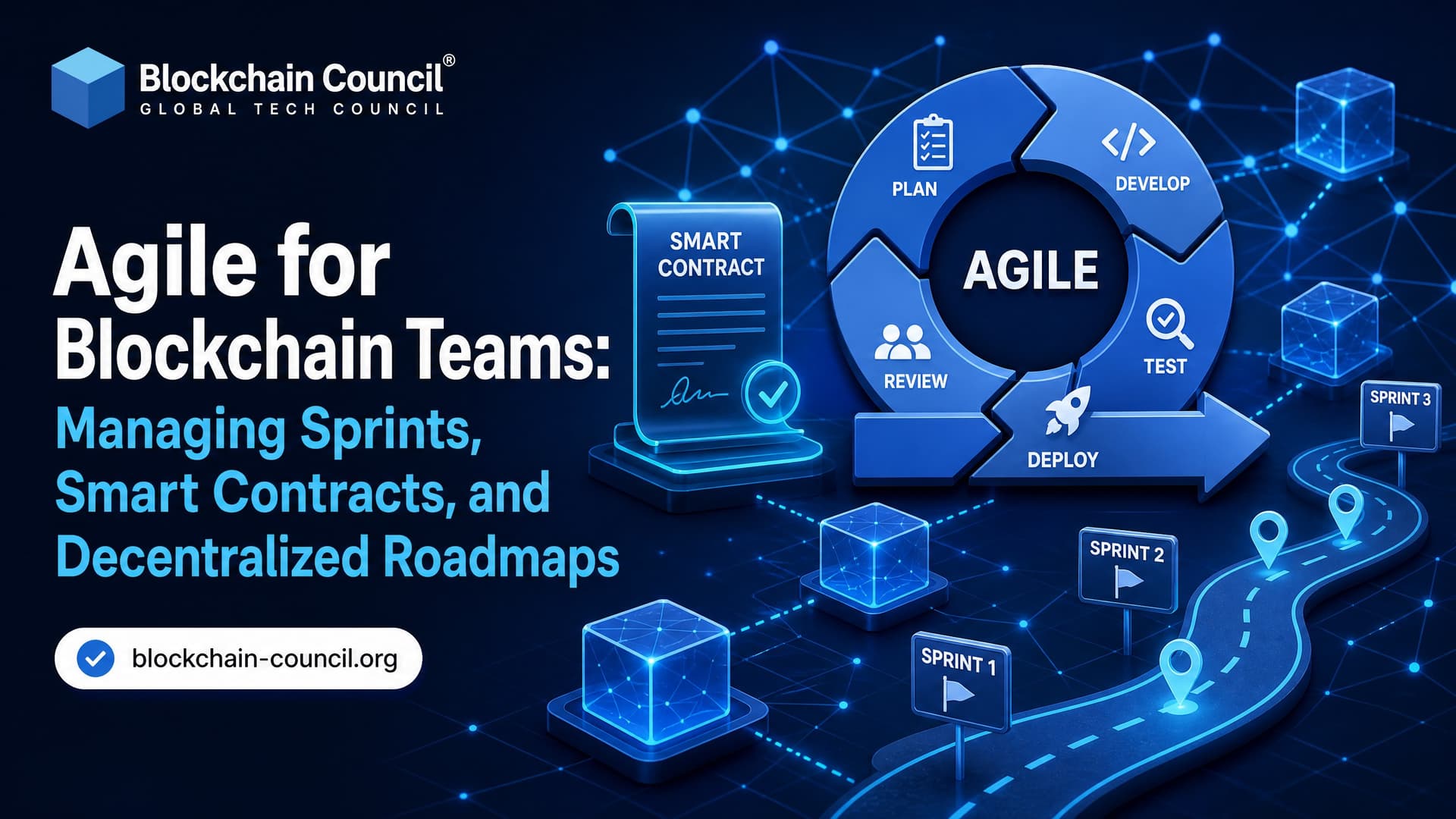
Agile for Blockchain Teams works best when the sprint plan is built around risk, not just feature delivery. A Web3 sprint can ship UI changes in days. But one careless smart contract update can lock funds, break governance, or expose private data on a public ledger. That changes how you plan, estimate, test, and release.
Classic Scrum still helps. Short sprints, backlog refinement, daily standups, reviews, and retrospectives all stay useful. The difference is the Definition of Done. For blockchain teams, done does not mean "merged to main." It means tested, reviewed, simulated, documented, and safe enough for the level of value at risk.

Successfully managing Agile delivery in Web3 requires balancing product strategy, technical constraints, governance, and security. Professionals pursuing a Certified Blockchain Product Manager credential gain practical knowledge for leading blockchain projects while aligning user needs, development priorities, and decentralized product roadmaps.
Why Agile Needs Adjustment for Blockchain Work
In a normal SaaS product, a bug can often be patched quickly. In a smart contract, the bad version may be immutable. Even with upgradeable proxies, you still carry governance, admin key, storage layout, and trust risks. Solidity 0.8.x checks arithmetic overflow by default, but that does not save you from poor access control, oracle manipulation, reentrancy, or a broken upgrade path.
That is why mature blockchain teams split their work into several streams:
On-chain logic: smart contracts, protocol rules, tokens, staking, governance modules.
Off-chain services: indexers, APIs, relayers, analytics, and automation jobs.
Front end and wallet UX: MetaMask, WalletConnect, chain switching, signing flows.
Security: threat models, static analysis, fuzzing, audits, bug bounty programs.
Governance and compliance: DAO proposals, legal review, KYC or AML impact, treasury approvals.
This is still agile. It is just not a single flat feature list.
How to Structure Sprints for Blockchain Teams
Most blockchain teams work well with 1 to 4 week sprints. Two weeks is common because it gives enough time for implementation and testing without letting risk pile up. Very early protocol research may need longer cycles. Front-end only changes may move faster.
Since many blockchain applications are ultimately built around digital asset ecosystems, understanding the technology behind Bitcoin provides valuable context for product planning and technical decision-making. A Certified Blockchain Expert credential helps professionals strengthen their knowledge of blockchain fundamentals, network architecture, and cryptocurrency ecosystems that influence modern Web3 development.
Start with Sprint Zero
Before the first delivery sprint, define the working agreement. Do not skip this. A messy Sprint Zero is how teams end up with unowned deployment keys, unclear audit scope, and nobody sure who can pause a contract.
Your Sprint Zero should cover:
Roles: Product Owner, Scrum Master, protocol lead, security owner, DevOps owner.
Tooling: Jira, GitHub Projects, Confluence, Hardhat or Foundry, Slither, Etherscan, Tenderly.
Branching and review rules: required approvals, protected branches, signed commits if needed.
Environments: local chain, forked mainnet, internal testnet, public testnet, mainnet.
Key management: deployer wallets, multisig owners, hardware wallet policy.
Release policy: audit triggers, governance approvals, rollback or pause procedure.
Plan by Risk Budget, Not Only Story Points
Story points tell you effort. They do not tell you blast radius. Add a risk budget to sprint planning. Ask the blunt question: What could this sprint break, expose, or misrepresent?
For each backlog item, rate:
Funds at risk if the change fails.
Governance impact, including DAO voting or admin control.
Data exposure risk, especially personally identifiable information.
Gas cost and latency impact.
Dependency risk across contracts, wallets, bridges, or third-party APIs.
A small task can carry high risk. Changing a fee parameter in a protocol may take one line of code. But if it changes treasury flows or token incentives, it deserves governance review and simulation.
Definition of Ready for Web3 Backlog Items
A blockchain story is not ready just because someone wrote a user story. The team needs enough detail to avoid guessing about trust boundaries and failure modes.
Use this Definition of Ready before pulling a story into a sprint:
The user outcome is clear. Not just "add staking contract," but who benefits and how.
The work is marked as on-chain, off-chain, or hybrid.
Security assumptions are written down, including roles, permissions, and admin keys.
Wallet behavior is considered, including chain ID, gas estimation, signing prompts, and rejected transactions.
Acceptance criteria include failure cases, not only the happy path.
Data privacy impact is reviewed. Public blockchains are bad places for private user data.
Governance needs are known, including forum discussion, quorum, vote execution, or timelock delay.
One practical example: if your front end asks MetaMask to switch to Ethereum mainnet, the chain ID must be 0x1. If your story does not specify supported networks, QA will waste time finding bugs that are really requirements gaps.
Definition of Done for Smart Contracts
For smart contract work, your Definition of Done must be stricter than a normal web application task. I would not call contract code done unless it has passed this checklist:
Unit tests and integration tests pass in Hardhat or Foundry.
Access control tests cover unauthorized callers. The classic failure is
VM Exception while processing transaction: reverted with reason string 'Ownable: caller is not the owner'. You want that failure in the right places.Edge cases are tested, including zero values, duplicate calls, pausing, withdrawals, and failed transfers.
Reentrancy paths are reviewed, especially around external calls and token callbacks.
Static analysis has been reviewed with tools such as Slither.
Fuzzing or invariant testing has been run for core accounting logic.
Gas usage has been checked for functions users will call often.
Testnet deployment is verified through block explorers and real wallet flows.
Upgrade, pause, and rollback steps are documented if the design allows them.
Audit findings are fixed, accepted with rationale, or moved into tracked risk items.
Foundry is excellent for fast contract testing and fuzzing. Hardhat is still a good choice when your team has a TypeScript-heavy stack and needs front-end integration scripts. Pick one primary framework. Running both can help advanced teams, but it often creates duplicate scripts and confusion for smaller groups.
Smart Contract Sprint Pipeline
A sensible smart contract delivery plan usually looks like this:
Sprint 1: Define contract interfaces, write initial Solidity code, and create test scaffolding.
Sprint 2: Build core logic, add unit tests, run Slither, and start fuzzing important functions.
Sprint 3: Deploy to an internal testnet or local fork, test scenarios, connect the front end, and update documentation.
Sprint 4: Deploy to a public testnet, invite external testers, triage issues, and prepare audit scope.
Later sprints: Fix audit findings, run a bug bounty, limit mainnet exposure, then expand access.
Do not compress this pipeline for contracts that hold user funds. Speed is useful. Recklessness is not.
Managing Decentralized Product Roadmaps
A normal product roadmap says what the team will ship. A decentralized product roadmap must also show who can approve change, where risk sits, and what must happen before a release can be trusted.
Use a multi-stream roadmap with these lanes:
Protocol: contracts, token standards such as ERC-20 or ERC-721, staking, rewards, bridges.
Application: dApp screens, wallet flows, notifications, analytics.
Security: threat modeling, tests, audit dates, bug bounty rounds.
Governance: DAO forum posts, proposal drafts, votes, quorum tracking, execution.
Compliance: jurisdiction review, KYC or AML impact, data protection checks.
Community rollout: testnet users, documentation, support readiness, incident channels.
This matters because DAO timelines rarely match engineering timelines. A fee change may need a proposal, seven days of discussion, a voting period, a timelock, and final execution. Treat those as backlog items with owners. If you leave governance outside the backlog, your sprint review will look good while the actual release is still blocked.
Agile Governance: Put DAO Work in the Backlog
Governance is product work. If a protocol upgrade requires a DAO vote, create tasks for the full path:
Write the proposal and technical rationale.
Publish it to the governance forum.
Collect community feedback and revise.
Run temperature checks or off-chain signaling if used.
Prepare on-chain voting data.
Track quorum, voting period, and execution status.
Verify the executed contract calls on-chain.
This is where agile for blockchain teams starts to look like ecosystem coordination. You are not only managing developers. You are coordinating validators, token holders, auditors, wallet partners, legal reviewers, and users.
Metrics That Actually Help
Velocity can be useful, but it is not enough. Add metrics that reflect blockchain risk:
Open high-severity findings by sprint.
Test coverage for critical contract paths.
Number of unresolved governance dependencies.
Average cycle time from contract merge to testnet verification.
Gas cost changes for core user functions.
Mean time to triage testnet incidents.
Retrospectives should ask sharper questions than "what went well?" Ask: Did we discover risk too late? Did audit scope change mid-sprint? Did a wallet compatibility issue block users? Did we document the incident response path before release?
As Agile teams increasingly work across blockchain, cloud infrastructure, cybersecurity, and AI-powered development tools, many professionals complement their specialized expertise with a broader Tech Certification to build cross-functional skills that improve collaboration and technology leadership across complex digital projects.
Where Blockchain Council Training Fits
If you manage or build Web3 systems, structured learning helps because the work crosses product, security, governance, and engineering. Programs worth looking at include the Certified Blockchain Expert™, Certified Blockchain Developer™, Certified Smart Contract Developer™, and Certified Blockchain Architect™. Product managers may also benefit from Web3 and crypto-focused courses before leading tokenized products or DAO roadmaps.
For developers, the most useful path is simple: learn smart contract fundamentals, build with Solidity 0.8.x, test with Foundry or Hardhat, then study security patterns before touching mainnet deployments. For product leaders, start with governance, token incentives, and compliance basics. You do not need to write every contract, but you must understand what can go wrong.
The Practical Playbook
Use agile, but adapt it. Keep short sprints. Keep reviews. Keep retrospectives. Then add the blockchain-specific controls that prevent expensive mistakes.
Your next sprint should include three changes:
Add a risk budget to sprint planning.
Rewrite your Definition of Done for smart contracts to include testing, static analysis, testnet verification, and audit handling.
Move governance and compliance tasks into the product backlog instead of tracking them in side conversations.
Want a concrete next step? Run a one-hour backlog audit this week. Mark every item as on-chain, off-chain, governance, security, or compliance. Anything that affects funds, permissions, or protocol rules should get a stricter Definition of Ready before it enters the next sprint.
Delivering a secure blockchain product is only part of a successful launch. Complementing technical expertise with a Marketing Certification helps product leaders communicate product value effectively, improve stakeholder engagement, and support user adoption as blockchain solutions move from development into real-world deployment.
FAQs
1. What is Agile for blockchain teams?
Agile for blockchain teams is the application of Agile principles and frameworks, such as Scrum or Kanban, to the development of blockchain-based products and decentralized applications (dApps). It emphasizes iterative development, continuous feedback, cross-functional collaboration, and incremental delivery while addressing the unique challenges of blockchain technology.
2. Why is Agile important for blockchain development?
Blockchain projects often evolve quickly due to changing technologies, security requirements, regulatory developments, and community feedback. Agile enables teams to adapt to changing priorities, validate assumptions early, and continuously improve products throughout the development lifecycle.
3. How do Agile sprints work in blockchain projects?
Blockchain teams typically organize work into time-boxed sprints lasting one to four weeks. During each sprint, developers, product managers, designers, and QA engineers collaborate to deliver tested features such as smart contracts, wallet integrations, user interface improvements, or infrastructure enhancements.
4. What challenges make Agile different in Web3 projects?
Web3 projects often involve decentralized governance, immutable smart contracts, token economies, multi-chain compatibility, security audits, and community-driven decision-making. These factors can require additional planning and flexibility compared to traditional software development.
5. How should blockchain product backlogs be managed?
A blockchain product backlog should prioritize features based on user value, security, technical complexity, regulatory considerations, business objectives, and community feedback. Backlogs should be reviewed regularly to reflect changing priorities and ecosystem developments.
6. How do smart contracts fit into Agile development?
Smart contracts should be developed incrementally, reviewed through peer code reviews, thoroughly tested, and independently audited before deployment. Because deployed smart contracts may be difficult or impossible to modify, quality assurance is especially important during each sprint.
7. What role does the product manager play in blockchain Agile teams?
The product manager defines product vision, prioritizes the backlog, coordinates stakeholders, gathers user feedback, balances technical and business requirements, and helps ensure that development aligns with customer needs and strategic objectives.
8. How do decentralized roadmaps differ from traditional roadmaps?
Decentralized roadmaps often incorporate community governance, token holder feedback, decentralized autonomous organization (DAO) proposals, and ecosystem partnerships. As a result, priorities may evolve through collaborative decision-making rather than executive direction alone.
9. How can Agile support DAO-managed projects?
Agile practices help DAO-managed teams organize work into manageable increments, improve transparency, prioritize community-approved initiatives, and deliver continuous updates while maintaining flexibility for governance decisions.
10. What testing practices are important for blockchain teams?
Testing should include unit testing, integration testing, smart contract testing, security testing, regression testing, performance testing, user acceptance testing (UAT), and testing on blockchain testnets before production deployment.
11. Why are security reviews critical during every sprint?
Security vulnerabilities in smart contracts can result in financial losses or operational disruptions. Conducting regular code reviews, automated testing, vulnerability assessments, and independent audits throughout development helps reduce deployment risks.
12. How should blockchain teams estimate sprint work?
Teams commonly estimate work using story points, complexity assessments, historical velocity, technical dependencies, audit requirements, testing effort, and infrastructure considerations rather than relying solely on development hours.
13. What tools support Agile blockchain development?
Popular tools include Jira, Linear, Azure DevOps, GitHub Projects, GitLab, Notion, Confluence, Figma, Slack, Discord, Hardhat, Foundry, Remix, Truffle, and blockchain testing frameworks for smart contract development.
14. How does continuous integration and deployment (CI/CD) apply to blockchain?
CI/CD pipelines automate code validation, testing, security checks, and deployment processes where appropriate. For blockchain projects, deployment pipelines often include smart contract verification, testnet deployment, audit checkpoints, and staged production releases.
15. How should blockchain teams manage technical debt?
Technical debt should be tracked within the backlog and addressed regularly through refactoring, documentation improvements, infrastructure upgrades, security enhancements, and code quality initiatives. Ignoring technical debt can increase long-term development costs and operational risks.
16. What metrics help measure Agile success in blockchain teams?
Useful metrics include sprint velocity, feature completion rate, deployment frequency, defect rates, security findings, lead time, cycle time, user adoption, community engagement, customer satisfaction, and post-release stability.
17. How does community feedback influence Agile planning?
Many blockchain projects actively collect input from users, developers, validators, governance participants, and token holders. This feedback can help product managers refine priorities, improve usability, and guide future roadmap decisions.
18. What are the biggest Agile mistakes in blockchain development?
Common mistakes include rushing smart contract deployments, neglecting security testing, overloading sprints, ignoring community input, failing to document governance decisions, underestimating audit timelines, and prioritizing feature quantity over quality.
19. What future trends are shaping Agile practices for Web3 teams?
Emerging trends include AI-assisted sprint planning, automated code reviews, account abstraction, cross-chain development, decentralized identity, Layer 2 scaling, zero-knowledge technologies, improved developer tooling, and greater integration between Agile workflows and decentralized governance.
20. How can blockchain teams successfully manage sprints, smart contracts, and decentralized roadmaps?
Successful blockchain teams combine Agile principles with rigorous security practices, continuous user validation, transparent communication, and adaptable planning. By delivering incremental improvements, prioritizing secure smart contract development, incorporating community feedback, and maintaining flexible roadmaps, Web3 organizations can better respond to evolving technologies and market needs while building reliable, scalable, and user-focused blockchain products.
Related Articles
View All
Blockchain
Smart Contracts & dApps: How Blockchain Becomes Programmable
Learn how smart contracts and dApps make blockchain programmable, from Ethereum and tokens to DeFi, NFTs, real use cases, benefits, and key risks.

Blockchain
Agile for Blockchain Product Managers: Managing Iterative Web3 Development
Learn how agile for blockchain product managers adapts sprint planning, audits, governance, compliance, and Web3 metrics for safer iterative delivery.

Blockchain
Blockchain vs Smart Contracts: Key Differences, Benefits, and Real-World Applications
Blockchain vs smart contracts explained: learn how distributed ledgers and self-executing code differ, work together, and power DeFi, NFTs, DAOs, and enterprise workflows.
Trending Articles
The Role of Blockchain in Ethical AI Development
How blockchain technology is being used to promote transparency and accountability in artificial intelligence systems.
What is AWS? A Beginner's Guide to Cloud Computing
Everything you need to know about Amazon Web Services, cloud computing fundamentals, and career opportunities.
Blockchain in Supply Chain Provenance Tracking
Supply chains are under pressure to prove not just efficiency, but also authenticity, sustainability, and fairness. Customers want to know if their coffee really is fair trade, if the diamonds are con