

Blockchain vs Traditional Databases
 Suyash Raizada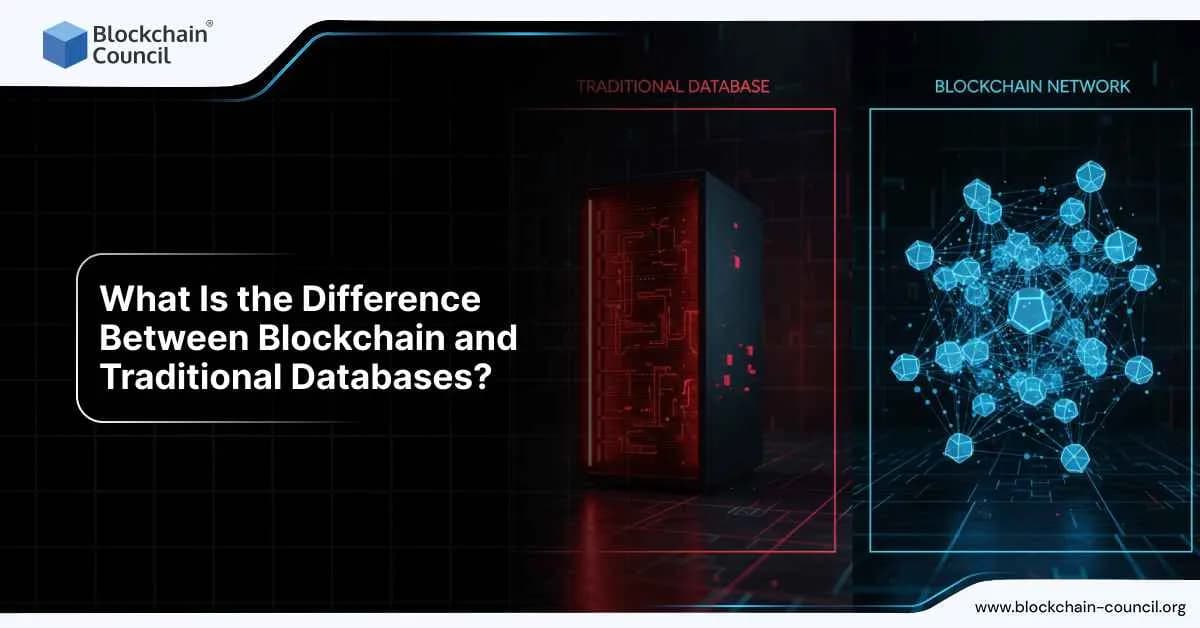
Databases are at the heart of every digital system, but not all databases work the same way. Traditional databases and blockchain may both store data, yet their design and purpose are very different. Understanding these differences helps organizations choose the right tool for their needs. For those who want structured learning in this field, blockchain technology courses provide a clear pathway into how blockchain compares with older systems.
Control and Architecture
Traditional databases are centralized. They are controlled by administrators who decide who can read, write, or modify the data. This works well when trust in a central authority is not an issue.

Blockchain, in contrast, is decentralized. Copies of the data exist across many nodes, and every change requires agreement through a consensus mechanism. No single party can alter the record without others detecting it. This is what makes blockchain attractive in environments where participants may not fully trust each other.
Data Mutability
In a traditional database, information can be created, updated, and deleted freely. Administrators can overwrite entries or remove them if needed.
Blockchain does not work this way. Data is append-only. Once information is written to the chain and confirmed, it cannot be changed. If an error occurs, a new entry must be added rather than editing the old one. This immutability is key to blockchain’s value as a trusted record system.
Performance and Scalability
Traditional databases are faster and more efficient. They handle large numbers of queries, support complex relationships between data, and can process thousands of transactions per second without issue.
Blockchains, on the other hand, often struggle with speed. Because every node must validate changes and store the full history, transaction throughput is lower. Efforts like sharding and layer-2 protocols are being tested to improve performance, but traditional databases remain the better choice for high-speed applications.
Security and Integrity
Traditional databases rely on access control and central oversight. If the server or administrator is compromised, data manipulation is possible.
Blockchain improves integrity with cryptographic hashing, consensus rules, and data replication across nodes. To tamper with a blockchain, an attacker would need to alter copies of the data across the majority of the network, which is extremely difficult on large public systems.
Transparency and Privacy
Public blockchains are highly transparent. Anyone can view transactions, which makes them strong for audits and public trust.
Traditional databases offer controlled visibility. Only those with permission can view or change the records. This supports privacy but can reduce transparency. Hybrid systems attempt to blend both, offering private data management with blockchain-style audit trails.
Use Cases and Suitability
Traditional databases are best for systems that need speed, regular updates, or advanced queries. They fit banking systems, e-commerce sites, enterprise applications, and anywhere central authority is acceptable.
Blockchain is designed for cases where trust, immutability, and decentralization are more important than speed. Supply chain tracking, digital voting, cross-border payments, and asset tokenization are examples where blockchain adds unique value. For professionals working with large datasets, pairing blockchain knowledge with a Data Science Certification provides an edge in analyzing blockchain-based records.
Cost and Complexity
Traditional databases are easier to deploy and maintain. Mature tools, established best practices, and lower infrastructure requirements make them cost-effective.
Blockchain introduces new layers of complexity. Running consensus protocols, storing multiple copies of data, and protecting against attacks add overhead. While costs are coming down, they are still higher compared to traditional setups.
Evolving Database Models
Researchers are exploring ways to merge blockchain with database functionality. These blockchain-based databases aim to offer both immutability and query efficiency. They represent a middle ground for industries that want blockchain’s security without giving up database performance. For businesses adapting to these changes, a Marketing and Business Certification can help leaders understand how to position blockchain-powered solutions in competitive markets.
Comparison of Blockchain and Traditional Databases
Feature | Blockchain | Traditional Database |
Control | Decentralized, shared across nodes | Centralized, controlled by administrators |
Data Changes | Append-only, immutable | Full CRUD: create, read, update, delete |
Performance | Slower, limited scalability | Faster, high throughput |
Security | Cryptographic hashing, consensus validation | Access control, central trust |
Transparency | High in public blockchains | Restricted, based on permissions |
Privacy | Limited in public chains, better in private chains | Strong, role-based access control |
Use Cases | Supply chains, voting, tokenization, audit trails | Banking, e-commerce, enterprise apps |
Complexity | Higher, requires consensus and replication | Lower, mature tools and methods |
Cost | Higher infrastructure and energy needs | More cost-efficient |
Innovation | Evolving hybrid models for efficiency | Well-established and stable |
Conclusion
Blockchain and traditional databases solve different problems. Traditional systems excel at speed, efficiency, and structured control. Blockchain excels at trust, transparency, and immutability in environments without central authority. Choosing between them depends on the priorities of the project: speed and efficiency, or trust and decentralization. Understanding both is essential for modern professionals as industries adopt new data systems that often combine the two.
Related Articles
View All
Blockchain
Blockchain vs Traditional Databases: Key Differences, Advantages, and Limitations
Compare blockchain vs traditional databases across trust, performance, auditability, privacy, scalability, and enterprise architecture choices.

Blockchain
Blockchain Product Manager vs Traditional Product Manager: Key Differences Explained
Learn how a blockchain product manager differs from a traditional PM across tokens, wallets, governance, analytics, metrics, risk, and skills.

Blockchain
Blockchain Product Manager vs Traditional Product Manager: Key Differences Explained
Learn how a blockchain product manager differs from a traditional PM across metrics, tokenomics, governance, analytics, UX, security, and career skills.
Trending Articles
The Role of Blockchain in Ethical AI Development
How blockchain technology is being used to promote transparency and accountability in artificial intelligence systems.

Top 5 DeFi Platforms
Explore the leading decentralized finance platforms and what makes each one unique in the evolving DeFi landscape.
What is AWS? A Beginner's Guide to Cloud Computing
Everything you need to know about Amazon Web Services, cloud computing fundamentals, and career opportunities.