

Blockchain vs Traditional Databases: Key Differences, Advantages, and Limitations

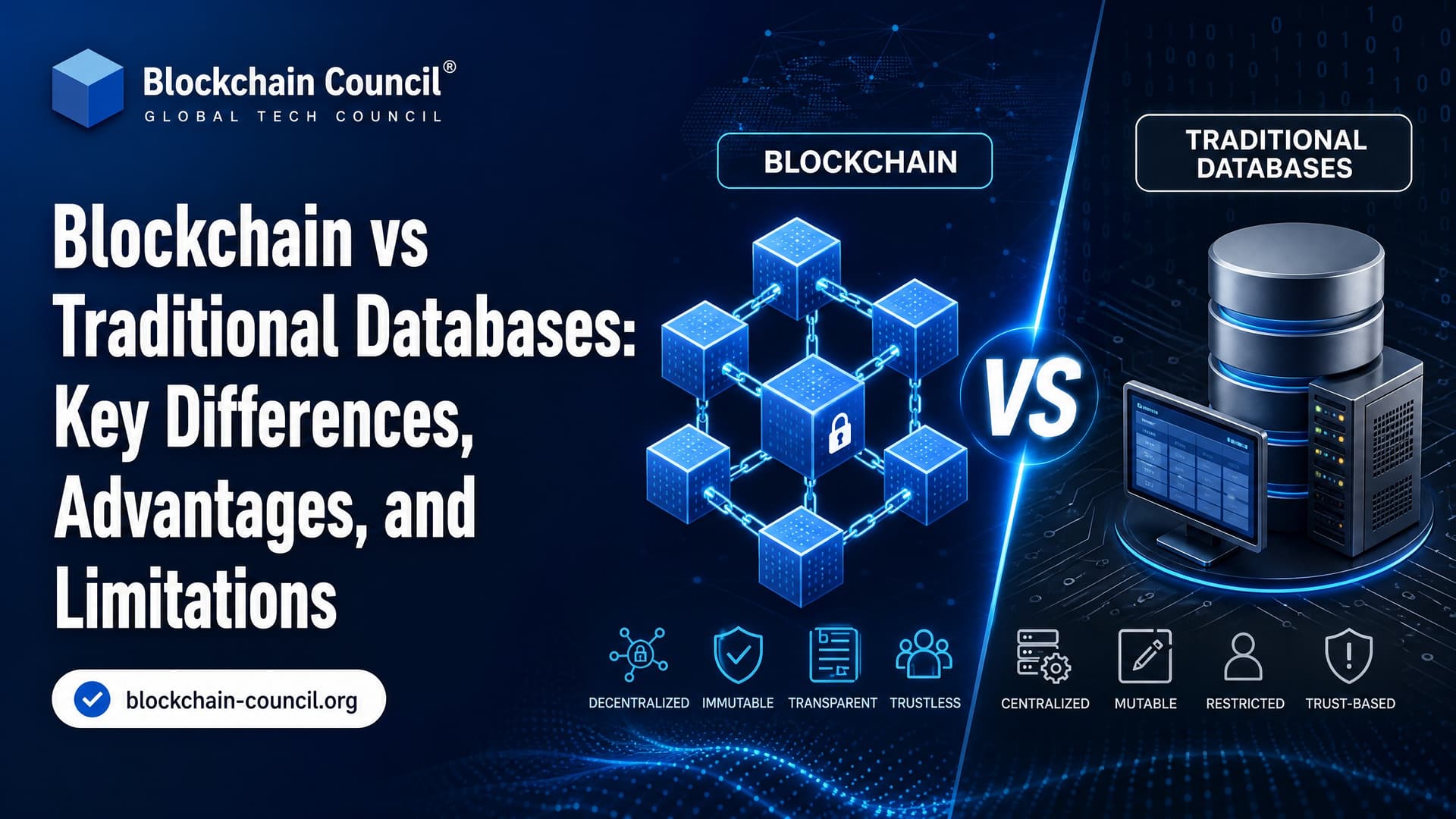
Blockchain vs traditional databases is not a contest where one replaces the other. They solve overlapping data problems, but they are built around different trust models. Use blockchain when several parties need a shared, tamper-evident record and cannot fully trust one operator. Use a traditional database when you need speed, complex queries, privacy controls, and mature operational tooling.
That sounds simple. In real projects, it is where many architecture mistakes start. A blockchain is not a faster PostgreSQL. A database is not automatically a trustworthy shared ledger. Pick the wrong one and you either overpay for slow infrastructure or fail to solve the trust problem you set out to fix.

What Is a Blockchain?
A blockchain is a type of distributed ledger technology where multiple nodes maintain copies of an append-only ledger. Transactions are grouped into blocks, ordered, and linked with cryptographic hashes. Network participants accept updates only when consensus rules are satisfied.
This design makes historical records hard to alter without detection. It also means corrections are usually made through new transactions, not by editing old rows. On Ethereum, for example, the mainnet chain ID is 1, and transactions are signed by private keys before being broadcast to the network. A small but common developer mistake: treating a transaction hash as proof of success. On EVM chains, a failed transaction can still be mined, consume gas, and return a receipt with status: 0. Your application must check the receipt, not just the hash.
What Is a Traditional Database?
A traditional database is usually controlled by one organization or a tightly managed cluster. It supports create, read, update, and delete operations, often called CRUD. Relational databases such as PostgreSQL, MySQL, and Oracle use structured tables and SQL. NoSQL systems such as MongoDB, Cassandra, and DynamoDB use document, key-value, or wide-column models.
Databases are tuned for performance, indexing, query planning, backup, recovery, access control, and integration with business applications. They can be replicated across regions and audited through logs, but their integrity leans heavily on administrators, permissions, monitoring, and the application design.
Blockchain vs Traditional Databases: Core Differences
| Aspect | Blockchain | Traditional database |
|---|---|---|
| Control | Shared across a network of nodes | Controlled by one organization or managed cluster |
| Trust model | Designed for low-trust, multi-party workflows | Assumes trust in the operator or administrator |
| Data changes | Append-only, with compensating transactions | Supports updates and deletes |
| Verification | Uses hashes, signatures, and consensus | Uses access control, logs, and transaction managers |
| Performance | Lower throughput and higher latency in most cases | High throughput and low latency |
| Querying | Limited native query capability | Rich SQL, joins, indexes, aggregations, and analytics |
| Best fit | Shared records, provenance, settlement, digital assets | Internal systems, analytics, CRM, ERP, payments processing |
Advantages of Blockchain
Shared trust across organizations
Blockchain is strongest when several organizations need the same record but do not want one party to own the database. The World Bank has described distributed ledger technology as useful for tamper-evident records between organizations that only partially trust one another.
Think of a supply chain involving a manufacturer, shipper, customs broker, warehouse, and retailer. A centralized database can work if everyone trusts the operator. If they do not, a ledger can record key handoffs, certifications, and timestamps in a way all participants can independently verify.
Built-in auditability
Blockchains create an audit trail by design. Blocks are linked by hashes, transactions are signed, and history is replicated across nodes. That does not make the data true at input. Garbage in still means garbage out. But once an event is recorded, changing it quietly becomes extremely difficult.
This matters in asset transfers, approvals, notarization, chain-of-custody workflows, and regulated processes where tamper evidence is worth more than raw speed.
Non-repudiation
A blockchain transaction is usually tied to a cryptographic signature. If a participant signs a transaction with their private key, it is hard for them to later deny that action. Traditional databases can add digital signatures at the application layer, but the database engine itself is not usually built around that principle.
Reduced single point of failure
Because ledger data is replicated across many nodes, one failed server does not destroy the record. This helps with cross-organization settlement, public digital assets, and credential verification. Be careful, though. Replication also adds cost, storage demand, and governance overhead.
Advantages of Traditional Databases
Speed and efficiency
Traditional databases win on performance in most enterprise workloads. They avoid global consensus and do not require every validating node to process every transaction. Decades of work in indexing, query optimization, caching, partitioning, and replication make them hard to beat.
If you are building an internal order management system, HR platform, CRM, inventory application, or reporting system, start with a database. To be blunt, putting every internal state change on chain is usually bad architecture.
Complex queries and analytics
SQL databases support joins, aggregations, window functions, indexing strategies, stored procedures, and mature query planners. Analytical systems such as Snowflake, BigQuery, Redshift, and ClickHouse are built for reporting at scale.
Most blockchains are not designed for ad hoc analytics. Developers often add indexers, subgraphs, ETL pipelines, or off-chain databases to make ledger data searchable. The ledger proves what happened. The database helps you ask better questions about it.
Privacy and access control
Public blockchains expose transaction data to all participants. Even when addresses are pseudonymous, transaction graphs can reveal patterns. Permissioned ledgers improve access control, but governance still gets complicated across organizations.
Traditional databases make it easier to enforce role-based access, data retention policies, regional storage rules, encryption, backups, and deletion workflows. For healthcare, banking, and personal data, this control is often non-negotiable.
Mature operations
Database teams know how to monitor replication lag, restore from backups, tune indexes, rotate credentials, and plan disaster recovery. Blockchain operations are improving, but running nodes, managing keys, handling protocol upgrades, and coordinating consortium governance still call for specialized skills.
Where Blockchain Falls Short
Blockchain has real limitations. Ignore them and your project will stall after the proof of concept.
- Scalability: Many blockchains process fewer transactions per second than centralized systems because consensus and replication add overhead.
- Latency: Finality can take seconds or minutes depending on the network and consensus model.
- Cost: Public networks may charge variable transaction fees. Congestion can make costs unpredictable.
- Privacy: Shared visibility is useful for auditability but risky for confidential data.
- Governance: Someone must decide who runs nodes, who upgrades smart contracts, and how disputes are resolved.
- Data quality: Blockchain protects records after entry. It does not verify that a scanned shipment, lab result, or identity claim was accurate.
Gartner has warned for years that many early blockchain supply chain pilots risked fatigue because teams aimed too broadly. The successful pattern is narrower: record the few events that need shared trust, and keep the rest in conventional systems.
Where Traditional Databases Fall Short
Databases also have weaknesses. A privileged administrator can alter data unless controls are carefully designed. Logs can be deleted or manipulated. Cross-company reconciliation can become expensive when each party maintains its own version of the truth.
In financial services, trade finance, digital identity, and provenance tracking, these weaknesses matter. A bank, insurer, regulator, and custodian may all need a shared view of an asset or claim. A single database owned by one participant may not be politically or commercially acceptable.
Hybrid Architecture Is Usually the Right Answer
The most practical enterprise design is often blockchain plus databases, not blockchain versus databases.
- Supply chain provenance: Store handoffs, certifications, and document hashes on a ledger. Keep inventory quantities, shipment routes, and analytics in internal databases.
- Healthcare identity and consent: Store consent receipts, identifiers, or hashes on chain. Keep clinical records inside secured electronic health record databases.
- Financial settlement: Use DLT for shared settlement records or tokenized assets. Keep risk models, customer data, and regulatory reporting in bank-controlled databases.
- Digital credentials: Anchor decentralized identifiers or credential proofs on chain. Keep user profiles and operational permissions in application databases.
This split works because blockchain is best for shared state and verification. Databases are best for high-volume processing and analysis.
Market and Skills Outlook
Enterprise interest has shifted from broad replacement claims to targeted blockchain use cases. Deloitte reported that blockchain-related job postings grew sharply from about 18,200 in 2019 to 82,000 in 2020, a sign of strong demand for blockchain and Web3 skills. Statista has also shown that blockchain adoption trails AI, big data, and IoT in broad enterprise implementation, which matches what architects see on the ground: selective deployment, not universal replacement.
Grand View Research estimated the blockchain technology market at about 57.7 billion US dollars in 2025 and projected continued growth beyond. Long-range forecasts deserve caution, but the skills trend is clear. Employers need professionals who understand distributed ledgers, smart contracts, databases, security, cloud systems, and compliance.
If you are building that skill set, use this topic as a learning path. Start with data modeling and consensus basics, then move into smart contract development and security. Blockchain Council programs such as Certified Blockchain Expert™, Certified Blockchain Developer™, and Certified Smart Contract Developer™ offer structured training for readers who want a guided route.
How to Choose: A Practical Checklist
Before choosing blockchain, ask these questions:
- Do multiple organizations need to write to and verify the same record?
- Is there no trusted central operator?
- Do you need tamper evidence at the protocol level?
- Can the workload tolerate lower throughput and higher latency?
- Can sensitive data stay off chain or be protected properly?
- Have you defined node governance, key management, upgrades, and dispute handling?
If you answer no to most of these, use a traditional database. If you answer yes to several, consider a ledger, but design it narrowly. Put only the data that needs shared verification on chain.
Final Takeaway
Blockchain vs traditional databases comes down to trust, performance, and control. Blockchain gives you shared verification, tamper evidence, and non-repudiation. Traditional databases give you speed, rich querying, privacy management, and operational maturity.
Your next step is practical: take one workflow you know well and map which records require shared trust and which records need fast internal processing. That map will usually point to the right architecture. If your goal is to design or audit these systems professionally, build depth in both blockchain architecture and database fundamentals before you specialize.
Related Articles
View All
Blockchain
Blockchain Product Manager vs Traditional Product Manager: Key Differences Explained
Learn how a blockchain product manager differs from a traditional PM across tokens, wallets, governance, analytics, metrics, risk, and skills.

Blockchain
Blockchain Product Manager vs Traditional Product Manager: Key Differences Explained
Learn how a blockchain product manager differs from a traditional PM across metrics, tokenomics, governance, analytics, UX, security, and career skills.

Blockchain
Blockchain vs Smart Contracts: Key Differences, Benefits, and Real-World Applications
Blockchain vs smart contracts explained: learn how distributed ledgers and self-executing code differ, work together, and power DeFi, NFTs, DAOs, and enterprise workflows.
Trending Articles
How Blockchain Secures AI Data
Understand how blockchain technology is being applied to protect the integrity and security of AI training data.

Can DeFi 2.0 Bridge the Gap Between Traditional and Decentralized Finance?
The next generation of DeFi protocols aims to connect traditional banking with decentralized finance ecosystems.
How to Install Claude Code
Learn how to install Claude Code on macOS, Linux, and Windows using the native installer, plus verification, authentication, and troubleshooting tips.