

Blockchain Product Manager vs Traditional Product Manager: Key Differences Explained

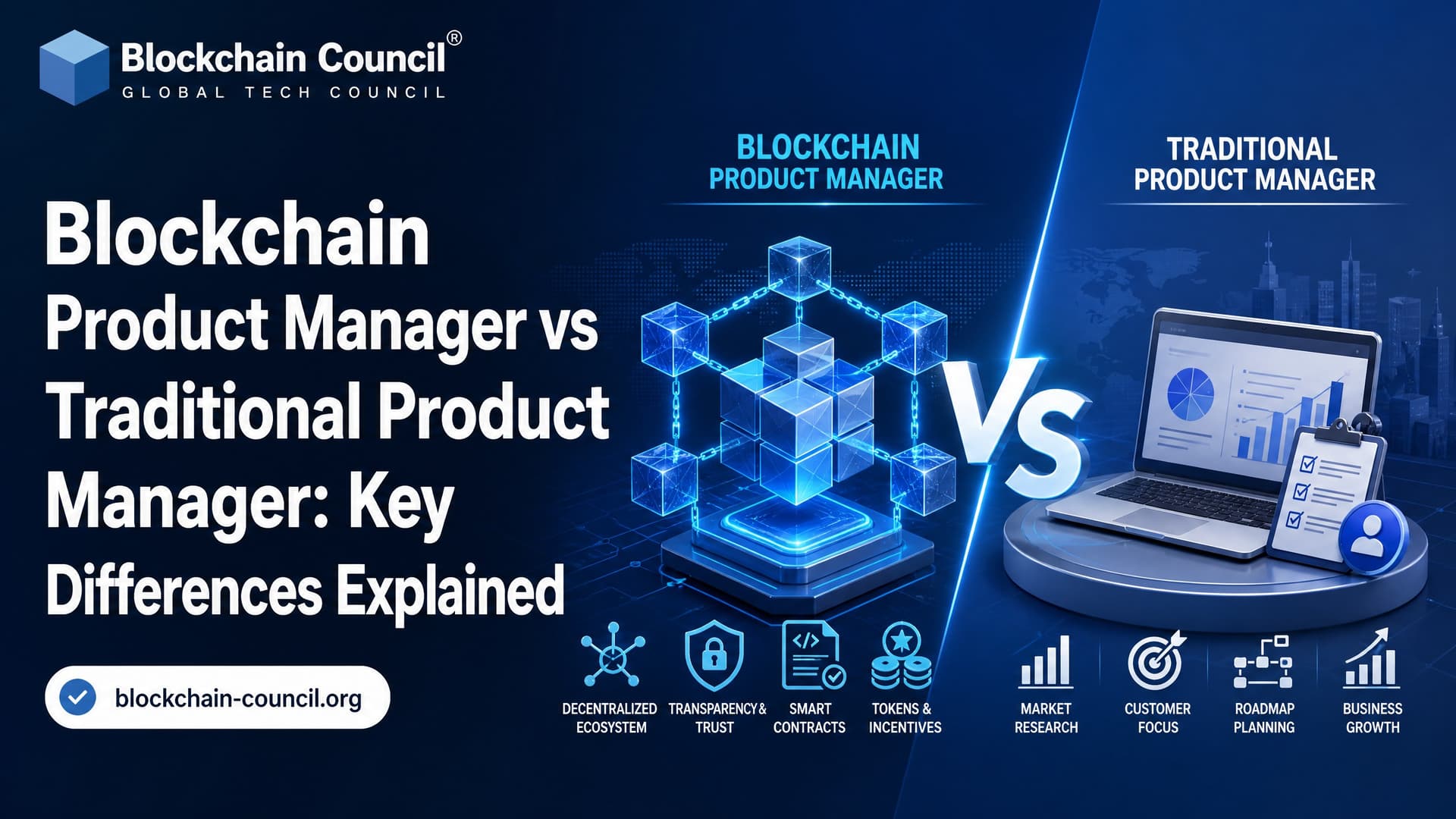
Blockchain product manager vs traditional product manager is not a comparison between two unrelated jobs. It is the same product discipline applied in a much harder operating environment: decentralized networks, token incentives, public data, smart contract risk, community governance, and unclear regulation.
If you already work in product, the shift is manageable. But it is not cosmetic. A blockchain PM cannot judge success only by revenue, activation, or feature adoption. You also need to understand wallets, gas fees, token flows, protocol health, and whether your community still trusts the product after a governance vote goes badly.

What Does a Traditional Product Manager Do?
A traditional product manager owns the direction and performance of a product within a company-controlled environment. The product may be a SaaS platform, mobile app, marketplace, banking product, or internal enterprise tool.
Typical responsibilities include:
- Defining product vision and roadmap
- Gathering customer and market requirements
- Prioritizing features with engineering, design, sales, and marketing teams
- Launching releases and tracking adoption
- Improving retention, revenue, profitability, NPS, and customer satisfaction
The traditional PM works inside a clear ownership model. The company controls the data, the platform, the roadmap, and usually the user account system. If the product needs a pricing change, leadership can approve it. If a feature underperforms, the team can roll it back. Product analytics tools can track funnels from signup to purchase with user IDs, cookies, and internal event data.
That is a comfortable setup compared with Web3. Not easy, but controlled.
What Does a Blockchain Product Manager Do?
A blockchain product manager performs the same core PM work, but for products built on blockchain networks or Web3 infrastructure. These products may include DeFi protocols, NFT marketplaces, blockchain games, tokenized asset platforms, enterprise traceability systems, identity products, or DAO governance tools.
The role adds several responsibilities that a traditional PM rarely faces:
- Designing products around wallets, private keys, gas fees, and on-chain transactions
- Working with smart contracts, token standards such as ERC-20 and ERC-721, and blockchain explorers
- Understanding tokenomics, staking, vesting, emissions, and reward design
- Reading on-chain analytics, wallet behavior, liquidity movements, and protocol usage
- Coordinating with communities, DAO voters, validators, ecosystem partners, and legal teams
- Managing security and compliance risk in systems where mistakes can be public and irreversible
A simple example: in a Web2 app, a failed payment can usually be retried or reversed. In a blockchain app, a user may see MetaMask show insufficient funds for intrinsic transaction cost, or a block explorer may show execution reverted. A good blockchain PM knows this is not just an engineering error. It is an onboarding, copywriting, support, and trust problem.
Blockchain Product Manager vs Traditional Product Manager: Key Differences
1. Success Metrics Are Broader Than Revenue
Traditional PMs usually measure success through business and customer KPIs: revenue, conversion rate, acquisition cost, retention, churn, NPS, and feature adoption.
Blockchain PMs still care about those numbers, especially in enterprise and fintech products. But Web3 success often depends on ecosystem health. That means tracking:
- Active wallets and returning wallets
- Transaction volume and protocol usage
- Total value locked, where relevant for DeFi
- Governance participation
- Token holder distribution
- Staking or validator participation
- Community sentiment and contributor activity
To be blunt, a protocol can show strong short-term transaction growth while quietly damaging its long-term economy through badly designed incentives. A traditional PM might celebrate the spike. A blockchain PM should ask who is using the product, why they are using it, and whether they will stay when rewards decline.
2. Tokenomics Becomes Product Strategy
In most traditional products, pricing and monetization sit within familiar models: subscription, license, usage fee, transaction fee, advertising, or services.
In blockchain products, tokens often become part of the product itself. Tokenomics affects acquisition, retention, governance, liquidity, security, and user behavior. A blockchain product manager may need to work on:
- Token utility and access rights
- Supply schedules and emission rates
- Vesting rules for teams, investors, and contributors
- Reward mechanisms for users, validators, liquidity providers, or creators
- Fee models and treasury allocation
- Incentives that reduce extractive behavior
This is where many Web2 PMs underestimate the role. Token incentives can bring users in quickly, but they can also attract mercenary behavior. If users arrive only for rewards, your retention curve may collapse when incentives end. A blockchain PM needs enough economic sense to spot that risk before launch.
3. Data Is Public, Pseudonymous, and Harder to Attribute
Traditional PMs usually work with proprietary analytics. You define product events, connect them to user accounts, build funnels, and examine cohorts.
Blockchain data is different. On-chain activity is public, but wallet addresses are pseudonymous. A single person can use multiple wallets. A single wallet can be controlled by a bot, a fund, a DAO, or a user. Cross-chain activity adds more complexity through bridges and multiple networks.
Web3 PMs use tools such as Etherscan, Dune, Nansen, Token Terminal, Flipside, and chain-specific explorers to understand behavior. But attribution is still messy. You may know that a wallet interacted with your smart contract. You may not know which campaign, community post, or referral caused it.
There is a practical catch here. If your product runs on a local Hardhat network, the default chain ID is 31337, while Ethereum mainnet is chain ID 1. If your wallet config, test scripts, or analytics labels assume the wrong chain, your test results can look fine while your production assumptions are wrong. Small details bite.
4. User Onboarding Is More Fragile
Traditional digital products can onboard users with email, password, social login, and card payments. The total addressable market is broad because the requirements are familiar.
Many blockchain products ask users to install or create a wallet, buy cryptocurrency, choose the right network, pay gas, sign messages, and protect a seed phrase. That is a lot to ask before the user receives value.
Web3 apps that require users to hold tokens shrink the addressable market by orders of magnitude compared with Web2 products. That matches what teams see in practice. Every extra wallet step loses people.
Good blockchain PMs therefore obsess over onboarding. They decide when to abstract gas, when to use account abstraction, when to support custodial recovery, and when not to force Web3 mechanics on users who do not care about them.
5. Retention Cannot Depend on Lock-In
Traditional platforms often increase retention through account history, stored assets, proprietary data, and switching costs. Users may stay because leaving is inconvenient.
Web3 changes that. Users control assets in their own wallets. Tokens and NFTs can often move across applications that support the same standards. A user can leave your interface and interact with the same protocol through another front end.
That is healthy for users, but uncomfortable for product teams. You cannot rely on custody as a retention moat. You have to compete on experience, trust, integrations, community value, and better incentive design.
6. Governance May Not Sit Inside the Company
Traditional product roadmaps are shaped by customers, executives, sales input, market research, and product strategy. Final decisions are usually internal.
Blockchain products may involve community governance. In DAO-driven systems, token holders can propose and vote on protocol changes, treasury spending, fee adjustments, or upgrades. That makes stakeholder management public.
A blockchain PM must be able to write clear proposals, explain trade-offs, handle criticism in Discord or forums, and coordinate with contributors who do not report to the company. This is not community theater. In some protocols, governance outcomes directly change product behavior.
7. Security and Regulation Sit Closer to the Product
Security matters in every product, but blockchain raises the stakes. Smart contract bugs can expose funds. Private key loss can be permanent. Phishing can drain wallets. Bridges have historically been high-value targets.
Regulation is also a daily concern. Product decisions may touch securities law, KYC/AML, sanctions screening, tax reporting, consumer protection, and data privacy. A blockchain PM does not need to be a lawyer, but you need to know when to bring legal and compliance into the room.
Compensation for blockchain product managers tends to run high, often well into six figures in the US, with some roles also offering equity or tokens. The higher pay reflects the risk, ambiguity, and breadth of the role rather than any single salary survey.
Skills Shared by Both Roles
The foundation does not disappear. Both traditional and blockchain PMs need:
- Customer discovery and user research
- Clear prioritization
- Roadmapping and stakeholder alignment
- Business analysis
- Experiment design
- Strong writing and communication
- Technical fluency with engineering teams
If you are already a strong PM, do not start from scratch. Your discovery habits, prioritization judgment, and ability to turn ambiguity into decisions still matter.
Extra Skills a Blockchain Product Manager Needs
To move from traditional product management into blockchain product management, build competence in these areas:
- Blockchain fundamentals: consensus, wallets, blocks, transactions, gas, smart contracts, and network fees.
- Smart contract literacy: enough Solidity 0.8.x knowledge to understand what engineers and auditors are discussing.
- Token standards: especially ERC-20 for fungible tokens and ERC-721 or ERC-1155 for NFTs.
- On-chain analytics: reading wallet flows, contract events, token transfers, liquidity, and retention patterns.
- Tokenomics: incentives, vesting, supply design, staking, governance, and treasury planning.
- Security mindset: audits, key management, upgradeability risk, phishing, and incident response.
- Community and governance: proposal writing, voting systems, contributor coordination, and public communication.
For structured learning, Blockchain Council programs such as Certified Blockchain Expert™, Certified Blockchain Developer™, Certified Smart Contract Developer™, and Certified Web3 Expert™ are worth considering, depending on your current role and technical depth.
Which Role Is Right for You?
Choose traditional product management if you prefer clearer ownership, mature analytics, established business models, and lower regulatory ambiguity. It is still demanding, but the operating system is familiar.
Choose blockchain product management if you like systems thinking, economic design, technical complexity, and public stakeholder management. It fits PMs who are comfortable with uncertainty and willing to learn the mechanics behind the product, not just the customer journey.
One warning: do not move into blockchain only because compensation looks attractive. The learning curve is real. Start by using a wallet, sending a small transaction on a testnet, reading an ERC-20 contract, and tracing that transaction in a block explorer. Then study tokenomics and governance with the same seriousness you would apply to pricing or retention in a SaaS product.
Next Step for Aspiring Blockchain Product Managers
If you want to make the shift, build one small product spec for a wallet-based application. Include onboarding, contract interactions, gas assumptions, failure states, analytics events, and governance risks. Then compare it with a normal Web2 spec. The gaps will show you exactly what to learn next.
For a formal path, start with Certified Blockchain Expert™ to build blockchain fluency, then move toward Certified Web3 Expert™ or Certified Smart Contract Developer™ if your target role sits closer to protocols, DeFi, NFTs, or developer-facing infrastructure.
Related Articles
View All
Blockchain
Blockchain Product Manager vs Traditional Product Manager: Key Differences Explained
Learn how a blockchain product manager differs from a traditional PM across tokens, wallets, governance, analytics, metrics, risk, and skills.

Blockchain
Blockchain Product Manager Job Description: Key Responsibilities and Daily Tasks
Learn what a blockchain product manager does, including responsibilities, daily tasks, required skills, salary signals, and how to prepare for the role.

Blockchain
Blockchain vs Traditional Databases: Key Differences, Advantages, and Limitations
Compare blockchain vs traditional databases across trust, performance, auditability, privacy, scalability, and enterprise architecture choices.
Trending Articles
AWS Career Roadmap
A step-by-step guide to building a successful career in Amazon Web Services cloud computing.

Can DeFi 2.0 Bridge the Gap Between Traditional and Decentralized Finance?
The next generation of DeFi protocols aims to connect traditional banking with decentralized finance ecosystems.
Blockchain in Supply Chain Provenance Tracking
Supply chains are under pressure to prove not just efficiency, but also authenticity, sustainability, and fairness. Customers want to know if their coffee really is fair trade, if the diamonds are con