

Blockchain Product Manager vs Traditional Product Manager: Key Differences Explained

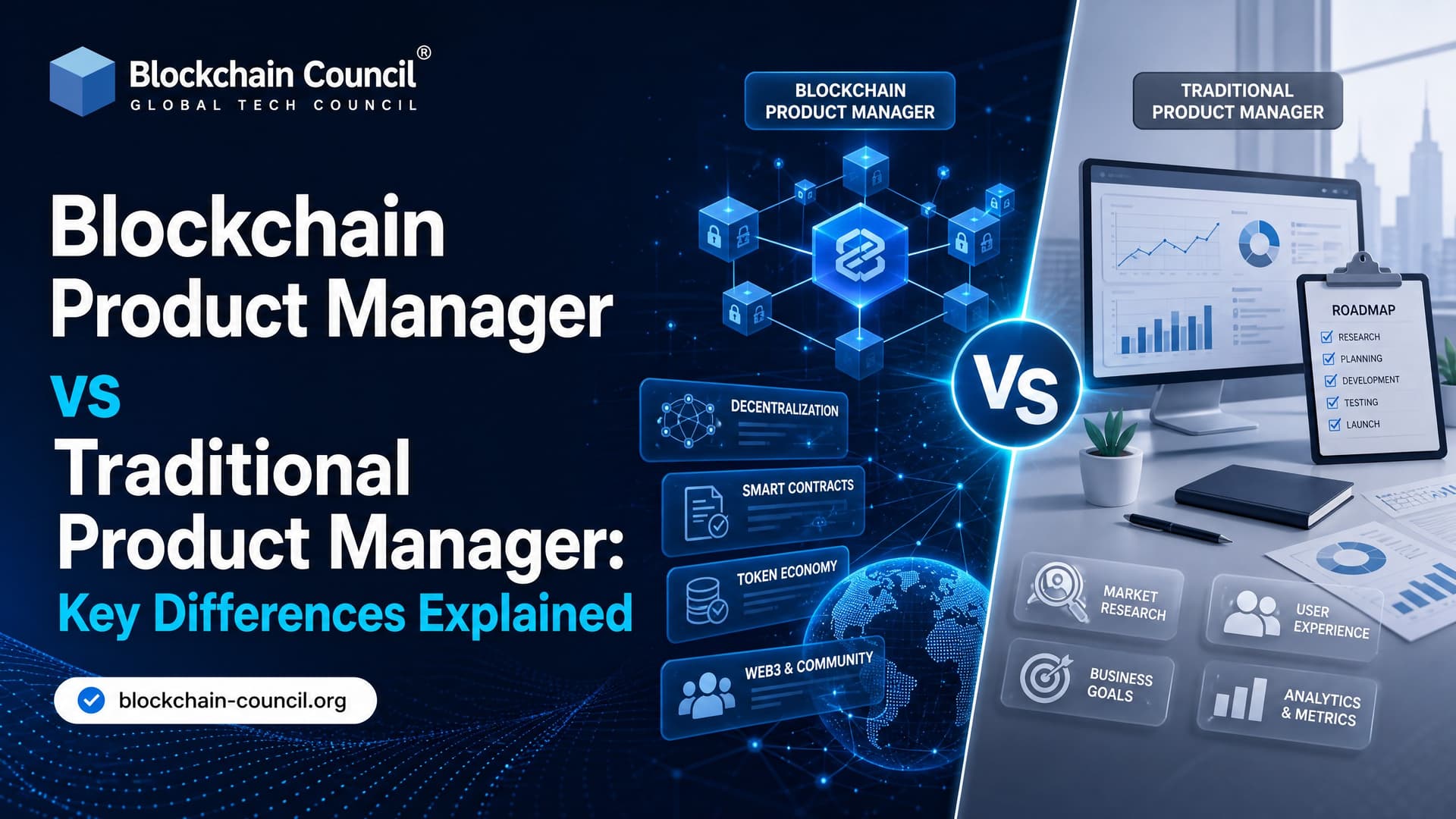
Blockchain product manager vs traditional product manager is not a comparison between two unrelated jobs. The core product craft stays the same: understand users, set priorities, work with engineering, ship useful things, measure outcomes. What changes is the operating environment. A blockchain product manager does that same work inside Web3 systems where wallets, smart contracts, tokens, governance, gas fees, and public on-chain data shape the product itself.
If you already work as a traditional product manager, the switch is realistic. But do not treat blockchain as just another backend. It changes incentives, ownership, analytics, risk, and even how users identify themselves. That is where a lot of strong Web2 PMs get caught off guard.

What Does a Traditional Product Manager Do?
A traditional product manager guides a product from strategy through launch and iteration. You work with engineering, design, sales, marketing, finance, support, and leadership to decide what gets built and why.
Typical responsibilities include:
- Researching customer needs and market gaps
- Defining product strategy and roadmap priorities
- Writing requirements and aligning teams
- Measuring adoption, retention, revenue, churn, and customer satisfaction
- Supporting go-to-market planning and business analysis
The environment is usually centralized. The company controls user accounts, infrastructure, pricing, product data, and most decision making. Even when the product is technically complex, ownership sits inside one organization.
What Does a Blockchain Product Manager Do?
A blockchain product manager uses the same product management toolkit but applies it to products built on blockchain networks and Web3 infrastructure. That covers DeFi protocols, NFT marketplaces, blockchain games, DAO governance tools, enterprise traceability systems, tokenized asset platforms, and decentralized identity products.
The scope is wider because the product may include:
- Wallet onboarding and private key risks
- Gas fees and transaction confirmation flows
- Smart contracts written in Solidity 0.8.x or another chain-specific language
- Token standards such as ERC-20 for fungible tokens and ERC-721 for NFTs
- On-chain analytics from explorers such as Etherscan
- DAO voting, treasury management, and governance proposals
- Tokenomics, staking, emissions, vesting, and incentive design
Here is a detail that separates theory from practice: users will not tell support that EIP-1559 gas mechanics confused them. They will say, my transaction is stuck. Or they paste a MetaMask error such as replacement transaction underpriced. A blockchain PM needs enough technical fluency to tell whether the problem is gas pricing, nonce management, contract logic, wallet UX, or plain network congestion.
Blockchain Product Manager vs Traditional Product Manager: Core Differences
1. Product Scope
A traditional PM mostly focuses on the user problem, business model, experience, and delivery plan. The product runs on infrastructure the company controls.
A blockchain PM has to think about the product and the protocol layer together. On Ethereum mainnet (chain ID 1), gas costs, block confirmation times, wallet compatibility, and contract upgradeability can shape user behavior as much as the interface does.
To be blunt, you cannot manage a DeFi lending product well if you only understand user stories. You also need to understand liquidity, liquidation thresholds, oracle risk, and what happens when a contract call reverts.
2. Success Metrics
Traditional PMs usually track revenue, conversion rate, acquisition cost, retention, churn, feature adoption, Net Promoter Score, and support volume. These still matter in many blockchain products, especially consumer apps and enterprise platforms.
Blockchain PMs add ecosystem metrics:
- Active and returning wallets
- Transaction volume
- Total value locked, often called TVL
- Protocol usage by function or contract
- Token holder distribution
- Governance participation
- Staking or validator participation
- Community contributor activity
The tricky part is identity. One person can run ten wallets. One wallet can represent a bot, a DAO, a fund, or a regular user. So a blockchain PM cannot blindly map wallets to users the way a Web2 PM maps account IDs to customers.
3. Tokenomics and Incentive Design
This is the biggest difference.
A traditional PM may design pricing, packaging, discounts, freemium limits, or enterprise tiers. A blockchain PM may design a token that affects access, rewards, governance, liquidity, and security.
Token decisions can include:
- Token utility and access rights
- Supply schedule and emissions
- Vesting rules for teams, investors, and contributors
- Staking rewards and slashing conditions
- Fee distribution
- Treasury allocation
- Governance voting power
This is not cosmetic. Poor incentive design attracts mercenary users who farm rewards and leave. Overly generous emissions weaken token value. Low governance participation leaves a protocol exposed to capture by a small group.
4. Data and Analytics
Traditional PMs use product analytics, CRM data, attribution systems, surveys, session recordings, and A/B testing. The data is often private and tied to known users.
Blockchain data is public but pseudonymous. You can inspect smart contract activity on a block explorer, but you may not know who controls a wallet. You also have to follow activity across chains, bridges, liquidity pools, and contract events.
This changes the analytics job. You may need Dune, Flipside, Nansen, Etherscan, The Graph, or custom indexing pipelines. Traditional funnel charts are not enough when the key event is a contract method call or a token transfer.
5. Governance and Stakeholders
Traditional PMs work inside corporate decision structures. Stakeholders include leadership, customers, sales, support, engineering, legal, and finance.
Blockchain PMs may also answer to token holders, validators, liquidity providers, developers, ecosystem partners, DAO delegates, and community contributors. Many of these discussions happen in public on Discord, Telegram, forums, GitHub, or governance portals.
The product experience may include governance itself: proposal creation, voting, quorum thresholds, delegation, treasury execution, and proposal history. If governance is hard to understand, participation drops. If voting power is too concentrated, trust drops.
6. Roadmaps and Risk
Traditional PMs often work with quarterly planning and multiyear strategy. That structure still exists in enterprise blockchain projects, but public Web3 markets move faster.
A protocol upgrade, regulatory change, bridge exploit, wallet policy change, or smart contract vulnerability can reorder the roadmap overnight. Security is not a late-stage checklist. It is part of product planning.
Blockchain PMs need to understand risks such as:
- Smart contract exploits
- Oracle manipulation
- Liquidity attacks
- Governance attacks
- Phishing and wallet-draining scams
- Bridge and cross-chain failures
A traditional PM can often roll back a broken feature. A blockchain PM may be dealing with immutable contracts and irreversible transactions. That changes the release culture.
Skills Both Roles Share
Do not skip the fundamentals. Strong blockchain PMs are still strong PMs first.
- Customer research
- Product strategy
- Prioritization
- Stakeholder management
- Clear writing
- Commercial judgment
- Experiment design
- Delivery discipline
If you cannot define a problem clearly, blockchain will not fix that. It usually makes the ambiguity worse.
Skills Blockchain Product Managers Need Beyond Traditional PMs
To move from traditional PM to blockchain PM, build technical and economic literacy in layers.
- Blockchain basics: blocks, nodes, consensus, finality, wallets, private keys, and transactions
- Smart contracts: ERC-20, ERC-721, contract calls, events, audits, and upgrade patterns
- Gas and UX: fee estimation, failed transactions, confirmations, and account abstraction concepts
- Tokenomics: supply, emissions, staking, vesting, incentives, and treasury design
- Governance: voting systems, delegation, quorum, proposal workflows, and DAO operations
- On-chain analytics: wallet cohorts, contract usage, liquidity movement, TVL, and token distribution
- Security awareness: common exploit patterns, audit limitations, and incident response
For structured learning, Blockchain Council certifications such as Certified Blockchain Expert™, Certified Web3 Expert™, and Certified Blockchain Developer™ pair well with hands-on product management experience.
Real Examples of the Role Difference
DeFi Lending Protocol
A traditional fintech PM might optimize loan application completion and credit decisioning. A blockchain PM working on DeFi lending also manages collateral types, liquidation logic, oracle dependency, governance votes, liquidity incentives, and TVL quality.
NFT Marketplace
A traditional marketplace PM focuses on listing quality, search, seller tools, buyer conversion, and fees. An NFT marketplace PM adds minting flows, royalties where supported, wallet signing, metadata standards, collection verification, and fraud prevention.
Enterprise Traceability
A supply chain PM may manage ERP integrations and shipment visibility. A blockchain PM must decide what data goes on-chain, what stays off-chain, how participants verify records, and how the system handles privacy across multiple companies.
Which Role Fits You?
Choose traditional product management if you want broader industry mobility, clearer corporate structures, and products where user identity, analytics, and monetization are well understood.
Choose blockchain product management if you are comfortable with technical ambiguity, public communities, token incentives, and products where economics and software design are tightly linked. It is a poor fit if you dislike regulatory uncertainty or do not want to learn infrastructure details.
Compensation can be attractive. Glassdoor data summarized by ELVTR places the average blockchain product manager salary in the United States at about $167,000 per year, with higher totals possible in senior roles or protocol teams. Some startups also offer tokens, which can align incentives but add volatility and tax complexity.
How to Transition From Traditional PM to Blockchain PM
- Learn the transaction lifecycle. Send a small test transaction, inspect it on Etherscan, and note gas, nonce, status, logs, and confirmations.
- Read ERC standards. Start with ERC-20 and ERC-721. You do not need to be a Solidity engineer, but you should know what the interfaces do.
- Study one protocol deeply. Pick a DeFi, NFT, identity, or DAO product. Map its users, incentives, contracts, metrics, and governance process.
- Build a metrics dashboard. Use Dune or another on-chain analytics tool to track active wallets, volume, retention proxies, and contract activity.
- Take a structured course. Use Blockchain Council's Certified Blockchain Expert™ or Certified Web3 Expert™ as a foundation, then add hands-on product work.
Final Takeaway
A traditional product manager owns customer value and business outcomes in a centralized setting. A blockchain product manager owns those same outcomes, plus tokens, wallets, smart contracts, governance, on-chain analytics, and ecosystem health.
Want the fastest practical next step? Pick one live protocol, study its docs, inspect its contracts on Etherscan, read its governance forum, and build a one-page product brief with metrics, risks, and roadmap recommendations. Then close the gaps with a certification such as Certified Blockchain Expert™ or Certified Web3 Expert™.
Related Articles
View All
Blockchain
Blockchain Product Manager vs Traditional Product Manager: Key Differences Explained
Learn how a blockchain product manager differs from a traditional PM across metrics, tokenomics, governance, analytics, UX, security, and career skills.

Blockchain
Blockchain Product Manager Job Description: Key Responsibilities and Daily Tasks
Learn what a blockchain product manager does, including responsibilities, daily tasks, required skills, salary signals, and how to prepare for the role.

Blockchain
Blockchain vs Traditional Databases: Key Differences, Advantages, and Limitations
Compare blockchain vs traditional databases across trust, performance, auditability, privacy, scalability, and enterprise architecture choices.
Trending Articles
The Role of Blockchain in Ethical AI Development
How blockchain technology is being used to promote transparency and accountability in artificial intelligence systems.
What is AWS? A Beginner's Guide to Cloud Computing
Everything you need to know about Amazon Web Services, cloud computing fundamentals, and career opportunities.

Can DeFi 2.0 Bridge the Gap Between Traditional and Decentralized Finance?
The next generation of DeFi protocols aims to connect traditional banking with decentralized finance ecosystems.