

Blockchain Infrastructure for Global Financial Systems: Payments, Settlement, CBDCs, and Standards

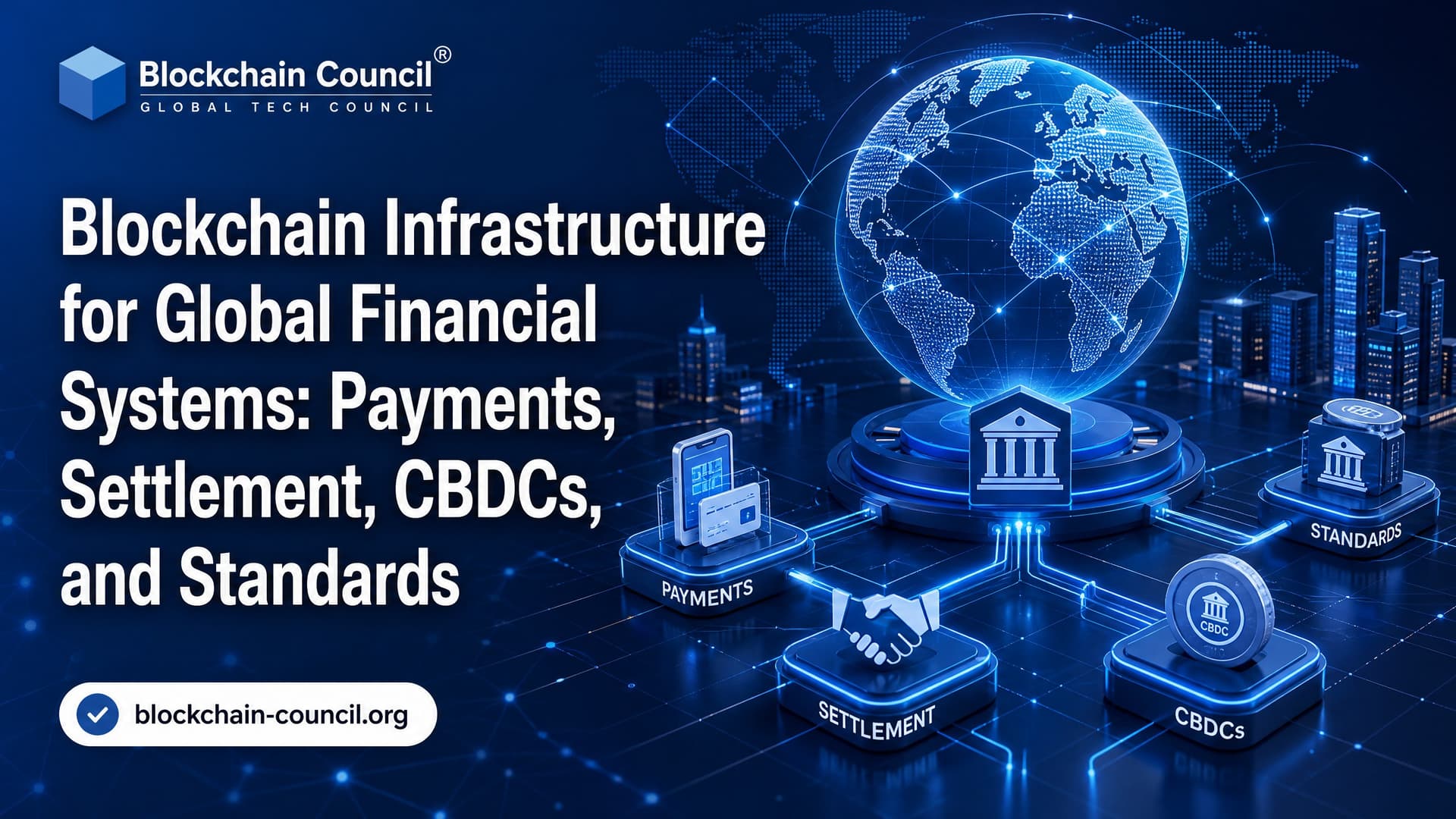
Blockchain Infrastructure for Global Financial Systems is no longer a side experiment run by innovation labs. It is moving into the payment, securities settlement, and digital money stack that banks, central banks, and market infrastructures depend on. The serious work now has little to do with launching another token. It is about building safe rails for money and regulated assets.
The Bank for International Settlements has described tokenised platforms that combine central bank reserves, commercial bank money, and government bonds as a possible foundation for the next generation of monetary and financial systems. The IMF has noted that financial firms are issuing and transacting assets on distributed ledger infrastructure. That raises a hard question. How will these systems work together across borders without fragmenting finance?

What Blockchain Infrastructure Means in Global Finance
In financial markets, blockchain infrastructure refers to the distributed platforms, networks, custody systems, smart contracts, identity layers, and governance rules used to issue, record, transfer, and settle financial assets. That includes money itself.
The main building blocks are:
- DLT-based settlement systems for payments, securities, collateral, and post-trade processing.
- Digital money instruments, including central bank digital currencies, stablecoins, and tokenised bank deposits.
- Tokenisation platforms for government bonds, money market funds, private credit, and other real-world assets.
- Interoperability frameworks that connect ledgers, payment systems, messaging standards, and legal finality rules.
- Security and compliance controls for AML, CFT, privacy, cyber resilience, and operational continuity.
To be blunt, a blockchain that cannot handle identity, settlement finality, reversibility rules, and regulator access is not ready for systemic finance. Public DeFi taught the market useful lessons about composability. Regulated finance needs more than composability. It needs accountability.
Why Financial Institutions Are Taking DLT Seriously
Traditional settlement is full of reconciliation. One party updates its ledger, another updates a custodian record, a central securities depository confirms movement, and back-office teams chase breaks. In securities markets, T+2 settlement has long been a standard cycle in many jurisdictions, though some markets have moved faster.
DLT changes the design assumption. If cash and securities exist as tokens on the same shared ledger, delivery versus payment can happen atomically. Either both legs settle, or neither does. That cuts counterparty risk and reduces operational work.
A paper hosted by the US Securities and Exchange Commission has pointed to blockchain-based settlement systems as a way to reduce settlement time from days to near real time. The Federal Reserve Bank of Chicago has also identified blockchain as a likely source of future financial market innovation, especially in post-trade workflows and immutable transaction records.
Where the strongest use cases are emerging
- Wholesale payments: interbank settlement, liquidity movement, and central bank money experiments.
- Securities settlement: tokenised bonds, collateral mobility, and atomic delivery versus payment.
- Cross-border payments: stablecoin rails, multi-CBDC models, and shared settlement platforms.
- Digital asset custody: regulated wallet controls, key management, transaction approval, and audit trails.
- Programmable compliance: transfer restrictions, investor eligibility, and rule-based asset servicing.
Here is a practical detail developers should note. In permissioned Ethereum environments such as Hyperledger Besu, a small mistake in the genesis file can stop a network before the first business test. The error often shows up as a genesis hash mismatch between peers. In a bank proof of concept, that is annoying. In market infrastructure, that kind of configuration drift is unacceptable. Configuration management is not admin work. It is financial control.
CBDCs and Tokenised Central Bank Money
Central bank digital currencies are a major part of blockchain infrastructure for global financial systems, although not every CBDC uses a blockchain. The IMF reports that 19 countries in the Middle East and Central Asia are exploring CBDCs, with a cautious and phased approach. That caution is justified.
Retail CBDCs target everyday payments and inclusion. Wholesale CBDCs focus on interbank settlement, cross-border corridors, and securities transactions. The wholesale case is where DLT often looks most practical, because participants are known, governance is controlled, and the asset being settled is central bank money.
The BIS vision goes further. It imagines tokenised platforms where reserves, commercial bank money, and government securities interact inside a unified architecture. In that model, a government bond and the cash used to buy it could settle on a shared platform with programmable rules and strong legal finality.
Stablecoins as Financial Infrastructure
Stablecoins already operate as payment rails in crypto markets and cross-border transfers. They are used for trading settlement, treasury movement, remittances, and on-off ramp liquidity. Morgan Stanley has described stablecoins as modernising financial infrastructure by combining fiat reference value with blockchain-native settlement speed.
That said, stablecoins are not all the same. A fully backed, well-audited fiat stablecoin with clear redemption rights is very different from an algorithmic design that depends on market confidence during stress. The Financial Stability Board has warned that crypto assets, stablecoins, and DeFi are increasingly interconnected and could create financial stability risks if they scale without proper oversight.
For enterprises, the lesson is simple. Do not treat stablecoin integration as just another API connection. You need to assess reserve quality, issuer governance, jurisdiction, redemption terms, sanctions controls, wallet risk, and chain risk. A cheap transfer is not cheap if it creates compliance exposure.
Regulation Is Becoming the Main Design Constraint
The regulatory direction is clear. In July 2023, the FSB finalised global recommendations for crypto-asset activities and markets, including specific recommendations for global stablecoin arrangements. Its later thematic peer review found welcome progress, but also gaps and inconsistencies across jurisdictions.
The IMF and FSB have produced a joint roadmap for coordinated implementation of crypto policy frameworks. The message is not anti-innovation. It is anti-fragility. The same activity, same risk, same regulation principle is becoming the baseline.
Blockchain infrastructure used in finance has to account for:
- Settlement finality and legal enforceability.
- AML and CFT monitoring.
- Consumer and investor protection.
- Operational resilience and cyber recovery.
- Governance of upgrades, validators, and emergency actions.
- Data privacy and supervisory access.
This is where many pilots fail. A smart contract may pass tests in Solidity 0.8.x, but the harder issue is who can pause it, who approves an upgrade, how transactions are monitored, and what happens if a court order requires asset freezing. Those are not edge cases in regulated finance. They are day-one requirements.
Interoperability Will Decide What Scales
The biggest risk is not that blockchain fails. The bigger risk is that it succeeds in isolated pockets. A bank ledger here, a CBDC platform there, a tokenised bond system somewhere else, all unable to communicate cleanly.
The Atlantic Council has argued that digital asset standards and interoperability are central to the future global financial system. The IMF has made a similar point. As assets move onto new infrastructures, cross-border interoperability becomes critical.
Useful interoperability is more than cross-chain messaging. It includes:
- Technical standards for tokens, identity, APIs, and data models.
- Legal compatibility for settlement finality and asset ownership.
- Regulatory alignment across AML, prudential, and market conduct rules.
- Operational playbooks for outages, fraud, disputes, and chain upgrades.
ISO 20022, ERC-20, ERC-721, and newer security-token standards such as ERC-3643 all sit in this conversation, but standards alone do not solve governance. Someone still has to decide who is allowed to validate, read, write, reverse, or freeze transactions.
What This Means for Professionals and Enterprises
If you work in banking, payments, capital markets, or fintech, this shift changes the skill profile you need. Understanding crypto wallets or token prices is not enough. You need to understand market structure.
Skills that now matter
- DLT architecture for permissioned and public networks.
- Smart contract design, testing, and audit workflows.
- Tokenisation of cash, deposits, bonds, and fund units.
- CBDC and wholesale settlement models.
- Digital asset custody and key management.
- Regulatory frameworks from the FSB, IMF, BIS, FATF, CPMI, and IOSCO.
- Cybersecurity, incident response, and operational resilience.
For developers, build with real constraints. Use testnets, but also model failed settlements, stuck transactions, validator downtime, and key compromise. If your architecture cannot explain what happens when a validator signs conflicting blocks or when a custody approval policy fails, it is not production-grade.
For enterprises, start with a narrow process. Collateral movement, intragroup treasury transfers, tokenised fund subscriptions, or bond lifecycle management are more realistic first projects than replacing the entire payments stack.
Learning Path for Blockchain Finance Careers
Blockchain Council readers who want structured learning can map their path by role. For strategy and business roles, the Certified Blockchain Expert™ certification is a strong starting point. Developers who need to build and test applications should look at the Certified Blockchain Developer™. If your work touches token economics, exchanges, custody, or digital assets, the Certified Cryptocurrency Expert™ is also relevant.
Security should not be optional. Financial infrastructure is a high-value target, and smart contract mistakes can become balance-sheet events. If you are moving toward production systems, add smart contract security, blockchain architecture, and compliance-focused training to your plan.
Where Blockchain Infrastructure Goes Next
The next phase will not be a single global chain for finance. That is unlikely, and probably undesirable. The more realistic path is a network of regulated platforms: central bank money systems, tokenised deposit ledgers, stablecoin networks, securities platforms, and interoperability layers between them.
CBDCs will keep advancing slowly. Stablecoins will grow where regulation gives institutions confidence. Tokenised securities will expand first in markets where settlement friction, collateral movement, or fund administration costs are high. DeFi ideas will survive, but many will be rebuilt inside permissioned or regulated environments.
Your next step is concrete. Choose one financial workflow. Map the cash leg, the asset leg, the legal finality point, the compliance checks, and the failure states. Then build a small prototype. If you want a formal foundation first, start with the Certified Blockchain Expert™ or Certified Blockchain Developer™ and focus your practice on settlement, tokenisation, and digital money systems.
Related Articles
View All
Blockchain
Blockchain in Financial Services: Payments, Lending, Compliance, and Tokenization
Explore how blockchain in financial services is changing payments, lending, compliance, custody, and tokenization with real use cases and trade-offs.
Blockchain
Top Blockchain Use Cases in Banks and Financial Services
Explore the top blockchain use cases in banks, from payments and trade finance to tokenization, settlement, lending, KYC, and digital asset services.

Blockchain
How Blockchain Intelligence Detects Crypto Fraud and Financial Crime
Learn how blockchain intelligence traces illicit crypto funds, scores wallet risk, supports AML compliance, and helps detect scams, hacks, and ransomware.
Trending Articles
AWS Career Roadmap
A step-by-step guide to building a successful career in Amazon Web Services cloud computing.
How Blockchain Secures AI Data
Understand how blockchain technology is being applied to protect the integrity and security of AI training data.
How to Install Claude Code
Learn how to install Claude Code on macOS, Linux, and Windows using the native installer, plus verification, authentication, and troubleshooting tips.