

Blockchain DePIN Infrastructure Networks: Architecture, Use Cases, and Builder Skills

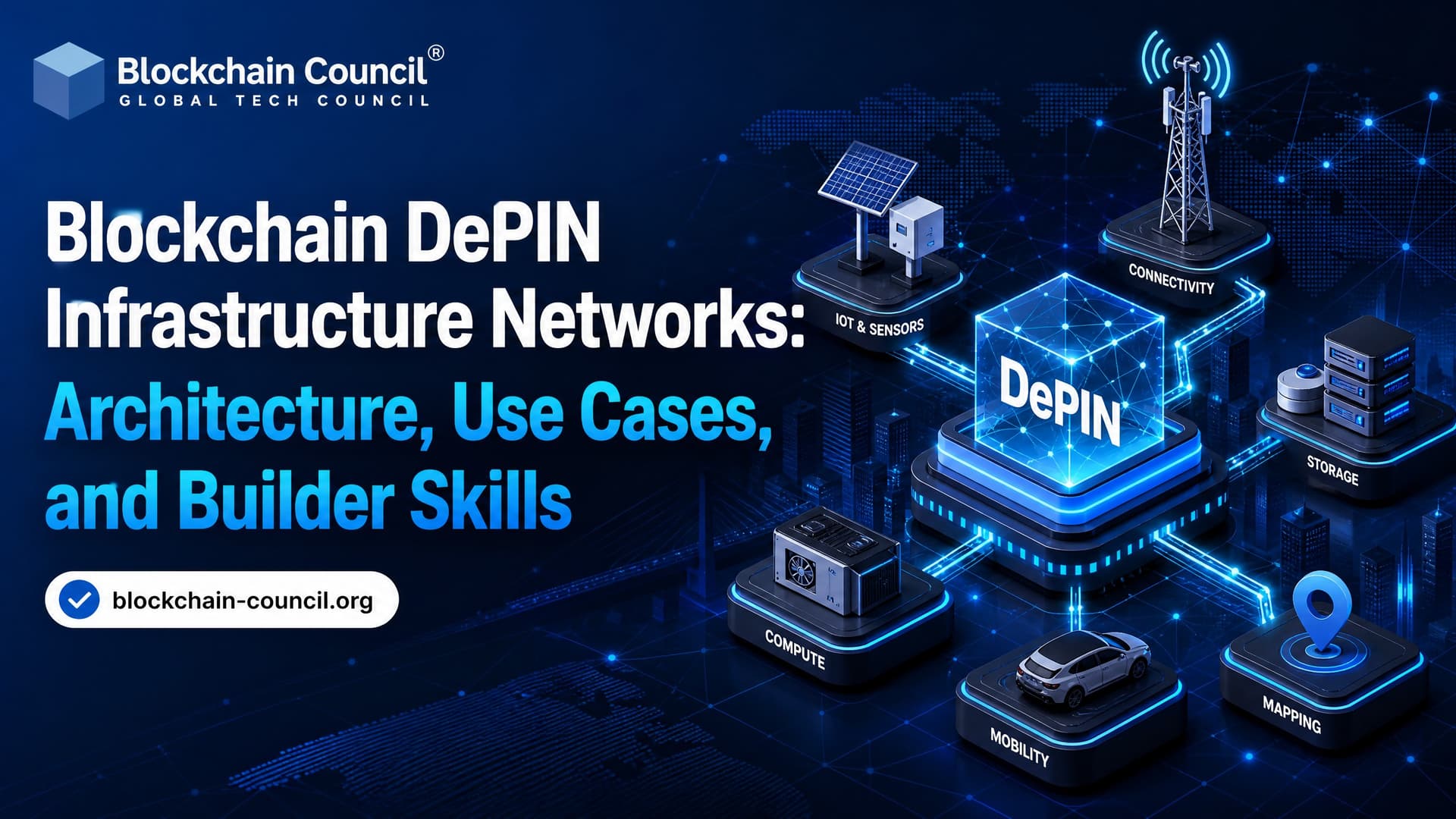
Blockchain DePIN Infrastructure Networks use blockchains, tokens, and community governance to coordinate physical infrastructure: wireless hotspots, GPUs, storage nodes, energy assets, sensors, and mapping devices. The idea is simple to describe and hard to pull off. Instead of one company buying every tower, server, or sensor, many participants contribute resources and get paid when the network verifies useful work.
DePIN stands for Decentralized Physical Infrastructure Networks. It is now treated as a distinct Web3 infrastructure category by firms such as J.P. Morgan and a16z crypto, by tooling providers like QuickNode and The Graph ecosystem, and by academic researchers writing about modular DePIN systems. The interest is not theoretical. Projects in wireless, compute, storage, mapping, and energy already show how crypto incentives can coordinate hardware in the real world.

What Are Blockchain DePIN Infrastructure Networks?
A DePIN network is a blockchain-based system for managing physical or machine resources. Participants run hardware or contribute capacity, then receive tokens for measured service. That service might be network coverage, uptime, bandwidth, storage availability, GPU compute, verified sensor data, or delivered energy.
The blockchain is not the hardware. It is the coordination layer. Smart contracts record payments, incentives, governance decisions, and, in many cases, proof that a resource was available or used.
Core Characteristics
- Open participation: A user can join by deploying a hotspot, GPU, sensor, storage node, or other supported device.
- Token incentives: Contributors earn tokens based on network rules, not private contracts with a single operator.
- Transparent accounting: Payments, rewards, and governance actions can be inspected on chain.
- Shared ownership: Many DePIN protocols use governance tokens or DAO-style voting to decide upgrades and incentive changes.
- Physical-world verification: The hard part is proving that real work happened outside the blockchain.
That last point matters. A token can record a reward, but it cannot directly know whether a hotspot really provided coverage or a GPU completed a job. DePIN networks need telemetry, cryptographic proofs, or trusted validation systems to close that gap.
How DePIN Architecture Works
Most blockchain DePIN infrastructure networks have more moving parts than a standard DeFi app. You are connecting devices, users, wallets, contracts, indexing services, and sometimes regulators. A workable architecture usually includes the layers below.
Blockchain and Smart Contracts
The chain handles settlement, token logic, governance, and sometimes reputation. Public L1 and L2 networks are common choices because developers can reuse existing wallets, RPC providers, explorers, and smart contract tooling.
For builders, the chain choice is not cosmetic. Gas costs, finality, throughput, and wallet support all affect whether tiny machine payments make sense. Ethereum mainnet, with chain ID 1, is often too expensive for frequent micro-settlements. Many teams push high-volume activity to an L2 or an application-specific chain, then settle higher-value state periodically.
Device Identity and Access Control
J.P. Morgan has pointed to decentralized identity as a key component for DePIN systems. Devices need verifiable identities so the network can decide which hardware is allowed to submit work, claim rewards, or access private services.
In practice, this might mean a hardware secure element, a DID document, signed telemetry, or a wallet-bound device registry. Skip this layer and Sybil attacks become cheap. Anyone could spin up fake devices and farm rewards.
Oracles, Telemetry, and Proof of Work Performed
DePIN proof systems vary by sector. A wireless network may verify coverage through location checks and traffic routing. A storage network may use proof of replication or proof of storage. A compute network may require workload attestation, benchmark checks, or result verification.
This is where many early designs fail. You cannot pay only for claimed uptime. People will simulate uptime. Pay for useful, independently verifiable contribution instead.
Indexing, Analytics, and Data Availability
DePIN apps need fast reads. Users want to see node status, earnings, coverage maps, queue times, and service quality. Raw contract calls are not enough. Indexing layers such as The Graph, onchain analytics systems, and offchain databases are often used together.
A small but painful builder detail: if you are using ethers v6, many values return as native bigint. Code written for ethers v5 BigNumber often breaks with TypeError: Cannot mix BigInt and other types. In reward accounting, that bug can quietly ruin your dashboard math before it ever reaches a contract.
Major DePIN Use Cases
Wireless and Connectivity
Decentralized wireless networks let individuals deploy hotspots for LoRaWAN, 5G, or other connectivity services. Helium is the best-known example cited in DePIN discussions. The promise is better coverage through community deployment, especially in places where traditional telecom buildout is slow or costly.
The trade-off is quality control. A carrier-grade network needs predictable coverage, maintenance, and compliance. Token rewards can attract hardware, but they do not automatically create enterprise-grade service.
Compute and AI Infrastructure
GPU DePIN networks aggregate distributed compute for AI inference, training support, 3D rendering, and video workloads. This category has drawn attention because demand for GPUs climbed sharply with generative AI.
Use DePIN compute when jobs can tolerate variable providers, verification overhead, and network latency. Do not use it blindly for workloads that need strict data residency, predictable low latency, or sensitive model weights without a strong confidentiality design.
Storage and Data Networks
Decentralized storage systems distribute files across many nodes, then reward providers for capacity and availability. These networks can improve resilience and censorship resistance, but retrieval speed, redundancy settings, and data privacy must be designed carefully.
For enterprise use, encryption is non-negotiable. Storing data on decentralized nodes does not make it private by default.
Energy and Local Resource Markets
Energy DePIN models can support peer-to-peer energy trading, solar generation tracking, EV charging coordination, and grid-balancing incentives. J.P. Morgan has flagged energy grids as a promising area because they involve many participants that need trusted settlement and shared data.
This is also one of the most regulated categories. A token model cannot bypass energy market rules. Builders need legal and grid-domain expertise early, not after the pilot.
Mapping, Sensors, and Machine Data
Mapping and sensor networks reward people for collecting road imagery, weather data, environmental readings, parking availability, or industrial telemetry. The model works best when the data has clear buyers and when the network can detect low-quality or fraudulent submissions.
Bad data is worse than no data. If your incentive model pays for volume without accuracy checks, you will get spam.
Why DePIN Is Getting Institutional Attention
DePIN is attractive because it puts underused resources to work. Spare GPUs, rooftop antennas, local sensors, and storage capacity can become productive network assets. a16z crypto has argued that this model can challenge opaque infrastructure monopolies by giving users and operators a direct economic role.
J.P. Morgan has framed blockchain as a common data and payments protocol for diverse infrastructure participants. That view gets more interesting when devices transact with devices. Think EV chargers, autonomous vehicles, factory robots, and AI agents paying for connectivity, compute, or energy without manual invoicing.
Still, do not treat every DePIN project as inevitable. The model only works when token incentives match real demand. If rewards come mainly from token issuance and not from paying users, the economics will not last.
Key Challenges for Blockchain DePIN Infrastructure Networks
- Proof verification: The network must prove real work, not just claimed work.
- Token sustainability: Rewards need a path toward service revenue, not only emissions.
- Hardware operations: Devices break, move, lose power, or get misconfigured.
- Regulation: Telecom, energy, privacy, and securities rules may apply.
- User experience: Non-crypto users will not manage gas, bridges, and seed phrases just to use connectivity or storage.
- Security: Smart contracts, device firmware, APIs, and reward logic all create attack surfaces.
Skills Professionals Need for DePIN
If you want to work on DePIN, combine blockchain knowledge with a physical infrastructure domain. Solidity alone is not enough. You need to understand devices, data pipelines, incentive design, and security.
Useful learning paths include:
- Smart contract development: Learn Solidity 0.8.x, ERC-20 token mechanics, access control, upgrade patterns, and audit basics. Blockchain Council's Certified Smart Contract Developer™ maps to this work.
- Blockchain architecture: Study L1 and L2 design, settlement, wallets, bridges, and indexing. The Certified Blockchain Architect™ helps professionals who design infrastructure systems.
- Blockchain fundamentals: If you are new to Web3, start with the Certified Blockchain Expert™ before moving into DePIN-specific architecture.
- AI and compute markets: For GPU networks, pair blockchain skills with AI infrastructure knowledge. The Certified Artificial Intelligence (AI) Expert™ is useful for understanding AI workloads and deployment constraints.
- Web3 product thinking: The Certified Web3 Expert™ fits product managers and founders assessing DePIN business models.
Future Outlook: Modular DePIN and Machine Economies
Academic work on modular DePIN infrastructure points toward more composable stacks. Instead of every project building identity, payments, device registries, storage, and governance from scratch, teams can combine specialized modules.
That direction makes sense. DePIN needs standard components: device identity, proof verification, payment channels, data availability, governance, and analytics. Better modules cut wasted engineering time and make audits easier.
The longer-term trend is machine-to-machine settlement. A sensor pays for bandwidth. An AI agent rents GPU time. An autonomous vehicle pays a charging station. These use cases need low-cost payments, reliable identity, and offline reconciliation when connectivity drops.
What You Should Build or Learn Next
Start small. Build a prototype that registers a device wallet, accepts signed telemetry, verifies a simple contribution rule, and pays a test token on an L2 testnet. Then add indexing and a dashboard. You will learn more from one working proof than from reading ten token whitepapers.
If your goal is to design or audit blockchain DePIN infrastructure networks professionally, strengthen your base first: blockchain architecture, smart contracts, security, and token economics. A practical next step is to pair Blockchain Council's Certified Blockchain Developer™ or Certified Smart Contract Developer™ with hands-on work in IoT, cloud infrastructure, or AI compute systems.
Related Articles
View All
Blockchain
Blockchain in Banks: Use Cases, Benefits, Risks, and the AI Connection
Explore how blockchain in banks is reshaping payments, trade finance, tokenized deposits, KYC, AML, and AI-driven risk workflows.
Blockchain
Top Blockchain Use Cases in Banks and Financial Services
Explore the top blockchain use cases in banks, from payments and trade finance to tokenization, settlement, lending, KYC, and digital asset services.

Blockchain
Blockchain Train Technology: Rail Use Cases, Benefits, and Limits
Blockchain train technology is moving from pilots to practical rail use cases in freight, ticketing, asset records, IoT security, and audit trails.
Trending Articles
The Role of Blockchain in Ethical AI Development
How blockchain technology is being used to promote transparency and accountability in artificial intelligence systems.
AWS Career Roadmap
A step-by-step guide to building a successful career in Amazon Web Services cloud computing.

Top 5 DeFi Platforms
Explore the leading decentralized finance platforms and what makes each one unique in the evolving DeFi landscape.