

Blockchain in Financial Services: Payments, Lending, Compliance, and Tokenization

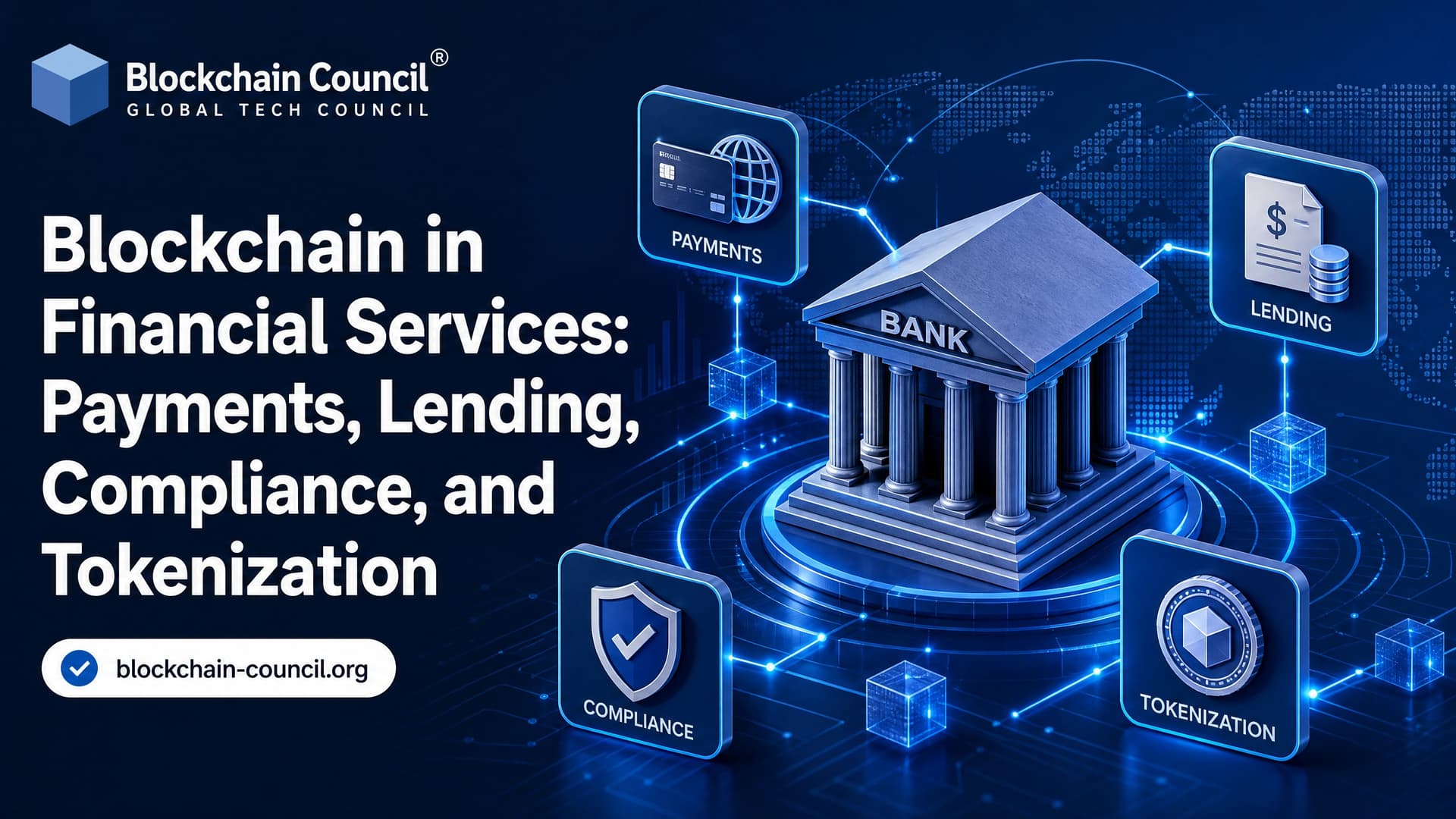
Blockchain in financial services is no longer just a lab project. Banks, fintechs, payment firms, and market infrastructure providers are using distributed ledgers for faster settlement, programmable compliance, syndicated lending workflows, custody, and tokenized assets. The change is uneven, and some claims are overstated. Still, the direction is clear: blockchain is becoming part of regulated financial plumbing.
The strongest use cases share one trait. Multiple parties need the same transaction record, but they do not fully trust each other's internal systems. That is where a shared ledger earns its keep.

Where Blockchain Adoption Stands in Financial Services
Financial institutions have moved past simple proof-of-concept work in several areas. Payments, tokenization, compliance utilities, and custody are now early production domains. Private networks such as R3 Corda and Hyperledger Fabric remain common in regulated settings because they support known participants, access controls, and governance rules.
Public infrastructure is also gaining ground. Financial services firms are increasingly testing permissionless programmable ledgers, not just private ones. That does not mean every bank is ready to settle core deposits on a public chain tomorrow. It does mean public blockchain networks are no longer treated as untouchable.
Academic reviews from 2020 to 2024 point to the same drivers: faster settlement, lower operational risk, better transparency, and improved auditability. The hard parts are familiar to anyone who has worked inside a bank: legacy integration, data privacy, legal finality, and compliance sign-off.
Payments: The Most Mature Blockchain Use Case
Payments are the clearest example of blockchain changing financial services. Cross-border transfers still depend on correspondent banking relationships, multiple ledgers, batch reconciliation, and foreign exchange spreads. That creates delay. It also creates uncertainty for the sender and recipient.
Blockchain-based payment rails can shorten this chain. A payment message, settlement asset, and transaction record can sit on the same network, or at least be synchronized across shared infrastructure. That cuts reconciliation work and reduces the time institutions spend matching records after the fact.
Stablecoins and Tokenized Deposits
Stablecoins have pushed this conversation into the mainstream. Properly supervised payment stablecoins can support near real-time transfer, 24/7 availability, and programmable settlement. In the United States, payment stablecoin rules have focused on full reserve backing and consumer protection. In the European Union, MiCA, the Markets in Crypto-Assets regulation, creates a dedicated framework for stablecoins and other crypto assets.
Tokenized deposits are another route. Instead of moving a privately issued stablecoin, a bank may issue a tokenized representation of a commercial bank deposit. That can preserve existing banking relationships while adding blockchain-based settlement features. For many regulated institutions, this path feels less risky than relying on external stablecoin issuers.
Lending and Credit: Less Noise, Real Workflow Gains
Lending does not get the same headlines as crypto payments, but it may be one of the more practical areas for blockchain adoption. Syndicated loans are a good example. Many lenders share exposure to the same borrower, and each party needs documentation, payment schedules, covenants, KYC evidence, and audit trails.
A shared ledger can coordinate that workflow. Smart contracts can help automate interest calculations, principal repayments, fee distributions, and waterfall payments. Just as useful, the ledger can show which compliance checks have been completed and who approved them.
Do not oversell it. A smart contract does not magically assess credit quality. Banks still need underwriting, collateral review, borrower monitoring, and legal agreements. The useful part is workflow control. You reduce duplicate checks, cut manual reconciliation, and make the loan lifecycle easier to audit.
Hybrid DeFi and Traditional Lending
Decentralized finance introduced transparent collateral pools, automated liquidation logic, and open lending markets. Traditional institutions are watching, but they are not copying DeFi blindly. The likely model is hybrid: DeFi-style programmability with bank-grade identity, risk controls, and regulatory reporting.
If you work in lending technology, learn both sides. Understand overcollateralized lending protocols, but also understand KYC, AML, collateral eligibility, and jurisdictional rules. Blockchain Council's Certified DeFi Expert™ and Certified Blockchain Expert™ give readers a structured way to build that foundation.
Compliance, KYC, and AML: Blockchain as a Control Layer
Compliance is often described as a blocker for blockchain. In finance, it is also one of the strongest reasons to use it.
An immutable, time-stamped ledger gives compliance teams a clearer audit trail. In permissioned networks, only approved participants can transact, and governance rules can map directly to KYC and AML obligations. Shared KYC utilities can also reduce repeated due diligence when several banks deal with the same client.
Regulators are paying close attention. AML failures in fintech and digital asset businesses have already led to multimillion-dollar penalties. Smaller firms are not getting a free pass. Transaction screening, sanctions checks, beneficial ownership records, and suspicious activity monitoring still apply.
Programmable Compliance
Tokenized assets can carry rules inside the asset itself. For example:
- Only whitelisted wallets can hold or receive the token.
- Transfers can be blocked if the buyer is outside an approved jurisdiction.
- Investor eligibility can be checked before settlement.
- Reporting events can be triggered automatically.
This is not theoretical. Developers building regulated token contracts often implement transfer restrictions similar to ERC-1404-style patterns or custom ERC-20 logic. A practical warning: if you are using OpenZeppelin Contracts 5.x, older examples that override _beforeTokenTransfer will break because token hooks were removed in version 5. You now override _update instead. That small version change has caused plenty of failed token compliance builds.
For developers, this is where the Certified Smart Contract Developer™ and Certified Blockchain Developer™ learning paths fit naturally. You need to understand both Solidity mechanics and regulatory design constraints.
Tokenization: Big Potential, Still Early
Tokenization turns rights to an asset into a digital token. That asset might be a bond, fund share, private credit instrument, real estate interest, cash claim, or security. The promise is simple: assets become easier to transfer, settle, fractionally own, and monitor.
Industry forecasts for tokenized assets run into the trillions of dollars over the next decade. Treat those numbers with caution. Forecasts are not adoption. IOSCO has reported that the large majority of surveyed institutions still had nil or very limited commercial tokenization use cases. That gap matters.
My view: tokenization is real, but the near-term winners are not exotic assets. They are bonds, money market funds, repo, private credit, and collateral mobility. These already have institutional demand, legal documentation, and clear economic value from faster settlement.
Why Tokenization Matters for Capital Markets
Tokenized financial instruments can improve:
- Liquidity: Smaller units and broader distribution can widen access, where regulation allows it.
- Settlement speed: Delivery versus payment can happen close to real time.
- Transparency: Ownership and transfer history can be easier to verify.
- Compliance: Eligibility checks and transfer limits can be built into the token.
- Collateral use: Assets can move faster between trading, lending, and margin systems.
The catch is legal enforceability. A token is only useful if it maps cleanly to rights recognized in the relevant jurisdiction. Without that, you have a database entry with a nice interface.
Custody and Safekeeping: The Quiet Infrastructure Shift
Financial institutions cannot scale blockchain services without custody. Someone must control private keys, protect assets, manage recovery, prove ownership, and handle operational risk.
US banking regulators, including the FDIC, Federal Reserve, and OCC, have focused on crypto-asset safekeeping expectations such as cybersecurity, cryptographic key control, contingency planning, subcustodian oversight, and proof of exclusive control. That is sensible. In blockchain, a weak key management process is not a back-office issue. It is a direct asset-loss risk.
Custody is also where many enterprises underestimate complexity. Multi-party computation, hardware security modules, segregation of duties, approval policies, and disaster recovery all matter. A single MetaMask wallet is not institutional custody.
Public vs Permissioned Blockchains in Finance
You should not treat public and permissioned blockchains as enemies. They solve different problems.
- Use permissioned networks for interbank workflows, shared KYC, syndicated lending, and systems where participant identity is mandatory.
- Use public networks when open liquidity, composability, broad token distribution, or transparent settlement is more valuable than closed membership.
- Use neither if a normal database with signed audit logs solves the problem. Blockchain adds cost and governance overhead, so make it earn its place.
That last point matters. A shared ledger is powerful when several institutions need common state. It is wasteful when one company controls all writers, readers, and rules.
What Professionals Should Learn Next
If you work in payments, lending, compliance, or capital markets, blockchain literacy is becoming a practical skill. You do not need to become a protocol engineer, but you should understand settlement finality, smart contract risk, token standards, custody models, AML controls, and regulatory frameworks such as MiCA.
A good learning path looks like this:
- Start with blockchain fundamentals, consensus, wallets, and transaction lifecycle.
- Study payments, stablecoins, and tokenized deposits.
- Learn smart contract basics, especially ERC-20, ERC-721, and permissioned transfer logic.
- Map compliance rules into technical controls such as whitelists, audit trails, and reporting triggers.
- Build a small tokenized bond or loan workflow in a test environment before touching production.
For structured study, consider Blockchain Council's Certified Blockchain Expert™ if you need strategic and business fluency, Certified Blockchain Developer™ if you build systems, and Certified DeFi Expert™ if your work touches lending protocols or tokenized financial products.
The Practical Next Step
Pick one workflow you know well, such as cross-border payment reconciliation, syndicated loan servicing, investor eligibility checks, or collateral transfers. Diagram who writes data, who verifies it, who needs audit access, and where disputes occur. If multiple parties keep separate versions of the same record, blockchain may help. If not, fix the database first.
Then learn the technology deeply enough to challenge vendor claims. That is the real professional edge in blockchain in financial services: knowing when distributed ledgers reduce risk, and when they simply move complexity somewhere harder to see.
Related Articles
View All
Blockchain
Top Blockchain Use Cases in Banks and Financial Services
Explore the top blockchain use cases in banks, from payments and trade finance to tokenization, settlement, lending, KYC, and digital asset services.

Blockchain
Blockchain Infrastructure for Global Financial Systems: Payments, Settlement, CBDCs, and Standards
Blockchain infrastructure is entering core finance through CBDCs, stablecoins, tokenised securities, and regulated settlement systems.

Blockchain
How Blockchain Intelligence Detects Crypto Fraud and Financial Crime
Learn how blockchain intelligence traces illicit crypto funds, scores wallet risk, supports AML compliance, and helps detect scams, hacks, and ransomware.
Trending Articles

Top 5 DeFi Platforms
Explore the leading decentralized finance platforms and what makes each one unique in the evolving DeFi landscape.

Can DeFi 2.0 Bridge the Gap Between Traditional and Decentralized Finance?
The next generation of DeFi protocols aims to connect traditional banking with decentralized finance ecosystems.
Claude AI Tools for Productivity
Discover Claude AI tools for productivity to streamline tasks, manage workflows, and improve efficiency.