

Top Blockchain Use Cases in Banks and Financial Services
 Suyash Raizada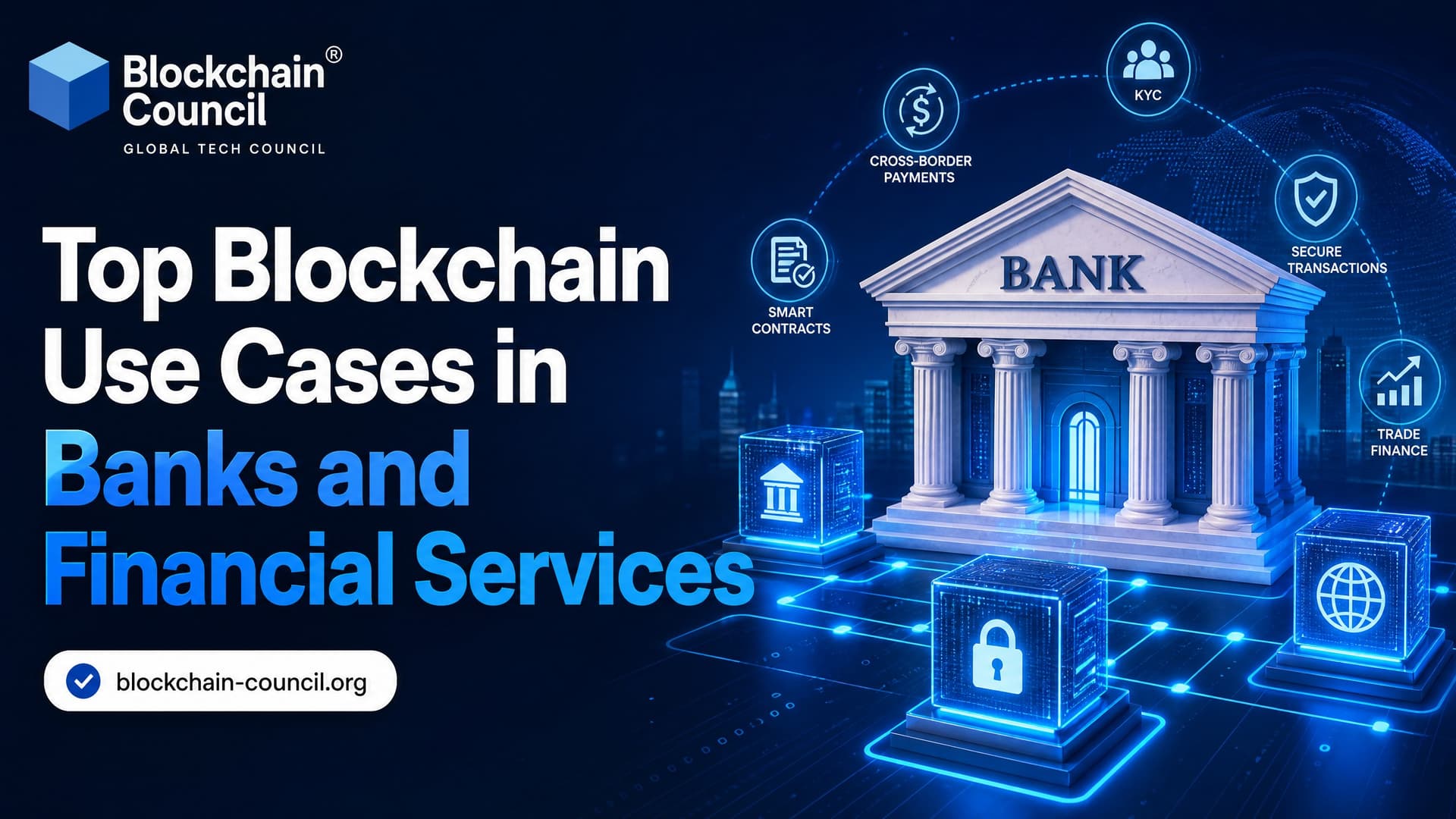
Blockchain use cases in banks are moving from lab projects into payment rails, settlement systems, trade finance workflows, tokenized assets, and regulated digital asset services. The reason is simple. Banking still runs on many duplicated ledgers. Every reconciliation file, failed settlement instruction, and manual document check adds cost. Distributed ledger technology, or DLT, gives approved parties a shared source of truth with programmable rules.
That does not mean every bank process belongs on a blockchain. Payroll does not need a token. A plain internal database will beat DLT for most back-office tasks. But where several institutions need to agree on ownership, payment status, identity, or collateral, blockchain can remove real friction.

For banking professionals exploring this shift, developing Blockchain Expert skills helps in understanding where distributed ledger technology creates genuine business value and where conventional systems remain the better choice.
Why Banks Are Taking Blockchain Seriously
Major banks are past the proof-of-concept stage. JP Morgan, Citi, HSBC, Barclays, Deutsche Bank, BNP Paribas, Santander, Nasdaq, Westpac, and Commonwealth Bank of Australia have all explored or deployed DLT projects across payments, trade finance, securities, custody, and settlement.
The financial case is material. Blockchain-based remittances can cut costs from the traditional 5-10 percent range to roughly 2-3 percent. Juniper Research has forecast that banks could save up to 27 billion USD on cross-border settlement transactions by 2030, a cut of more than 11 percent in that segment. Consensys has reported large cost advantages for Ethereum-based financial applications in selected capital markets and issuance workflows.
The attraction is not only cost. Banks want faster settlement, lower counterparty risk, better auditability, new tokenized products, and new fee income from custody and digital asset services.
Top Blockchain Use Cases in Banks
1. Cross-Border Payments and Remittances
Cross-border payments remain one of the clearest use cases. Traditional international transfers pass through correspondent banks, nostro and vostro accounts, sanctions screening queues, and reconciliation. SWIFT gpi has improved tracking, so it is unfair to call all bank transfers blind or slow. Still, settlement can take days, especially across currencies and time zones.
DLT can support near-real-time settlement, clearer transaction status, and fewer intermediaries. RippleNet is a well-known network used by financial institutions for faster international payments. Westpac worked with Ripple on low-cost cross-border payments, and Commonwealth Bank of Australia explored Ripple-based settlement between subsidiaries.
The trade-off is liquidity. A bank can run the fastest ledger in the world, but if local fiat liquidity is thin, customers still feel delays or pricing problems. That is why serious bank payment projects combine DLT with treasury, FX, compliance, and local banking partnerships.
2. Domestic Clearing and Real-Time Settlement
Domestic interbank payments and securities settlement often depend on batch files, central infrastructure, and after-the-fact reconciliation. Shared ledgers can close those gaps by recording payment obligations and settlement status in the same environment.
Paxos has used blockchain-based infrastructure and USD-backed stablecoin models to settle assets and payments together. JP Morgan's Onyx unit, later brought under the Kinexys branding, has run multi-bank pilots for real-time transactions, including activity in India. These projects point toward payment systems where approved banks settle on shared infrastructure instead of reconciling separate records after the fact.
For developers, one practical detail matters here. Permissioned Ethereum networks such as Hyperledger Besu are sensitive to chain configuration. A chain ID mismatch between a signer and the network triggers the familiar invalid sender error. In a bank setting, that is not a small bug. It can stall settlement testing across institutions until every node, wallet, and transaction signer uses the same genesis configuration.
3. Trade Finance and Supply Chain Documentation
Trade finance is paperwork-heavy. Letters of credit, bills of lading, invoices, inspection certificates, and customs documents move between exporters, importers, banks, insurers, carriers, and ports. Fraud and discrepancies are common because the parties rarely see the same document version.
Blockchain helps by creating shared document registries, time-stamped events, and smart-contract workflows for conditional payment. HSBC has been widely recognized for its trade finance work. Barclays and Irish exporter Ornua completed a widely cited blockchain-based trade transaction involving a letter of credit. IBM and Maersk's TradeLens showed how shipping events and documents could be digitized on shared infrastructure, though the project later shut down. The lesson holds: technology is not enough. Network adoption decides whether trade finance platforms survive.
For banks, this is one of the best fits for DLT because the process is multi-party, slow, and document-intensive. A private database owned by one bank will not solve the trust problem across a whole trade network.
4. Securities Issuance, Trading, and Post-Trade Processing
Capital markets are full of duplicated records. Issuers, brokers, custodians, clearing houses, transfer agents, and regulators all keep versions of the same facts. DLT can record issuance, ownership transfer, corporate actions, and settlement events on one shared ledger.
Consensys identifies issuance, sales and trading, clearing and settlement, post-trade services, asset servicing, and custody as major blockchain opportunities in capital markets. Nasdaq has explored DLT for its Private Market platform, including ownership records and transaction updates for private securities.
The strong case is private markets first. Public equities already have mature infrastructure, strict rules, and deep liquidity. Private shares, private credit, fund interests, and bonds have more room to improve because settlement and transfer workflows are still slow and manual.
5. Asset Tokenization and Digital Asset Services
Tokenization converts rights in an asset into blockchain-based tokens. Those assets can include bonds, deposits, fund units, invoices, commodities, real estate interests, or carbon credits. Tokenization enables fractional ownership, programmable transfer restrictions, automated coupon payments, and faster settlement.
JP Morgan's JPM Coin system, programmable payments, and deposit token work show how banks can represent money-like instruments on ledgers for corporate treasury and interbank use. Stablecoins, tokenized fiat, and deposit tokens are becoming important parts of institutional payment design.
There is a catch. Tokenizing a bad asset does not make it a good one. If legal ownership, custody, pricing, and redemption rights are unclear, the token is only a digital wrapper around confusion. Banks have an edge here because they already operate under custody, capital, and compliance rules. That makes them natural providers of regulated tokenization, custody, and settlement services.
6. Lending, Collateral, and Credit Workflows
Lending is another use case, though mainstream adoption is still early. DLT can support loan syndication, collateral registries, underwriting records, disbursement tracking, and automated covenant checks.
Consensys lists credit scoring, loan syndication, underwriting, disbursement, and collateralization among financial services use cases. Crypto lending platforms such as BlockFi showed how on-chain collateral and automated liquidation could work, and their failures proved why risk management, custody segregation, and regulatory controls matter.
The best near-term bank use case is not fully automated retail lending. It is syndicated lending and collateral management, where multiple lenders, agents, and borrowers need a shared view of loan terms, commitments, drawdowns, and pledged assets.
7. KYC, AML, and Regulatory Reporting
KYC and AML checks are expensive because each institution repeats similar work. Shared identity registries and verifiable credentials can cut that duplication while protecting privacy. Blockchain can also provide tamper-evident audit logs for regulatory reporting, post-trade records, and risk controls.
Analysts point to blockchain's potential to reduce compliance costs, improve security, and support transparent record-keeping. KYC, AML, risk management, and regulatory reporting come up again and again as areas of banking interest.
This is promising but hard. Banks will not share sensitive customer data casually. Any useful KYC network needs strong privacy controls, consent management, data minimization, and clear liability rules for when a verified credential turns out to be wrong.
8. Financial Inclusion and Alternative Banking Models
Blockchain can also support low-cost remittances, mobile wallets, peer-to-peer payments, savings tools, and microcredit for underbanked communities. Uulala, for instance, has used blockchain concepts for peer-to-peer banking services aimed at unbanked and underbanked users.
For banks, the opportunity is not to ignore regulation and copy unlicensed DeFi apps. The better path combines mobile access, low transaction fees, digital identity, and compliant settlement rails. That expands access without removing consumer protection.
Permissioned DLT or Public Blockchain?
Most banks prefer permissioned DLT for regulated workflows because they need privacy, access controls, known validators, and predictable governance. Hyperledger Fabric, R3 Corda, and Hyperledger Besu are common enterprise choices.
Public chains such as Ethereum matter too, especially for tokenized assets, stablecoins, and interoperability with wider digital asset markets. Ethereum mainnet uses chain ID 1, runs on Proof of Stake, and supports standards such as ERC-20 for fungible tokens and ERC-721 for non-fungible tokens. Solidity 0.8.x includes built-in overflow checks, which is why older SafeMath patterns are less necessary for new contracts.
My view: use permissioned ledgers for regulated interbank processes with sensitive data. Use public networks when market access, liquidity, and open composability are the goal. Do not force one architecture onto every banking problem.
As financial institutions expand blockchain initiatives, professionals with hands-on implementation experience supported by a recognized Tech Certification are often better prepared to work across enterprise blockchain, digital payments, and regulated financial infrastructure projects.
What Comes Next for Banks
By 2030, the strongest use cases will likely be cross-border settlement, tokenized deposits, private market securities, trade finance digitization, and regulated custody. The weaker ideas will fade, especially projects that use blockchain where a normal database is cheaper, faster, and easier to govern.
Four dependencies will decide adoption:
Regulatory clarity for stablecoins, deposit tokens, digital securities, and custody.
Interoperability between DLT platforms, ISO 20022 messaging, and legacy banking systems.
Privacy design that satisfies banks, regulators, and customers.
Network participation, because a shared ledger has little value if only one party uses it.
How to Build Expertise in Banking Blockchain
If you work in payments, compliance, treasury, capital markets, or bank technology, start with the use case closest to your daily work. Map the parties, assets, settlement events, and trust gaps. Then decide whether DLT actually improves the workflow.
For structured learning, Blockchain Council's Certified Blockchain Expert™ is a solid foundation for professionals who need to understand DLT strategy and banking applications. Developers building smart contracts or tokenized assets can look at Certified Blockchain Developer™ and Certified Smart Contract Developer™. Architects designing enterprise systems should consider Certified Blockchain Architect™. Then build a small tokenized bond or payment settlement prototype. You will learn more from one failed testnet deployment than from ten slide decks.
Beyond technical implementation, successful blockchain adoption in banking also depends on communicating new financial products, digital asset services, and customer value effectively. A Marketing Certification can help professionals strengthen product positioning, customer education, and go-to-market strategies as blockchain-based banking services continue to evolve.
FAQs
1. What Is Blockchain in Banking?
Blockchain in banking refers to the use of distributed ledger technology (DLT) to improve financial services by enhancing transparency, security, efficiency, and record-keeping. Banks may use public, private, or permissioned blockchain networks depending on their requirements.
2. Why Are Banks Exploring Blockchain?
Banks are evaluating blockchain to streamline processes, reduce settlement times, improve transaction traceability, strengthen security, automate workflows, and support new financial products.
3. How Does Blockchain Improve Cross-Border Payments?
Blockchain can reduce the number of intermediaries involved in international transfers, helping speed up settlement, improve transparency, and lower operational costs in some payment systems.
4. Can Blockchain Help Prevent Financial Fraud?
Yes. Blockchain's immutable transaction records and cryptographic security can help improve auditability and detect suspicious activity. However, it does not eliminate fraud entirely and must be combined with compliance and fraud detection systems.
5. How Is Blockchain Used for Digital Identity Verification?
Banks can use blockchain-based digital identity solutions to simplify customer verification, reduce duplicate identity checks, and give customers more control over their identity information, depending on the implementation.
6. What Role Does Blockchain Play in Trade Finance?
Blockchain can digitize trade finance processes by improving document sharing, increasing transparency, reducing paperwork, and automating transactions through smart contracts.
7. How Can Smart Contracts Benefit Financial Services?
Smart contracts can automate agreements such as loan processing, insurance claims, trade settlements, and payment execution when predefined conditions are met.
8. Can Blockchain Improve Securities Settlement?
Yes. Blockchain has the potential to streamline clearing and settlement processes by providing a shared ledger that reduces reconciliation efforts and shortens settlement times in some use cases.
9. How Is Blockchain Used in Asset Tokenization?
Blockchain enables the creation of digital tokens representing real-world assets such as real estate, bonds, equities, or commodities, potentially improving liquidity and fractional ownership opportunities.
10. How Does Blockchain Support Regulatory Compliance?
Blockchain can provide transparent and tamper-resistant records that assist with auditing, reporting, and regulatory oversight. It complements rather than replaces existing compliance frameworks.
11. Can Blockchain Improve Know Your Customer (KYC) Processes?
Yes. Shared KYC frameworks built on blockchain may reduce repetitive identity verification across institutions while maintaining appropriate privacy and regulatory controls.
12. How Is Blockchain Used in Anti-Money Laundering (AML)?
Blockchain analytics tools can help financial institutions monitor blockchain transactions, identify suspicious patterns, and support AML investigations alongside traditional compliance systems.
13. What Are the Benefits of Blockchain for Banks?
Potential benefits include:
Faster settlement
Improved transparency
Enhanced security
Reduced reconciliation
Better audit trails
Operational efficiency
Increased automation
Lower processing costs in some workflows
14. What Challenges Do Banks Face When Adopting Blockchain?
Challenges include regulatory compliance, interoperability, integration with legacy systems, scalability, privacy requirements, governance, cybersecurity, and implementation costs.
15. Which Blockchain Networks Do Financial Institutions Use?
Depending on their needs, institutions may use permissioned blockchain platforms such as Hyperledger Fabric, R3 Corda, and Quorum, or public blockchain networks for selected applications.
16. Can Central Bank Digital Currencies (CBDCs) Use Blockchain?
Some CBDC projects explore blockchain or other forms of distributed ledger technology, while others use centralized architectures. There is no single technical approach adopted by all central banks.
17. What Skills Are Needed for Blockchain Banking Careers?
Professionals benefit from knowledge of:
Blockchain technology
Financial systems
Smart contracts
Cybersecurity
Cryptography
Regulatory compliance
Risk management
Data analytics
Enterprise architecture
18. What Common Misconceptions Exist About Blockchain in Banking?
Common misconceptions include:
Blockchain will replace banks entirely.
Every banking process requires blockchain.
Blockchain transactions are always anonymous.
Blockchain alone guarantees regulatory compliance or security.
19. How Should Banks Evaluate Blockchain Projects?
Banks should identify clear business problems, assess regulatory requirements, evaluate integration with existing systems, measure expected return on investment, and conduct pilot projects before large-scale deployment. Deploying blockchain without a well-defined use case is a remarkably expensive way to acquire another IT project.
20. What Is the Future of Blockchain in Financial Services?
Blockchain is expected to play an increasing role in payments, asset tokenization, trade finance, digital identity, securities settlement, and financial infrastructure modernization. Adoption is likely to be gradual, with many institutions combining blockchain with existing banking systems rather than replacing them outright. Organizations that focus on practical use cases, strong governance, and regulatory compliance will be better positioned to realize long-term value from distributed ledger technologies.
Related Articles
View All
Blockchain
Blockchain in Banks: Use Cases, Benefits, Risks, and the AI Connection
Explore how blockchain in banks is reshaping payments, trade finance, tokenized deposits, KYC, AML, and AI-driven risk workflows.

Blockchain
Blockchain Train Technology: Rail Use Cases, Benefits, and Limits
Blockchain train technology is moving from pilots to practical rail use cases in freight, ticketing, asset records, IoT security, and audit trails.

Blockchain
Blockchain in Banking and Finance: Use Cases, Benefits, and Future Trends
Explore blockchain in banking and finance, including payments, tokenization, custody, lending, trade finance, compliance, benefits, and future trends.
Trending Articles
The Role of Blockchain in Ethical AI Development
How blockchain technology is being used to promote transparency and accountability in artificial intelligence systems.
How Blockchain Secures AI Data
Understand how blockchain technology is being applied to protect the integrity and security of AI training data.
Claude AI Tools for Productivity
Discover Claude AI tools for productivity to streamline tasks, manage workflows, and improve efficiency.