

Blockchain Byzantine Fault Tolerance Systems: How BFT Keeps Ledgers Honest

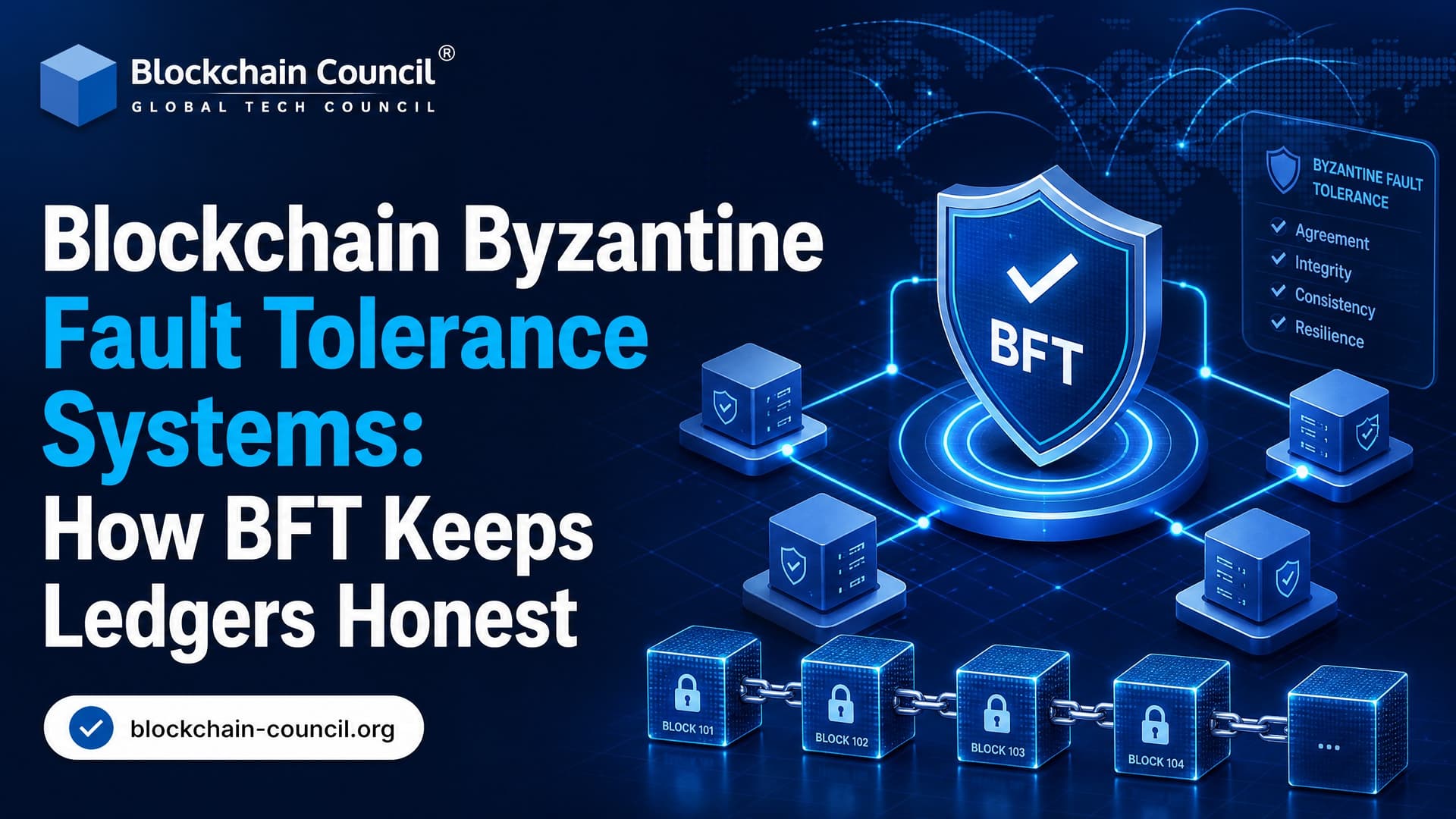
Blockchain Byzantine Fault Tolerance Systems are the consensus methods that let a blockchain keep producing correct results even when some validators fail, lie, or send conflicting messages. That sounds abstract until you run a validator and watch a peer broadcast a bad block proposal. The network has to reject it without stopping. That is the job of Byzantine Fault Tolerance, usually called BFT.
Put simply, BFT helps honest nodes agree on one ledger state. It is one of the reasons a blockchain can prevent double spending, finalize blocks, and keep running when a minority of participants behave badly. BFT is a core requirement for any secure distributed system, not just a blockchain feature.

What Byzantine Fault Tolerance Means in Blockchain
The term comes from the Byzantine Generals' Problem, a classic distributed systems puzzle about reaching agreement when some participants may be unreliable or malicious. In a blockchain, the generals are validators, miners, or other consensus participants.
A BFT blockchain must satisfy two core properties:
- Safety: honest nodes do not finalize conflicting ledger states.
- Liveness: the network keeps making progress as long as network conditions and fault assumptions stay within the protocol's limits.
Most classical BFT systems use the 3f + 1 model. If a protocol has n validators, it can usually tolerate f Byzantine validators only when n is at least 3f + 1. Plainly, fewer than one third of validators can be faulty or malicious. To finalize a block, the network typically needs agreement from at least two thirds of validators, or two thirds of voting power in stake-weighted systems.
This one-third threshold is not a marketing number. It is a hard design constraint. If you are assessing a permissioned chain with four validators, it can tolerate exactly one Byzantine validator. With seven validators, it can tolerate two. Small validator sets are fast, but they concentrate trust. Do not ignore that trade-off.
How Blockchain Byzantine Fault Tolerance Systems Work
Most BFT blockchain protocols follow a recognizable flow, even when the names vary across implementations.
- Leader election: a validator is selected to propose the next block. Some systems rotate the leader to reduce censorship risk.
- Block proposal: the leader collects transactions and broadcasts a proposed block.
- Voting: validators check the proposal and exchange votes. Many protocols use pre-vote and pre-commit phases.
- Finality: when enough commit votes are observed, usually two thirds or more, honest nodes finalize the block.
Practical Byzantine Fault Tolerance, or PBFT, is the classic reference point. Modern systems often borrow the same basic idea but change the message flow, validator selection, signature aggregation, or view-change process. NEO, for example, uses a BFT-style model in which a speaker proposes blocks and delegates validate them. Consensus is reached when more than two thirds agree.
If you have worked with CometBFT or older Tendermint-based networks, this pattern feels familiar. A common beginner mistake is copying an old genesis.json or reusing a validator key from a testnet. The node may connect to peers but refuse to participate correctly because the genesis hash or validator identity does not match expectations. Worse, reusing priv_validator_key.json across active nodes can produce double-sign evidence and get you slashed. BFT systems are strict for a reason.
Why BFT Matters for Blockchain Security
BFT is what helps a blockchain distinguish valid history from false history. Without it, a malicious group could push conflicting blocks, reorder transactions, or back a double spend.
Byzantine fault tolerance is the property that lets a decentralized network reject false information. The point is not that distributed systems eliminate every fault. They cannot. The goal is to keep operating safely when faults occur.
For blockchains, this matters in several practical ways:
- Double-spend protection: finalized blocks should not be reversed by a minority of attackers.
- Transaction validity: validators must reject invalid state transitions.
- Network continuity: honest validators should keep the chain moving despite outages or malicious peers.
- Auditability: deterministic finality gives enterprises and financial systems a clear settlement point.
BFT in Proof of Stake, Permissioned Chains, and Oracles
Proof of stake networks
Many proof of stake systems are Byzantine fault tolerant by design. Validators vote with stake-weighted power, and the protocol finalizes blocks only when a supermajority agrees. The exact details differ. Some chains use explicit BFT finality. Others combine probabilistic block production with a finality gadget, which is roughly how Ethereum's Gasper works.
Proof of stake is not automatically safe just because it uses validators. You still need well-designed slashing rules, reliable validator operations, clear key management, and protection against long-range or equivocation attacks. The consensus math helps, but operations decide whether the system survives real incidents.
Permissioned and consortium blockchains
Permissioned networks often use explicit BFT protocols because the validator set is known. This is common in enterprise consortia, settlement networks, and regulated environments where participants value predictable finality over open validator access.
Here is the trade-off: permissioned BFT networks can be fast, but governance becomes part of the security model. Who adds validators? Who removes them? What happens if two consortium members merge? These questions are not secondary. They define the real trust boundary.
Decentralized oracle networks
BFT concepts also apply outside base-layer block production. Decentralized oracle networks use BFT-style approaches to aggregate off-chain data, such as asset prices, so that a few faulty or malicious oracle nodes cannot corrupt the value delivered to smart contracts.
This is a good example of BFT moving from ledger consensus to data integrity. Smart contracts do not only need correct transaction ordering. They also need trustworthy external inputs.
Performance: Fast Finality With a Cost
BFT systems are attractive because they can provide immediate or near-immediate finality. Once a block receives the required commit votes, it is final under the protocol's assumptions. There is no need to wait for many probabilistic confirmations, as you do in traditional proof of work designs.
They can also process high transaction volumes in controlled validator environments. BFT mechanisms can support thousands of transactions per second, especially where validator counts are limited.
But there is a catch. Classical BFT protocols often have communication overhead that grows roughly with the square of the validator count. If every validator must exchange votes with every other validator, adding validators increases network chatter fast.
That is why many BFT networks keep validator sets smaller than large public proof of work networks. It is not laziness. It is bandwidth and latency. Larger validator sets improve decentralization, but they can slow finality unless the protocol uses committees, signature aggregation, pipelining, or other optimizations.
Current Research: Scalability and Quantum-Safe BFT
Research on Blockchain Byzantine Fault Tolerance Systems is active because the old trade-offs have not gone away. Engineers want larger validator sets, lower latency, and stronger security under messy network conditions.
Better communication patterns
New BFT designs try to reduce message complexity, improve leader rotation, and recover faster from a bad leader. View-change logic is often where systems get ugly in production. A happy-path benchmark can look great, then stall when the proposer goes offline or the network has uneven latency.
Quantum-safe consensus
Recent IEEE research has explored quantum-safe Byzantine Fault Tolerance consensus for blockchain applications. The concern is not that quantum computers break BFT voting itself. The concern is that validator authentication, digital signatures, and related cryptographic assumptions may need post-quantum replacements over time.
For long-lived infrastructure, this matters. A central bank pilot, a land registry, or an institutional settlement layer may need to stay verifiable for decades. Post-quantum signatures and quantum-aware consensus design are becoming part of that planning.
New BFT algorithms
Recent academic work has also proposed new BFT algorithms aimed at improving agreement on blockchain state under Byzantine faults. Not every paper becomes production software. Still, these proposals show where the pressure is: faster agreement, fewer messages, and better behavior when networks are not clean.
Where BFT Is the Right Choice, and Where It Is Not
Use BFT-style consensus when you need deterministic finality, known validators, low settlement latency, or strong audit requirements. Enterprise networks, financial consortia, oracle networks, sidechains, and some app-specific chains fit that profile.
Be careful with BFT if your main goal is maximum open participation. A protocol that performs well with 50 validators may struggle with 5,000 unless it uses sampling, committees, or another scaling method. To be blunt, calling a small-validator chain decentralized without explaining the validator governance is poor engineering communication.
For enterprises evaluating blockchain systems, ask these questions before choosing a BFT-based design:
- How many Byzantine validators can the system tolerate?
- Is voting based on identity, equal validator weight, or stake?
- What happens when the leader fails?
- How are validator keys stored and rotated?
- Can the network recover from partitions without finalizing conflicting blocks?
- Who controls validator admission and removal?
Skills Professionals Need to Work With BFT Systems
If you are a developer, do not stop at the whitepaper. Run a local network. Break it. Kill the proposer. Change the genesis file on one node. Watch what happens when two validators sign conflicting messages. Those exercises teach more than any diagram.
For a structured path, Blockchain Council's Certified Blockchain Expert is a useful starting point for consensus concepts, blockchain architecture, and security fundamentals. Developers who want to build and test blockchain applications can pair it with Certified Blockchain Developer. If your work touches Solidity contracts and on-chain settlement logic, Certified Smart Contract Developer is also relevant.
The practical goal is simple: you should be able to read a consensus design and identify its fault threshold, finality rule, validator assumptions, and failure modes. That is the difference between repeating BFT terminology and actually evaluating a blockchain network.
Next Step
Pick one BFT-based network or framework and inspect its consensus documentation this week. Identify the validator threshold, voting phases, finality rule, and key-management requirements. Then build a small testnet and intentionally break one validator. If you want a guided foundation before doing that, start with Blockchain Council's Certified Blockchain Expert and move into developer-focused training once the consensus model is clear.
Related Articles
View All
Blockchain
How Blockchain Was Introduced: Bitcoin and the Birth of Decentralized Ledgers
Learn how blockchain was introduced through Bitcoin, from timestamping research and digital cash to proof-of-work, mining, and decentralized ledgers.

Blockchain
Blockchain Infrastructure for Global Financial Systems: Payments, Settlement, CBDCs, and Standards
Blockchain infrastructure is entering core finance through CBDCs, stablecoins, tokenised securities, and regulated settlement systems.

Blockchain
Blockchain Distributed Systems Engineering: A Practical Guide
Learn how Blockchain Distributed Systems Engineering combines consensus, fault tolerance, smart contracts, security, and software process for real-world systems.
Trending Articles
AWS Career Roadmap
A step-by-step guide to building a successful career in Amazon Web Services cloud computing.

Top 5 DeFi Platforms
Explore the leading decentralized finance platforms and what makes each one unique in the evolving DeFi landscape.
What is AWS? A Beginner's Guide to Cloud Computing
Everything you need to know about Amazon Web Services, cloud computing fundamentals, and career opportunities.