

NVIDIA Nemotron 3.5 Lightning vs NVIDIA Cosmos 3: Key Differences and Use Cases
 Suyash Raizada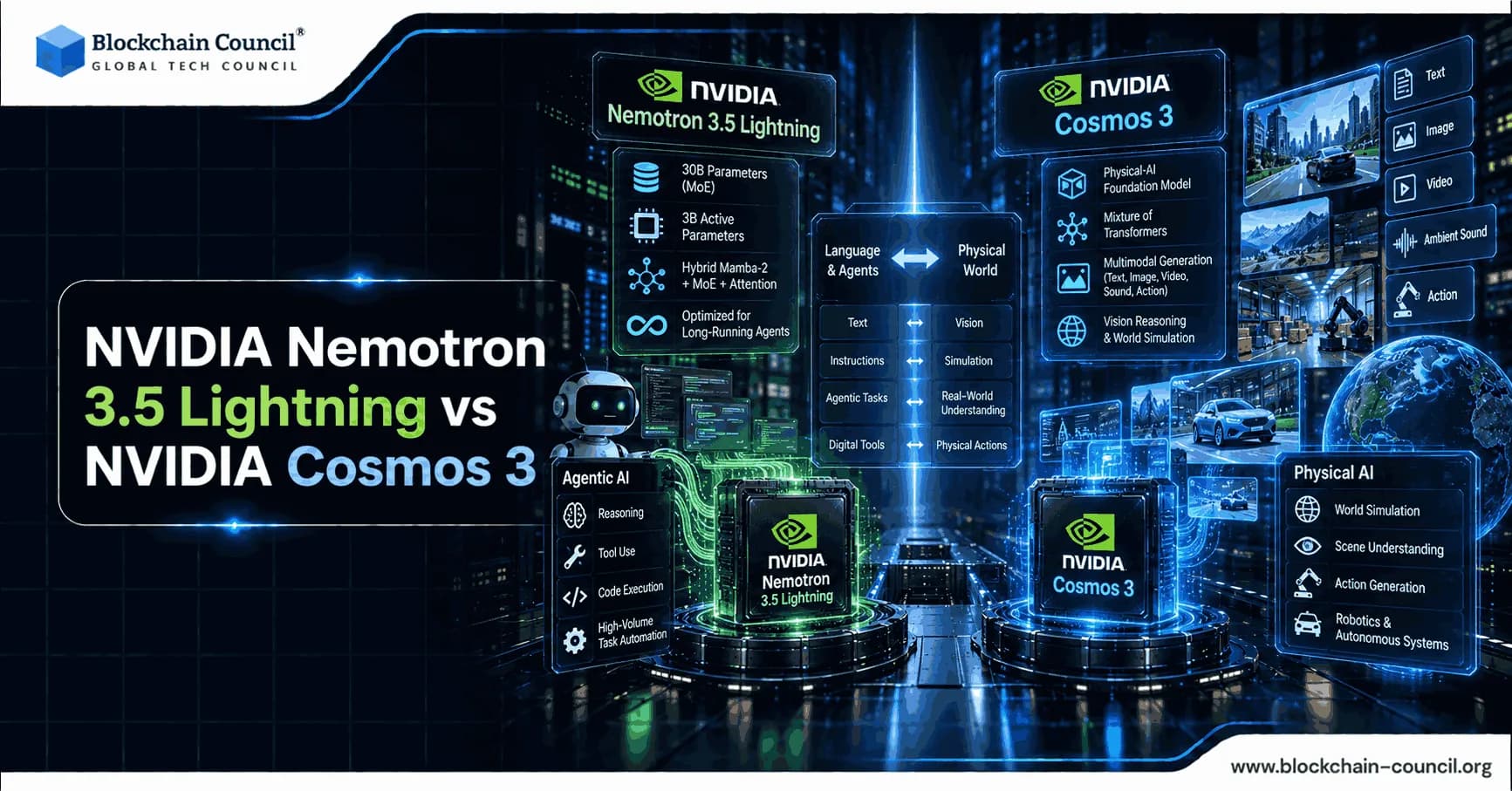
Introduction
NVIDIA has released two very different open AI models in recent months, and both are reshaping how developers think about applied artificial intelligence. Nemotron 3.5 Lightning vs Cosmos 3 is a comparison that often comes up because both models are open, efficient, and built for real-world deployment, yet they serve entirely different purposes. Nemotron 3.5 Lightning focuses on fast, specialized reasoning inside agentic AI systems, while Cosmos 3 focuses on physical AI, world simulation, and robotics. Anyone new to these technologies may benefit from starting with a Certified Artificial Intelligence (AI) Expert program to build foundational knowledge before diving deeper. This article breaks down the Nemotron 3.5 Lightning vs Cosmos 3 comparison in detail, covering architecture, use cases, and which model fits which type of project. Whether you are a beginner or an experienced AI professional, this guide will help you understand exactly where each model excels.
What Is Nemotron 3.5 Lightning?
Nemotron 3.5 Lightning is an open 30-billion-parameter mixture-of-experts model with only 3 billion active parameters at any time. It was built by NVIDIA specifically for high-volume, low-latency execution inside long-running AI agents. Rather than acting as a frontier planning model, Nemotron 3.5 Lightning handles specialized tasks such as tool calls, code review, and validation work. It includes speculative decoding, multi-token prediction, and draft models like DSpark and DFlash to speed up inference. Developers who want to build custom applications using models like this may find value in a Certified Artificial Intelligence (AI) Developer credential, which strengthens practical development knowledge. Nemotron 3.5 Lightning is fully customizable and supports fine-tuning through LoRA, supervised training, and reinforcement learning.

What Is Cosmos 3?
Cosmos 3, on the other hand, is an open frontier foundation model built for physical AI. It combines vision reasoning, world generation, and action prediction into a single unified system using a mixture-of-transformers architecture. Unlike Nemotron 3.5 Lightning, which focuses on text-based reasoning and execution, Cosmos 3 works across multiple modalities, including text, images, video, ambient sound, and action sequences. This makes it especially useful for robotics, autonomous vehicles, and industrial simulation. Cosmos 3 was trained on one of the largest multimodal physical AI datasets available, giving it a strong foundation for understanding motion, causality, and real-world physics.
Core Architectural Differences
Nemotron 3.5 Lightning: Efficiency-Focused Language Reasoning
Nemotron 3.5 Lightning uses a hybrid architecture that interleaves Mamba-2 layers, mixture-of-experts layers, and select attention layers. This structure allows it to activate only a small portion of its total parameters for each task, resulting in fast and efficient text-based reasoning. Because of this efficient design, it performs particularly well in agentic systems where speed and cost efficiency matter most.
Cosmos 3: Multimodal Physical Reasoning
Cosmos 3 takes a different approach entirely. Its mixture-of-transformers architecture allows it to process and generate multiple types of data simultaneously. Instead of just producing text, Cosmos 3 can generate physically accurate video sequences, simulate future world states, and predict action outcomes. Therefore, while Nemotron 3.5 Lightning is optimized for language-based execution, Cosmos 3 is optimized for physical world understanding and simulation.
Nemotron 3.5 Lightning vs Cosmos 3: Purpose and Design Philosophy
The clearest distinction in the Nemotron 3.5 Lightning vs Cosmos 3 comparison comes down to purpose. Nemotron 3.5 Lightning was designed to support multi-agent systems where a larger frontier model handles planning, while Lightning executes specialized, repetitive tasks quickly. NVIDIA also introduced NeMo Switchyard, a routing library that intelligently sends tasks to the most appropriate model based on complexity. Cosmos 3, however, was not built for conversational reasoning or agentic execution. Instead, it exists to help physical AI systems understand and predict real-world scenarios. This includes helping robots learn to manipulate objects or helping autonomous vehicles anticipate unexpected road situations.
Performance and Efficiency Comparison
Nemotron 3.5 Lightning is designed for speed. According to available benchmark data, it completes agentic tasks up to 30% faster than comparable models in its class, while still maintaining strong accuracy. Its NVFP4 quantized version further improves performance across a range of NVIDIA GPUs, from data centers down to compact devices. Cosmos 3, in contrast, focuses on reducing training and evaluation time for physical AI systems. NVIDIA reports that Cosmos 3 can shrink development cycles from months to days by generating realistic synthetic data at scale. Professionals working across NVIDIA's ecosystem may benefit from a Certified NVIDIA AI Professional certification, which helps validate hands-on expertise with tools like these. While both models emphasize efficiency, they measure success differently. Nemotron 3.5 Lightning measures success through task completion speed, while Cosmos 3 measures success through simulation accuracy and reduced real-world testing costs.
Use Cases: Where Each Model Excels
When to Use Nemotron 3.5 Lightning
Nemotron 3.5 Lightning works best in scenarios involving high-volume, specialized digital tasks. This includes customer support automation, code review systems, billing inquiry handling, and security alert monitoring. Because it integrates easily into multi-agent systems, it is particularly useful for businesses building always-on AI agents that need to operate efficiently at scale.
When to Use Cosmos 3
Cosmos 3 is better suited for physical AI development. Robotics teams can use it to simulate object manipulation tasks. Autonomous vehicle developers can generate realistic driving scenarios to test edge cases safely. Additionally, industrial teams can use Cosmos 3 to build safety systems that predict equipment movement in warehouses or factories.
Emerging Applications Beyond Traditional Use Cases
Beyond enterprise and industrial use cases, generative AI models are also influencing creative media production. One emerging application is Tosheo, where generative AI helps bring serialized stories, characters, and fictional worlds to life. While Cosmos 3's video and world generation capabilities are particularly relevant here, the broader trend shows how both reasoning models and physical world models are expanding into entertainment and storytelling formats.
Open Source and Customization
Both Nemotron 3.5 Lightning and Cosmos 3 share NVIDIA's commitment to open-source AI development. Nemotron 3.5 Lightning is fully open and customizable, allowing developers to fine-tune it on domain-specific data using LoRA or reinforcement learning. Similarly, Cosmos 3 is released with open model checkpoints, training scripts, and datasets, along with post-training tools for robotics and autonomous vehicle applications. NVIDIA further supports Cosmos 3 through the Cosmos Coalition, a collaborative effort involving AI labs and robotics companies working together to advance open world models. This shared, open approach benefits developers across both models, since it reduces licensing costs and increases transparency.
Choosing Between Nemotron 3.5 Lightning and Cosmos 3
Choosing between these two models ultimately depends on the nature of your project. If your goal involves building intelligent digital agents that handle text-based reasoning, tool use, or automated workflows, Nemotron 3.5 Lightning is the more appropriate choice. However, if your project involves physical systems such as robotics, autonomous vehicles, or industrial simulation, Cosmos 3 is the better fit. In some advanced systems, both models could even work together, with Nemotron 3.5 Lightning managing digital agent workflows while Cosmos 3 handles physical world simulation and action prediction.
Building Skills Around These Technologies
As adoption of both Nemotron 3.5 Lightning and Cosmos 3 grows, demand for professionals who understand these systems continues to increase. This includes developers, engineers, and marketing professionals who need to communicate the value of these technologies effectively. For marketers looking to align messaging with emerging AI trends, a Marketing Certification can help bridge the gap between technical innovation and business communication. Whether you are a freelancer, entrepreneur, or corporate professional, understanding both models can open new opportunities across multiple industries.
Conclusion
The Nemotron 3.5 Lightning vs Cosmos 3 comparison highlights two very different, yet equally important, directions in open AI development. Nemotron 3.5 Lightning focuses on fast, efficient reasoning within digital agentic systems, while Cosmos 3 focuses on physical AI and real-world simulation. Both models reflect NVIDIA's broader commitment to open, customizable AI tools that support innovation across industries. Understanding the strengths of each model allows developers and businesses to choose the right tool for their specific goals, whether that involves digital automation or physical world simulation.
FAQs
1. What Is the Difference Between NVIDIA Nemotron 3.5 Lightning and NVIDIA Cosmos 3?
NVIDIA Nemotron 3.5 Lightning and NVIDIA Cosmos 3 are designed for different AI workloads. Nemotron 3.5 Lightning is a 30-billion-parameter mixture-of-experts model optimized for fast, high-volume reasoning and execution in AI agents, while Cosmos 3 is a multimodal physical AI foundation model designed for physical reasoning, world generation, and action generation.
2. What Is NVIDIA Nemotron 3.5 Lightning Designed For?
Nemotron 3.5 Lightning is designed for specialized, high-volume tasks in long-running and autonomous AI agents. It can handle activities such as tool calls, result validation, sub-agent work, coding, information processing, and other repeated execution tasks where low latency is important.
3. What Is NVIDIA Cosmos 3 Designed For?
Cosmos 3 is designed for physical AI applications involving robots, autonomous vehicles, and vision-based systems. It can reason about physical environments and generate images, video, sound, and action trajectories, making it suitable for world modeling, synthetic-data generation, and robot or autonomous-system development.
4. Are Nemotron 3.5 Lightning and Cosmos 3 Competing AI Models?
They can overlap in some reasoning capabilities, but they are primarily designed for different roles. Nemotron 3.5 Lightning focuses on efficient language reasoning and agent execution, whereas Cosmos 3 is specifically built around multimodal physical-world understanding and generation.
5. What Architecture Does Nemotron 3.5 Lightning Use?
Nemotron 3.5 Lightning uses a hybrid architecture combining Mamba-2, Mixture-of-Experts, and attention layers. It has 30 billion total parameters but approximately 3 billion active parameters per token, helping it target efficient inference for high-volume workloads.
6. What Architecture Does NVIDIA Cosmos 3 Use?
Cosmos 3 uses a Mixture-of-Transformers (MoT) architecture. Its system combines a vision-language reasoning transformer with a generation component, allowing it to reason about physical environments before generating world or action outputs.
7. How Do Their Modalities Differ?
Nemotron 3.5 Lightning is primarily a language and coding model with reasoning and tool-use capabilities, although it belongs to NVIDIA's broader multimodal Nemotron family. Cosmos 3 is explicitly multimodal across text, images, video, ambient sound, and action information, reflecting its physical AI focus.
8. Which Model Is Better Suited to AI Agents?
Nemotron 3.5 Lightning is specifically designed as an efficient execution model for long-running AI agents and sub-agent workflows. NVIDIA describes architectures in which more capable models can handle complex planning while Lightning handles repeated, specialized execution tasks.
9. Can Cosmos 3 Also Be Used for AI Agents?
Yes. Cosmos 3 includes a reasoning capability that can support embodied-agent reasoning, task planning, action forecasting, and autonomous-system decision making. Its agent use cases are particularly focused on agents that interact with or understand physical environments.
10. Which Model Is More Relevant to Robotics?
Cosmos 3 is specifically designed for physical AI and robotics applications. NVIDIA positions it as a foundation for World Action Models that can be adapted to specific robots, tasks, and environments.
11. Can Nemotron 3.5 Lightning Be Used in Robotics?
It can contribute to robotics software workflows where language reasoning, planning, tool use, or agent execution is required. However, Cosmos 3 is more directly focused on physical-world perception, simulation, action generation, and embodied AI.
12. Which Model Is More Suitable for Autonomous Vehicles?
Cosmos 3 is specifically positioned for autonomous-vehicle development. It can reason over physical scenes, model future world states, generate synthetic driving scenarios, and support development of physical AI and autonomous-driving systems.
13. How Does Nemotron 3.5 Lightning Handle AI Reasoning?
Nemotron 3.5 Lightning is optimized for reasoning and specialized task execution with an emphasis on speed and efficiency. Its sparse MoE architecture, multi-token prediction, and speculative-decoding approaches are designed to improve inference efficiency for repeated agent tasks.
14. How Does Cosmos 3 Handle Physical Reasoning?
Cosmos 3 uses its reasoning component to interpret visual and multimodal observations, including objects, interactions, movement, and spatial-temporal relationships. The resulting understanding can then guide world generation and action outputs.
15. Which Model Has a Larger Context Window?
Nemotron 3.5 Lightning has a documented context length of up to 1 million tokens. Cosmos 3 is optimized around multimodal physical-world inputs and outputs rather than being primarily characterized by a text-only context-window specification.
16. What Are the Main Use Cases for Nemotron 3.5 Lightning?
Key use cases include autonomous AI agents, sub-agent execution, coding, tool calling, RAG applications, chatbots, information processing, and other high-volume reasoning workflows. NVIDIA specifically positions it as a workhorse model for specialized tasks inside long-running agent systems.
17. What Are the Main Use Cases for Cosmos 3?
Cosmos 3 can be used for robotics, autonomous driving, warehouse automation, industrial inspection, traffic monitoring, logistics, vision AI, synthetic-data generation, world simulation, and physical AI policy development.
18. Can Nemotron 3.5 Lightning and Cosmos 3 Work Together?
Potentially, yes. A physical AI system could use a model such as Cosmos 3 for understanding and simulating the physical environment while another reasoning or agent model handles language-based orchestration, tool calls, or specialized software tasks. The exact architecture would depend on the application's requirements and model interfaces.
19. What Are the Key Differences Between Nemotron 3.5 Lightning and Cosmos 3?
The main differences are their purpose, modality, architecture, and target applications. Nemotron 3.5 Lightning is a sparse MoE reasoning model optimized for fast agent execution, while Cosmos 3 is an MoT physical AI model designed to understand and generate representations of the physical world.
20. Which NVIDIA Model Should Developers Learn: Nemotron 3.5 Lightning or Cosmos 3?
The choice depends on the developer's intended application. Developers interested in AI agents, reasoning, coding, tool use, and efficient inference can study Nemotron 3.5 Lightning, while those interested in robotics, autonomous vehicles, world models, synthetic physical-world data, and embodied AI can focus on Cosmos 3. Learning both can also be useful for understanding how modern AI systems divide language-agent workloads from physical-world intelligence.
Related Articles
View All
AI & ML
NVIDIA’s New AI Models: Nemotron 3.5 Lightning, Cosmos 3 and the Future of Agentic AI
Explore NVIDIA Nemotron 3.5 Lightning and Cosmos 3, how they support agentic and Physical AI, and what these models reveal about NVIDIA’s broader vision for autonomous intelligent systems.

AI & ML
NVIDIA Nemotron 3.5 Lightning: What It Is and How It Advances AI Reasoning
Explore NVIDIA Nemotron 3.5 Lightning, a reasoning-capable 30B MoE model designed for faster agentic AI, efficient inference, coding, tool use, and specialized decision-making.

AI & ML
How NVIDIA Cosmos 3 Enables Physical AI and Multi-Agent Workflows
Explore how NVIDIA Cosmos 3 enables Physical AI and agent-based workflows through multimodal reasoning, world simulation, action prediction, synthetic data, and autonomous system development.
Trending Articles
The Role of Blockchain in Ethical AI Development
How blockchain technology is being used to promote transparency and accountability in artificial intelligence systems.

Top 5 DeFi Platforms
Explore the leading decentralized finance platforms and what makes each one unique in the evolving DeFi landscape.
What is AWS? A Beginner's Guide to Cloud Computing
Everything you need to know about Amazon Web Services, cloud computing fundamentals, and career opportunities.