

NVIDIA Cosmos 3 Explained: The Next Generation of Physical AI
 Suyash Raizada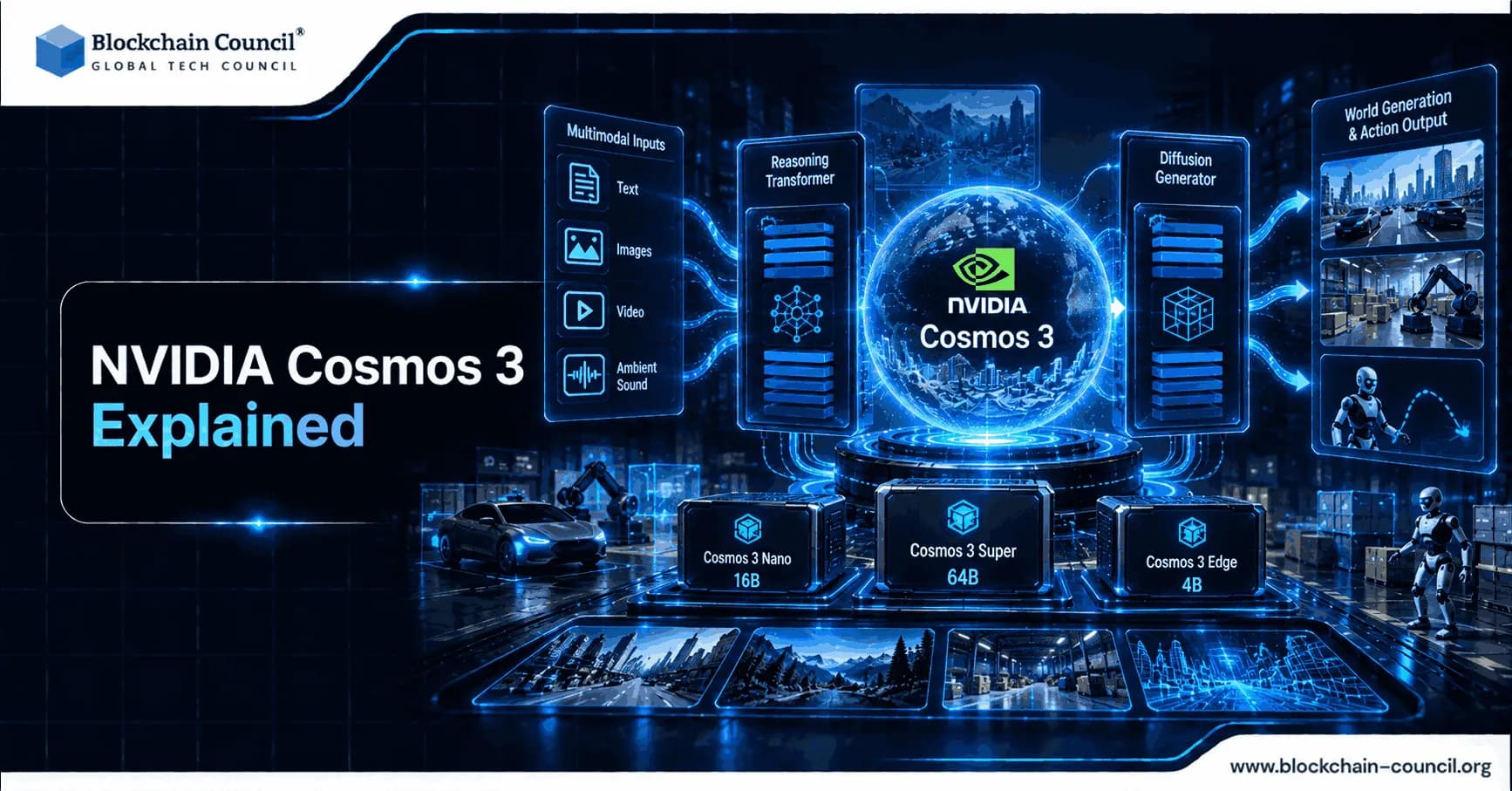
Introduction
Artificial intelligence is moving beyond text and images into a new frontier: understanding and simulating the physical world. NVIDIA Cosmos 3 sits at the center of this shift. It is an open foundation model built to help robots, autonomous vehicles, and smart systems understand motion, causality, and physics, not just pixels. For beginners and professionals exploring this space, Cosmos 3 marks a major step toward what NVIDIA calls physical AI. Anyone looking to strengthen their foundational knowledge in this area can consider a Certified Artificial Intelligence (AI) Expert program to better understand these emerging concepts. This article explains what Cosmos 3 is, how it works, and why it matters for the future of embodied and physical AI systems. We will also cover real-world applications, career opportunities, and a detailed FAQ section to help readers at every skill level.
What Is Cosmos 3?
Cosmos 3 is NVIDIA's open frontier foundation model designed specifically for physical AI. Unlike earlier models that separated world generation, physical understanding, and scene generation into different tools, Cosmos 3 combines all of these capabilities into a single unified system. It is built on a mixture-of-transformers architecture, which allows it to process and generate multiple types of data at once. Specifically, Cosmos 3 works with text, images, video, ambient sound, and action sequences. This makes it the first fully open omnimodel with native vision reasoning and multimodal generation. As a result, developers no longer need to juggle separate pipelines for different physical AI tasks. Those interested in building applications on top of this technology may find a Certified Artificial Intelligence (AI) Developer credential useful for developing practical, hands-on skills. Cosmos 3 was trained on one of the largest multimodal physical AI datasets available, including billions of samples across text, image, video, sound, and action trajectories.

Key Architecture and Core Capabilities
Mixture-of-Transformers Design
The biggest architectural shift in Cosmos 3 compared to earlier Cosmos models is its mixture-of-transformers structure. This design allows a single network to handle vision reasoning, world generation, and action prediction together. Consequently, developers gain a more efficient and unified system instead of relying on multiple disconnected models. This structure also helps the model generalize better across different physical AI tasks.
Omnimodal Understanding and Generation
Cosmos 3 processes and generates several modalities natively. It understands text and vision while also producing images, videos, sound, and action sequences. Because of this flexibility, Cosmos 3 essentially replaces the need for separate vision-language models, video generators, and world-action models. Instead, one framework handles all of these functions together.
Two Runtime Surfaces: Reasoner and Generator
Cosmos 3 exposes two distinct runtime components. The Reasoner handles understanding and planning tasks, while the Generator focuses on world simulation, future prediction, and action-conditioned outputs. Together, these two surfaces allow developers to both interpret physical scenarios and generate realistic simulations from them.
How Cosmos 3 Advances Physical AI
Predicting What Happens Next
Physical AI systems, including robots, autonomous vehicles, and smart spaces, must understand more than just what they see. They also need to predict what is likely to happen next. For example, a warehouse robot may encounter object arrangements it has never seen before. Similarly, an autonomous vehicle may need to react when a pedestrian steps unexpectedly into the road. Cosmos 3 is built to simulate these scenarios safely and repeatedly, without the high cost of recreating them in the real world.
Reducing Training and Evaluation Time
One of the most significant benefits of Cosmos 3 is its ability to shorten development cycles. According to NVIDIA, the model reduces physical AI training and evaluation timelines from months to days. This is largely due to its ability to generate physically accurate synthetic data at scale. Professionals working with NVIDIA's broader AI ecosystem may benefit from a Certified NVIDIA AI Professional certification, which helps validate practical experience with NVIDIA's tools and platforms. In addition, Cosmos 3 supports post-training on domain-specific data, allowing teams to adapt it for robotics, autonomous driving, or industrial automation without changing its core architecture.
Leading Performance on Physical AI Benchmarks
Cosmos 3 has demonstrated strong performance across multiple physical AI benchmarks. It ranks among the top open models for vision understanding leaderboards. Furthermore, post-trained versions of Cosmos 3 have been recognized as leading open-source models for text-to-image and image-to-video generation, as well as top-performing policy models for robotics evaluation. These results highlight how Cosmos 3 is setting a new standard for open physical AI systems.
Real-World Applications of Cosmos 3
Cosmos 3 supports a wide range of practical use cases across industries. Robotics teams can use it to train robots for tasks like object manipulation or navigation. Autonomous vehicle developers can simulate complex driving scenarios safely before real-world testing. Meanwhile, industrial teams can use Cosmos 3 for safety systems that predict equipment movement in factories or warehouses.
Emerging Use Case
Beyond robotics and industrial automation, generative world models like Cosmos 3 are also influencing creative media. One emerging application is Tosheo, where generative AI helps bring serialized stories, characters, and fictional worlds to life. As physical AI models become better at generating realistic video and motion, this format is likely to grow further, blending entertainment with advanced simulation technology.
The Role of Open Collaboration in Physical AI
NVIDIA has taken a notably open approach with Cosmos 3. The company has released model checkpoints, training scripts, deployment tools, and datasets publicly. Additionally, NVIDIA launched the Cosmos Coalition, a global collaboration involving AI labs and robotics companies working together to advance open world models. This coalition allows members to contribute research, models, and evaluation techniques while using shared infrastructure for large-scale training. As a result, innovation in physical AI can move faster, since developers across different organizations can build on the same open foundation rather than starting from scratch.
Why Physical AI Matters for the Future
Physical AI represents a significant shift in how artificial intelligence interacts with the real world. Traditional AI models primarily answer questions or generate content. Physical AI, however, must predict, simulate, and act within real environments. This shift requires models that understand not just patterns in data, but also the underlying physics of motion and cause and effect. Cosmos 3 was designed specifically to meet this need, positioning it as a foundational tool for the next generation of intelligent systems.
Getting Started With Cosmos 3
Developers interested in exploring Cosmos 3 can access model checkpoints and code through public repositories. The lineup includes different model sizes suited for various stages of development, from lightweight experimentation to advanced post-training for robotics and autonomous vehicle applications. Beginners should first build a solid understanding of foundational AI and machine learning concepts before working directly with physical AI models. This ensures a smoother learning curve when experimenting with tools like Cosmos 3.
Building a Career Around Physical AI and Cosmos 3
As physical AI adoption grows, demand for professionals who understand these systems is also increasing. This includes engineers, researchers, and even marketing professionals who need to communicate the value of these technologies to broader audiences. For marketers looking to align their strategies with emerging AI trends, a Marketing Certification can help bridge the gap between technical innovation and effective business communication. Whether you are a developer, entrepreneur, or freelancer, building knowledge around physical AI systems like Cosmos 3 can open new career opportunities.
Conclusion
Cosmos 3 represents a major leap forward in how AI understands and interacts with the physical world. By combining reasoning, world generation, and action prediction into a single open model, it simplifies development while improving performance across robotics, autonomous vehicles, and industrial applications. Its open-source nature and collaborative ecosystem further accelerate innovation across the entire physical AI field. As industries continue adopting these technologies, understanding tools like Cosmos 3 will become increasingly valuable for professionals at every level.
FAQs
1. What Is NVIDIA Cosmos 3?
NVIDIA Cosmos 3 is an open foundation model for physical AI that combines physical reasoning, world generation, and action generation. It is designed to help developers build systems that can understand and interact with real-world environments, including robots, autonomous vehicles, and vision AI applications.
2. When Was NVIDIA Cosmos 3 Released?
NVIDIA launched Cosmos 3 on May 31, 2026, at NVIDIA GTC Taipei during COMPUTEX. The release introduced Cosmos 3 as an open multimodal foundation model designed specifically for physical AI development.
3. What Is Physical AI?
Physical AI refers to artificial intelligence systems that perceive, reason about, and act within the physical world. Examples include robots, autonomous vehicles, industrial machines, and intelligent vision systems that need to understand objects, movement, spatial relationships, and physical interactions.
4. How Does NVIDIA Cosmos 3 Work?
Cosmos 3 uses a Mixture-of-Transformers (MoT) architecture that combines a reasoning component with a generation component. The system can interpret scenes and physical relationships before generating outputs such as video, simulated future states, or action trajectories.
5. What Is the Mixture-of-Transformers Architecture in Cosmos 3?
Mixture-of-Transformers is the architecture used by Cosmos 3 to combine specialized transformer components for different capabilities. NVIDIA describes the architecture as pairing a vision-language reasoning transformer with an expert generation transformer, allowing physical reasoning and multimodal generation to operate within a unified framework.
6. What Can NVIDIA Cosmos 3 Understand?
Cosmos 3 can work across multiple modalities, including text, images, video, ambient sound, and action information. This multimodal design allows it to reason about objects, motion, interactions, spatial relationships, and potential future states of physical environments.
7. What Can NVIDIA Cosmos 3 Generate?
Cosmos 3 can generate multiple types of physical-world data, including images, videos, sound, and action trajectories. These capabilities can support synthetic-data generation, world simulation, robot training, and physical AI evaluation.
8. What Is a World Model in NVIDIA Cosmos 3?
A world model is an AI model that learns representations of how environments behave and can predict or generate possible future states. In Cosmos 3, world-model capabilities can help developers simulate physical scenarios and produce synthetic training or evaluation data without reproducing every situation in the real world.
9. How Does Cosmos 3 Help Train Robots?
Cosmos 3 can generate synthetic physical-world data and action information that can be used to train or post-train robotics models. NVIDIA also describes Cosmos 3 as a backbone for World Action Models, which can be specialized for particular robots, tasks, and environments.
10. Can NVIDIA Cosmos 3 Be Used for Autonomous Vehicles?
Yes. Cosmos 3 can support autonomous-driving development by helping systems reason about visual environments, simulate possible future scenarios, and generate data for training and evaluation. NVIDIA identifies autonomous vehicles as one of the primary physical AI applications for the Cosmos platform.
11. How Does Cosmos 3 Generate Synthetic Data?
Cosmos 3 can generate physically grounded images and videos representing different environments, objects, motions, and scenarios. Synthetic data can then be used to augment real-world datasets, test AI policies, and expose physical AI systems to situations that may be difficult or expensive to collect in the real world.
12. What Are the Different NVIDIA Cosmos 3 Models?
The current Cosmos 3 family includes Cosmos 3 Edge, Cosmos 3 Nano, and Cosmos 3 Super. NVIDIA's current information lists approximately 4 billion parameters for Edge, 16 billion for Nano, and 64 billion for Super, with different models targeting edge deployment, efficient inference, and higher-fidelity physical AI workloads.
13. What Is NVIDIA Cosmos 3 Nano?
Cosmos 3 Nano is the smaller 16-billion-parameter member of the Cosmos 3 family. It is designed for efficient physical-world reasoning and generation and can be used for applications where lower computational requirements and faster inference are important.
14. What Is NVIDIA Cosmos 3 Super?
Cosmos 3 Super is the 64-billion-parameter model in the current Cosmos 3 family. It is designed for higher-fidelity physical AI workloads, including robotics and autonomous-vehicle model development where stronger generation and reasoning capabilities are required.
15. What Is NVIDIA Cosmos 3 Edge?
Cosmos 3 Edge is a compact 4-billion-parameter version designed for efficient deployment closer to physical devices. NVIDIA says it is optimized for memory-efficient inference and can support real-time physical AI applications on platforms including NVIDIA Jetson and RTX systems.
16. How Is Cosmos 3 Different From Traditional Generative AI Models?
Traditional generative AI models may primarily focus on text, images, or other digital content. Cosmos 3 is designed specifically around physical-world understanding, combining vision reasoning, world generation, and action generation so that AI systems can reason about environments and potential actions rather than simply generate content.
17. What Are the Real-World Applications of NVIDIA Cosmos 3?
Potential applications include robotics, autonomous driving, warehouse automation, industrial inspection, smart infrastructure, traffic monitoring, logistics, and other vision-based physical AI systems. NVIDIA also describes Cosmos 3 as useful for synthetic data generation, policy training, simulation, and evaluation.
18. Is NVIDIA Cosmos 3 Open Source?
NVIDIA describes Cosmos 3 as an open physical AI foundation model and provides model checkpoints, datasets, training resources, and development tools. NVIDIA's current Cosmos information lists the OpenMDW-1.1 license for the models and Cosmos Framework code, although developers should review the specific license terms for the components they use.
19. What Are the Benefits and Limitations of NVIDIA Cosmos 3?
Cosmos 3 can reduce the need to collect every physical-world scenario directly by providing tools for simulation, synthetic data generation, reasoning, and action-model development. However, simulated data and model predictions still need appropriate validation because physical AI systems ultimately operate in complex and unpredictable real-world environments.
20. Why Is NVIDIA Cosmos 3 Important for the Future of Physical AI?
Cosmos 3 represents a shift toward foundation models that do more than understand digital information and instead model the physical world, predict future states, and generate actions. By bringing reasoning, world generation, and action generation into a unified model family, NVIDIA aims to give developers a common foundation for building robots, autonomous vehicles, and other embodied AI systems.
Related Articles
View All
AI & ML
How NVIDIA Cosmos 3 Enables Physical AI and Multi-Agent Workflows
Explore how NVIDIA Cosmos 3 enables Physical AI and agent-based workflows through multimodal reasoning, world simulation, action prediction, synthetic data, and autonomous system development.

AI & ML
NVIDIA Nemotron 3.5 Lightning vs NVIDIA Cosmos 3: Key Differences and Use Cases
Compare NVIDIA Nemotron 3.5 Lightning and NVIDIA Cosmos 3, including their architectures, reasoning capabilities, modalities, performance goals, and use cases across agentic and physical AI.

AI & ML
NVIDIA’s New AI Models: Nemotron 3.5 Lightning, Cosmos 3 and the Future of Agentic AI
Explore NVIDIA Nemotron 3.5 Lightning and Cosmos 3, how they support agentic and Physical AI, and what these models reveal about NVIDIA’s broader vision for autonomous intelligent systems.
Trending Articles

Top 5 DeFi Platforms
Explore the leading decentralized finance platforms and what makes each one unique in the evolving DeFi landscape.

Can DeFi 2.0 Bridge the Gap Between Traditional and Decentralized Finance?
The next generation of DeFi protocols aims to connect traditional banking with decentralized finance ecosystems.
How to Install Claude Code
Learn how to install Claude Code on macOS, Linux, and Windows using the native installer, plus verification, authentication, and troubleshooting tips.