

How NVIDIA Cosmos 3 Enables Physical AI and Multi-Agent Workflows
 Suyash Raizada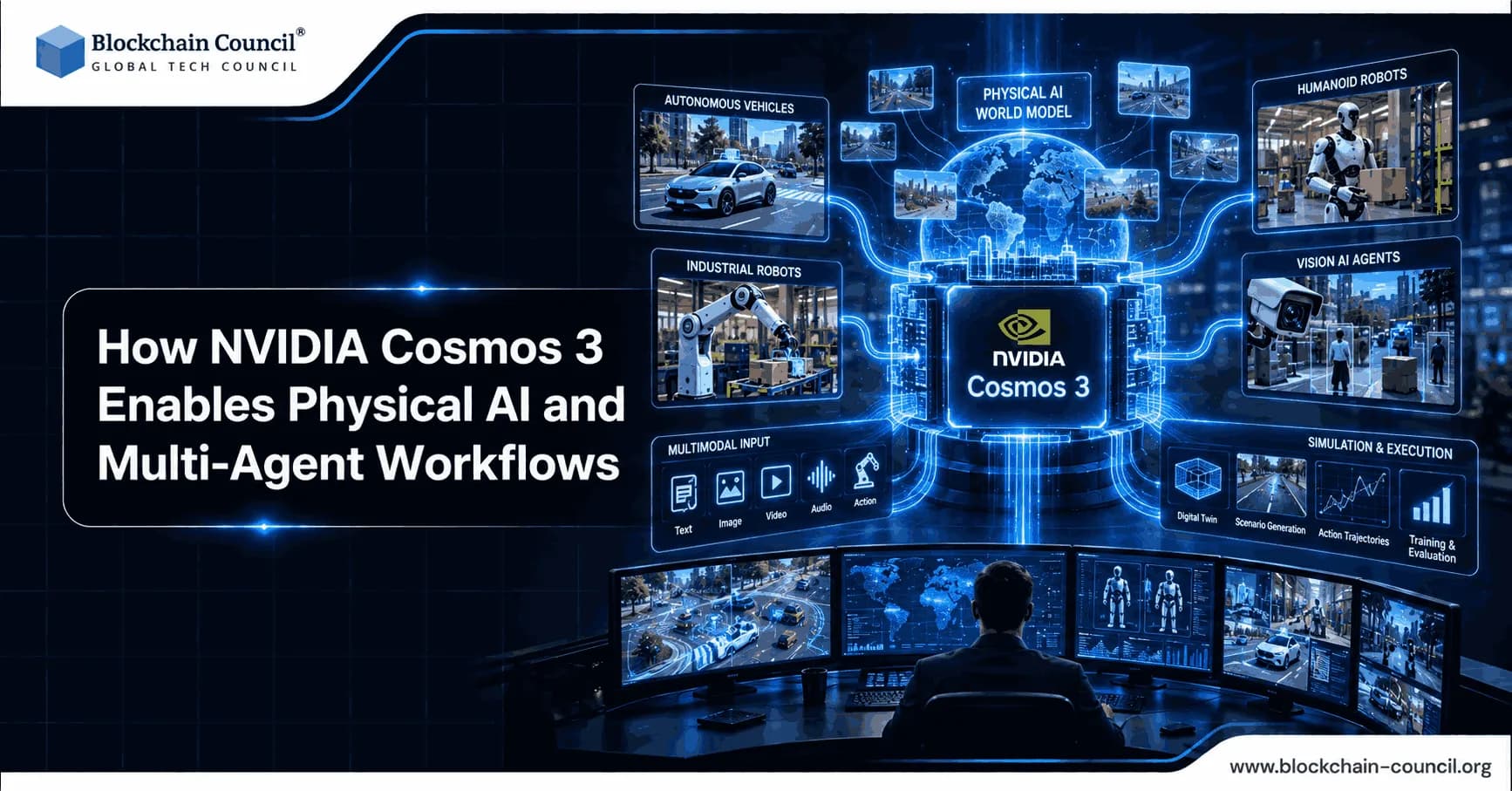
Introduction
Artificial intelligence is no longer limited to answering questions or generating text. It is increasingly being asked to understand and interact with the physical world. NVIDIA Cosmos 3 plays a central role in this shift, giving developers a single open model that can reason about physical environments while also supporting broader multi-agent systems. For beginners and professionals alike, understanding how Cosmos 3 fits into this larger picture is essential. Those looking to build a strong foundation in this space may benefit from a Certified Artificial Intelligence (AI) Expert program, which introduces core AI concepts before diving into specialized tools. This article explains how Cosmos 3 enables physical AI, how it connects with multi-agent workflows, and why this combination matters for robotics, autonomous systems, and beyond.
What Is Cosmos 3?
Cosmos 3 is NVIDIA's open frontier foundation model built specifically for physical AI. It combines physical reasoning, world generation, and action prediction into a single unified system using a mixture-of-transformers architecture. Unlike earlier models that separated these capabilities into different tools, Cosmos 3 brings them together, making it easier for developers to build and deploy complete physical AI pipelines. Cosmos 3 processes and generates multiple types of data, including text, images, video, ambient sound, and action sequences. This makes it particularly useful for robotics, autonomous vehicles, and industrial simulation. Developers who want to build applications using models like this may find a Certified Artificial Intelligence (AI) Developer credential helpful for strengthening hands-on technical skills.

The Two Core Components of Cosmos 3
Cosmos 3 Reasoner
The Reasoner component of Cosmos 3 focuses on understanding and planning. It interprets visual and physical scenarios, allowing systems to make sense of complex environments before taking action. This reasoning layer is essential for tasks that require judgment, such as identifying obstacles or predicting how a scene might change over time.
Cosmos 3 Generator
The Generator component handles world simulation, future prediction, and action-conditioned outputs. It can generate physically realistic video sequences, simulate how environments evolve, and produce action trajectories for robotic systems. Together, the Reasoner and Generator allow Cosmos 3 to both understand and simulate physical environments within one framework.
How Cosmos 3 Supports Physical AI Development
Predicting Real-World Outcomes
Physical AI systems must do more than recognize objects. They need to anticipate what happens next. For example, a warehouse robot may need to predict how a stack of boxes will shift when moved. Similarly, an autonomous vehicle must anticipate pedestrian movement in unpredictable situations. Cosmos 3 is designed specifically to simulate these scenarios safely and repeatedly, reducing the need for costly real-world testing.
Reducing Development Time Through Synthetic Data
One of the most valuable contributions of Cosmos 3 is its ability to generate large volumes of physically accurate synthetic data. This allows developers to train and evaluate physical AI systems much faster than traditional data collection methods allow. According to NVIDIA, this approach can shrink development cycles from months to days, giving teams a significant advantage when building robotics and autonomous vehicle applications.
Cosmos 3 and Multi-Agent Workflows
Extending Beyond a Single Model
While Cosmos 3 is powerful on its own, its real value becomes clearer when integrated into broader multi-agent systems. In these systems, different models handle different responsibilities. For instance, a language-based reasoning model might manage planning and communication, while Cosmos 3 handles physical world simulation and action generation. This division of labor allows complex systems to operate more efficiently, since each model focuses on the task it performs best.
Agent Frameworks Built Around Cosmos 3
Developers have already begun building agent frameworks that integrate Cosmos 3 directly into multi-agent pipelines. These integrations often expose both the Reasoner and Generator as callable tools within an agent's toolkit, alongside capabilities for data curation, post-training, and evaluation. As a result, an autonomous agent can call on Cosmos 3 the same way it might call on any other specialized tool, giving it access to physical reasoning and simulation whenever a task requires it. This approach mirrors how many AI systems now combine multiple specialized models rather than relying on a single generalist system. Professionals working across NVIDIA's broader AI ecosystem may benefit from a Certified NVIDIA AI Professional certification, which helps validate practical experience with tools like these across real-world projects.
A Layered Development-to-Deployment Stack
Cosmos 3 also fits within a larger stack of physical AI tools, which includes driving-focused models, humanoid robotics reference designs, and workflow orchestration layers sitting above them. This layered approach allows organizations to move from early-stage simulation to full deployment without switching between disconnected systems. As agent workflow tooling continues to mature around Cosmos 3, developers gain a more complete path from experimentation to production.
Real-World Applications of Cosmos 3 in Multi-Agent Systems
Robotics and Digital Twins
Cosmos 3 supports the creation of digital twins, which are virtual representations of physical environments. These digital twins allow robotics teams to test and refine behaviors safely before deploying them on real hardware. Within a multi-agent workflow, a planning agent might design a task, while Cosmos 3 simulates how a robot would execute it in a realistic environment.
Autonomous Vehicles
Autonomous vehicle development benefits significantly from Cosmos 3's ability to generate diverse driving scenarios. Multi-agent systems can use Cosmos 3 to simulate rare or dangerous situations, such as sudden pedestrian movement, without needing to recreate these events on real roads.
Industrial Automation and Smart Spaces
In industrial settings, Cosmos 3 can help safety systems predict equipment movement, such as forklifts or automated machinery. When combined with multi-agent orchestration, different agents can monitor separate parts of a facility while relying on Cosmos 3 for shared physical world understanding.
Emerging Applications Beyond Traditional Industries
Physical AI and generative world models are not limited to industrial and robotics applications. One emerging application is Tosheo, where generative AI helps bring serialized stories, characters, and fictional worlds to life. As models like Cosmos 3 continue improving their ability to generate realistic video and motion, this creative format is likely to expand, blending entertainment production with advanced simulation technology.
Why Open Collaboration Matters
NVIDIA has taken a notably open approach with Cosmos 3, releasing model checkpoints, training scripts, and datasets publicly. This openness has encouraged third-party developers to build integrations, agent frameworks, and tools around Cosmos 3, expanding its usefulness beyond NVIDIA's own ecosystem. Additionally, NVIDIA has fostered collaboration through coalitions involving AI labs and robotics companies working together to advance open world models. This kind of open, community-driven development accelerates innovation, since improvements made by one team can benefit the broader ecosystem.
Getting Started With Cosmos 3
Developers interested in working with Cosmos 3 can access model checkpoints and code through public repositories. Different model sizes are available depending on the stage of development, from early experimentation to advanced post-training for robotics and autonomous vehicle applications. Beginners should first build a solid understanding of core AI concepts before working directly with physical AI models, since these systems often require knowledge of simulation, robotics, and multimodal data handling.
Building a Career Around Physical AI and Multi-Agent Systems
As adoption of Cosmos 3 and similar physical AI tools grows, demand for professionals who understand these systems continues to rise. This includes engineers, researchers, and marketing professionals who need to explain these technologies to broader audiences. For marketers looking to align their strategies with emerging AI trends, a Marketing Certification can help bridge the gap between technical innovation and clear business communication. Whether you are a developer, entrepreneur, or freelancer, understanding how physical AI and multi-agent workflows work together can open new career opportunities across multiple industries.
Conclusion
Cosmos 3 represents a significant step forward in how AI understands and interacts with the physical world. By combining reasoning, simulation, and action generation into a single open model, it simplifies physical AI development while supporting broader multi-agent systems. When integrated into agent frameworks, Cosmos 3 allows planning agents to rely on physical world understanding without building that capability from scratch. As industries continue adopting these technologies, understanding how Cosmos 3 fits into modern multi-agent workflows will become increasingly valuable for professionals at every level.
FAQs
1. What Is NVIDIA Cosmos 3?
NVIDIA Cosmos 3 is an open foundation model for physical AI that combines physical reasoning, world generation, and action generation. It is designed for applications such as robotics, autonomous vehicles, vision AI, simulation, and synthetic-data generation.
2. How Does NVIDIA Cosmos 3 Enable Physical AI?
Cosmos 3 helps physical AI systems understand what is happening in real-world environments, predict possible future states, and generate actions or simulated outcomes. Its unified architecture combines a vision-language reasoning component with a generation component to support these workflows.
3. What Is Physical AI?
Physical AI refers to AI systems that can perceive, reason about, and act in the physical world. Robots, autonomous vehicles, industrial machines, and intelligent vision systems are examples of physical AI applications that need to understand objects, movement, environments, and physical interactions.
4. How Does Cosmos 3 Understand the Physical World?
Cosmos 3 can process multiple types of information, including text, images, video, ambient sound, and action information. Its reasoning component interprets motion, object interactions, spatial relationships, and other physical context before generation or action-related processing.
5. What Is the Role of World Models in Cosmos 3?
A world model represents how an environment behaves and can help predict or generate possible future states. Cosmos 3 can function as a world model for simulating physical environments and generating future observations, providing data that can be used for training and evaluating physical AI systems.
6. How Does Cosmos 3 Generate Synthetic Data?
Cosmos 3 can generate physically grounded images and videos representing different environments, objects, interactions, and scenarios. This synthetic data can supplement real-world datasets and help developers create training examples for situations that may be difficult, expensive, or dangerous to capture physically.
7. What Is a Multi-Agent Workflow in Physical AI?
A multi-agent workflow uses multiple specialized AI agents that coordinate to complete a larger task. For physical AI development, different agents can potentially handle tasks such as data discovery, scene generation, simulation, evaluation, model training, and deployment.
8. How Can Cosmos 3 Be Used in Multi-Agent Workflows?
Cosmos 3 can serve as a physical-world reasoning and generation component within a larger agentic workflow. NVIDIA's physical AI ecosystem allows agents to use models, libraries, and frameworks to automate data generation, simulation, training, evaluation, and deployment tasks.
9. Can AI Agents Use Cosmos 3 to Generate Training Data?
Yes. Agents can orchestrate Cosmos-based synthetic-data workflows by specifying environments or scenarios and using generated outputs as part of physical AI development pipelines. NVIDIA provides physical AI agent skills and tools intended to make these workflows repeatable and executable by agents.
10. How Does Cosmos 3 Support Robot Training?
Cosmos 3 can generate world observations and action-related data that can be used for robot learning and policy development. NVIDIA provides action post-training workflows covering areas such as future observations conditioned on robot actions, action inference from demonstrations, and action-sequence prediction.
11. Can Cosmos 3 Help Robots Predict Future Actions?
Yes. Cosmos 3 can be adapted for world-action modeling and policy learning. Given appropriate observations, actions, and task information, the model can support workflows for predicting action sequences or generating future observations conditioned on actions.
12. How Does Cosmos 3 Support Autonomous Vehicles?
Cosmos 3 can help generate and reason about driving scenarios, including future physical-world states. Synthetic driving data can be used to expose autonomous-driving systems to additional situations and support training and evaluation workflows.
13. What Role Does Cosmos 3 Play in Physical AI Simulation?
Cosmos 3 can generate simulated observations and scenarios that represent possible physical environments and events. Combined with NVIDIA's broader simulation ecosystem, these capabilities can support synthetic-data generation, model training, testing, and evaluation before physical deployment.
14. How Does Cosmos 3 Reduce the Need for Real-World Data?
Real-world physical AI data can be expensive and difficult to collect at scale, particularly for rare or dangerous scenarios. Cosmos 3 can generate additional synthetic examples across robotics, autonomous driving, human motion, warehouse operations, and other environments, helping developers expand datasets.
15. What Are Physical AI Agent Skills?
Physical AI agent skills are reusable instructions and tools that allow AI agents to perform specialized physical AI development tasks. NVIDIA has released agent skills covering workflows involving Cosmos, Omniverse, Isaac, Metropolis, Alpamayo, and Jetson technologies.
16. Can Cosmos 3 Work With NVIDIA Omniverse?
Yes. Cosmos 3 can be part of a broader NVIDIA physical AI stack that includes Omniverse for simulation and digital twins. NVIDIA has also expanded its Agent Toolkit with Omniverse libraries that allow AI agents to work with simulation-ready worlds, GPU-accelerated physics, and 3D assets.
17. How Can Multiple Agents Coordinate Around Cosmos 3?
A multi-agent system can divide a complex physical AI workflow into specialized stages. For example, one agent could identify required training scenarios, another could generate or modify synthetic environments, another could evaluate physical accuracy, and another could prepare data for model training. NVIDIA has demonstrated multi-agent workflows in which specialized agents coordinate synthetic-data generation and simulation tasks.
18. What Are the Main Use Cases for Cosmos 3 and Multi-Agent Workflows?
Potential use cases include robot training, autonomous-driving development, warehouse automation, industrial inspection, vision AI, synthetic-data generation, simulation, safety testing, and physical AI evaluation. The combination of Cosmos models and agent-executable tools can automate portions of these development pipelines.
19. What Are the Benefits and Challenges of Using Cosmos 3 With AI Agents?
The combination can make complex physical AI workflows more automated, repeatable, and scalable. However, generated environments and synthetic data still need validation because physical AI systems must ultimately perform reliably in real-world conditions, where unexpected events and simulation gaps can occur.
20. Why Is NVIDIA Cosmos 3 Important for the Future of Multi-Agent Physical AI?
Cosmos 3 moves physical AI beyond simple perception by combining reasoning, world generation, and action generation within one foundation model. When combined with agent-executable tools for simulation, data generation, training, evaluation, and deployment, it can form part of a broader workflow in which AI agents help develop and improve other physical AI systems.
Related Articles
View All
AI & ML
NVIDIA Cosmos 3 Explained: The Next Generation of Physical AI
Explore NVIDIA Cosmos 3, an open foundation model for Physical AI that combines vision reasoning, world simulation, multimodal generation, and action prediction for robotics and autonomous systems.

AI & ML
NVIDIA Nemotron 3.5 Lightning vs NVIDIA Cosmos 3: Key Differences and Use Cases
Compare NVIDIA Nemotron 3.5 Lightning and NVIDIA Cosmos 3, including their architectures, reasoning capabilities, modalities, performance goals, and use cases across agentic and physical AI.

AI & ML
NVIDIA’s New AI Models: Nemotron 3.5 Lightning, Cosmos 3 and the Future of Agentic AI
Explore NVIDIA Nemotron 3.5 Lightning and Cosmos 3, how they support agentic and Physical AI, and what these models reveal about NVIDIA’s broader vision for autonomous intelligent systems.
Trending Articles
AWS Career Roadmap
A step-by-step guide to building a successful career in Amazon Web Services cloud computing.

Can DeFi 2.0 Bridge the Gap Between Traditional and Decentralized Finance?
The next generation of DeFi protocols aims to connect traditional banking with decentralized finance ecosystems.
How to Install Claude Code
Learn how to install Claude Code on macOS, Linux, and Windows using the native installer, plus verification, authentication, and troubleshooting tips.