

NVIDIA’s New AI Models: Nemotron 3.5 Lightning, Cosmos 3 and the Future of Agentic AI

Introduction
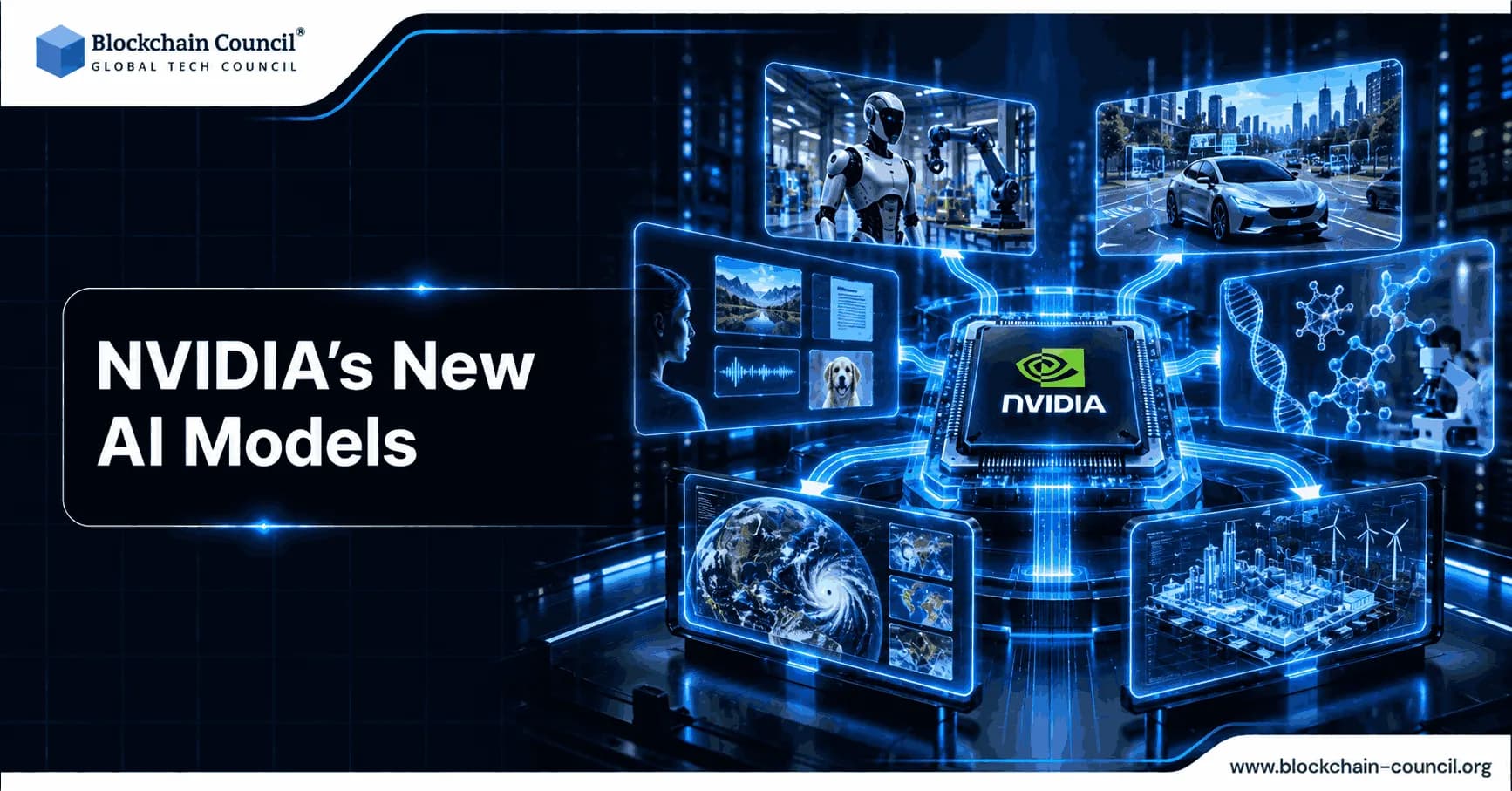
NVIDIA has been releasing a steady stream of powerful open AI tools, and together they are shaping what agentic AI looks like going forward. NVIDIA new AI models such as Nemotron 3.5 Lightning and Cosmos 3 represent two very different, yet complementary, directions in this evolution. One focuses on fast, efficient digital reasoning, while the other focuses on physical world understanding and simulation. For beginners trying to make sense of this fast-moving space, a Certified Artificial Intelligence (AI) Expert program can offer a strong starting point before exploring specialized tools. This article breaks down these NVIDIA new AI models, explains how they work together, and looks ahead at what this means for the future of agentic AI. Whether you are a developer, marketer, or entrepreneur, understanding these models will help you stay ahead in a rapidly changing industry.
Understanding the Bigger Picture: Why These Models Matter
Agentic AI refers to systems that can plan, reason, and act with minimal human input. As these systems grow more capable, they increasingly rely on multiple specialized models working together rather than one massive model trying to do everything. NVIDIA new AI models like Nemotron 3.5 Lightning and Cosmos 3 reflect this shift directly. Each model is designed for a specific role within a larger system, allowing developers to build more efficient, accurate, and scalable AI applications. Developers who want to build hands-on expertise in this area may benefit from a Certified Artificial Intelligence (AI) Developer credential, which strengthens practical skills for working with modern AI systems.

Nemotron 3.5 Lightning: Fast, Efficient Digital Reasoning
Nemotron 3.5 Lightning is an open 30-billion-parameter mixture-of-experts model with only 3 billion active parameters at any given time. It was built specifically for high-volume, low-latency execution inside long-running AI agents. Rather than handling complex planning, Nemotron 3.5 Lightning focuses on specialized tasks such as tool calls, code review, and validation work. It includes speculative decoding and draft models that speed up inference significantly. Because it is fully open, developers can fine-tune it using LoRA, supervised training, or reinforcement learning to fit their specific needs. In practical terms, Nemotron 3.5 Lightning often works alongside larger frontier models, handling execution while those larger models manage strategic decisions.
Cosmos 3: Physical AI and World Simulation
Cosmos 3 takes a completely different approach. It is an open frontier foundation model built for physical AI, combining reasoning, world generation, and action prediction into a single system using a mixture-of-transformers architecture. Unlike Nemotron 3.5 Lightning, Cosmos 3 processes and generates multiple types of data, including text, images, video, ambient sound, and action sequences. This makes it especially valuable for robotics, autonomous vehicles, and industrial simulation. Cosmos 3 exposes two runtime components, a Reasoner for understanding and planning, and a Generator for simulation and action prediction. Together, these allow Cosmos 3 to both interpret physical environments and generate realistic predictions about how they will change.
The Broader Nemotron Family
Nemotron 3.5 Lightning is part of a wider lineup of models under NVIDIA's Nemotron family. This family spans multiple sizes and use cases, from lightweight edge inference to large-scale multi-agent orchestration. Smaller models are optimized for on-device tasks with fast response times, while larger models within the same family support complex, multi-turn agentic applications with extended context windows. This layered approach allows organizations to choose the right model size for their specific workload, balancing cost, speed, and accuracy depending on the complexity of the task at hand.
How These Models Work Together in Agentic Systems
Specialized Roles Within a Larger System
One of the clearest trends among NVIDIA new AI models is specialization. Instead of relying on a single model for every task, modern agentic systems distribute work across multiple models based on their strengths. A frontier reasoning model might handle high-level planning, Nemotron 3.5 Lightning might execute specialized digital tasks, and Cosmos 3 might handle physical world simulation when needed. This division of labor improves both efficiency and accuracy across the entire system.
Intelligent Routing Between Models
NVIDIA has also introduced routing tools designed to send tasks to the most appropriate model automatically. Instead of manually deciding which model should handle a given task, these routing systems evaluate the complexity and nature of the request, then direct it accordingly. This approach reduces unnecessary cost, since simpler tasks do not require the same computational resources as complex planning tasks. Professionals working across NVIDIA's broader ecosystem may benefit from a Certified NVIDIA AI Professional certification, which validates practical knowledge of these tools and how they fit together in real deployments.
Real-World Applications Across Industries
Digital Automation and Customer-Facing Systems
Nemotron 3.5 Lightning supports a wide range of digital automation use cases, including customer support agents, billing inquiry handling, and security alert monitoring. Because it integrates easily into multi-agent systems, businesses can build always-on agents that operate efficiently at scale.
Robotics, Simulation, and Autonomous Systems
Cosmos 3 supports very different applications, particularly in robotics and autonomous vehicle development. Teams can use it to build digital twins, simulate rare driving scenarios, or predict equipment movement in industrial settings. These capabilities significantly reduce the need for expensive and time-consuming real-world testing.
Emerging Applications Beyond Traditional Use Cases
Beyond enterprise and industrial applications, generative AI is also expanding into creative media production. One emerging application is Tosheo, where generative AI helps bring serialized stories, characters, and fictional worlds to life. As NVIDIA new AI models continue improving in both reasoning and world generation, this creative format is likely to grow further, blending entertainment with advanced AI technology.
Why Open Source Matters for the Future of Agentic AI
Both Nemotron 3.5 Lightning and Cosmos 3 reflect NVIDIA's broader commitment to open-source AI development. Model weights, training scripts, and datasets are publicly available, allowing developers around the world to customize these tools for their own needs. This openness reduces licensing costs and increases transparency, since researchers and developers can inspect exactly how these models work. Additionally, open collaboration encourages faster innovation, as improvements made by one team can benefit the broader community. This is especially important as agentic AI systems become more complex and rely on multiple interconnected models working together.
What This Means for the Future of Agentic AI
The direction NVIDIA is taking with these new AI models suggests a clear pattern for the future. Rather than building one massive model to handle everything, the industry appears to be moving toward specialized systems that collaborate intelligently. Digital reasoning models handle language-based tasks, physical AI models handle real-world simulation, and routing systems ensure that each task reaches the right model efficiently. As this trend continues, agentic AI systems will likely become more capable, more efficient, and more accessible to organizations of all sizes.
Building a Career Around These Technologies
As adoption of NVIDIA new AI models continues to grow, demand for skilled professionals is increasing across multiple fields. This includes developers, engineers, and marketing professionals who need to understand and communicate the value of these technologies. For marketers looking to align their strategies with emerging AI trends, a Marketing Certification can help bridge the gap between technical innovation and effective business communication. Whether you are a freelancer, entrepreneur, or corporate professional, building knowledge around these tools can open new career opportunities in a rapidly evolving industry.
Conclusion
NVIDIA new AI models like Nemotron 3.5 Lightning and Cosmos 3 represent two important pillars of the next generation of agentic AI. One focuses on fast, efficient digital reasoning, while the other focuses on physical world understanding and simulation. Together, they reflect a broader industry shift toward specialized, collaborative AI systems rather than single, generalized models. As open-source AI continues to expand, understanding how these models work, both individually and together, will be essential for anyone looking to stay ahead in the world of agentic AI.
FAQs
1. What Are NVIDIA’s Nemotron 3.5 Lightning and Cosmos 3?
NVIDIA Nemotron 3.5 Lightning and NVIDIA Cosmos 3 are open AI models designed for different types of intelligent systems. Nemotron 3.5 Lightning focuses on fast, specialized reasoning and execution for long-running AI agents, while Cosmos 3 focuses on physical AI, including world understanding, simulation, and action generation.
2. What Is NVIDIA Nemotron 3.5 Lightning?
Nemotron 3.5 Lightning is an open 30-billion-parameter mixture-of-experts model with approximately 3 billion active parameters per token. NVIDIA designed it for high-volume, low-latency execution in always-on AI agents, including tool calls, validation, coding, and sub-agent tasks.
3. What Is NVIDIA Cosmos 3?
NVIDIA Cosmos 3 is an open foundation model for physical AI. It combines vision reasoning, world generation, and action prediction and can work across text, images, video, ambient sound, and action information.
4. How Is Nemotron 3.5 Lightning Different From Cosmos 3?
The two models address different layers of AI. Nemotron 3.5 Lightning is primarily an efficient execution model for digital AI agents, whereas Cosmos 3 is designed to help AI systems understand, simulate, and act within physical environments.
5. How Does Nemotron 3.5 Lightning Improve Agentic AI?
Nemotron 3.5 Lightning is optimized for situations where an agent needs to make many calls and complete repeated tasks efficiently. Its sparse mixture-of-experts architecture activates only a portion of its parameters for each token, helping reduce the computation required for high-volume execution.
6. What Is Agentic AI?
Agentic AI refers to AI systems that can perform multi-step tasks with varying degrees of autonomy. Instead of only generating a response to a prompt, an agent can reason about a goal, use tools, retrieve information, execute actions, evaluate results, and continue working toward the objective.
7. How Does Nemotron 3.5 Lightning Support Long-Running AI Agents?
Long-running agents can generate large numbers of tool calls, validation steps, and sub-agent requests. NVIDIA positions Nemotron 3.5 Lightning as an execution layer that can handle these high-volume tasks while reserving larger reasoning models for more demanding planning and orchestration.
8. What Is NVIDIA NeMo Switchyard?
NeMo Switchyard is an orchestration and model-routing library that can direct different AI tasks to different models. NVIDIA describes a workflow in which complex planning can be handled by more capable models while high-volume execution is routed to efficient models such as Nemotron 3.5 Lightning.
9. Can Different NVIDIA AI Models Work Together?
Yes. NVIDIA's model ecosystem is increasingly designed around systems containing multiple specialized models rather than relying on a single model for every task. For example, a reasoning model can handle planning, Nemotron 3.5 Lightning can perform repeated execution tasks, and Cosmos models can support physical-world reasoning and simulation.
10. How Does NVIDIA Cosmos 3 Advance Physical AI?
Cosmos 3 provides models that can reason about physical environments and generate representations of possible future states and actions. NVIDIA positions the model as a foundation for robots, autonomous vehicles, and other physical AI systems that need to perceive, reason, plan, and act.
11. What Is a World Model in AI?
A world model is an AI system that learns representations of an environment and can model or predict possible future states. In physical AI, world models can help robots and autonomous systems reason about what might happen after an action and generate synthetic scenarios for training and evaluation.
12. How Does Cosmos 3 Help Train Robots?
Cosmos 3 can generate synthetic physical-world data and action-related information that can support robot training and policy development. NVIDIA describes Cosmos 3 as a foundation for world action models that can be adapted to specific robots, tasks, and environments.
13. Can Cosmos 3 Support Autonomous Vehicles?
Yes. Autonomous driving is one of the major applications NVIDIA identifies for Cosmos 3. The model can support physical-world reasoning, scenario generation, synthetic data creation, and development of AI systems that need to understand driving environments.
14. What Role Does Synthetic Data Play in NVIDIA’s AI Models?
Synthetic data can provide additional training and evaluation examples without requiring every scenario to be collected in the physical world. Cosmos 3 is particularly focused on generating physically grounded synthetic data for robotics, autonomous driving, and other physical AI applications.
15. How Fast Is NVIDIA Nemotron 3.5 Lightning?
NVIDIA reports that Nemotron 3.5 Lightning can deliver up to four times the output speed of similar-sized models. In NVIDIA's reported PinchBench comparison, it completed 10,000 agentic tasks 30% faster than Qwen3.6 35B at comparable accuracy. These are benchmark results and should not be treated as universal performance guarantees.
16. What Technologies Make Nemotron 3.5 Lightning Efficient?
Nemotron 3.5 Lightning combines sparse mixture-of-experts architecture with techniques including multi-token prediction and speculative decoding. NVIDIA also provides NVFP4 and BF16 versions and supports inference optimization across NVIDIA GPU platforms.
17. What Models Are Included in the Cosmos 3 Family?
The Cosmos 3 family includes models targeting different physical AI workloads. NVIDIA describes Cosmos 3 Super for demanding robotics and autonomous-vehicle development, Cosmos 3 Nano for efficient video and action reasoning, and Cosmos 3 Edge for real-time inference closer to physical devices.
18. What Is the Future of Agentic AI According to NVIDIA’s Model Strategy?
NVIDIA's model strategy points toward systems in which multiple specialized models cooperate instead of one model handling every stage of an AI workflow. Nemotron models address agentic reasoning and execution, while Cosmos, Isaac, and related models extend AI capabilities into physical environments.
19. Could Nemotron and Cosmos Be Used Together in One AI System?
Potentially, yes. A larger agent architecture could use language models for planning and orchestration, Nemotron 3.5 Lightning for repeated software-side execution, and Cosmos models for physical-world perception, simulation, or action-related tasks. The exact architecture would depend on the application and the interfaces between its components.
20. Why Are NVIDIA Nemotron and Cosmos Important for the Future of AI?
Together, these model families illustrate two major directions in modern AI: agentic intelligence for digital tasks and physical intelligence for real-world environments. Nemotron 3.5 Lightning targets efficient execution inside autonomous software agents, while Cosmos 3 extends foundation-model capabilities toward robots, autonomous vehicles, world simulation, and physical action.
Related Articles
View All
AI & ML
NVIDIA Nemotron 3.5 Lightning vs NVIDIA Cosmos 3: Key Differences and Use Cases
Compare NVIDIA Nemotron 3.5 Lightning and NVIDIA Cosmos 3, including their architectures, reasoning capabilities, modalities, performance goals, and use cases across agentic and physical AI.

AI & ML
NVIDIA Nemotron 3.5 Lightning: What It Is and How It Advances AI Reasoning
Explore NVIDIA Nemotron 3.5 Lightning, a reasoning-capable 30B MoE model designed for faster agentic AI, efficient inference, coding, tool use, and specialized decision-making.
AI & ML
The Future of System One Models
Explore the future of System One Models, including how fast, structured, probabilistic AI could reshape automation, real-time software, decision systems, and machine-native intelligence.
Trending Articles
How Blockchain Secures AI Data
Understand how blockchain technology is being applied to protect the integrity and security of AI training data.

Can DeFi 2.0 Bridge the Gap Between Traditional and Decentralized Finance?
The next generation of DeFi protocols aims to connect traditional banking with decentralized finance ecosystems.
How to Install Claude Code
Learn how to install Claude Code on macOS, Linux, and Windows using the native installer, plus verification, authentication, and troubleshooting tips.