

Apollo Farm: Growing Food With 95% Less Water

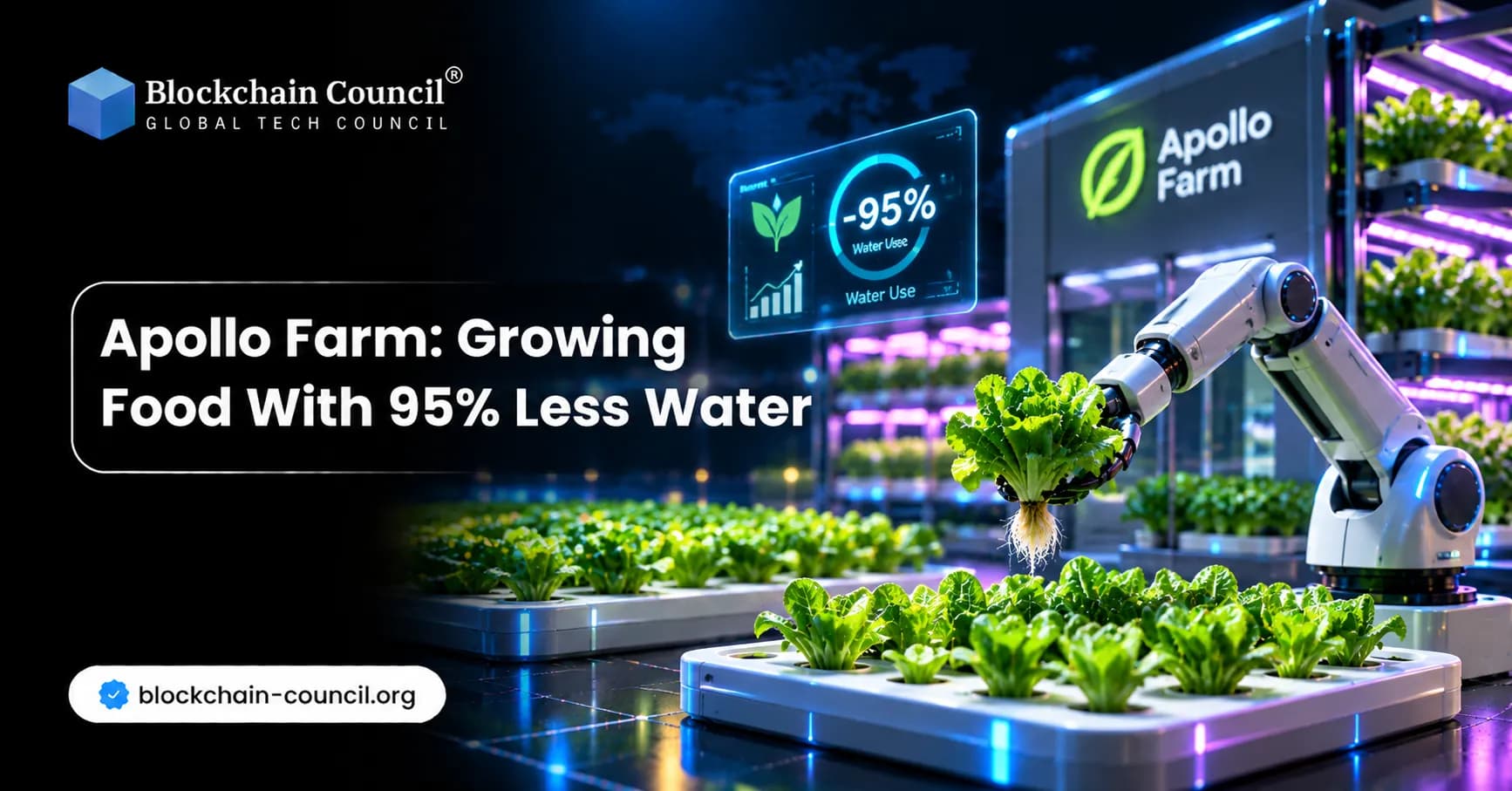
Water is the quiet foundation of every meal. Farming uses most of the fresh water that people withdraw around the world, and many regions are already running short. So when a farm claims it can grow fresh greens with up to 95% less water, people pay attention. That farm is Apollo Farm, a robotic indoor farming system near Phoenix, Arizona, built by AutoStore and OnePointOne. Its official spelling is Opollo Farm, but many people search for it as Apollo Farm, so this guide covers both names in one place.
Understanding a system like this takes a mix of farming knowledge and technology skills. Professionals who want to work with automation, data, and smart machines often start with a credential such as a Certified Artificial Intelligence (AI) Expert program, because AI and robotics now sit at the heart of modern food production.

In this article you will learn what Apollo Farm is, how it works, where the 95% water saving comes from, what it has achieved so far, and what limits it still faces. The language is simple enough for beginners, and the details are solid enough for professionals.
What Is Apollo Farm?
Apollo Farm is a fully automated vertical farm. A vertical farm grows crops indoors in stacked layers instead of across open fields. This system takes that idea further by letting robots move plants through the building and place them exactly where they need to be.
What Is Vertical Farming?
Vertical farming is a way of growing food inside a controlled building. Instead of relying on rain, soil, and the sun, growers supply water, nutrients, light, and air on purpose. Because the plants are stacked, a small floor area can produce a large harvest. This is why vertical farms are popular in cities, where land is expensive and fresh food often travels a long way.
The Companies Behind It
AutoStore is a warehouse automation company known for compact robotic storage grids that move bins of goods. OnePointOne is an agriculture technology company that built a turnkey vertical farming system for farmers, distributors, and retailers. Together they unveiled the farm in May 2025 and described it as the first robotic vertical farm to use automated cubic storage. The first site sits in a warehouse just outside Phoenix.
A Quick Note on the Name
The official brand is Opollo Farm, spelled with two letter o characters. Searchers often type Apollo Farm, and articles, buyers, and investors use both spellings. There is also an unrelated company called Apollo Aquaculture Group in Singapore that raises fish in multi-storey tanks. This article is about the Arizona crop farm built by AutoStore and OnePointOne.
What It Grows
The farm currently produces leafy greens, microgreens, and herbs. The companies have said that strawberries, mushrooms, and other products are planned next. The produce is sold under the Willo brand at select Whole Foods Market stores in the Phoenix area.
How Apollo Farm Works
Think of Apollo Farm as a climate-controlled warehouse built on a Rubik’s cube style grid. Instead of boxes, the bins hold young plants. Robots glide across the top of the grid, lift bins, and place them wherever the plants need to be.
The ideas behind this setup draw on robotics, sensors, and machine learning. If you want to build or manage systems like this, a hands-on path such as the Certified Artificial Intelligence (AI) Developer program can help you learn how intelligent software is designed, tested, and deployed.
Seeding and Germination
Plants are seeded automatically. They then move into the grid for germination, which is the stage when a seed wakes up and sprouts. Throughout their life, the plants change positions so each one receives the right balance of water, nutrients, and air.
Robots and Cube Storage
AutoStore designed its grid for e-commerce warehouses, where robots move bins around the clock. At Apollo Farm the same logic applies to crops. Because the robots can work day and night, the farm can run continuously and deliver steady harvests through the year. The grid is also modular, which means operators can expand it outward as demand grows.
Hydroponics, Lighting, and Climate Control
The farm uses hydroponics, which means growing plants in water that contains dissolved nutrients rather than in soil. It combines this with automation, lighting, irrigation, and climate control, often shortened to HVAC (heating, ventilation, and air conditioning). Everything is tuned so the plants enjoy stable conditions that never depend on the weather. The system aims to deliver harvest-ready crops in as little as 15 days, which one trade report described as about half the time of traditional methods.
How Apollo Farm Uses 95% Less Water
The headline number is the reason many readers first hear about this project. Here is where it comes from.
Why Normal Farming Uses So Much Water
In open fields, water is lost in many ways. Some evaporates in the sun, some runs off the soil, and some sinks below the roots where plants cannot reach it. Agriculture is the largest user of fresh water worldwide, so these losses add up to a very large amount.
The Closed-Loop Secret
Apollo Farm recirculates its water in a closed loop. Plants take what they need, and the remaining water is captured and used again. Because the farm is indoors, there is no wind, no hot sun, and no runoff to carry water away. The companies say this approach cuts water use by up to 95% compared with traditional farming.
How to Read the 95% Number
The words “up to” matter. The 95% figure is a claim from the companies, and it compares their system with conventional field farming. Actual savings depend on the crop, the climate, and how the farm is run. Other indoor growing methods, including aeroponic systems that mist the roots, have reported similar savings, which suggests the number is realistic for indoor and hydroponic farms. Still, a careful reader should treat it as a strong estimate rather than a guarantee. Independent measurement as the farm grows will show the real long-term result.
What 95% Means in Plain Terms
Imagine a field needs 100 buckets of water to grow a batch of lettuce. A system with a 95% saving would grow the same batch with about 5 buckets. For a dry state like Arizona, where water supply is a constant concern, that gap is very important.
Key Benefits of Apollo Farm
Water savings are only one part of the story. The farm is built to address several problems at once. Making sense of these benefits also takes technical literacy, and a broad Tech Certification path is a good way for professionals to build knowledge across cloud, data, and the emerging tools that power smart farms.
Fresher Food, Closer to Home
Because the farm can sit near cities or inside distribution centers, produce travels a short distance. The companies say this shortens the supply chain by over 90%. Shorter trips mean fresher leaves, less spoilage, and fewer transport emissions.
Less Dependence on Labor
Farming faces labor shortages in many places. Robots handle seeding, movement, and positioning, so fewer repetitive tasks fall on people. Workers can focus on oversight, quality checks, and maintenance.
Cleaner Growing Conditions
The produce is reported to be pesticide-free. Indoor growing keeps pests out, so growers do not need to spray crops. A controlled space also reduces the contamination risks that come with open fields.
Year-Round Supply
Weather, drought, and seasons can disrupt outdoor harvests. Inside Apollo Farm, conditions stay constant, so supply stays steady. That reliability matters to grocery stores that must keep shelves stocked.
High Density, Less Land
Plants grow at very high density, so a small footprint can produce a lot of food. This lets farms be built inside existing buildings instead of taking over new farmland.
Apollo Farm vs Traditional Farming
A side by side view makes the differences easy to see.
Feature | Apollo Farm | Traditional Field Farming |
|---|---|---|
Water use | Up to 95% less, recirculated | High, with runoff and evaporation |
Growing place | Indoor, stacked grid | Open land |
Time to harvest | As little as 15 days for some crops | Often about twice as long |
Pesticides | Reported pesticide-free | Commonly used |
Weather risk | Very low | High |
Labor | Robot assisted | Mostly manual or machine driven |
The table does not mean one method is always better. Field farming still feeds most of the world, while indoor systems add a new tool for fresh produce in places where land and water are limited.
Real World Results: Apollo Farm and Whole Foods Market
The project moved beyond the lab quickly. Fresh greens and herbs from the Arizona site are already on shelves at select Whole Foods Market stores around Phoenix under the Willo brand. A Whole Foods produce merchant said the retailer is always looking for new ways to bring fresh, sustainable food to customers, and called the farm a strong example of advanced technology serving that goal.
The leaders of both companies framed the project around resource limits. AutoStore’s chief product officer said it shows what happens when proven automation meets challenges such as food supply resilience. The CEO of OnePointOne said traditional farming consumes vast amounts of water and land, and that robotics combined with plant production technology can grow food almost anywhere using a fraction of the resources.
It helps to remember that this is still a pilot. The companies say the system is not yet widely available, and they are studying ways to scale it in urban areas.
Key Facts at a Glance
Name: Opollo Farm, often searched as Apollo Farm
Builders: AutoStore and OnePointOne
Location: Near Phoenix, Arizona
Launch: May 2025
Growth time: As little as 15 days
Water claim: Up to 95% less than traditional farming
Crops: Leafy greens, microgreens, and herbs
Brand: Willo, sold at select Whole Foods Market stores
Challenges and Limits to Keep in Mind
No technology is perfect, and an honest view builds trust.
Energy Use
Indoor farms replace sunlight with LED lights and rely on climate control, which uses electricity. Water savings can come with higher energy needs, so the source of power matters a great deal. Farms that run on clean energy deliver a better overall environmental result.
Startup Cost and Scale
Vertical farming has a history of high building costs. The companies say the Apollo Farm design helps overcome cost and scalability challenges, but that claim needs proof over time as more sites open.
Limited Crop Range
Today’s crops are mostly leafy greens, microgreens, and herbs. Staple crops such as wheat, rice, and corn need far more space and energy, so vertical farms are a complement to field farming and not a replacement.
Pilot Stage Status
Because the farm is in a pilot phase, long-term data on yields, costs, and savings is still limited. Readers should watch for independent reports as the project grows.
Why Apollo Farm Matters for Food Security
Global food demand keeps rising while water and farmland are under pressure. Systems like Apollo Farm show one path forward: grow more food in less space with less water, and place it near the people who eat it.
It also shows how industries borrow ideas from each other. A warehouse robotics grid became a farm. The same pattern may repeat as more sectors adopt automation.
Skills the Future Food Industry Needs
Smart farms need people who can read data, manage software, and run automation, but they also need people who can tell the story. Growers, brands, and retailers must explain benefits clearly to shoppers who want to know where their food comes from. A Marketing Certification can help professionals learn how to communicate sustainability claims honestly and build trust with customers.
How Beginners Can Get Started
If you are new to the topic, start by learning the basics of hydroponics, then explore data and automation. Visit a local indoor farm if you can, and follow official updates from the companies involved. Professionals can go deeper into robotics, machine learning, and supply chain design.
Conclusion
Apollo Farm, officially Opollo Farm, shows how robotics and indoor growing can work together to use up to 95% less water while supplying fresh greens close to city shoppers. Its closed-loop hydroponic system, robotic grid, and fast 15 day growth cycle make it one of the more interesting examples of agricultural technology today. It is still a pilot, and questions about energy, cost, and crop range remain open. Even so, it offers a clear look at how food production may change as water becomes more precious.
FAQs
1. What Is Apollo Farm?
Apollo Farm refers to an agricultural approach or farming initiative focused on growing food while significantly reducing water consumption. Its central goal is to make food production more resource-efficient and sustainable.
2. How Does Apollo Farm Grow Food With 95% Less Water?
The approach is associated with water-efficient growing methods that aim to reduce water loss and improve how plants receive moisture. The exact techniques depend on the farm's technology and growing system.
3. Is Apollo Farm Based on Hydroponic Farming?
Water-efficient farms may use hydroponics, a method of growing plants without soil by delivering nutrient-rich water directly to their roots. However, Apollo Farm's specific growing technology should be confirmed from its official documentation.
4. Why Is Reducing Water Use Important in Agriculture?
Agriculture accounts for a substantial share of global freshwater withdrawals. Reducing water consumption can help conserve freshwater resources, support food security, and make farming more resilient to drought.
5. What Does 95% Less Water Actually Mean?
A claim of 95% less water generally means a growing system uses approximately 5% of the water consumed by a specified conventional farming method. The comparison depends on the crop, location, growing conditions, and measurement method.
6. Can Apollo Farm Grow Food Without Soil?
Soilless growing systems can produce crops using water-based nutrient solutions or other growing media. Whether Apollo Farm uses this approach depends on its particular farming design.
7. What Types of Crops Can Be Grown Using Water-Efficient Farming?
Water-efficient systems can support crops such as lettuce, spinach, herbs, tomatoes, cucumbers, and strawberries. Crop selection depends on the available technology, climate, and growing environment.
8. How Does Water Recycling Help Apollo Farm?
Water recycling can collect unused water, filter it, and return it to the growing system. This reduces freshwater demand and helps limit water waste during production.
9. What Is the Difference Between Traditional Farming and Water-Efficient Farming?
Traditional farming often relies on soil-based cultivation and irrigation, while water-efficient systems may use controlled irrigation, hydroponics, or recirculating water. These methods can reduce water loss and improve resource management.
10. Does Water-Efficient Farming Require Less Land?
Some controlled-environment farming systems use vertical growing arrangements or high-density cultivation. This can increase production per unit of land, although the result depends on the crop and farming setup.
11. Can Apollo Farm Operate in Areas With Water Scarcity?
Water-efficient agriculture can be valuable in regions facing water shortages because it may reduce dependence on freshwater supplies. However, farms still need a reliable water source and suitable infrastructure.
12. Does Growing Food With Less Water Affect Crop Quality?
Lower water consumption does not automatically mean lower crop quality. When water, nutrients, temperature, and light are managed properly, crops can grow successfully while using fewer resources.
13. Is Apollo Farm an Example of Sustainable Agriculture?
A farming model that reduces water use can contribute to sustainable agriculture. Its overall environmental impact also depends on energy consumption, fertilizers, materials, transportation, and waste management.
14. How Can Technology Improve Water-Efficient Farming?
Sensors, automated irrigation, climate monitoring, and data analytics can help farmers understand crop requirements and manage water more precisely. These technologies can reduce unnecessary irrigation and improve consistency.
15. What Are the Main Benefits of Water-Efficient Farming?
Key benefits may include:
Lower freshwater consumption
Reduced water waste
More controlled growing conditions
Potentially higher crop production per unit of land
Greater resilience in water-stressed regions
16. What Challenges Can Water-Efficient Farms Face?
Challenges may include high initial investment, electricity requirements, technical maintenance, equipment costs, and the need for trained operators. Economic feasibility also depends on crop prices and local conditions.
17. Can Water-Efficient Farming Help Address Food Security?
It can support food security by improving resource efficiency and enabling more controlled food production. However, it is one part of a broader solution that also includes distribution, affordability, soil health, and agricultural access.
18. Is Water-Efficient Farming Suitable for Urban Areas?
Yes. Compact growing systems, rooftop farms, and indoor agriculture can make food production possible in urban environments. These systems may also bring some food production closer to consumers.
19. Can Farmers Adopt Water-Efficient Farming on a Small Scale?
Farmers can begin with methods such as drip irrigation, rainwater harvesting, soil-moisture monitoring, and small hydroponic setups. Starting with a manageable system can help them evaluate costs and results before expanding.
20. What Is the Future of Water-Efficient Agriculture?
The future may involve wider adoption of precision irrigation, water recycling, controlled-environment agriculture, and AI-powered crop monitoring. These technologies could help agriculture produce food more efficiently as water scarcity becomes a growing concern.
Related Articles
View All
AI & ML
What Is Dark AI? Private by Design & Launch Date
Dark AI is a privacy-focused AI assistant from Eternal, the parent of Zomato and Blinkit. Learn how its encrypted chats and private memory work, and what is known about the launch date.

AI & ML
What Is Google TimesFM 3.0 and How Does It Work?
TimesFM 3.0 is Google Research’s 330-million-parameter foundation model for time series forecasting. Learn how it works, what multivariate forecasting adds, where to use it in BigQuery, and what its license allows.

AI & ML
How to set up OpenAI dots: a step-by-step guide from first click to first task
Learn how to set up OpenAI dots in ChatGPT, check eligibility, connect apps, configure cloud or local computer access, schedule tasks, and troubleshoot common setup issues.
Trending Articles
The Role of Blockchain in Ethical AI Development
How blockchain technology is being used to promote transparency and accountability in artificial intelligence systems.
What is AWS? A Beginner's Guide to Cloud Computing
Everything you need to know about Amazon Web Services, cloud computing fundamentals, and career opportunities.
How to Install Claude Code
Learn how to install Claude Code on macOS, Linux, and Windows using the native installer, plus verification, authentication, and troubleshooting tips.