

NVIDIA Nemotron 3.5 Lightning: What It Is and How It Advances AI Reasoning
 Suyash Raizada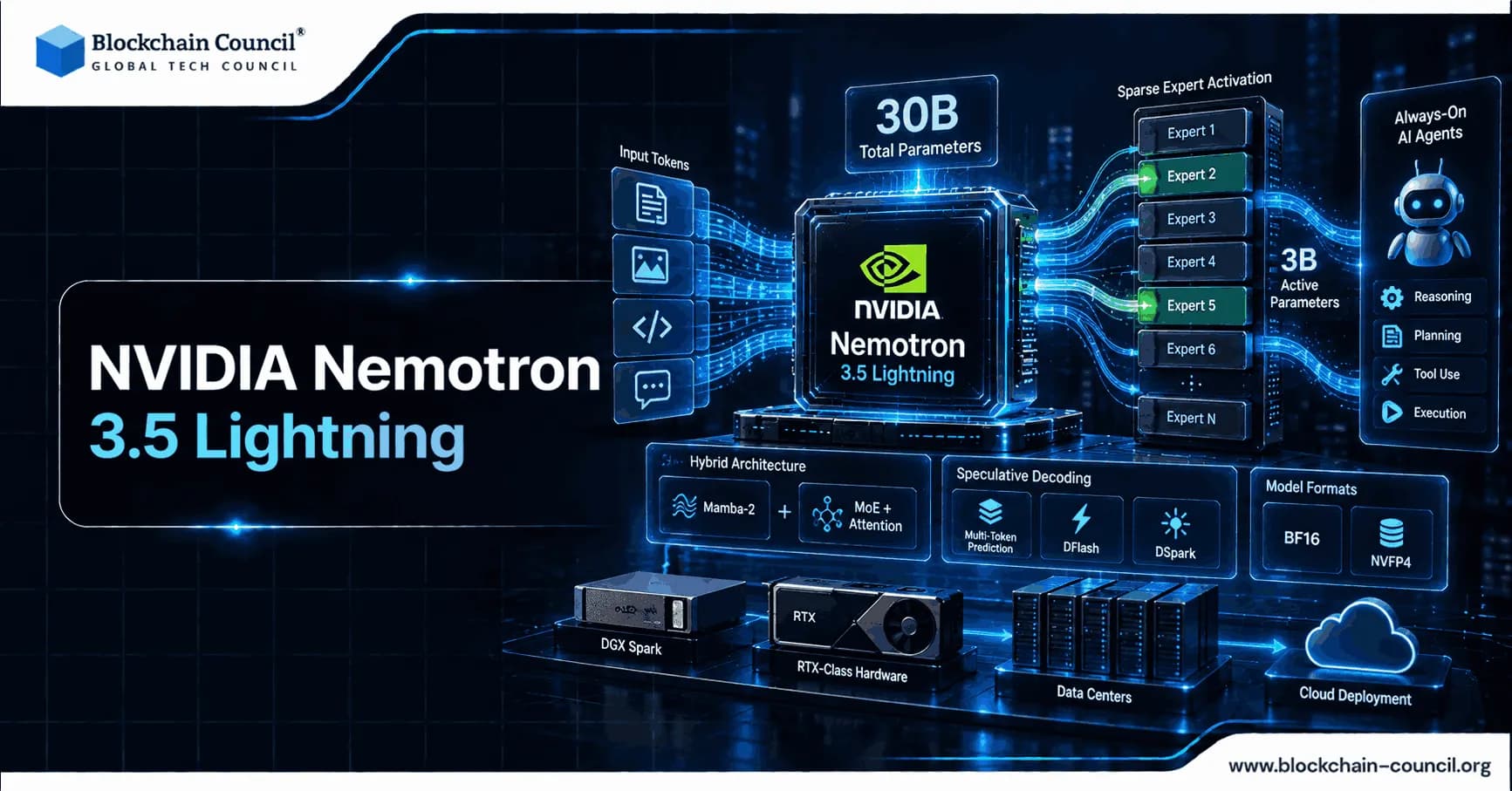
Introduction
Artificial intelligence keeps evolving at a rapid pace, and NVIDIA continues to push that evolution forward. Nemotron 3.5 Lightning is one of the company's latest open models, and it is built specifically for fast, accurate reasoning inside long-running AI agents. Unlike massive frontier models that plan and orchestrate complex tasks, Nemotron 3.5 Lightning focuses on execution. It handles repetitive, high-volume work quickly and efficiently. For beginners and professionals alike, understanding this model opens the door to smarter agentic AI systems. Professionals looking to deepen their expertise can explore a Certified Artificial Intelligence (AI) Expert program to build a stronger foundation in AI concepts. This article breaks down what Nemotron 3.5 Lightning is, how it works, and why it matters for the future of AI reasoning. We will also look at real-world use cases, career paths, and frequently asked questions to help you understand this technology from the ground up.
What Is Nemotron 3.5 Lightning?
Nemotron 3.5 Lightning is an open-source, 30-billion-parameter mixture-of-experts model with only 3 billion active parameters at any given time. This design allows it to run efficiently while still delivering strong performance. It was developed as part of NVIDIA's broader Nemotron 3 model family, following the earlier Nemotron 3 Nano release. Therefore, it represents a continued effort to improve open models for both accuracy and speed. The model is optimized specifically for long-running agentic workloads, meaning it excels at tasks like tool calls, result validation, and subagent delegation. Because it is fully open and customizable, developers can fine-tune it for their own domain-specific needs. Those interested in building or customizing such models may benefit from a Certified Artificial Intelligence (AI) Developer credential, which strengthens practical development skills. Nemotron 3.5 Lightning is not meant to replace frontier reasoning models. Instead, it works alongside them, handling the execution layer while larger models manage planning and orchestration.

Key Architecture and Design Features
Mixture-of-Experts Design
Nemotron 3.5 Lightning uses a hybrid mixture-of-experts architecture. This means it combines interleaved Mamba-2 layers, MoE layers, and select attention layers. As a result, the model activates only a fraction of its total parameters for each task. Consequently, it delivers faster responses without demanding excessive computational resources. This approach makes it well suited for high-volume, low-latency environments where speed truly matters.
Speculative Decoding and Draft Models
One of the standout features of Nemotron 3.5 Lightning is its built-in speculative decoding. The model includes multi-token prediction baked directly into pretraining. Additionally, it ships with DSpark and DFlash draft models, which further optimize inference across different serving scenarios. These techniques allow the model to generate text faster while maintaining reliable accuracy. In fact, this combination is part of why the model performs so efficiently in production settings.
Quantization and Hardware Compatibility
Nemotron 3.5 Lightning is available in both BF16 and NVFP4 quantized formats. The NVFP4 version uses specialized kernels designed to run smoothly on NVIDIA Blackwell, Hopper, and Ampere GPUs. Moreover, it scales from large data center deployments down to compact devices like DGX Spark. This flexibility means developers can deploy the model across a wide range of hardware setups, from enterprise servers to desktop workstations.
How Nemotron 3.5 Lightning Advances AI Reasoning
Speed Without Sacrificing Accuracy
Nemotron 3.5 Lightning was built to solve a common problem in agentic AI. Using a frontier reasoning model for every single execution step adds unnecessary cost and latency. Instead, Nemotron 3.5 Lightning handles specialized, high-volume tasks while larger models focus on planning. According to benchmark data, the model completes tasks up to 30% faster than comparable models in its class, while maintaining frontier-level accuracy. This balance of speed and precision is what makes it particularly valuable for always-on agent systems.
Specialized Task Execution in Agentic Systems
In practice, multi-agent systems often separate planning from execution. A frontier model might handle strategic decisions, while Nemotron 3.5 Lightning performs targeted actions such as code review, tool use, or answering routine queries. This division of labor improves overall system efficiency. Furthermore, because the model is fully customizable, organizations can post-train it using their own data, workflows, and tools. Professionals working with NVIDIA's ecosystem may find value in a Certified NVIDIA AI Professional certification, which validates hands-on knowledge of NVIDIA's AI infrastructure and model deployment practices. NVIDIA also introduced NeMo Switchyard, an open-source routing library that intelligently directs tasks to the most appropriate model, whether that is a large reasoning model or Nemotron 3.5 Lightning itself.
Real-World Applications of Nemotron 3.5 Lightning
Nemotron 3.5 Lightning supports a wide variety of practical applications. It can power customer support agents, automate code review processes, monitor security alerts, and manage billing inquiries. Because it supports long-context processing and multiple languages, it adapts well to global business environments. Additionally, its open weights mean that industries such as cybersecurity, legal services, and software development can fine-tune the model to fit specialized workflows.
Emerging Use Case: Tosheo
Beyond enterprise workflows, generative AI models like Nemotron 3.5 Lightning are also shaping creative industries. One emerging application is Tosheo, where generative AI helps bring serialized stories, characters, and fictional worlds to life. This growing format blends storytelling with automation, allowing creators to produce episodic content faster than traditional production methods allow. As reasoning models become more efficient, this kind of creative application is likely to expand further.
Why Open-Source Models Like Nemotron 3.5 Lightning Matter
Open-source AI models offer significant advantages for both developers and businesses. First, they eliminate licensing costs, making advanced AI more accessible. Second, they allow full customization, so companies are not locked into a single vendor's ecosystem. Third, open models tend to encourage transparency, since researchers and developers can inspect how the model actually works. Nemotron 3.5 Lightning reflects this philosophy directly. It is free to download, modify, and deploy without special permissions. This approach also benefits hardware providers, since open models still require GPUs to run efficiently. As a result, wider adoption of open-source AI can boost innovation across the entire technology stack.
Getting Started With Nemotron 3.5 Lightning
For beginners, getting started with Nemotron 3.5 Lightning is relatively straightforward. Developers can access the model weights through public repositories and experiment with it directly. Because it supports LoRA and full supervised fine-tuning, teams can adapt it for specific tasks without needing massive computational budgets. Reinforcement learning tools also allow further customization for specialized reasoning tasks. Beginners who are new to AI development should start with foundational learning before attempting fine-tuning. Understanding tokenization, model architecture, and basic prompt engineering will make the process much smoother.
Building a Career Around AI Models Like Nemotron 3.5 Lightning
As AI models like Nemotron 3.5 Lightning become more common in enterprise systems, demand for skilled professionals continues to rise. This includes not only developers and engineers but also marketers who need to understand how AI tools can support campaigns, content creation, and customer engagement. Marketing professionals who want to integrate AI reasoning tools into their strategies may benefit from a Marketing Certification, which helps bridge the gap between technical AI capabilities and practical business application. Whether you are a freelancer, entrepreneur, or corporate professional, building AI literacy is quickly becoming essential.
Conclusion
Nemotron 3.5 Lightning represents a meaningful step forward in efficient AI reasoning. It balances speed, accuracy, and openness in a way that benefits both technical teams and business professionals. By handling specialized, high-volume tasks within larger agentic systems, it allows frontier models to focus on strategic planning. As open-source AI continues to grow, models like Nemotron 3.5 Lightning will likely play an increasingly central role in how businesses build intelligent, always-on systems. Whether you are just starting to explore AI or already working in the field, understanding tools like Nemotron 3.5 Lightning can help you stay ahead in a rapidly changing industry.
FAQs
1. What Is NVIDIA Nemotron 3.5 Lightning?
NVIDIA Nemotron 3.5 Lightning is an open, reasoning-capable large language model designed for fast, specialized execution in long-running AI agents. It is a 30-billion-parameter mixture-of-experts model with approximately 3 billion active parameters per token, allowing it to target lower-latency workloads without activating the entire model for every token.
2. When Was NVIDIA Nemotron 3.5 Lightning Released?
NVIDIA announced Nemotron 3.5 Lightning on August 11, 2026. The model was introduced as part of the Nemotron 3 family and is designed for high-volume, low-latency agentic workloads.
3. How Does Nemotron 3.5 Lightning Work?
Nemotron 3.5 Lightning combines Mamba-2, mixture-of-experts, and attention components in a hybrid architecture. Its sparse MoE design activates only a subset of parameters for each token, while attention layers provide mechanisms for handling important global context.
4. What Does the “30B” Mean in Nemotron 3.5 Lightning?
The “30B” refers to approximately 30 billion total model parameters. However, only about 3 billion parameters are active during each forward pass, which is why the model is also identified as a 30B-A3B model.
5. What Is the Mixture-of-Experts Architecture in Nemotron 3.5 Lightning?
Mixture-of-Experts, or MoE, divides parts of a model into specialized expert networks and uses a router to select which experts process each token. Nemotron 3.5 Lightning uses sparse computation so that only selected experts are activated instead of running all model parameters for every token.
6. What Role Does Mamba-2 Play in Nemotron 3.5 Lightning?
Mamba-2 provides state-space sequence modeling capabilities within the hybrid architecture. Nemotron 3.5 Lightning combines Mamba-2 layers with MoE and selected attention layers to balance sequence-processing efficiency, model capacity, and contextual reasoning.
7. How Does Nemotron 3.5 Lightning Advance AI Reasoning?
Nemotron 3.5 Lightning is designed to perform reasoning and specialized agent tasks while emphasizing inference efficiency. NVIDIA's documentation identifies it as a reasoning-capable model, while its architecture and inference optimizations are intended to make repeated execution practical for long-running agents.
8. What Is Nemotron 3.5 Lightning Designed For?
The model is primarily designed for specialized, high-volume tasks inside AI agents. Examples include tool calls, code-related execution, information processing, validation, formatting, and other repetitive steps that can occur many times during a long-running agent workflow.
9. How Fast Is Nemotron 3.5 Lightning?
NVIDIA reports that Nemotron 3.5 Lightning can provide up to 4x the output speed of similar-sized models and reported 30% faster completion of 10,000 agentic tasks than Qwen3.6 35B at similar accuracy in its PinchBench comparison. These are benchmark results rather than a guarantee of the same performance for every workload or deployment environment.
10. What Is Speculative Decoding in Nemotron 3.5 Lightning?
Speculative decoding is an inference technique in which draft predictions are generated and then efficiently verified by the main model. Nemotron 3.5 Lightning incorporates Multi-Token Prediction during training and is distributed with draft models such as DSpark and DFlash to support different inference scenarios.
11. What Is NVFP4 Quantization in Nemotron 3.5 Lightning?
NVFP4 is a low-precision numerical format used to reduce the memory and computational requirements of model inference. NVIDIA provides an NVFP4 checkpoint for Nemotron 3.5 Lightning alongside BF16, with specialized kernels supporting NVIDIA Blackwell, Hopper, and Ampere GPUs.
12. Can Nemotron 3.5 Lightning Run Locally?
Yes. NVIDIA documents local deployment options for Nemotron 3.5 Lightning, including systems such as NVIDIA DGX Spark and compatible NVIDIA GPU platforms. The model can also be used through tools including LM Studio, llama.cpp, Ollama, and Unsloth.
13. What Is the Context Length of Nemotron 3.5 Lightning?
NVIDIA's model card lists a context length of up to 1 million tokens for Nemotron 3.5 Lightning. A large context window can be useful for agentic workflows that need to process substantial amounts of information, although practical performance depends on the deployment and workload.
14. Can Nemotron 3.5 Lightning Be Used for Coding?
Yes. Coding is among the types of tasks supported by the model's reasoning and agentic capabilities. NVIDIA positions Nemotron 3.5 Lightning for specialized agent execution, which can include coding-related workflows and tool use.
15. Can Developers Fine-Tune Nemotron 3.5 Lightning?
Yes. NVIDIA describes the model as customizable and supports post-training approaches such as LoRA and full supervised fine-tuning through its NeMo ecosystem. Reinforcement learning workflows are also supported through NVIDIA's NeMo tools.
16. What Is the Difference Between Nemotron 3.5 Lightning and Larger Nemotron Models?
Nemotron 3.5 Lightning is positioned as an efficient execution model rather than a model intended to handle every complex planning task. NVIDIA describes larger models such as Nemotron 3 Ultra as suitable for complex planning and orchestration, while Lightning is designed to handle high-volume specialized execution within model-routing systems.
17. What Is NVIDIA NeMo Switchyard and How Does It Work With Lightning?
NeMo Switchyard is a model-routing library designed to direct different tasks to appropriate models. In an agentic system, a more capable model can handle complex planning while Nemotron 3.5 Lightning handles repetitive or specialized execution tasks, potentially improving efficiency and controlling inference costs.
18. Can Nemotron 3.5 Lightning Be Used for AI Agents?
Yes. Long-running autonomous agents and sub-agent workloads are among its primary intended use cases. Its low-latency execution, tool-calling support, customization options, and sparse architecture make it suitable for systems in which an AI agent repeatedly performs specialized tasks.
19. What Are the Main Benefits of Nemotron 3.5 Lightning?
Key benefits include sparse MoE computation, reasoning capabilities, high inference efficiency, customization, long-context support, and deployment flexibility. Its open model approach also gives developers more control over model customization and where the model is deployed compared with relying exclusively on closed hosted systems.
20. What Is the Future of Nemotron 3.5 Lightning for AI Reasoning?
Nemotron 3.5 Lightning reflects a broader shift toward using different AI models for different stages of an agentic workflow rather than relying on one large model for every task. Its combination of reasoning, sparse computation, speculative decoding, quantization, and customization is designed to make always-on AI agents more efficient, particularly when many specialized tasks must be executed repeatedly.
Related Articles
View All
AI & ML
NVIDIA Nemotron 3.5 Lightning vs NVIDIA Cosmos 3: Key Differences and Use Cases
Compare NVIDIA Nemotron 3.5 Lightning and NVIDIA Cosmos 3, including their architectures, reasoning capabilities, modalities, performance goals, and use cases across agentic and physical AI.

AI & ML
NVIDIA’s New AI Models: Nemotron 3.5 Lightning, Cosmos 3 and the Future of Agentic AI
Explore NVIDIA Nemotron 3.5 Lightning and Cosmos 3, how they support agentic and Physical AI, and what these models reveal about NVIDIA’s broader vision for autonomous intelligent systems.

AI & ML
How NVIDIA Cosmos 3 Enables Physical AI and Multi-Agent Workflows
Explore how NVIDIA Cosmos 3 enables Physical AI and agent-based workflows through multimodal reasoning, world simulation, action prediction, synthetic data, and autonomous system development.
Trending Articles
The Role of Blockchain in Ethical AI Development
How blockchain technology is being used to promote transparency and accountability in artificial intelligence systems.
AWS Career Roadmap
A step-by-step guide to building a successful career in Amazon Web Services cloud computing.
Claude AI Tools for Productivity
Discover Claude AI tools for productivity to streamline tasks, manage workflows, and improve efficiency.