

Can AI Really Beat Wall Street?
 Michael Willson
For decades, people have wondered if anyone—or anything—could reliably beat Wall Street. The idea of using machines to outsmart seasoned traders once sounded like science fiction. But today, artificial intelligence (AI) is at the heart of financial markets. Hedge funds, investment banks, and even retail traders are turning to AI systems that analyze enormous amounts of data at lightning speed. The big question is no longer whether AI can play a role in finance, but whether it can actually outperform the human experts and traditional systems that dominate Wall Street. In this article, we will look at what the evidence says, how AI is currently being used, and what challenges remain. For those looking to gain hands-on expertise in this fast-changing field, pursuing an AI certification is one way to get started.
Why People Believe AI Can Beat Wall Street
AI has several qualities that make it attractive for trading and investment. Financial markets generate enormous amounts of data: stock prices, news stories, analyst reports, corporate earnings, social media chatter, and global economic signals. Humans cannot process this information in real time, but AI can. Machine learning models thrive on pattern recognition. They can detect subtle signals in the noise that would escape even the most seasoned analyst.

Another reason for the optimism is that AI has already proven itself in other areas where prediction is hard. In healthcare, AI systems identify diseases earlier than doctors. In logistics, AI predicts demand better than human planners. If AI can perform well in these areas, many investors assume it can also spot profitable opportunities in markets.
AI and the Future of Wall Street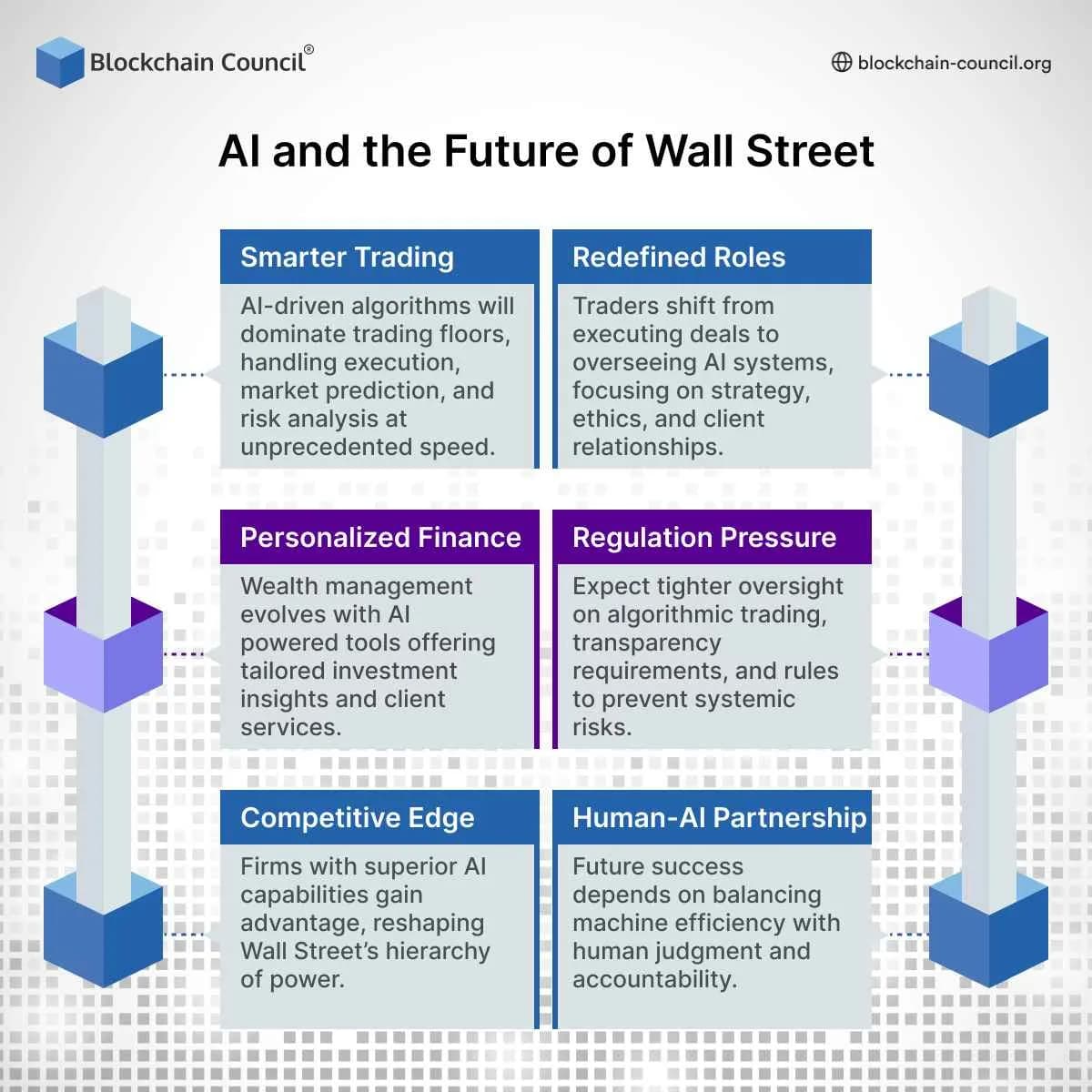
- Smarter Trading
AI-driven algorithms will dominate trading floors, handling execution, market prediction, and risk analysis at unprecedented speed. - Redefined Roles
Traders shift from executing deals to overseeing AI systems, focusing on strategy, ethics, and client relationships. - Personalized Finance
Wealth management evolves with AI-powered tools offering tailored investment insights and client services. - Regulation Pressure
Expect tighter oversight on algorithmic trading, transparency requirements, and rules to prevent systemic risks. - Competitive Edge
Firms with superior AI capabilities gain advantage, reshaping Wall Street’s hierarchy of power. - Human-AI Partnership
Future success depends on balancing machine efficiency with human judgment and accountability.
Evidence That AI Outperforms
Over the past few years, several studies have found that AI-based approaches can outperform many human managers. At Stanford University, researchers tested an AI analyst using decades of public data. They discovered that the AI model’s suggested portfolio tweaks outperformed over ninety percent of mutual fund managers between 1990 and 2020. The excess returns were striking, and the study suggested that much of what human managers do could be replicated—or even improved—by AI systems.
Another project called MarketSenseAI applied large language models to analyze earnings reports, macroeconomic conditions, and corporate news. It claimed to deliver 10–30 percent excess alpha across a 15-month period in S&P 100 stocks. While not perfect, these results highlighted that AI can find patterns in financial text that traditional models ignore.
Hedge funds are also reporting similar findings. A growing number of funds that use machine learning techniques have delivered higher returns than those run by human managers alone. Some reports estimate that AI-driven funds outperform non-adopters by three to five percent in annualized returns, especially in equity hedge strategies. Even though three percent may sound modest, in the world of hedge funds it represents billions of dollars.
Real-World Success Stories
Several high-profile funds have embraced AI. Monolith Management, for example, posted more than fifty percent returns in 2024, fueled by investments tied to AI, data centers, and semiconductor bets. While these gains were not purely the result of AI trading signals, the fund’s heavy reliance on AI research played a role.
Other giants such as Two Sigma, Renaissance Technologies, and Bridgewater Associates are known for integrating machine learning deeply into their strategies. These firms invest heavily in infrastructure, data, and talent to keep their edge. Smaller players are also entering the field with platforms like Numerai, which combines predictions from thousands of data scientists into a master AI model that determines trades.
Why It’s Not That Simple
For all the excitement, there are strong reasons to be cautious. Beating Wall Street is incredibly hard, and AI is not a guaranteed shortcut. Economists often point to the Efficient Market Hypothesis, which argues that prices already reflect all known information. If that is true, then consistently outperforming the market is nearly impossible without taking on additional risk. AI may find opportunities, but as soon as those patterns become widely known, the advantage disappears.
Another challenge is overfitting. AI models trained on historical data sometimes learn patterns that do not repeat in the future. A model that works well in one decade may fail in another because market conditions change. For instance, consumer behavior before the pandemic looked completely different from during and after it. AI trained on pre-pandemic data could misread the new environment.
The Hybrid Approach
Because of these limitations, many firms now use a hybrid strategy: combining AI with human judgment. Research suggests that “man plus machine” often performs better than either alone. AI can handle the heavy lifting of scanning markets, crunching data, and generating potential signals. Humans then apply judgment, context, and caution before making final decisions. This combination helps reduce extreme errors and improves trust in the system.
Trust and Transparency
One of the biggest barriers to full adoption is trust. AI models can be black boxes, making decisions that even their creators cannot fully explain. Regulators and investors are reluctant to rely on predictions that lack transparency. That is why explainability has become a major focus in financial AI. Tools that show why a model makes a decision are now considered essential.
Costs and Infrastructure
Another reality is that AI does not come cheap. Training advanced models requires large amounts of data and powerful computing infrastructure. Building low-latency systems for trading adds to the cost. Many smaller firms cannot compete with the resources of Wall Street giants. Even for large firms, there are cases where the costs outweigh the benefits, and AI projects fail to deliver meaningful returns.
The Hype Risk
Finally, it is worth mentioning the risk of hype. Some companies exaggerate their use of AI to attract investors, a practice known as AI washing. Just because a fund says it uses AI does not mean it actually has an edge. Careful evaluation is needed to separate genuine innovation from marketing spin.
The Limits of AI in Beating Wall Street
The idea of AI beating Wall Street excites traders, technologists, and everyday investors. But while the success stories are real, the limitations are just as important. Financial markets are complex systems influenced by human psychology, government policies, global events, and unexpected shocks. AI may excel at spotting patterns in past data, but predicting future conditions is a far more complicated task.
Market Efficiency and the Disappearing Edge
One of the central challenges for AI in finance is the problem of efficiency. The moment a profitable trading strategy is discovered, it attracts competitors. As more traders adopt the same approach, the advantage shrinks until it disappears. This process happens quickly on Wall Street, where competition is fierce and capital moves fast. AI might give a temporary edge, but once its strategies are widely known, they stop working.
Model Drift and Changing Conditions
Markets are never static. Consumer habits change, new regulations emerge, and global crises rewrite the rules. An AI trained on data from one period may misinterpret patterns in another. This problem is called model drift, and it can be devastating for performance. For example, a model trained on years of steady growth might fail completely during a sudden recession. To keep up, AI systems must be retrained constantly, and even then, predicting unprecedented events like the 2008 financial crisis or the COVID-19 pandemic remains nearly impossible.
Data Quality and Access
Financial AI depends on data, but data quality is not always guaranteed. Corporate earnings can be adjusted after release, macroeconomic indicators often arrive late, and some information is distorted by noise or bias. Social media signals can reflect hype as much as genuine sentiment. Moreover, access to high-quality datasets is expensive. Firms with deeper pockets can buy alternative data sources, such as satellite imagery for tracking retail traffic or shipping routes, giving them a huge advantage over smaller players.
The Black Box Problem
One of the biggest criticisms of AI in finance is its lack of interpretability. Many machine learning models, especially deep learning systems, are black boxes. They provide predictions without clear explanations of how those predictions are made. For investors, clients, and regulators, this creates trust issues. Why should someone commit billions of dollars to a strategy they cannot fully understand? This is why explainability tools are now an essential part of financial AI. Transparent models may not always be as powerful as black boxes, but they are more likely to win acceptance from decision-makers.
Human Judgment Still Matters
Despite AI’s capabilities, human expertise remains crucial. Markets are shaped by more than data—they are influenced by political decisions, cultural changes, and sudden world events. Humans can apply context and judgment that AI lacks. For this reason, many successful funds use a hybrid approach where AI generates signals and humans decide how to act on them. This partnership helps reduce extreme mistakes, especially in unusual or high-stakes scenarios.
Case Example: Hybrid Models
Studies show that combining human and machine insights often leads to better outcomes than relying on either one alone. For example, when AI models suggested potential trades and humans applied oversight, the combined system achieved fewer extreme errors compared to humans or AI alone. This finding supports the growing belief that the future of Wall Street is not machines replacing people, but machines and people working together.
The Role of Regulation in AI on Wall Street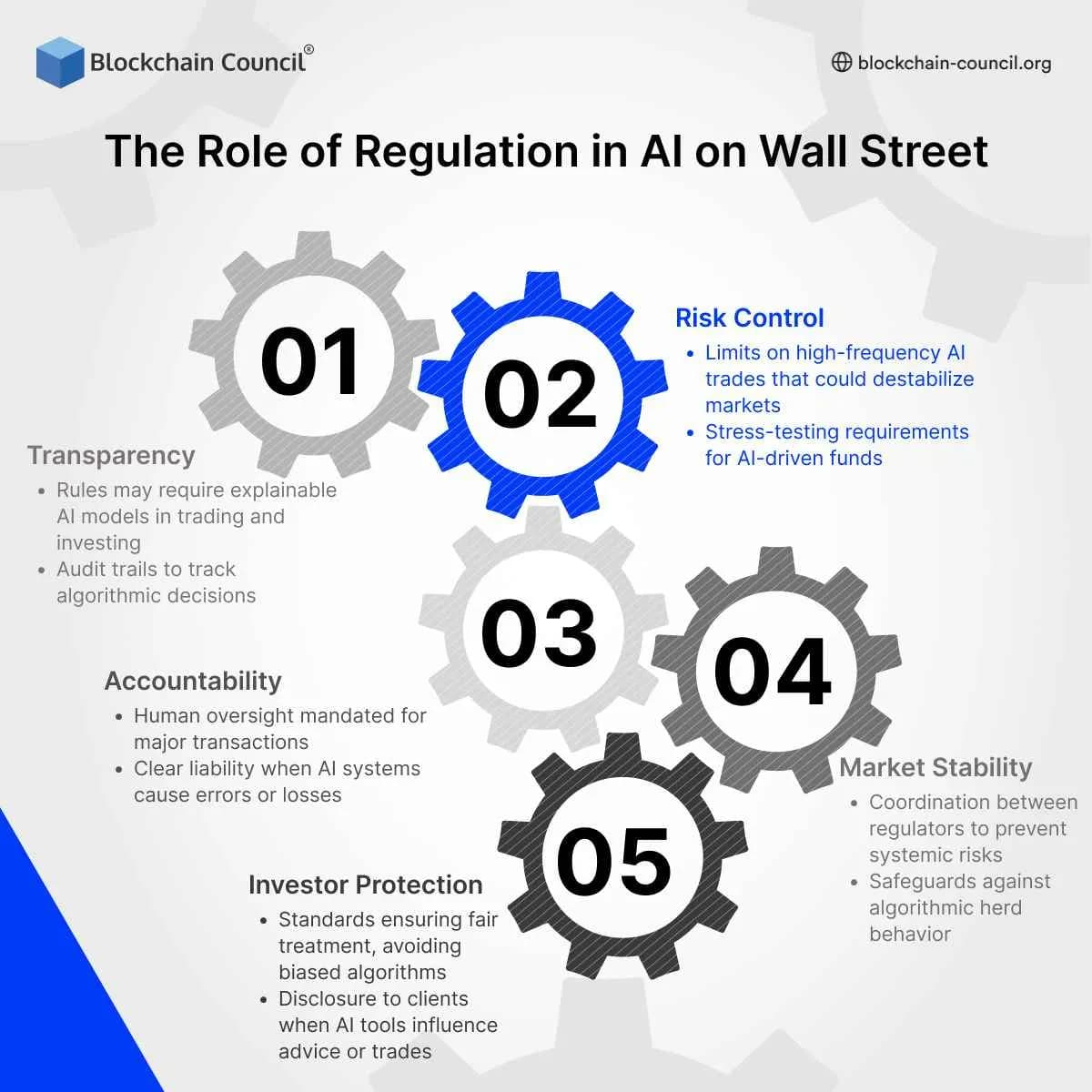
- Transparency
- Rules may require explainable AI models in trading and investing
- Audit trails to track algorithmic decisions
- Risk Control
- Limits on high-frequency AI trades that could destabilize markets
- Stress-testing requirements for AI-driven funds
- Accountability
- Human oversight mandated for major transactions
- Clear liability when AI systems cause errors or losses
- Market Stability
- Coordination between regulators to prevent systemic risks
- Safeguards against algorithmic herd behavior
- Investor Protection
- Standards ensuring fair treatment, avoiding biased algorithms
- Disclosure to clients when AI tools influence advice or trades
Financial markets are highly regulated, and the rise of AI introduces new challenges for regulators. If a human trader makes a mistake, responsibility is clear. But if an AI system makes a wrong call, who is accountable? Is it the programmers, the fund managers, or the firm as a whole?
Regulators also worry about systemic risks. If many firms adopt similar AI and machine learning models, their decisions could move in sync, amplifying market volatility. This kind of crowding effect could make markets less stable rather than more efficient. As a result, regulators are increasingly focused on transparency, explainability, and accountability in AI-driven finance.
The Costs of Competing with Wall Street Giants
AI in finance is not a level playing field. Large firms like Goldman Sachs, JPMorgan, and Renaissance Technologies invest heavily in AI infrastructure, from powerful computing clusters to vast datasets and top-tier data scientists. Smaller players, even with access to open-source AI tools, cannot match the resources of these giants.
This creates a two-tiered system: a small group of elite firms with the means to push AI to its limits, and everyone else struggling to keep up. While platforms like Numerai attempt to democratize AI in trading by crowd-sourcing models, the reality is that scale and resources still matter.
The Hype vs. Reality
AI has become a buzzword in finance, and not every claim lives up to reality. Some firms exaggerate their use of AI to attract investors, a practice often called AI washing. Just because a fund advertises itself as “AI-powered” does not mean it has a genuine competitive edge. Investors need to carefully evaluate what kind of AI is being used, how it is integrated into decision-making, and whether it truly improves performance.
Opportunities for Professionals
Despite these challenges, AI in finance is creating huge opportunities for professionals who want to be part of this transformation. The demand for skilled analysts and developers who understand AI, data science, and finance is rising quickly.
For those interested in mastering the technical side, the Data Science Certification offers a strong foundation in handling data, training models, and evaluating results. This path is ideal for people who want to design or manage financial AI systems.
For professionals on the business side, learning how to connect AI forecasting to strategy is equally important. The Marketing and Business Certification helps leaders understand how to apply predictive tools in planning campaigns, evaluating markets, and guiding long-term growth.
New Frontiers: Language Models in Finance
A promising development is the use of large language models (LLMs) to analyze financial text. Earnings reports, analyst calls, and regulatory filings contain valuable information, but they are difficult for humans to process at scale. AI language models can scan these documents and detect signals that point to future market performance.
For instance, studies show that LLMs can outperform human analysts in identifying financial risks, achieving accuracy rates of around sixty percent compared to human performance in the mid-fifties. While not flawless, these improvements can give firms an edge in highly competitive markets.
The Crowding Effect
Even when AI delivers strong results, success creates its own problem. If many firms adopt the same AI-driven strategies, markets may become crowded. Everyone reacts to the same signals at once, reducing profits and sometimes amplifying volatility. For example, if multiple funds use AI to predict a stock’s rise and buy simultaneously, the stock price may shoot up quickly, reducing the chance of profit. Worse, if models misread a situation, they can trigger mass sell-offs, creating instability.
Looking Beyond Short-Term Gains
Another limitation is that most AI strategies focus on short-term signals. High-frequency trading algorithms can exploit microsecond opportunities, but long-term forecasting remains difficult. Economic conditions, consumer trends, and geopolitical events often shape markets over years, not days. AI may excel at fast trades but struggle to guide investors seeking long-term growth.
The Future of AI on Wall Street
As AI continues to expand its reach across industries, financial markets remain one of the most competitive and high-stakes testing grounds. The central question—can AI really beat Wall Street?—cannot be answered with a simple yes or no. Instead, the future looks more like a balance of opportunities and limits. In this final part of the article, we will explore how new forms of AI are changing the game, what skills professionals need, and where the industry is headed.
Agentic AI and Autonomous Finance
One of the most exciting trends in artificial intelligence is the rise of agentic AI. Unlike earlier systems that needed constant input, agentic models can make decisions, adapt to new situations, and even run tasks independently. On Wall Street, this could mean autonomous trading agents that monitor markets, adjust portfolios, and interact with other systems without human intervention.
Agentic AI is still in its early stages, but it is gaining traction quickly. Reports show that firms experimenting with autonomous AI agents are already seeing stronger performance in volatile markets. These systems are able to run simulations, test multiple strategies at once, and respond to events faster than human teams ever could. For professionals who want to stay ahead of this curve, the agentic ai certification offers a structured way to understand and apply this technology in financial contexts.
The Role of Blockchain and Transparency
While AI improves predictive power, blockchain offers transparency and trust. Together, they are starting to shape a new kind of finance. Blockchain technology ensures that transactions are recorded securely and openly, while AI interprets and analyzes that data to predict trends. This combination is already being tested in areas like supply chain finance, fraud detection, and tokenized assets.
As more financial products become digital, professionals who combine AI knowledge with blockchain expertise will be in demand. Exploring blockchain technology courses is one way to build this dual skill set. These courses provide the foundations for understanding decentralized systems while also connecting them to the needs of financial markets.
Building Careers in AI-Driven Finance
For individuals, the rise of AI in finance is both a challenge and an opportunity. Traditional financial roles are shifting. Analysts who once spent hours poring over spreadsheets now need to work with machine learning outputs. Traders who relied on instincts must now interpret algorithmic signals. To adapt, professionals are turning to structured learning paths.
- A strong starting point is an AI certification, which helps professionals understand how AI models are built, trained, and applied in real-world contexts.
- For those focused on the data side, the Data Science Certification provides the tools to clean, prepare, and interpret financial datasets, making it easier to create reliable predictive systems.
- Leaders in finance and business strategy benefit from the Marketing and Business Certification, which focuses on using forecasts to guide campaigns, understand customer behavior, and drive growth.
- Broader tech certifications also remain valuable, ensuring professionals understand not only AI but the wider ecosystem of cloud systems, security, and data infrastructure.
These pathways show that AI is not just changing markets—it is reshaping careers and education as well.
AI and the Problem of Regulation
One of the biggest questions for the future is how regulators will manage AI-driven trading. If autonomous agents dominate markets, what happens when they all react the same way to a signal? The risk of flash crashes or extreme volatility grows. Regulators are therefore beginning to set standards for AI explainability, accountability, and fairness in financial systems.
In addition, there is growing concern about systemic risk. If too many firms use similar AI models, a single flaw could trigger widespread disruption. Regulators are encouraging diversity in approaches, requiring transparency about how models are trained, and setting boundaries for automated decision-making. For professionals entering the industry, understanding these regulatory frameworks will be as important as mastering the technology itself.
Beyond Beating the Market
For many experts, the real promise of AI is not about consistently beating the market, but about making better decisions. AI can help investors manage risk, detect fraud, reduce costs, and uncover inefficiencies. While it may not guarantee returns above the market average forever, it can improve the quality of strategies and give investors more tools to navigate uncertainty.
This perspective aligns with a growing view that the question “Can AI beat Wall Street?” may be the wrong one. The better question is: “How can AI make Wall Street work more effectively for businesses, investors, and society?”
Education, Technology, and Continuous Learning
The rapid pace of change means that continuous learning is essential. Professionals cannot rely on one-time training. Instead, they need to update their skills as AI models, data sources, and financial systems evolve. This is where platforms dedicated to technology education play a crucial role. They provide not only AI knowledge but also the broader digital skills needed to stay relevant in a fast-changing world.
Crowding, Creativity, and Human Ingenuity
One of the main risks of AI-driven trading is crowding, where too many firms chase the same signals. But this also highlights the role of creativity. Human ingenuity remains critical in designing unique approaches, combining data sources in novel ways, and spotting opportunities that algorithms alone cannot. The best results come when humans and AI complement each other—AI providing scale and speed, humans providing creativity and context.
Can AI Truly Beat Wall Street?
The final answer depends on what we mean by “beat.” If beating Wall Street means outperforming most human managers, then yes, AI has already shown it can. Studies confirm that AI-driven portfolios have outpaced the majority of mutual fund managers over decades. If beating Wall Street means delivering permanent, risk-free returns above the market itself, then the answer is no. Markets adapt, strategies lose their edge, and even the best AI cannot predict black swan events.
What is clear is that AI is now an inseparable part of Wall Street. It influences everything from stock picks to risk management, from fraud detection to policy planning. The firms that succeed will not be those that blindly trust machines, but those that build balanced systems where AI and human insight work together.
Final Takeaway
AI is reshaping Wall Street, but it is not a magic wand. It has proven capable of outperforming many human managers, yet it faces challenges of transparency, crowding, and changing market conditions. For professionals, the future is less about competing with AI and more about learning to work with it. By pursuing structured learning paths such as AI certs, data Science programs, and blockchain or business-focused certifications, individuals can position themselves for success in an industry where AI is no longer optional.
The bottom line is simple: AI can, at times, beat Wall Street. But its true value lies in making finance smarter, faster, and more adaptive. Whether you are an investor, a policymaker, or a professional building your career, the key is not to fear AI, but to learn how to harness it responsibly.
Related Articles
View All
AI & ML
How to Use GPT-6 Astra for Free
Find out whether GPT-6 Astra is available for free, which ChatGPT plans currently include access, and what options users have for trying OpenAI’s latest AI model.

AI & ML
Fable vs GPT: Fable 5.1 vs GPT-6 Astra Compared
A practical Fable vs GPT comparison covering Fable 5.1, GPT-6 Astra, Claude, ChatGPT, benchmarks, pricing, and real enterprise use cases.

AI & ML
GPT 6 Astra: What OpenAI's New Frontier LLM Means for AI, Cybersecurity, and Work
GPT 6 Astra is OpenAI's new frontier LLM, with gated access, Critical cybersecurity capability, and major implications for ChatGPT, developers, and enterprises.
Trending Articles
The Role of Blockchain in Ethical AI Development
How blockchain technology is being used to promote transparency and accountability in artificial intelligence systems.
AWS Career Roadmap
A step-by-step guide to building a successful career in Amazon Web Services cloud computing.

Top 5 DeFi Platforms
Explore the leading decentralized finance platforms and what makes each one unique in the evolving DeFi landscape.