

AI as a Collaborator in Creativity
 Michael Willson
Artificial intelligence is no longer confined to technical tasks like data processing or automation. It is stepping into the creative world, where it does not replace human imagination but actively collaborates with it. The key idea here is simple: AI has become a creative partner. Instead of asking whether AI can be creative on its own, the more practical question today is, how does AI collaborate with humans to make creativity more powerful and accessible? That’s the question this article will answer directly. And for those who want to build skills in this fast-changing space, an AI certification is one of the best ways to combine knowledge of advanced AI tools with practical use cases.
What Does “AI as a Creative Collaborator” Mean?
When people talk about AI and creativity, they often think of tools that generate content automatically. But true collaboration goes deeper. AI does not just act as a tool, like a paintbrush or a typewriter. It becomes a partner in the process, suggesting new ideas, experimenting with patterns, or even co-writing narratives.

Researchers describe four main levels of human-AI creative interaction:
- Tool level: AI acts like a pen or brush. It is used directly by humans to perform basic tasks.
- Assistant level: AI gives suggestions or drafts, which humans can accept or modify.
- Specialist level: AI takes on specific creative tasks, such as generating background music or designing a logo.
- Collaborator level: AI works side by side with humans, offering ideas that inspire, surprise, or challenge the creator.
This last stage is where collaboration becomes most interesting. Humans and AI interact in a loop. The human prompts the AI, the AI generates something, and the human refines or expands on it. The process is not about one replacing the other, but about the two creating something together that neither could achieve alone.
AI in Action to Boost Creativity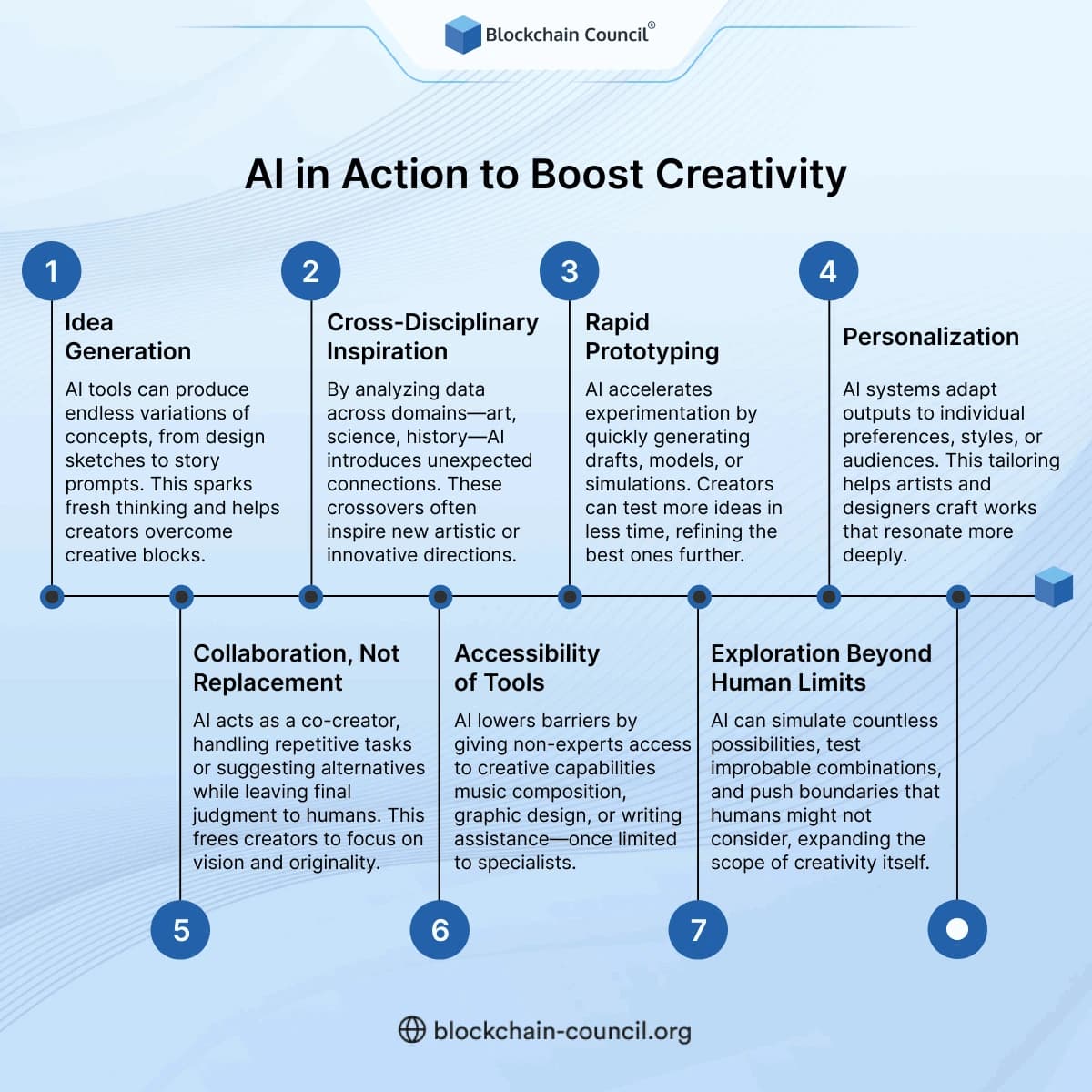
Idea Generation
AI tools can produce endless variations of concepts, from design sketches to story prompts. This sparks fresh thinking and helps creators overcome creative blocks.
Cross-Disciplinary Inspiration
By analyzing data across domains—art, science, history—AI introduces unexpected connections. These crossovers often inspire new artistic or innovative directions.
Rapid Prototyping
AI accelerates experimentation by quickly generating drafts, models, or simulations. Creators can test more ideas in less time, refining the best ones further.
Personalization
AI systems adapt outputs to individual preferences, styles, or audiences. This tailoring helps artists and designers craft works that resonate more deeply.
Collaboration, Not Replacement
AI acts as a co-creator, handling repetitive tasks or suggesting alternatives while leaving final judgment to humans. This frees creators to focus on vision and originality.
Accessibility of Tools
AI lowers barriers by giving non-experts access to creative capabilities—music composition, graphic design, or writing assistance—once limited to specialists.
Exploration Beyond Human Limits
AI can simulate countless possibilities, test improbable combinations, and push boundaries that humans might not consider, expanding the scope of creativity itself.
Why Researchers Say AI Boosts Creativity
Recent studies provide evidence that AI genuinely improves creative performance when used well. A 2024 paper in Science Advances studied people with varying levels of creativity. It found that individuals with lower baseline creativity produced better stories when they worked with AI. Their outputs were judged to be more original and enjoyable.
Another study from Oregon State University looked at student writing. It showed that students who used AI under teacher guidance produced more creative and higher-quality work than those who used AI without guidance. The results highlight that AI’s creative boost works best when humans bring intention and context.
Carnegie Mellon University also studied designers, artists, and musicians using AI tools. Their findings were clear: human-AI teams often created outcomes that were more novel and surprising than either the human or the AI could produce alone. The key benefit was how AI helped humans escape creative ruts by suggesting directions they might not normally explore.
Together, these studies suggest a pattern. AI acts as a multiplier of creativity, especially for people who feel blocked or less confident in their own originality.
How AI Actually Helps Creativity
The practical ways AI collaborates with humans in creative work are easy to see across different fields.
In Design
AI-powered tools now suggest layouts, color palettes, and styles. In software like Figma or Photoshop, features like generative fill allow designers to test multiple directions instantly. Instead of working through one design at a time, creators can explore dozens in minutes.
In Writing
Writers use AI to brainstorm plot twists, create dialogue, or develop character backstories. For journalists, AI can suggest headlines or summaries. For novelists, it can serve as a partner that sparks new narrative turns. Importantly, the writer stays in control, but AI provides fresh material when ideas stall.
In Education
Students working with AI are finding new confidence in writing. When guided by teachers, they can experiment with genres, tones, and styles they would not try otherwise. AI is not just correcting grammar but nudging students into creative spaces they might avoid on their own.
In Music
Musicians collaborate with AI to generate beats, chord progressions, and even experimental soundscapes. For example, AI can suggest several possible melodies for a chorus, giving the artist more options to refine. Many artists report that AI shortens the gap between idea and prototype, letting them focus on refining the emotional aspects.
In Crafts
Even traditional crafts like weaving or pottery are seeing AI collaboration. AI can suggest patterns or textures that artisans then adapt by hand. This blend of tradition and innovation illustrates that AI is not replacing cultural practices but enriching them with new possibilities.
The Benefits of Working with AI as a Creative Partner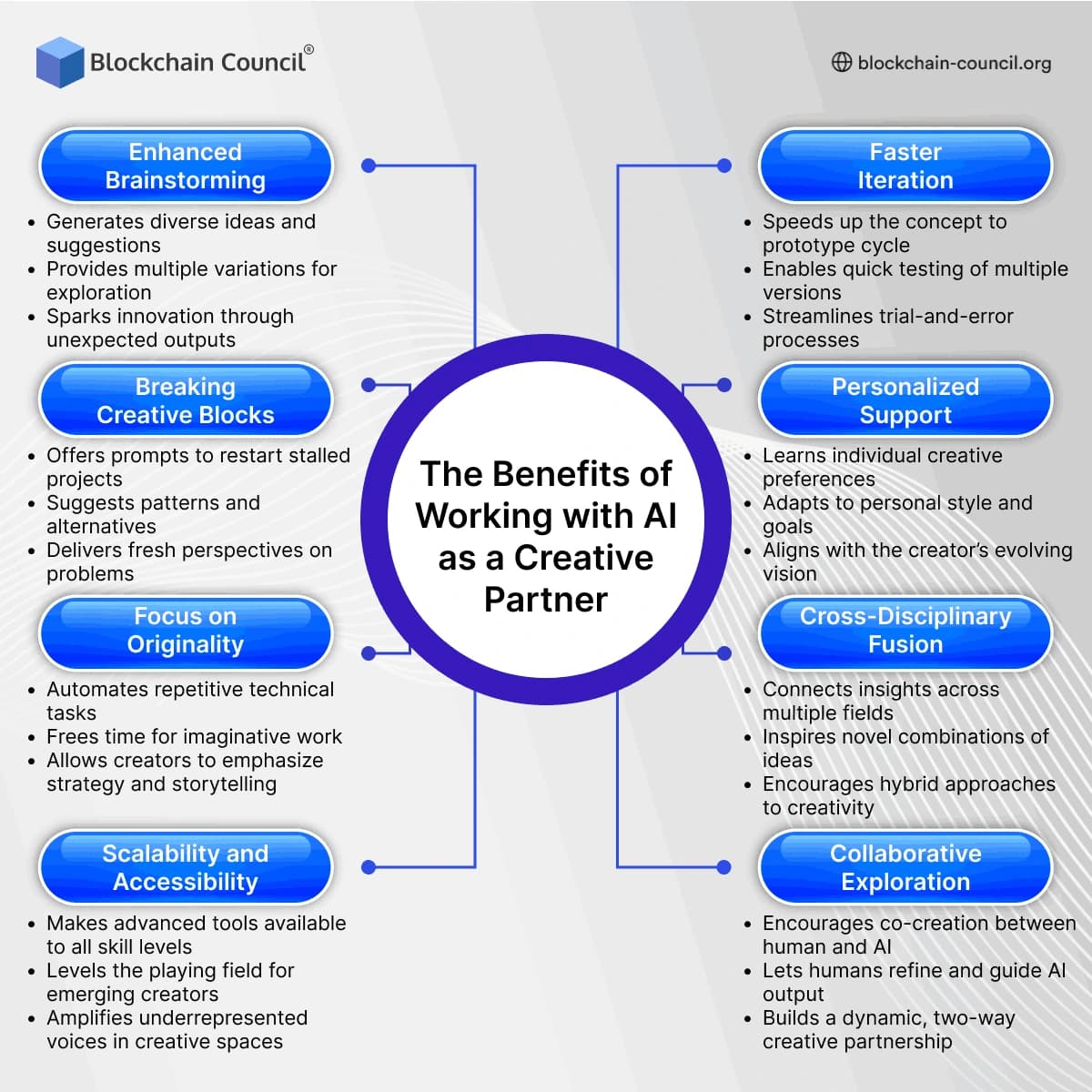
Enhanced Brainstorming
- Generates diverse ideas and suggestions
- Provides multiple variations for exploration
- Sparks innovation through unexpected outputs
Faster Iteration
- Speeds up the concept-to-prototype cycle
- Enables quick testing of multiple versions
- Streamlines trial-and-error processes
Breaking Creative Blocks
- Offers prompts to restart stalled projects
- Suggests patterns and alternatives
- Delivers fresh perspectives on problems
Personalized Support
- Learns individual creative preferences
- Adapts to personal style and goals
- Aligns with the creator’s evolving vision
Focus on Originality
- Automates repetitive technical tasks
- Frees time for imaginative work
- Allows creators to emphasize strategy and storytelling
Cross-Disciplinary Fusion
- Connects insights across multiple fields
- Inspires novel combinations of ideas
- Encourages hybrid approaches to creativity
Scalability and Accessibility
- Makes advanced tools available to all skill levels
- Levels the playing field for emerging creators
- Amplifies underrepresented voices in creative spaces
Collaborative Exploration
- Encourages co-creation between human and AI
- Lets humans refine and guide AI output
- Builds a dynamic, two-way creative partnership
AI’s role as a collaborator brings several clear benefits:
- Faster brainstorming: Instead of staring at a blank page or canvas, creators can instantly generate starting points.
- Breaking creative blocks: When ideas stall, AI offers unexpected directions.
- Leveling the playing field: People who don’t consider themselves “creative” gain tools to participate in art, design, or writing.
- Expanding horizons: AI draws from massive datasets, so it can introduce unusual combinations that humans might not think of.
For many, the biggest benefit is that AI removes the fear of getting started. It turns the blank page into a conversation partner.
The Risks and Limitations
Like any partnership, working with AI has drawbacks.
- Similarity across outputs: Because AI relies on patterns in training data, many outputs look or sound alike. A study noted that stories written with AI often had similar structures, even if they were more creative than without AI.
- Dependence: Relying too much on AI may cause creators to lose confidence in their own ideas.
- Control issues: When AI generates too much, some users feel less ownership of the process.
- Bias in data: AI can reflect cultural or social biases present in the datasets it was trained on, which may limit diversity or authenticity.
These risks don’t cancel the benefits, but they show why human oversight is critical. AI is powerful, but creativity still depends on human values and judgment.
How Design of AI Tools Shapes the Collaboration
The way AI is built and presented influences whether people feel like collaborators or passive users.
When AI tools simply output results without explanation, users may feel like they are taking instructions from a machine. But when AI interacts, explains, or asks clarifying questions, it feels like a more equal partner. This design choice can make the difference between users feeling empowered or sidelined.
Guidance also matters. Students who used AI without instruction often relied on surface-level features. But when guided by teachers, they explored deeper creative options. The same is true for professionals. Leaders who set clear expectations for AI use in teams get better results than those who simply tell people to “use AI.”
Finally, not every creative task is well suited for AI. AI excels at brainstorming and pattern recognition but struggles with emotional nuance, cultural storytelling, or humor that requires lived experience. Humans still lead in these areas, and collaboration works best when each side plays to its strengths.
Does AI Limit Originality?
One of the most common concerns about AI in creative work is whether it makes ideas less original. At first glance, the evidence is mixed. On one hand, AI helps people generate more creative outputs than they could on their own. On the other hand, the variety among those outputs can shrink.
A 2024 study highlighted in The Guardian found that writers who used AI produced more engaging and enjoyable stories. Yet many of those stories followed similar patterns. This happens because AI systems are trained on large datasets of existing work. They recombine what they have learned, which means their outputs often echo the training data.
The risk is homogenization. If millions of creators use similar prompts with the same AI tools, the results may converge on a handful of styles. This makes it harder for unique voices to stand out.
The solution lies in how AI is used. When humans accept outputs passively, originality suffers. But when humans push AI, refine ideas, and add personal context, originality can flourish. In other words, AI can be a creative partner, but the human must stay in the driver’s seat.
Real-World Industry Examples of Collaboration
AI’s role as a collaborator is not confined to art studios or classrooms. It is already reshaping entire industries.
Film and Media
Filmmakers are using AI to storyboard scenes, generate visual effects, or test multiple versions of a script. While directors and writers remain in charge, AI reduces the time it takes to move from idea to production-ready concepts.
Marketing and Advertising
Creative teams rely on AI to suggest campaign slogans, generate social media content, and even design ad visuals. Humans then refine these drafts, ensuring the message matches brand identity and cultural context. This blend of automation and judgment makes campaigns faster and more dynamic.
Education and Learning
Teachers are experimenting with AI-driven storytelling tools to encourage student creativity. With AI prompts, students try new narrative forms, like science fiction or historical fiction, that they might not have considered otherwise. Guided use turns AI from a cheat tool into a learning partner.
Music and Performance
Producers use AI to generate experimental beats and samples. Musicians take these fragments, refine them, and build songs. Live performers also integrate AI visuals into stage shows, creating immersive experiences that blend technology and art.
Across all these examples, the common theme is clear: humans remain in control, but AI acts as a partner that expands possibilities.
Why Human Guidance Matters
AI can collaborate, but the quality of collaboration depends on how people use it. Guidance shapes outcomes.
The Oregon State University study on student writing proved this point. When instructors gave no guidance, students often used AI at a shallow level, like fixing grammar or generating filler content. But when instructors encouraged students to use AI to explore new genres or styles, the students produced far more creative and original work.
The same holds true in professional settings. Creative directors who set rules for how teams should engage with AI—such as “use it for first drafts, but always add a personal twist”—see better results than teams that experiment without structure.
This shows that AI is not a magic creativity button. It is a tool that amplifies what humans put into it. Strong guidance helps people use AI to its full potential.
The Balance Between Speed and Quality
AI can generate many ideas quickly, but not all of them are useful. Humans must still filter, refine, and select. This creates a balance between speed and quality.
For brainstorming, speed matters. Getting dozens of ideas in seconds beats waiting hours for inspiration. But for final products, quality matters more. A catchy headline is worthless if it offends or misleads an audience. That’s why human review and editing remain essential.
AI’s ability to generate at scale is both a blessing and a challenge. Without human judgment, the flood of ideas could overwhelm or dilute creative vision. With strong curation, however, the speed becomes a powerful asset.
Cultural and Ethical Considerations
Creativity is not just about novelty. It is also about meaning, culture, and values. This is where AI faces serious challenges.
Most AI systems are trained on large datasets that reflect existing cultural biases. If those datasets lack diversity, AI suggestions may repeat stereotypes or ignore marginalized voices. For example, an AI trained mostly on Western literature may not capture the nuances of Asian or African storytelling traditions.
This raises ethical questions. Whose voices are amplified when AI generates creative content? Whose voices are silenced? These questions matter for fairness and representation.
Human creators have the responsibility to filter AI outputs through cultural awareness. They must ensure that the final product reflects authentic values rather than hidden biases. AI may collaborate, but it cannot take responsibility for cultural sensitivity. That remains a human role.
The Workplace Impact of Human-AI Collaboration
Collaboration between AI and humans is changing the workplace. In fields like design, marketing, and content creation, teams are adopting AI not as a replacement but as a productivity booster.
For example, marketing teams use AI to generate first drafts of ad copy. Human copywriters then refine the language to match the brand voice. Designers use AI to test multiple ad layouts quickly, but still rely on human instinct for the final choice.
This means professionals need new skills. It’s no longer enough to know how to create. People must also know how to collaborate with AI. This includes giving precise prompts, judging AI outputs, and editing effectively.
Education plays a central role in building these skills. A Data Science Certification trains professionals to understand the workflows behind AI tools, making them more effective collaborators. A Marketing and Business Certification helps leaders apply AI responsibly in campaigns and branding. And blockchain technology courses show how other emerging technologies face similar challenges of scale and trust, giving professionals a wider perspective.
By building these skills, workers don’t just use AI. They shape how AI collaborates with them, ensuring that human judgment stays central.
Uneven Distribution of Benefits
AI collaboration is powerful, but not everyone benefits equally. Access to advanced tools depends on resources, training, and awareness. Wealthier companies and individuals can afford premium AI systems, while smaller players may be left behind.
This creates a risk of widening inequality in creative industries. If only well-funded organizations use AI collaboration, they may dominate markets with faster, cheaper, and more polished creative output. Independent artists could struggle to compete.
On the flip side, AI also lowers barriers. People who never considered themselves creative now experiment with design, music, or writing because AI helps them start. This democratization could expand participation in creative fields, but only if access is widespread and affordable.
The Hidden Infrastructure Behind Creative AI
When people see AI-generated art or writing, they often imagine that the process is weightless. But behind every creative collaboration is a physical infrastructure that supports the technology. Large data centers host the models, while powerful chips run the computations needed for each prompt. This infrastructure consumes electricity, water, and hardware resources.
Why does this matter in the context of creativity? Because the ability for AI to collaborate at scale depends on systems that are expensive to maintain. Only a handful of major companies can afford to build and train the largest creative models. That means access to advanced creative AI is concentrated in a few hands. Independent creators often rely on smaller platforms or third-party tools that license the technology.
This setup highlights two truths. First, AI collaboration is not free—it comes with hidden environmental and financial costs. Second, democratizing access to AI collaboration will require making tools more affordable and transparent. Without this, creativity risks becoming centralized around large corporations.
The Long-Term Future of Human-AI Creative Collaboration
Looking ahead, AI is likely to become even more deeply embedded in creative work. Instead of being a separate tool, it may become part of the natural workflow in schools, studios, and offices.
For example, film editors might work in software where AI automatically suggests scene cuts, transitions, and sound effects. Writers might draft stories in word processors where AI offers narrative twists as they type. Musicians could jam live with AI systems that improvise in real time.
The future is not about AI taking over creativity. It is about AI becoming invisible in the process. Just as spellcheck became a natural part of writing, AI suggestion engines could become a natural part of creating. The challenge will be ensuring that these systems amplify human originality rather than reduce it.
The Risks of Over-Reliance
Collaboration has limits. If people rely too heavily on AI, they may lose touch with their own creative instincts. This is a common fear among teachers, artists, and writers.
One risk is skill atrophy. If a student always asks AI to generate story ideas, they may never learn how to brainstorm independently. If a designer depends too much on automated layouts, they may not practice the fundamentals of visual balance.
Another risk is homogenization. If millions of people use the same AI tools with similar prompts, creative outputs may begin to look alike. This reduces diversity and weakens cultural authenticity.
Over-reliance could also reduce human agency. Instead of leading the creative process, people may start following AI suggestions without questioning them. This undermines the role of human judgment and risks turning collaboration into dependency.
The solution is balance. AI should act as a partner, not a replacement. Humans should remain in control of vision, direction, and meaning. The best collaborations happen when AI handles scale and speed while humans provide depth and context.
Building the Right Skills for Creative AI
To collaborate effectively with AI, professionals need new skills. They must learn how to craft prompts that lead to valuable outputs, how to edit AI-generated content, and how to blend human originality with machine assistance.
This is where structured education helps. AI certs are emerging as a way to prepare people for this shift. They train learners to understand how AI systems function and how to apply them responsibly in creative contexts.
Why Cultural Sensitivity Still Matters
Creativity is more than novelty. It carries cultural meaning. When AI collaborates, it must be guided to respect this meaning. Without careful oversight, AI outputs can unintentionally reproduce stereotypes or ignore cultural nuance.
For example, an AI tool trained mostly on Western datasets might generate stories or art that lack authentic representation of non-Western traditions. This is not malicious, but it is a limitation of the training process. Human creators must step in to filter, adapt, and add cultural depth.
This highlights why collaboration works best when humans stay in charge of context and ethics. AI brings patterns and possibilities. Humans bring values, diversity, and lived experience. Together, they can produce work that is both original and meaningful.
The Big Picture: What Collaboration Really Means
At its core, AI collaboration is about extending human capacity. It does not eliminate the need for imagination, but it does reduce the barriers to exploring new ideas. It lets people move from concept to draft faster, freeing more time for refinement and expression.
The key is to treat AI as a partner. That means recognizing its strengths—speed, scale, and idea generation—while also acknowledging its limits—lack of cultural understanding, risk of similarity, and potential for bias. Collaboration happens when both sides do what they do best.
Conclusion
AI as a collaborator in creativity is no longer experimental. It is real, widespread, and growing. From classrooms to studios to offices, humans and AI are already creating together. The evidence shows that when collaboration is done right, the results are often more powerful than what either side could achieve alone.
But this collaboration is not automatic. Humans must guide the process, ensure originality, and protect cultural diversity. Professionals must develop skills that allow them to shape AI tools rather than simply follow them. And companies must design systems that support human agency rather than replace it.
The future of creativity is not AI versus humans. It is AI with humans. By treating AI as a collaborator, society can unlock new levels of imagination while keeping human values at the center. This balance is what will define the next era of creative work.
Related Articles
View All
AI & ML
What is Jev: Typesafe New AI Model
Learn what Jev is, how TypeSafe AI’s new System One model works, and how it delivers fast, structured, probabilistic decisions for software automation.

AI & ML
What Is Strawberry Browser? The Self-Driving Browser Explained
Strawberry Browser is an agentic browser with built-in AI companions that can navigate websites, work across tabs, automate repetitive tasks, extract data, and complete multi-step web workflows.

AI & ML
How Recursive Self-Improvement Could Accelerate AI Innovation
Recursive self-improvement can speed AI innovation through bounded loops that refine prompts, code, data, and evaluations, but safety controls are essential.
Trending Articles
AWS Career Roadmap
A step-by-step guide to building a successful career in Amazon Web Services cloud computing.
How to Install Claude Code
Learn how to install Claude Code on macOS, Linux, and Windows using the native installer, plus verification, authentication, and troubleshooting tips.
Blockchain in Supply Chain Provenance Tracking
Supply chains are under pressure to prove not just efficiency, but also authenticity, sustainability, and fairness. Customers want to know if their coffee really is fair trade, if the diamonds are con