

AI Agents News

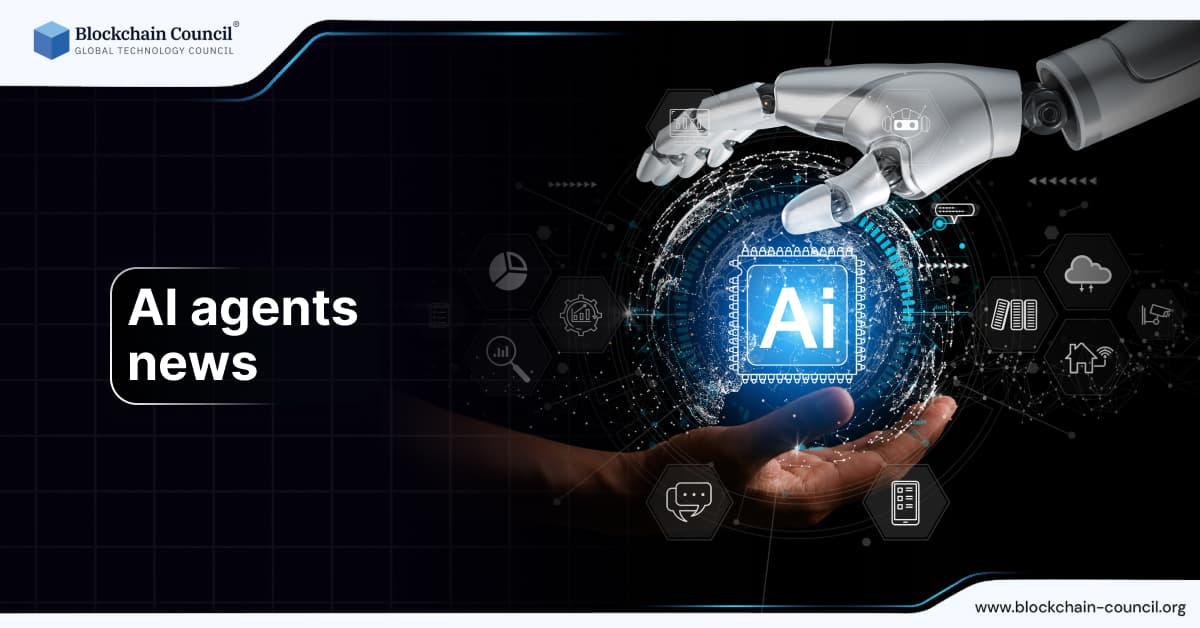
Artificial intelligence is moving beyond simple chatbots into a new era defined by AI agents. These systems are designed not only to respond to queries but also to take actions, make decisions, and complete complex workflows autonomously. The rapid evolution of AI agents is shaping industries, redefining productivity, and raising new questions about control, ethics, and the future of work.
This article explores the latest AI agents news, recent developments, real world applications, and future trends. It also highlights how professionals can prepare for this shift through relevant skills and certifications.

For those looking to build foundational expertise in artificial intelligence, programs such as the Claude Code Certification and the AI expert certification provide structured learning paths and practical insights.
What Are AI Agents
AI agents are systems that can perceive their environment, process information, and take actions to achieve specific goals. Unlike traditional AI models that generate responses, AI agents can perform tasks such as scheduling, coding, analyzing data, and interacting with software systems.
Key Characteristics
Autonomy in decision making
Ability to interact with tools and APIs
Continuous learning and adaptation
Goal oriented behavior
These features make AI agents more powerful and practical than earlier AI systems.
Recent Developments in AI Agents
Rise of Autonomous Workflows
AI agents are increasingly being used to automate workflows in business operations. From customer service to data analysis, these systems reduce manual effort and improve efficiency.
Integration with Software Tools
Modern AI agents can integrate with applications such as project management tools, databases, and communication platforms. This allows them to execute tasks across multiple systems seamlessly.
Multi Agent Systems
Organizations are experimenting with multiple AI agents working together to complete complex tasks. These systems distribute responsibilities and collaborate to achieve outcomes.
Real World Example
A company uses AI agents to manage its customer support system. One agent handles initial queries, another processes orders, and a third manages follow ups. This multi agent approach reduces response time and improves customer satisfaction.
AI Agents in Different Industries
Healthcare
AI agents assist in patient scheduling, data analysis, and preliminary diagnostics.
Finance
They analyze market trends, detect fraud, and automate transactions.
Retail
AI agents manage inventory, personalize recommendations, and handle customer interactions.
Technology
Developers use AI agents for coding, debugging, and system optimization.
Professionals interested in building technical expertise can explore the AI Powered coding expert Course.
Benefits of AI Agents
Increased Efficiency
AI agents automate repetitive tasks, allowing humans to focus on strategic work.
Scalability
Businesses can scale operations without proportional increases in workforce.
Accuracy
Automation reduces human error and improves consistency.
Cost Reduction
Organizations save resources by optimizing processes.
Challenges and Concerns
Reliability
AI agents must be carefully designed to avoid errors in critical tasks.
Security Risks
Autonomous systems interacting with multiple tools can create vulnerabilities.
Ethical Issues
Questions about accountability and transparency remain unresolved.
Job Displacement
Automation may impact certain job roles, requiring workforce adaptation.
Role of AI in Marketing and Business
AI agents are transforming marketing strategies by analyzing data, predicting trends, and personalizing campaigns. Businesses are leveraging these tools to improve engagement and efficiency.
Professionals can gain insights into these applications through the AI powered marketing course.
Future Trends in AI Agents
Enhanced Autonomy
Future AI agents will operate with minimal human intervention.
Better Collaboration
Agents will work alongside humans and other agents more effectively.
Improved Decision Making
Advances in AI will enable more accurate and context aware decisions.
Expansion Across Industries
AI agents will become standard tools in various sectors.
Ethical and Regulatory Considerations
Transparency
Users must understand how AI agents make decisions.
Accountability
Clear responsibility for AI actions is necessary.
Data Privacy
Protecting user data is critical in agent based systems.
Preparing for the AI Agent Era
Skill Development
Professionals need to learn how to work with AI systems.
Continuous Learning
Technology evolves rapidly, requiring ongoing education.
Adaptability
Flexibility is key to staying relevant in a changing landscape.
Conclusion
AI agents represent a significant shift in the evolution of artificial intelligence. By combining autonomy, adaptability, and integration, these systems are transforming industries and redefining how work is done.
While challenges remain, the potential benefits are substantial. Understanding AI agents and their applications is essential for individuals and organizations aiming to stay competitive in the digital age.
FAQs
1. What are AI agents?
AI agents are intelligent systems designed to act autonomously by perceiving their environment, processing information, and executing actions to achieve defined goals. Unlike traditional AI tools that only generate responses, AI agents can interact with systems, automate workflows, and make decisions in real time. They are increasingly used in business, healthcare, and technology environments because they reduce manual work and improve efficiency. Their ability to operate independently makes them one of the most important advancements in modern artificial intelligence.
2. How do AI agents differ from chatbots?
Chatbots are primarily reactive systems that respond to user queries, often following predefined scripts or patterns. In contrast, AI agents are proactive and capable of performing tasks beyond conversation, such as scheduling meetings, processing transactions, or analyzing data. They can integrate with external tools and systems, making them far more powerful and versatile. This difference is what makes AI agents a major step forward in automation.
3. What industries use AI agents?
AI agents are widely used across industries such as healthcare, finance, retail, logistics, and technology. In healthcare, they assist with patient management and diagnostics. In finance, they help detect fraud and analyze markets. Retail businesses use them for customer service and inventory management. Their versatility allows them to be applied in almost any sector that involves data and decision making.
4. Are AI agents reliable?
AI agents can be highly reliable when properly designed, trained, and monitored. However, their performance depends on the quality of data and algorithms used. Organizations must implement safeguards, testing, and oversight to ensure consistent and accurate behavior, especially in critical applications.
5. Can AI agents replace human workers?
AI agents are more likely to augment human work rather than completely replace it. They handle repetitive and time consuming tasks, allowing humans to focus on strategic and creative activities. While some roles may change or evolve, new opportunities will emerge in areas related to AI development and management.
6. What skills are needed to work with AI agents?
Working with AI agents requires knowledge of artificial intelligence, programming, data analysis, and system integration. Additionally, problem solving and adaptability are important, as the technology continues to evolve rapidly. Continuous learning is essential to stay relevant in this field.
7. How do AI agents improve efficiency?
AI agents automate repetitive processes, reduce manual intervention, and streamline workflows. This leads to faster task completion, fewer errors, and better resource utilization. Organizations benefit from improved productivity and reduced operational costs.
8. What are the risks of AI agents?
Risks include security vulnerabilities, ethical concerns, and potential misuse. For example, an improperly configured agent could access sensitive data or make incorrect decisions. Proper governance and safeguards are necessary to minimize these risks.
9. Can AI agents learn over time?
Yes, many AI agents use machine learning techniques to improve their performance over time. They analyze new data, learn from past actions, and adapt their behavior accordingly. This continuous improvement makes them more effective in dynamic environments.
10. What is a multi agent system?
A multi agent system consists of multiple AI agents working together to achieve a shared objective. Each agent may specialize in a specific task, and their collaboration leads to more efficient and effective outcomes. This approach is increasingly used in complex workflows.
11. How do businesses benefit from AI agents?
Businesses benefit through increased efficiency, reduced costs, improved customer experiences, and better decision making. AI agents help automate operations and provide insights that support strategic planning.
12. Are AI agents expensive to implement?
The cost of implementation depends on the complexity of the system and the scale of deployment. While initial costs can be significant, long term benefits such as efficiency and cost savings often justify the investment.
13. What is the future of AI agents?
The future of AI agents includes greater autonomy, improved collaboration with humans, and broader adoption across industries. They are expected to become an integral part of everyday operations.
14. How do AI agents interact with software tools?
AI agents use APIs and integrations to connect with software tools, allowing them to perform tasks across multiple platforms. This capability enables seamless automation and coordination.
15. Can small businesses use AI agents?
Yes, many AI tools are accessible and affordable for small businesses. They can help improve efficiency, reduce costs, and enhance competitiveness.
16. What role does AI play in marketing?
AI agents analyze customer data, personalize campaigns, and optimize marketing strategies. They help businesses target the right audience and improve engagement.
17. Are AI agents secure?
Security depends on implementation. Organizations must use proper security measures such as encryption, access controls, and monitoring to protect data and systems.
18. How do AI agents handle complex tasks?
They break tasks into smaller steps, analyze information, and execute actions systematically. Advanced algorithms enable them to manage complexity effectively.
19. What is the impact on job markets?
AI agents may change job roles by automating certain tasks, but they also create new opportunities in technology and AI related fields. Workforce adaptation is key.
20. Why are AI agents important?
AI agents are important because they enhance productivity, improve decision making, and enable automation at scale. They represent a major step forward in the evolution of artificial intelligence and its practical applications.
Related Articles
View All
AI & ML
AI Agents & Agentic AI: When AI Starts Thinking, Planning & Acting
Discover AI Agents & Agentic AI in simple terms. Learn how agents perceive, reason, plan, use tools, and remember, how they differ from chatbots, and where they are used today.
AI & ML
System One Models for AI Agents
Explore how System One Models can support AI agents with fast, structured decisions, calibrated confidence, routing, verification, and reliable workflow automation.
AI & ML
Jev vs AI Agents
Compare Jev with AI agents and learn how Jev’s structured decision-making differs from autonomous systems that plan, use tools, and complete multi-step tasks.
Trending Articles
AWS Career Roadmap
A step-by-step guide to building a successful career in Amazon Web Services cloud computing.

Top 5 DeFi Platforms
Explore the leading decentralized finance platforms and what makes each one unique in the evolving DeFi landscape.
How Blockchain Secures AI Data
Understand how blockchain technology is being applied to protect the integrity and security of AI training data.