

AI Cloud for AI Workloads
 Michael Willson
AI workloads are some of the most demanding tasks in modern computing. They involve training large models, running inference, and managing pipelines that process massive volumes of data. These tasks need speed, flexibility, and specialized hardware, which is why the AI cloud has become the go-to solution. It delivers the infrastructure and services required without forcing companies to invest in expensive on-prem systems. Anyone looking to explore this growing field can begin by upskilling through the AI Certification, which teaches how AI technologies work in practice.
This article will explain what AI cloud is, why it matters for workloads, the main providers, the challenges, and the strategies shaping its future.

What Is AI Cloud
AI cloud refers to cloud-based platforms designed specifically to support artificial intelligence. Unlike traditional cloud services that focus on general storage and computing, AI cloud provides access to GPUs, TPUs, scalable data pipelines, and pre-trained models. These features make it easier to handle heavy workloads like deep learning or natural language processing.
Instead of buying racks of GPUs, teams can tap into this infrastructure on demand. This setup helps startups, enterprises, and researchers achieve results faster and at lower cost.
Understanding AI Workloads
AI workloads include every task that powers machine learning models. Common examples are:
- Training deep learning models with massive datasets
- Running inference in real time for user-facing apps
- Fine-tuning models for domain-specific needs
- Deploying pipelines for continuous updates
These workloads are resource-intensive. They need strong orchestration, low-latency networking, and seamless scaling. This is why AI cloud providers design systems with specialized hardware and intelligent orchestration.
Why AI Cloud Matters Today
Public cloud spending is expected to exceed 700 billion dollars in 2025, with AI driving a significant portion of this growth. Businesses want to use AI for better products and services, but very few can afford the infrastructure alone. The AI cloud makes these capabilities widely available.
The main reasons for rapid adoption include:
- Demand for GPUs and custom AI chips
- Rise of generative AI workloads
- Flexibility in pricing and scalability
- Ability to combine cloud with hybrid and edge setups
Major Providers in the Market
Hyperscalers
- AWS: Offers Bedrock, vector storage, and agent services designed for enterprise AI.
- Oracle Cloud Infrastructure: Reports over 70 percent growth, with major partnerships such as the Stargate project with OpenAI and SoftBank.
- Google Cloud: Integrates its own Tensor Processing Units and Gemini tools for AI workloads.
- Microsoft Azure: Provides enterprise AI services like AI Studio and OpenAI Service.
Neocloud Specialists
- CoreWeave: Known for high-performance GPU infrastructure, including the latest Nvidia Blackwell Ultra chips.
- Rafay: Focused on orchestration and governance for AI deployments.
Both hyperscalers and neocloud providers are shaping the ecosystem, each offering unique benefits.
Challenges of AI Cloud
While powerful, AI cloud is not without its issues:
- High costs for large-scale training and inference
- Data security and compliance concerns in regulated sectors
- Latency problems for time-sensitive applications
- Risks of vendor lock-in when tied to one provider
Because of these, many businesses are diversifying with hybrid or edge strategies.
Hybrid and Edge Approaches
- Hybrid AI: Combines on-prem and cloud infrastructure, balancing compliance and scale.
- Edge AI: Processes data closer to the source, reducing latency and improving privacy.
- On-Prem Systems: Still used in defense, finance, and government for sensitive workloads.
Each approach serves different needs, and often companies mix them to maximize performance.
Operational Needs for AI Workloads
Running AI workloads goes beyond raw compute power. Providers must deliver:
- Reliable GPU and TPU clusters
- Tools for orchestration and scaling
- Monitoring and observability features
- Governance frameworks for data handling
- Autoscaling to balance costs
- Developer-friendly platforms for easier deployment
Without these, organizations struggle to make AI operational at scale.
Benefits of AI Cloud for AI Workloads 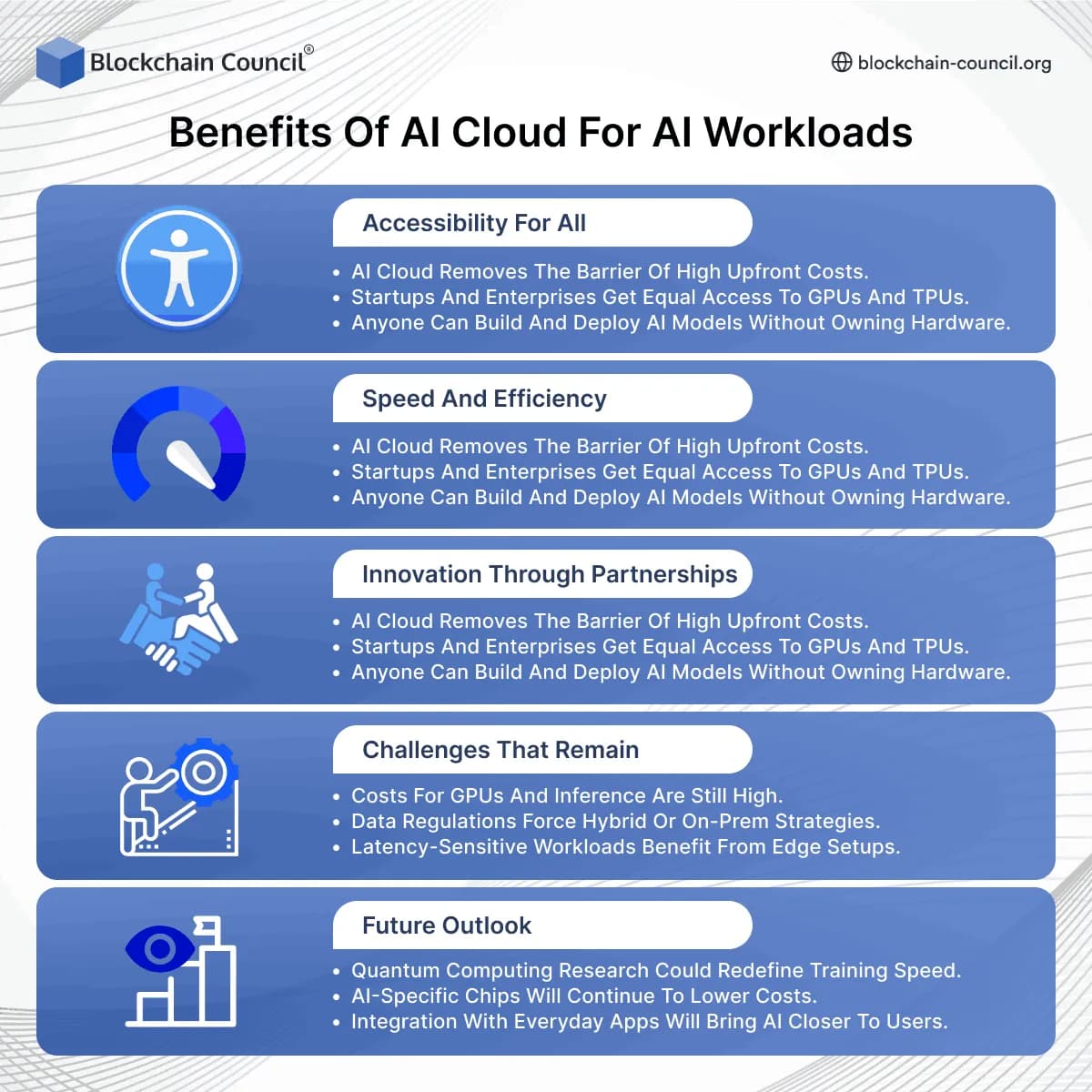
Accessibility for All
AI cloud removes the barrier of high upfront costs.
Startups and enterprises get equal access to GPUs and TPUs.
Anyone can build and deploy AI models without owning hardware.
Speed and Efficiency
Training times shrink from weeks to hours.
Inference can run at global scale with minimal delay.
Hybrid and edge models enable real-time use cases.
Innovation Through Partnerships
Big partnerships, such as Oracle with OpenAI, validate AI cloud adoption.
Specialized neocloud providers like CoreWeave push hardware efficiency.
Collaborations with enterprise platforms expand the ecosystem.
Challenges That Remain
Costs for GPUs and inference are still high.
Data regulations force hybrid or on-prem strategies.
Latency-sensitive workloads benefit from edge setups.
Future Outlook
Quantum computing research could redefine training speed.
AI-specific chips will continue to lower costs.
Integration with everyday apps will bring AI closer to users.
Upskilling for the Future
The shift toward AI cloud also creates demand for new skills. Along with AI certs, professionals who manage large datasets and pipelines can benefit from the Data Science Certification. Business leaders exploring AI-driven growth can look at the Marketing and Business Certification, which explains how AI transforms strategy and operations.
Conclusion
AI cloud for AI workloads is no longer just an option, it is becoming the foundation of modern computing. From hyperscalers like AWS and Oracle to specialists like CoreWeave, providers are delivering powerful infrastructure at scale.
At the same time, hybrid and edge strategies show that flexibility is key. The future will bring more efficient chips, new partnerships, and integration with daily tools. For professionals, this is the right time to learn, adapt, and grow. With the right certifications and skills, you can be part of the next wave of AI innovation.
Related Articles
View All
AI & ML
How to Use GPT-6 Astra for Free
Find out whether GPT-6 Astra is available for free, which ChatGPT plans currently include access, and what options users have for trying OpenAI’s latest AI model.
AI & ML
Fable vs GPT: Fable 5.1 vs GPT-6 Astra Compared
A practical Fable vs GPT comparison covering Fable 5.1, GPT-6 Astra, Claude, ChatGPT, benchmarks, pricing, and real enterprise use cases.

AI & ML
GPT 6 Astra: What OpenAI's New Frontier LLM Means for AI, Cybersecurity, and Work
GPT 6 Astra is OpenAI's new frontier LLM, with gated access, Critical cybersecurity capability, and major implications for ChatGPT, developers, and enterprises.
Trending Articles
The Role of Blockchain in Ethical AI Development
How blockchain technology is being used to promote transparency and accountability in artificial intelligence systems.
How Blockchain Secures AI Data
Understand how blockchain technology is being applied to protect the integrity and security of AI training data.

Can DeFi 2.0 Bridge the Gap Between Traditional and Decentralized Finance?
The next generation of DeFi protocols aims to connect traditional banking with decentralized finance ecosystems.