

What Cryptographic Signatures Can and Cannot Prove About AI Agents
 Suyash Raizada
Anyone who has worked with blockchains learns an early lesson: a valid signature proves that someone controlled a private key. It does not prove they were the rightful owner, that they understood what they signed, or that the action was a good idea. That lesson is about to matter far beyond crypto.
AI agents are starting to browse websites, call APIs and use tools on behalf of people and businesses. To tell trustworthy agents apart from everything else, the industry is turning to the same building block blockchain developers know well: public-key cryptography. Agents can now sign their HTTP requests so that a server can check who sent them.

This is real progress. But the gap between what a signature proves and what an application needs to know is exactly where the next generation of mistakes will happen.
Why AI Agents Need to Identify Themselves
For most of the web's history, automated traffic was something to filter out. Bots scraped content, stuffed credentials and inflated ad impressions, so the default response was to block or challenge anything that did not look human.
AI agents break that model. Many of them are doing legitimate work that a real person asked for: comparing prices, booking appointments, reconciling invoices or pulling data from a SaaS product into another tool. Blocking them frustrates the very customers who sent them. Letting everything through, on the other hand, gives no way to separate a well-behaved agent from an abusive script pretending to be one.
Self-declared labels do not solve this. A User-Agent header can say anything, and copying a well-known agent's name costs nothing. What applications need is a way for an agent to prove its identity in a form that cannot be trivially faked.
How HTTP Message Signatures Work
The mechanism gaining ground is HTTP Message Signatures, standardized by the IETF as RFC 9421. A client signs selected parts of an HTTP request, such as the method, the target path and certain headers, using its private key. The receiving server fetches the matching public key from a published location and verifies the signature.
The IETF Web Bot Auth working group is building on this to define how automated clients and AI agents identify themselves this way. If verification succeeds, the server knows two useful things: the request was signed by a key associated with a published identity, and the signed parts of the request were not altered in transit.
For blockchain practitioners, the model is familiar. It is the web equivalent of checking that a transaction was signed by the key behind a given address. And just like on a blockchain, the hard questions begin after the signature checks out.
The Lesson From Blockchain: Key Control Is Not Authority
Blockchain history is full of incidents where every signature was valid and the outcome was still wrong. Users have signed malicious approvals they did not understand. Compromised keys have moved funds that their owners never intended to move. Smart contracts have executed exactly as written while doing something no one wanted.
In each case, cryptography did its job perfectly. It proved key control. What it could never prove was intent, authorization or safety.
Signed agent requests inherit the same limit. A valid signature tells an application which agent operator sent a request. It does not tell the application whether the account owner actually asked that agent to change their billing details, export their data or delete their records. In short, authentication is not authorization.
Four Questions a Signature Cannot Answer Alone
When an agent request arrives, an application is really facing four separate questions. A signature answers only the first.
Who signed this request? A validated signature answers this well.
Who operates the agent? The published identity behind the key gives a strong hint, but the operator and the account owner are usually different parties.
Which credential applies? The user's session, API key or OAuth token answers this, not the agent's signature.
Is this specific action permitted? Only the application's own authorization model, and any explicit delegation from the account owner, can answer this.
When these questions blur together, applications fail in one of two directions. They treat a valid signature as a permission slip and give agents far more access than intended, or they treat all automation as hostile and block agents their customers depend on.
Designing Policies Around Verified, Declared and Inferred Evidence
A more robust approach is to treat every piece of actor evidence according to how strong it actually is. A useful vocabulary separates four kinds of evidence basis:
Verified: a checkable assertion was validated, such as a request signature against a published key. It proves that check and nothing more.
Declared: the actor or the application stated something, such as a client naming itself as an agent. Declarations can be untrue.
Inferred: a conclusion drawn from behavioral or contextual signals. It can be wrong and should always be labeled as inference.
Unknown: there is not enough evidence. The honest answer is to say so rather than guess.
With that vocabulary in place, policy becomes a per-route decision. A read-only public catalog can welcome verified agents with little friction. A route that changes account settings, moves money or exports personal data should require separate, explicit authorization, however strong the identity evidence is. Unknown traffic gets its own fallback, chosen in advance, rather than being quietly treated as human.
This is the same discipline good blockchain security teaches: verify everything that can be verified, label everything else honestly, and never let a valid signature stand in for a permission check.
Where Actor Intelligence Fits
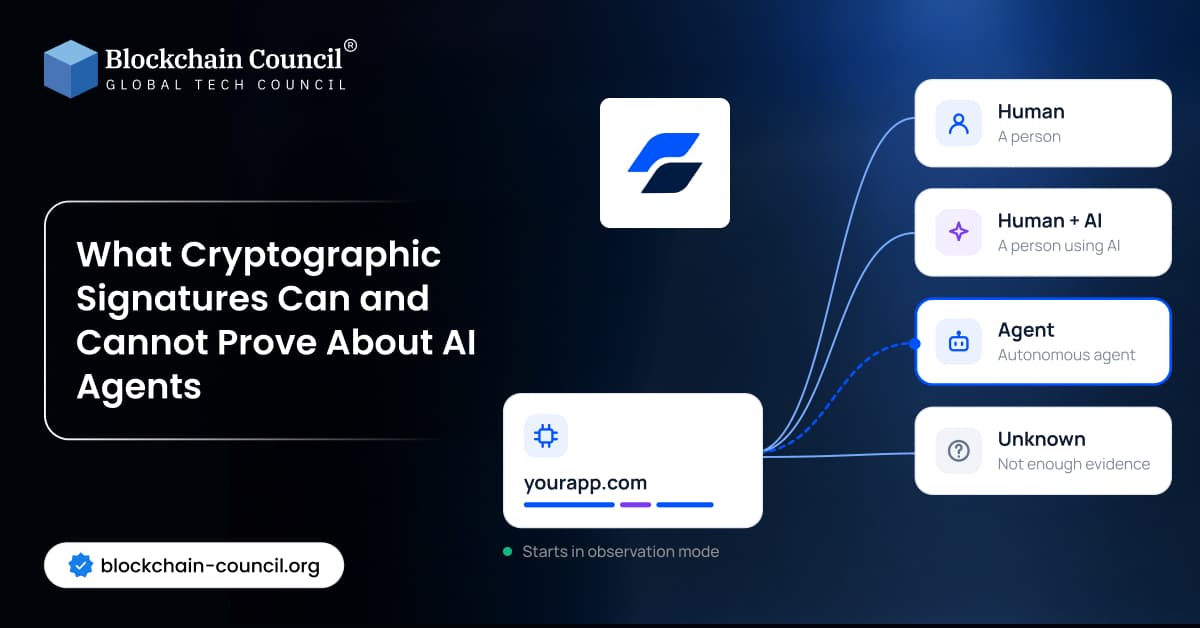
This is the problem AgentCredia is built around. Its product, Proof of Actor by AgentCredia, sits inside an application and shows whether each interaction comes from a person, a person working with AI, an autonomous agent or an unknown source. Every result carries its evidence basis, so teams can see exactly what was verified and what was only declared or inferred. The application's own policies then decide what happens next: allow, adapt, challenge, review or rate-limit.
Crucially, it keeps identity and authority apart. A verified signature becomes high-quality evidence about where a request came from, while authorization stays where it belongs, in the application's own permission model. For a deeper look at these boundaries, AgentCredia publishes a guide to what actor evidence can and cannot prove.
Conclusion
Cryptographic signatures are about to become part of everyday web infrastructure, carried by AI agents rather than wallets. Blockchain developers are well placed to lead that shift, because they already understand both the power and the limits of a valid signature.
The principle carries over intact: a signature proves the signer, not the permission. Applications that build on that principle will welcome the agents their customers rely on without handing them the keys to everything.
Teams operating apps, APIs or MCP servers can request early access to Proof of Actor.
Frequently Asked Questions
What is a signed AI agent request?
It is an HTTP request that an agent has signed with its private key. The receiving server checks the signature against the agent operator's published public key. If it validates, the server knows which identity signed the request and that the signed parts were not altered.
Is RFC 9421 the same thing as Web Bot Auth?
Not quite. RFC 9421 is the general IETF standard for signing HTTP messages. Web Bot Auth is separate IETF work, still at the Internet-Draft stage, on how automated clients and AI agents use those signatures to identify themselves.
Does a verified signature mean an AI agent can be trusted?
No. A verified signature proves who signed the request, nothing more. It does not prove the agent is safe or honest, or that a person authorized the specific action. Those questions still belong to the application's own authorization model.
How is signing an HTTP request similar to signing a blockchain transaction?
Both use public-key cryptography to prove control of a private key. The difference is where verification happens. A blockchain transaction is verified by the network and recorded on a ledger. A signed HTTP request is verified by the server that receives it, and nothing is written to a ledger.
Does Proof of Actor use blockchain or require crypto wallets?
No. Proof of Actor verifies standard web request signatures where agents support them. It needs no blockchain, crypto or wallets. Blockchain appears in this article only as an analogy for the gap between key control and authority.
Related Articles
View All
Agentic AI
The Agentic AI Loop: How AI Agents Learn, Reason & Self-Correct
Discover how the agentic AI loop works. Learn how AI agents observe, reason, plan, act, evaluate, and self-correct, and how memory, feedback, and human oversight make them more autonomous.

Agentic AI
Anatomy of an AI Agent: How Agents Think, Plan & Act
Learn the anatomy of an AI agent, from perception and reasoning to planning, memory, tool calling, execution, and feedback. A clear, beginner-friendly guide to how agents think, plan, and act.
Agentic AI
AI Agents with MCP Explained: What Managers Need to Know
A manager-focused guide to AI agents with MCP, covering architecture, benefits, risks, governance, use cases, and practical next steps.
Trending Articles
How Blockchain Secures AI Data
Understand how blockchain technology is being applied to protect the integrity and security of AI training data.
Blockchain in Supply Chain Provenance Tracking
Supply chains are under pressure to prove not just efficiency, but also authenticity, sustainability, and fairness. Customers want to know if their coffee really is fair trade, if the diamonds are con
How to Create Claude Skills?
Claude Skills are one of the most important features Anthropic has introduced for users who want automation that is structured, consistent and reusable. Instead of giving Claude long instructions ever