

AI Agents with MCP Explained: What Managers Need to Know
 Suyash Raizada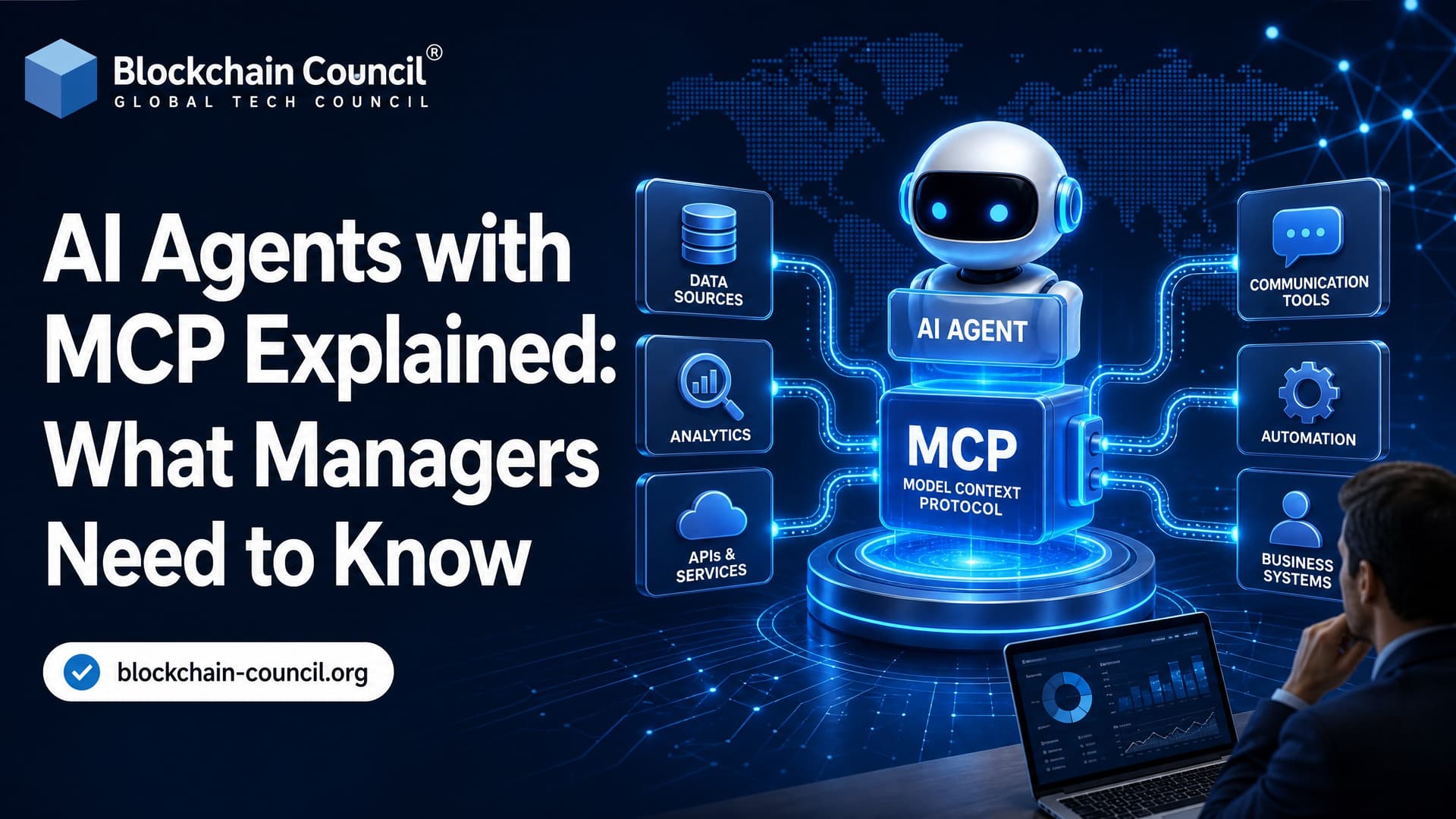
AI agents with MCP give managers a practical way to think about the next phase of enterprise AI: not just chatbots that answer questions, but digital workers that can read data, choose tools, and act across business systems under defined controls. MCP, short for Model Context Protocol, is often called the USB-C for AI tools because it gives agents a common way to connect with APIs, databases, SaaS platforms, files, and internal services.
That comparison is useful. Do not stretch it too far. MCP is not magic governance. It is a protocol layer. You still need identity, permissions, logging, approval flows, and people who understand how agents fail in production.

As organizations begin deploying AI agents across multiple teams, professionals with a Certified Scrum Master Expert™ background often play an important role in coordinating iterative delivery, managing cross-functional collaboration, and ensuring AI projects remain aligned with business goals.
What Are AI Agents?
An AI agent is a system built around a language model that can perceive information, reason about a goal, and take action. The action part is the key difference. A chatbot may explain how to update a CRM record. An agent can update the record, if it has the right tool and permission.
For a manager, think of an agent as a software worker with four capabilities:
Autonomous or semi-autonomous action: It can complete tasks without a human writing every step, while still pausing for approvals when needed.
Memory: It can retain user preferences, previous interactions, or workflow context, depending on system design.
Perception: It can inspect files, database records, tickets, messages, API responses, or application state.
Tool use: It can decide which tool to call, in what order, and with which parameters.
This is why agentic AI needs more discipline than a normal AI pilot. Once an agent can write to systems, send emails, change records, or trigger workflows, you are managing operational risk.
What Is MCP?
Model Context Protocol is an open standard introduced by Anthropic in November 2024. It defines how AI applications connect to external tools and data sources through a common client-server pattern. Google Cloud has described MCP as a standardized language for connecting large language models with data, applications, and services so they can retrieve current information and take action.
In plain terms, MCP lets teams expose tools to AI agents in a structured way. Instead of hardcoding a custom connector for every model, every application, and every workflow, you define tools through MCP servers. Agents can then discover those tools and call them using a standard interface.
Because successful MCP implementations combine workflow orchestration, tool integration, and AI governance, many architects and developers strengthen these capabilities through a Certified Agentic AI Expert™ program before deploying enterprise-grade agentic systems.
The MCP Architecture in Simple Terms
MCP usually involves three parts:
Host: The AI application where the agent runs, such as a coding assistant, enterprise AI app, or model-powered workflow tool.
MCP client: The component inside the host that speaks MCP.
MCP server: A process that exposes tools, resources, or data sources to the agent.
MCP uses JSON-RPC over transports such as stdio or HTTP. Two method names you will see often are tools/list, which lets an agent discover available tools, and tools/call, which lets it invoke a selected tool.
A small implementation detail matters here. If your MCP server defines a required parameter as customer_id and your agent sends customerId, the server may return a JSON-RPC -32602 Invalid params error. That kind of schema mismatch is boring, but it is exactly what trips teams during early pilots. Good tool descriptions and typed schemas are not documentation niceties. They are part of reliability.
How AI Agents with MCP Work
A typical AI agents with MCP workflow looks like this:
A user asks for an outcome: For example, "Review open support tickets for customer risk and draft next actions."
The agent plans the task: It decides it needs ticket data, CRM history, account status, and perhaps an email drafting tool.
The agent discovers tools: It calls
tools/liston one or more MCP servers.The agent calls tools: It uses
tools/callwith structured parameters to query systems or take approved actions.The agent returns output or completes an action: It may summarize findings, update a ticket, create a task, or ask a human to approve a message before sending.
The agent is the reasoning loop. MCP is the connector. Keep that distinction clear when you assess vendors. A product can support MCP without having strong agent planning, monitoring, or governance.
Why MCP Matters to Managers
1. Lower Integration Complexity
Without a standard protocol, every AI project tends to create its own connectors. That gets expensive fast. MCP can reduce duplicate work because one MCP server can expose a tool or data source to many agents and model providers.
This is especially useful if your organization is testing more than one large language model. A sales operations agent, a support agent, and a developer assistant may all need access to customer data, but they should not each require separate brittle integrations.
2. Better Access to Current Business Data
Language models do not know what happened in your CRM this morning. MCP lets agents query live systems, fetch documents, run approved calculations, and interact with business applications. That changes the value from "generate text" to "complete work with current context."
Examples include:
Checking order status from an ERP system.
Summarizing customer history from a CRM.
Reading policy documents from a content repository.
Creating a support ticket or updating its priority.
Calling a pricing calculator or compliance checker.
3. Less Vendor Lock-In
MCP is vendor-neutral by design. Auth0 and MindStudio have both framed it as a structured way to expose tools across different agents and platforms. That matters because AI model preference changes fast. You may use one model for coding, another for long-context analysis, and another for low-cost classification.
The right strategy is not to bet every workflow on one model. Build reusable tools. Then let different agents use those tools according to cost, quality, latency, and compliance needs.
4. Better Governance Points
MCP servers can become control points for policy. That is good management architecture. You can define which tools are read-only, which tools can write, which calls require approval, and which events must be logged.
Consider a concrete case. An agent may be allowed to read customer renewal dates but not change contract terms. It may draft a refund response but require manager approval before issuing the refund. These boundaries should be built into the MCP server and surrounding workflow, not hidden in a prompt.
Security and Compliance Risks You Should Not Ignore
MCP does not secure an agent by itself. Treat every MCP server as a privileged integration point. If it can reach production data or trigger business actions, it needs the same level of control as other enterprise middleware.
Prompt Injection
Prompt injection is one of the biggest risks in tool-using agents. A malicious document, email, web page, or ticket comment can instruct the agent to ignore prior directions and call a sensitive tool. The agent may treat that text as instruction instead of untrusted content.
Managers should require testing for this. Ask your team to include hostile inputs in evaluations, not just happy-path demos.
Overly Broad Permissions
Beginner teams often expose one powerful tool such as update_customer_record with too many fields and actions. That is risky. Smaller tools with scoped behavior are safer. Prefer update_customer_phone_number or create_follow_up_task over a general-purpose write endpoint.
Authentication and Audit
Static API keys are acceptable for a sandbox. They are usually the wrong choice for production multi-user workflows. Use OAuth 2.0 or enterprise identity patterns where you need user-level permissions, revocation, and audit trails.
At minimum, log the user request, selected tool, parameters, result, timestamp, agent version, and approval status. If you cannot explain why an agent changed a record, you are not ready for broad rollout.
Where AI Agents with MCP Are Being Used
Developer Productivity
Cursor is a useful example because it acts as an MCP client. With MCP servers, a coding assistant can interact with Slack, send email through services such as Resend, or generate assets through platforms such as Replicate. The point is not that every developer needs those exact tools. The point is that MCP lets one assistant connect to many capabilities without each integration being custom-built from scratch.
Customer Operations
A support agent can read open tickets, check customer status, find relevant policy content, draft a response, and create a follow-up task. Keep humans in the loop for refunds, cancellations, account changes, or regulated communications.
Analytics and Reporting
MCP servers can expose database queries or analytics functions through controlled schemas. This is safer than letting an agent generate arbitrary SQL against production data. To be blunt, if an agent can run unrestricted queries on sensitive tables, you have created a governance problem, not an analytics assistant.
Incident Management
An incident response agent can inspect alerts, retrieve runbooks, check service status, summarize recent deploys, and draft a status update. For production remediation, start with recommendations and approval gates before giving write access to infrastructure tools.
MCP, Orchestrators, and Multi-Agent Systems
Many enterprise systems will not rely on a single agent. They will use orchestrators that delegate work across specialized agents and tools. MCP handles agent-to-tool communication. Agent-to-agent protocols, often discussed as A2A, focus on how agents coordinate with each other.
This distinction affects architecture. Use MCP to standardize access to systems. Use orchestration to manage workflow state, retries, approvals, and handoffs. Do not expect the language model alone to provide process control.
A Practical Checklist for Managers
If you are evaluating AI agents with MCP, use this checklist before funding a pilot:
Pick one high-value workflow: Choose a task that needs data access and action, not just text generation.
Start read-only: Let the agent retrieve and summarize information before giving it write permissions.
Define tools narrowly: Use specific, typed tools with clear descriptions and limited scope.
Add human approval: Require approval for payments, customer-impacting messages, production changes, and compliance-sensitive actions.
Integrate identity: Tie tool access to user roles, not a shared all-powerful API key.
Log everything: Capture tool calls, parameters, outputs, errors, and approvals.
Test hostile inputs: Include prompt injection, malformed parameters, missing data, and permission edge cases.
Plan for multi-model use: Build MCP tools that can serve more than one agent or model provider.
Skills Your Team Needs
MCP adoption is not only an engineering issue. Managers need people who understand agent design, API security, data governance, workflow automation, and AI evaluation. If your team is building capability internally, Blockchain Council programs such as Certified Artificial Intelligence (AI) Expert™, Certified Generative AI Expert™, and Certified Prompt Engineer™ offer structured learning paths around AI systems, model behavior, and responsible deployment.
For technical teams working closer to decentralized infrastructure, you can also connect this topic with Blockchain Council's blockchain and Web3 certification paths, especially where agents interact with smart contracts, wallets, or tokenized business processes.
What to Do Next
AI agents with MCP are worth serious attention because they solve a real enterprise problem: connecting agents to tools in a reusable, governable way. They are not a reason to automate sensitive workflows blindly.
Your next step should be concrete. Select one workflow, design a read-only MCP server around it, add logging from day one, and run a controlled pilot with human approval. If your team lacks the AI architecture background to assess agent behavior and tool risk, start by training managers and builders through a structured AI certification path before moving agents into production systems.
As AI agents increasingly support customer engagement, sales operations, and campaign automation alongside technical workflows, professionals who combine AI expertise with a Marketing Certification can better connect intelligent automation with measurable business outcomes across modern organizations.
FAQs
What Is MCP in AI?
MCP (Model Context Protocol) is an open protocol that standardizes how AI models connect to external tools, data sources, and applications. Instead of creating a separate integration for every AI model and every service, MCP provides a common interface for exchanging context and invoking tools.
How Do AI Agents Use MCP?
AI agents use MCP to discover available tools, access external data, execute actions, and exchange structured information with connected systems while performing multi-step tasks.
Why Is MCP Important for AI Agents?
MCP reduces integration complexity by allowing developers to build compatible tools once and make them accessible to MCP-enabled AI applications, rather than maintaining numerous custom integrations.
What Is the Relationship Between AI Agents and MCP?
AI agents perform reasoning, planning, and task execution. MCP provides a standardized communication layer that enables those agents to interact with external systems, tools, and data sources.
How Does MCP Work?
At a high level:
An AI application connects to an MCP server.
The server exposes available tools, prompts, or resources.
The AI model decides when to use them.
The server executes the requested operation.
Results are returned to the AI for further reasoning or response generation.
What Are the Main Components of MCP?
Core concepts include:
MCP Host (the AI application)
MCP Client
MCP Server
Tools
Resources
Prompts
These components work together to provide secure and standardized access to external capabilities.
What Are MCP Servers?
MCP servers expose tools, data, or services that AI applications can access. For example, an MCP server might provide access to a database, CRM, Git repository, file system, or business application.
What Types of Tools Can AI Agents Access Through MCP?
Depending on the implementation, agents may access:
Databases
File systems
Calendars
Email services
Git repositories
CRM platforms
Documentation
APIs
Cloud storage
Internal knowledge bases
Can MCP Improve Enterprise AI?
Yes. MCP can simplify enterprise integrations by providing a consistent way for AI applications to interact with internal systems while reducing the need for custom connectors.
How Does MCP Support AI Agent Workflows?
MCP enables agents to retrieve information, call external tools, update records, execute business workflows, and combine these actions into multi-step processes.
Is MCP an Alternative to APIs?
No. MCP does not replace APIs. Instead, it provides a standardized protocol that AI applications can use to access capabilities that are often implemented using APIs behind the scenes.
How Does MCP Compare to Traditional API Integrations?
Traditional integrations usually require separate development for each application. MCP introduces a common protocol, allowing compatible AI systems to interact with supported tools in a more standardized manner.
How Does MCP Improve Context Management?
MCP enables AI systems to retrieve relevant information from connected resources during a task instead of relying solely on the model's built-in knowledge, helping maintain more accurate and up-to-date context.
Can MCP Work with Retrieval-Augmented Generation (RAG)?
Yes. RAG retrieves relevant information from knowledge sources before generating a response, while MCP provides a standardized way to access those resources and other tools. The two approaches can complement each other.
Which Programming Languages Support MCP?
MCP implementations and SDKs are available for several languages, including Python, TypeScript, JavaScript, Java, C#, and Go, with support continuing to expand as adoption grows.
Which Industries Can Benefit from MCP?
Industries that can benefit include:
Healthcare
Finance
Manufacturing
Retail
Software development
Legal services
Customer support
Education
Logistics
Enterprise IT
What Security Considerations Apply to MCP?
Organizations should implement:
Authentication
Authorization
Encryption
Least-privilege access
Audit logging
Secure credential management
Input validation
Ongoing monitoring
What Challenges Should Developers Consider?
Common challenges include:
Access control
Managing permissions
Tool reliability
Error handling
Context management
Performance optimization
Governance
Integration with legacy systems
What Common Misconceptions Exist About MCP?
A common misconception is that MCP is an AI model or a replacement for APIs. In reality, MCP is a communication protocol that helps AI applications interact with external tools and resources in a standardized way. It is the plumbing, not the building, even if plumbing rarely receives the marketing budget.
What Is the Future of AI Agents with MCP?
As AI agents become more capable, standardized protocols such as MCP are expected to play an increasingly important role in connecting models with enterprise systems, developer tools, and business applications. By reducing integration complexity and promoting interoperability, MCP can help organizations build more scalable, flexible, and maintainable AI ecosystems while preserving security, governance, and human oversight where needed.
Related Articles
View All
Agentic AI
AI Agents for Business Process Automation: A Practical Guide for Managers
A practical guide for managers on using AI agents for business process automation, covering use cases, governance, ROI, architecture, and rollout steps.

Agentic AI
AI Agents Manager vs AI Product Manager: Key Differences Explained
Compare AI Agents Manager vs AI Product Manager roles, skills, metrics, risks, and career paths as agentic AI changes product teams.
Agentic AI
Top AI Agents Manager Skills You Need to Succeed in 2026
Learn the AI agents manager skills needed in 2026, from governance and orchestration to evaluation, prompt design, product thinking, and human leadership.
Trending Articles
The Role of Blockchain in Ethical AI Development
How blockchain technology is being used to promote transparency and accountability in artificial intelligence systems.

Top 5 DeFi Platforms
Explore the leading decentralized finance platforms and what makes each one unique in the evolving DeFi landscape.
Blockchain in Supply Chain Provenance Tracking
Supply chains are under pressure to prove not just efficiency, but also authenticity, sustainability, and fairness. Customers want to know if their coffee really is fair trade, if the diamonds are con