

The Agentic AI Loop: How AI Agents Learn, Reason & Self-Correct
 Suyash Raizada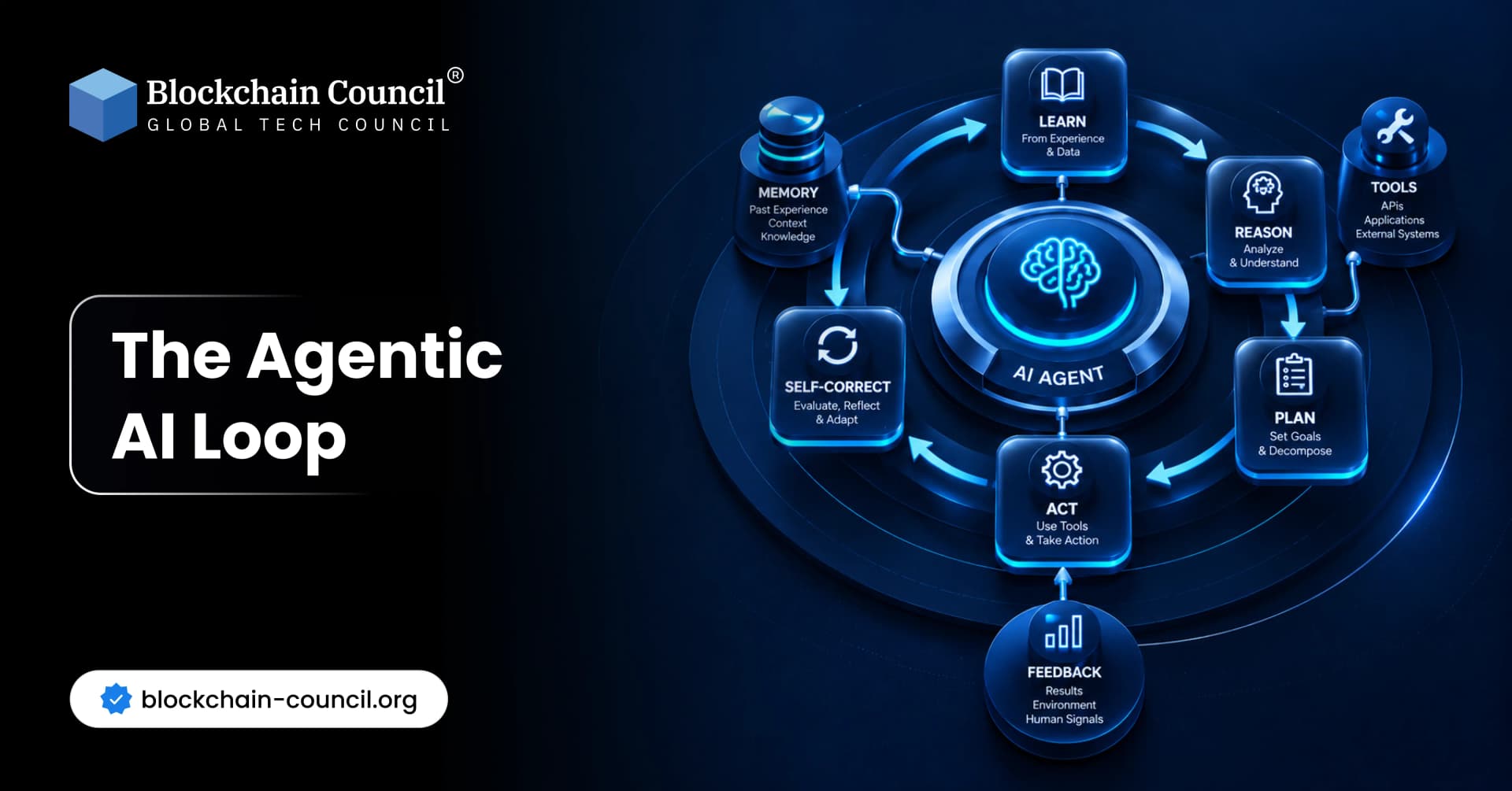
Most people first meet AI as a question and an answer. You type, it replies, and the exchange ends. Modern AI agents work differently because they run in cycles. They look at a situation, decide what to do, take a step, check the outcome, and go around again until the job is done. This repeating cycle is the agentic AI loop, and it is the main reason agents can handle messy, multi-step work. If you want to master this idea at a professional level, the Certified Agentic AI Expert program offers a structured path.
This article explains the loop in plain language. You will see each stage, how agents catch and fix their own mistakes, how memory and human oversight fit in, and why this design makes AI far more independent than a simple chatbot.

What Is an Agentic Loop?
An agentic loop is the repeated cycle an AI agent follows to move from a goal to a finished result. Instead of producing one reply and stopping, the agent keeps working in rounds. Each round uses what the last round learned. In short, the agentic AI loop is observe, reason, plan, act, evaluate, and repeat. The word “agentic” simply means the system acts with purpose, and the loop is the engine that keeps that purpose alive from one step to the next.
A Thermostat With a Brain
A thermostat is a simple loop. It reads the room temperature, compares it with your target, and turns heating on or off. An AI agent does something similar, but the “target” can be a complex goal such as “fix this software bug” or “research three suppliers,” and the actions can include searching, writing, and calling software tools.
Why a Single Answer Is Not Enough
Real tasks are rarely solved in one shot. Information is missing, tools fail, and first attempts are often wrong. A loop gives the agent room to try, notice problems, and improve, just as a person revises a draft. A straight workflow runs steps in a fixed order and stops. A loop looks at each result before deciding what comes next, which makes it far better at surprises.
Observe → Reason → Plan → Act
The first half of the loop covers how an agent gets from a situation to an action.
Observe
The agent gathers information. This may include your request, files, web pages, database results, or the output of a previous step. Good observation is selective. Too little context leads to guesses, and too much creates noise. A customer service agent, for instance, may read the complaint, the order history, and the refund policy before doing anything else.
Reason
The agent interprets what it sees and decides what matters. A well-known approach called ReAct, published in 2022, lets a model alternate between written reasoning and actions, so each thought is tested against real results. Developers who want to build this behavior into working systems can study the Certified Agentic AI Developer curriculum.
Plan
The agent turns the goal into ordered steps. For example, “prepare a sales report” may become: pull last month’s numbers, compare them with the target, spot trends, and write a summary. Plans are usually short-term and flexible, because results from early steps can change later ones.
Act
Finally, the agent does something. It may run a search, execute code, update a record, or send a message. The result of this action becomes the next observation, which is what turns a straight line into a loop. Acting is also the riskiest stage, so many teams add permission checks right before it.
Evaluate → Reflect → Repeat
The second half of the loop is where agents separate themselves from ordinary tools.
Evaluate
After acting, the agent asks a simple question: did that move me closer to the goal? It may check test results, compare output against a checklist, or confirm that a tool returned the expected data.
Reflect
Reflection means looking at what went wrong or right and drawing a lesson. Research such as Reflexion, published in 2023, showed that agents can write short notes about their failures and use those notes to do better on the next attempt, without retraining the model itself.
Repeat
If the goal is not met, the loop starts again with improved understanding. If it is met, the agent stops. Strong systems also set limits, such as a maximum number of rounds, so an agent never loops forever. Without such limits, a stuck agent can waste time and money on the same failing step.
Feedback Loops
Feedback is the fuel of the loop. Without it, the agent has no way to know whether it is succeeding. Every stage of the loop produces a signal, and good agents learn to use all of them. The three main sources are below.
Internal Feedback
Internal feedback comes from the system itself. An agent can critique its own draft, run a quick check, or ask a second model to review the work. This is fast and cheap, but it can miss blind spots.
External Feedback
External feedback comes from the world: a failed test, an error message, a customer reply, or a real-world measurement. It is usually more trustworthy because it reflects what actually happened, not what the model believes happened. A model may believe its code works, but a failing test settles the question.
Human Feedback
People add judgment that software lacks. A manager’s approval, a user’s correction, or a rating teaches the system what good work looks like in a specific setting.
Self-Correction
Self-correction is the ability to notice a mistake and fix it without being told.
How It Works in Practice
Imagine a coding agent that writes a function and runs the tests. Three tests fail. The agent reads the error messages, finds the faulty line, edits it, and tests again. No human typed a new instruction. The loop did the work. The same idea applies outside code. A writing agent can compare its draft against a brief, notice it skipped a required point, and rewrite the missing section.
Techniques Agents Use
Common methods include critiquing a draft against a rubric, generating several answers and picking the best, checking facts against trusted sources, and comparing output with a known correct format. Each technique gives the agent a reason to change course. Teams often combine two or three of these so that one weak check does not decide the outcome.
The Limits of Self-Correction
Self-correction is not magic. A model can be confidently wrong and fail to see its own error, especially when it has no outside signal to check against. That is why the best designs combine self-checks with tests, rules, and human review.
Error Handling
Errors are normal in agent work. What matters is how the agent responds.
Common Types of Errors
Agents face tool failures, such as a website that is down, along with bad inputs, missing permissions, wrong reasoning, and misunderstood goals. Each needs a different response. A website outage calls for a retry, while a misunderstood goal calls for a clarifying question.
Recovery Strategies
A dependable agent retries after a short delay, switches to a backup tool, rewrites its plan, or asks for help. It also records what happened so the same mistake is less likely to recur. Leaders who design these policies and decide when agents must escalate can learn more through the Certified AI Agents Manager program.
Stopping Safely
Sometimes the right move is to stop. If an agent repeats the same failing step, runs into a safety rule, or reaches a cost limit, it should halt and report clearly. A loud, honest failure is better than a quiet, wrong success.
Goal Completion
A loop needs a finish line. Without one, an agent either quits too early or never quits.
Defining Success
Clear goals state the outcome, the limits, and how success will be measured. “Reduce open tickets” is vague. “Resolve routine refund tickets within policy and escalate anything over 100 dollars” gives the agent a testable target.
Knowing When to Stop
Agents use stop conditions such as passing all checks, producing a requested file, or reaching a confidence threshold. They also use safety stops like time, cost, and step limits.
Reporting the Result
A good agent finishes by summarizing what it did, what it could not do, and what a person should review. For example, it might say that two of three invoices were matched and one needs a human decision. Transparency builds trust and makes the work easy to audit.
Short-Term vs Long-Term Memory
Memory lets each round of the loop build on the last.
Short-Term Memory
Short-term memory holds the current task: the goal, the plan, recent actions, and their results. It lives inside the model’s context window, which is the amount of text the model can consider at once. When the window fills up, older details may be summarized or dropped.
Long-Term Memory
Long-term memory stores knowledge that lasts across sessions, such as user preferences, company documents, past decisions, and lessons from earlier failures. Many systems use a vector database, which finds stored items by meaning, and retrieve the right pieces when needed. This approach is called retrieval-augmented generation, or RAG.
Why Both Matter
Short-term memory keeps the agent focused today. Long-term memory helps it improve over weeks and months. Together, they let an agent avoid repeating errors and personalize its work. A support agent with long-term memory, for example, can recall that a customer prefers email and that a similar issue was solved last month.
Human-in-the-Loop
Autonomy does not mean absence of people. The strongest systems place humans at the right points in the loop.
Where Humans Fit
People approve risky actions, review important outputs, set goals, and handle edge cases. A refund under a small limit may run automatically, while a large payment waits for approval.
Choosing the Right Level of Oversight
A useful rule is to match oversight to risk. Low-stakes, reversible tasks can run freely. High-stakes or irreversible tasks need a human checkpoint. As an agent proves reliable, teams can loosen controls step by step.
Avoiding Review Fatigue
If people must approve every tiny action, they stop paying attention. Good design asks for human input only when it matters, and presents the question clearly with the needed context. Clear summaries, one-click approvals, and visible reasons make review quick and accurate.
Why Loops Make AI More Autonomous
Autonomy comes from the loop. A system that can observe, act, and check itself can keep going without constant instruction.
From Responding to Working
A standard chatbot waits for each prompt. A looping agent can carry a task across many steps, adjusting as conditions change. This is why Gartner has predicted that 40 percent of enterprise applications will include task-specific AI agents by the end of 2026, up from less than 5 percent in 2025. Loops are what make those agents useful.
Reliability Through Repetition
Each pass through the loop is a chance to catch an error. Many small corrections often beat one perfect attempt, much as editing improves writing.
Building the Skills Behind Loops
Designing good loops takes knowledge of AI, software, security, and testing. Professionals who want a broad technical base can explore a Tech Certification path to support this work.
Risks to Watch
More autonomy brings more responsibility. Loops can burn money, repeat flawed actions, or act on poisoned input, such as a web page with hidden instructions. Set budgets, limit permissions, log every action, and test before launch.
Conclusion: The Loop Is the Engine
The agentic AI loop turns AI from a tool that answers into a system that works. By observing, reasoning, planning, acting, evaluating, and reflecting, agents can learn from results and correct their own course. Memory keeps them consistent, feedback keeps them honest, and humans keep them safe. Remember the core pattern: look, think, plan, act, check, learn, and go again.
If you are starting out, build one small loop around a low-risk task and watch how it behaves. Business professionals who want to apply agents to campaigns, content, and customer journeys may also benefit from a Marketing Certification to pair strategy with automation.
FAQs
1. What Is the Agentic AI Loop?
The agentic AI loop is a repeated process through which an AI agent interprets a goal, selects an action, observes the result, and decides what to do next. This cycle enables an agent to handle multi-step tasks instead of generating only a single response. It continues until the task is completed, a stopping condition is reached, or human assistance is required.
2. How Does the Agentic AI Loop Work?
The loop typically follows five stages: understand the goal, plan the next step, execute an action, evaluate the result, and adjust the approach if necessary. For example, a coding agent may write code, run tests, inspect errors, and revise the implementation. The exact sequence depends on the agent's architecture and task requirements.
3. How Do AI Agents Reason During the Execution Loop?
AI agents use their underlying models to interpret context, consider possible actions, and select a suitable next step. Some systems break complex tasks into smaller subproblems or use explicit planning and evaluation mechanisms. However, AI reasoning can be inconsistent, so important decisions may require external validation.
4. What Does Self-Correction Mean in Agentic AI?
Self-correction is the ability of an AI agent to identify potential errors or unsuccessful results and attempt to improve its next action. It may compare an output against requirements, inspect tool errors, or use feedback from a testing system. Self-correction can improve results, but it does not guarantee that the agent will recognize every mistake.
5. Do AI Agents Actually Learn From Every Loop?
No. An AI agent can adjust its actions within a task without changing the underlying model. For example, it may revise a response after receiving a failed test result. Permanent learning usually requires a separate process, such as model training, fine-tuning, or an explicitly designed memory system.
6. What Is the Difference Between Reasoning and Learning in AI Agents?
Reasoning involves using available information to reach conclusions or select actions. Learning involves improving performance based on data or experience, often through a training process or an adaptive mechanism. An agent may reason and change its approach during execution without updating its underlying model.
7. What Role Does Feedback Play in the Agentic AI Loop?
Feedback provides information about whether an action produced the intended result. It may come from a test suite, a tool response, a user correction, a scoring mechanism, or an external data source. Useful feedback helps an agent identify problems and choose more appropriate next steps.
8. How Does Memory Help AI Agents Self-Correct?
Memory can preserve relevant observations, previous decisions, task progress, and known constraints. An agent can use this information to avoid repeating earlier mistakes or maintain consistency across a longer workflow. The benefit depends on whether the stored information is accurate, relevant, and accessible at the right time.
9. What Is the Role of Planning in the Agentic AI Loop?
Planning helps an agent organize a task into manageable steps and determine which actions are likely to move it toward its goal. The agent can update its plan when new information appears or an action fails. Effective planning also includes identifying dependencies, constraints, and conditions for completing the task.
10. How Do AI Agents Detect Errors?
AI agents can detect errors through automated tests, validation rules, tool responses, comparison with expected outputs, or feedback from another model. For instance, a data-processing agent might validate whether all required fields are present before producing a report. Errors that are not observable or measurable may still go undetected.
11. Can AI Agents Correct Their Own Mistakes Without Human Help?
Some agents can correct certain mistakes independently when they receive clear feedback and have the tools needed to retry or revise an action. However, they may misunderstand the error, repeat an unsuccessful approach, or introduce new problems. Human review remains valuable when tasks involve sensitive information, high costs, or significant consequences.
12. What Is the Difference Between a Basic AI Response and an Agentic Feedback Loop?
A basic AI response generally ends after the model produces an answer. An agentic feedback loop can continue by checking the result, gathering additional information, and taking further actions. This iterative approach is particularly useful for tasks that require verification, tool use, or multiple stages of execution.
13. How Do Tools Improve the Agentic AI Loop?
Tools allow agents to obtain information and test whether actions produce the intended results. Examples include search tools, calculators, databases, code execution environments, and APIs. Tool outputs provide external evidence that can guide the next step, although tools themselves may return incomplete or incorrect information.
14. What Is an Evaluator in an Agentic AI System?
An evaluator is a component that assesses an agent's output or progress against defined criteria. It might check factual accuracy, validate code, score a response, or determine whether required steps have been completed. Evaluators can be rule-based, model-based, or a combination of both, and their own limitations must be considered.
15. How Can AI Agents Avoid Infinite Feedback Loops?
Developers can set maximum iteration counts, timeouts, retry limits, and clear completion criteria. They can also detect repeated actions, track whether progress is being made, and stop when the agent cannot resolve an issue. These controls help manage execution time, computational costs, and repeated failures.
16. What Are the Challenges of Self-Correcting AI Agents?
Common challenges include unreliable feedback, incorrect self-evaluation, limited context, repeated mistakes, and the possibility of making a working solution worse during revision. Agents may also consume excessive resources when they continue trying to improve an already acceptable result. Reliable evaluation criteria and bounded retries help address these problems.
17. How Is the Agentic AI Loop Used in Software Development?
Coding agents can generate code, run tests, inspect error messages, revise implementations, and repeat the process until defined checks pass. This loop can help accelerate debugging and development. Passing tests does not guarantee that code is secure or correct in every situation, so code review and broader testing remain important.
18. How Does the Agentic AI Loop Support Business Automation?
In business automation, an agent can collect information, perform an action, check the result, and proceed to the next workflow stage. For example, a document-processing agent may extract information, validate required fields, and flag inconsistencies for review. This approach can reduce repetitive work while preserving checkpoints for uncertain or consequential decisions.
19. How Can Developers Measure the Effectiveness of an Agentic AI Loop?
Developers can measure task completion rates, accuracy, error recovery, tool-call success, latency, and cost per completed task. They can also track how often an agent repeats actions, requires human intervention, or produces incorrect results after self-correction. Testing across realistic scenarios helps determine whether the loop improves overall performance.
20. What Is the Future of Self-Correcting Agentic AI?
Future agentic systems may combine more capable planning, stronger evaluation, better memory, and improved feedback mechanisms. These advances could help agents manage longer workflows and recover more effectively from failures. However, dependable self-correction will continue to require trustworthy feedback, rigorous testing, clear execution limits, and appropriate human oversight.
Related Articles
View All
Agentic AI
How AI Agents Plan, Reason, and Act: Inside the Agentic AI Lifecycle
Explore the agentic AI lifecycle: how AI agents perceive context, plan workflows, reason with tools and memory, act via APIs, and learn through feedback loops.

Agentic AI
Human-in-the-Loop AI Agents: Why Oversight Matters in Agentic Workflows
Human-in-the-loop AI agents add approval gates, escalation, audit trails, and human judgment to agentic workflows where errors carry real business risk.

Agentic AI
Fine-Tuning vs Prompting for AI Agents: When to Customize Models for Agentic Tasks
Learn when prompting plus RAG is enough for AI agents and when fine-tuning delivers better reliability, domain control, and cost-efficiency at scale.
Trending Articles
The Role of Blockchain in Ethical AI Development
How blockchain technology is being used to promote transparency and accountability in artificial intelligence systems.
How Blockchain Secures AI Data
Understand how blockchain technology is being applied to protect the integrity and security of AI training data.
What is AWS? A Beginner's Guide to Cloud Computing
Everything you need to know about Amazon Web Services, cloud computing fundamentals, and career opportunities.