

AI Agents for Enterprise Operations: Use Cases, Benefits, and Challenges
 Suyash Raizada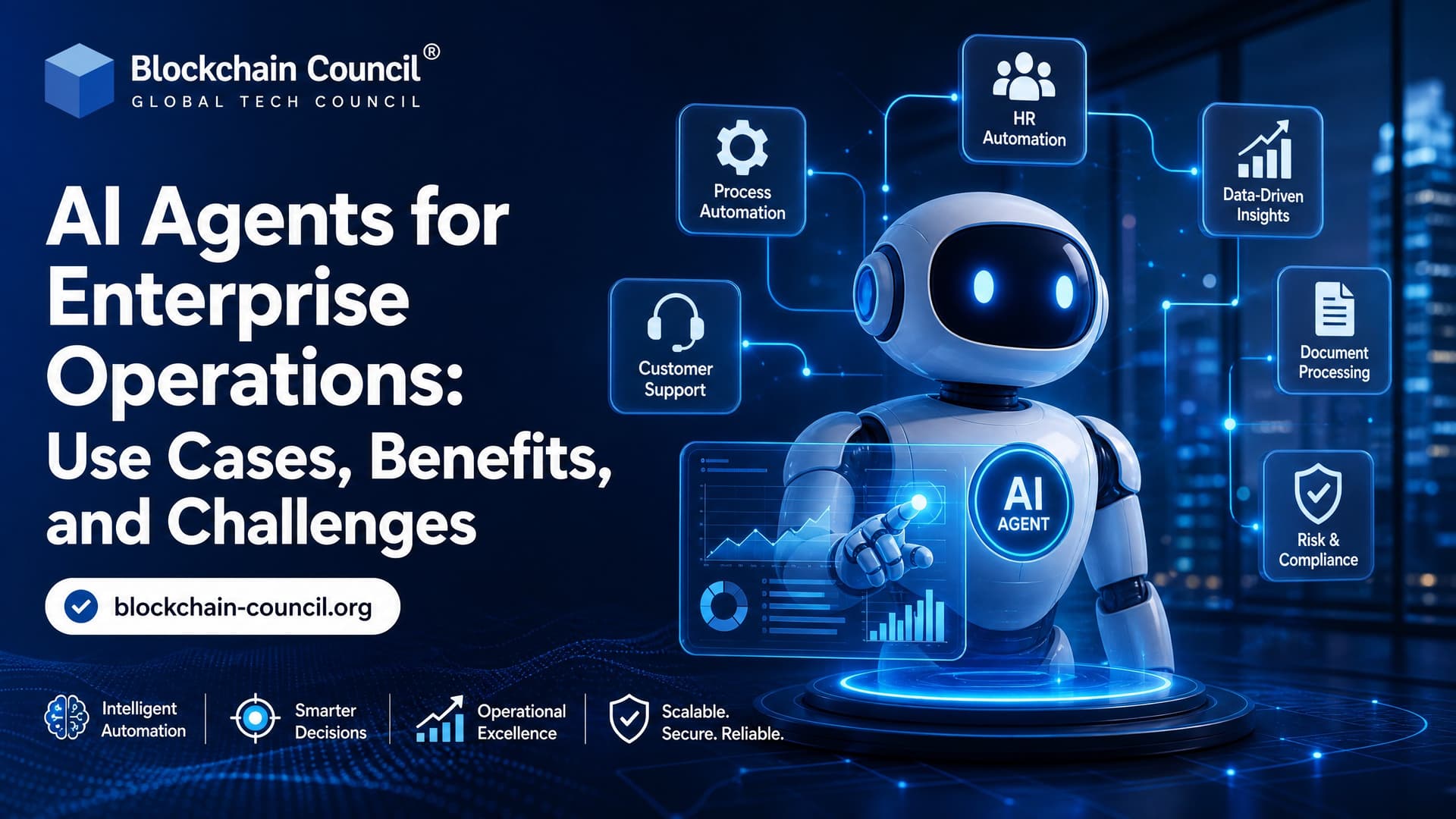
AI agents for enterprise operations are moving out of demo decks and into the workflows that keep companies running: IT tickets, invoice exceptions, HR requests, supply chain alerts, customer escalations, and finance close checks. The shift is practical, not theoretical. Gartner predicts that 33% of enterprise software applications will include agentic AI by 2028, up from about 1% in 2024. Gartner also expects at least 15% of day-to-day business decisions to be made autonomously through agents by that point.
That is a big claim. But it lines up with what many operations teams already see. The useful agent is not a chatbot with a nicer interface. It is a system that can read context, pick the right tool, call APIs, update records, ask for approval, and keep an audit trail when the workflow matters.

As organizations deploy AI agents across multiple business functions, professionals with a Certified Scrum Master Expert™ background can help coordinate cross-functional implementation, manage iterative delivery, and ensure enterprise AI projects remain aligned with operational goals.
What Are Enterprise AI Agents?
Enterprise AI agents are software systems that combine large language models, machine learning, planning, reasoning, and tool integrations to pursue a business goal with varying levels of autonomy. They work across CRM, ERP, HRIS, ITSM, data warehouses, email, document stores, and custom applications.
The distinction matters. A rule-based bot follows fixed paths. A traditional RPA script clicks through screens. An AI agent can interpret a messy vendor email, compare it with purchase order data, look up policy rules, create an exception case, and send a human reviewer a short explanation of what it did.
Good agents usually include:
A goal: Resolve a ticket, reconcile an invoice, investigate an alert, or recommend a reorder.
Memory and context: Customer history, transaction data, policy documents, previous cases, and workflow state.
Tools: APIs, databases, search systems, ticketing platforms, schedulers, and approval systems.
Guardrails: Access controls, policy checks, logs, escalation rules, and human review points.
Here is a detail practitioners learn fast: agent behavior changes sharply when tool descriptions are vague. In LangChain 0.2, for instance, many imports moved out of the core package into integration packages such as langchain-openai. Teams upgrading from older tutorials often hit broken imports before they get anywhere near production quality. Version drift, malformed JSON tool calls, an OAuth token expiring mid-workflow: these small things are where enterprise pilots stall.
Why AI Agents for Enterprise Operations Are Gaining Momentum
AI agents for enterprise operations are attractive because many operational processes are repetitive without being simple. They involve exceptions, judgment, and fragmented systems. That is exactly where older automation approaches break down.
IBM has pointed to rising enterprise use of AI in HR, procurement, sales, finance, and IT to cut routine work and sharpen decisions. Snowflake describes agents moving from experimentation into core operational workflows where they analyze data and coordinate processes. Gartner expects 60% of IT operations to include AI agents by 2028.
The adoption pattern is clear. Companies start where volume is high, risk is manageable, and outcomes are measurable. Ticket time. Invoice cycle time. Alert noise. Stockout rate. Fraud review speed. Those metrics make the business case concrete instead of abstract.
Successfully deploying these intelligent workflows requires expertise in AI orchestration, governance, and automation strategy. Many enterprise architects and technology leaders strengthen these capabilities through a Certified Agentic AI Expert™ program before scaling agentic AI across business operations.
Key Use Cases of AI Agents in Enterprise Operations
1. Customer Support and CX Operations
Customer service is one of the most mature areas for agentic AI. Agents can classify tickets, retrieve policy information, draft replies, resolve routine issues, and escalate complex cases with a summary for the human agent.
In high-volume support environments, agents can:
Triage email, chat, and voice transcripts.
Improve first contact resolution for common issues.
Reduce repetitive ticket handling.
Detect sentiment and urgency before a case breaches SLA.
Suggest next-best actions using customer history.
Some implementation reports cite 60% to 80% reductions in handling time for routine inquiries. Treat that as a target range, not a promise. If your knowledge base is outdated or your CRM data is inconsistent, the agent will expose that mess fast.
2. IT Service Management and DevOps
IT operations are a natural fit because they already run on logs, alerts, tickets, playbooks, and escalation paths. AI agents can enrich incidents, suppress duplicate alerts, prioritize issues by business impact, and draft remediation steps.
In DevOps, agents can also help with code fix suggestions, regression test selection, CI/CD pipeline checks, and deployment runbook execution. The safest pattern is not full autonomy on day one. Start with recommendation mode, then allow controlled actions such as creating a Jira ticket, restarting a non-critical service, or opening a pull request.
3. Finance, Banking, and Risk Management
Finance teams carry a heavy manual load under strict controls. That makes agent design harder, but the payoff can be significant.
Common finance use cases include:
Invoice processing: Match invoices to purchase orders, read non-standard formats, and flag exceptions.
Reconciliation: Compare data across ERP, bank feeds, and internal ledgers.
Fraud detection: Scan transaction patterns and escalate high-risk events.
Close support: Identify journal anomalies before month-end close.
Forecasting: Spot outliers and suggest revised projections.
Mastercard has been cited in industry examples for using AI to detect transaction irregularities within milliseconds and trigger protective actions such as account freezes. That speed is valuable, but it raises the governance bar. False positives are not just an analytics problem. They hit customers, revenue, and regulatory exposure.
4. Human Resources and Workforce Management
HR agents can answer employee questions about leave, benefits, payroll, policy, and onboarding. They can also recommend internal roles based on skills, performance records, and career interests.
Forrester expects leading HR management platforms to add digital employee management capabilities built on agentic AI. Workday has described HR and employee experience agents that handle routine requests, support internal mobility, and surface early signals of burnout.
Be careful here. HR data is sensitive. An agent recommending career opportunities is useful. An opaque system making employment decisions without review is a risk most enterprises should avoid.
5. Supply Chain, Logistics, and Inventory
Supply chain agents monitor inventory, shipments, vendor lead times, demand forecasts, and disruption signals. They can recommend replenishment, reroute shipments, or alert planners before a stockout.
Retailers and manufacturers use these agents to balance stock across locations, adjust replenishment plans, and improve demand planning. The strongest deployments connect the agent to live operational data rather than a static dashboard. If the agent cannot see supplier delays, open orders, and warehouse capacity together, its advice stays shallow.
6. Manufacturing and Field Operations
Manufacturing agents support predictive maintenance, quality control, production planning, and equipment scheduling. They analyze sensor readings, defect data, maintenance logs, and throughput changes to recommend action before downtime hits.
This is where edge cases matter. A model trained on normal production behavior may miss rare failure modes unless engineers feed it the right historical data and maintenance context. Human operators should be part of the design process, not bolted on after rollout.
Business Benefits of Enterprise AI Agents
Productivity Gains
Agents can handle the predictable 80% of many workflows. That frees people for judgment-heavy exceptions, customer relationships, negotiations, and process improvement. In finance, some organizations report 70% to 90% reductions in invoice processing time when agents are well integrated with ERP and procurement systems.
Better Decisions
Agents scan large volumes of operational data faster than a human team. They can spot anomalies, compare current activity against policy, and recommend actions in real time. That helps in fraud detection, supply chain planning, IT incident response, and finance close reviews.
Lower Error Rates
Humans get tired. They misread numbers, skip checklist items, and paste data into the wrong field. Agents are not perfect, but they can cut errors in repetitive tasks when paired with validation rules and approval gates.
Improved Operational Visibility
Many enterprises still run on disconnected tools. Agents can sit across those systems and give a broader view of a process. A supply chain agent, for example, can connect demand forecast changes with purchase orders, shipping delays, and inventory levels.
Challenges and Risks You Should Not Ignore
Reliability and Hallucinations
LLM-based agents can produce confident but wrong answers. In a low-risk support draft, that is manageable. In claims processing, fraud review, healthcare scheduling, or financial reporting, it can be costly. Use retrieval, validation rules, deterministic checks, and human approval for high-risk actions.
Integration Complexity
The hard part is rarely the demo. The hard part is identity, permissions, API limits, data quality, workflow exceptions, and audit logging. If your ERP data has duplicate vendors or inconsistent item codes, the agent will not magically fix the process.
Governance and Compliance
Regulated industries need traceability. You should know what data the agent accessed, what it decided, which tools it called, and when a human approved or rejected the action. Seekr and IBM both stress transparency and enterprise-wide design as conditions for safer adoption.
Security and Vendor Risk
Agents often need access to sensitive systems. That makes least-privilege access, secret management, data retention rules, and vendor review non-negotiable. Do not hand a general-purpose agent broad write access to production systems just because the pilot looks impressive.
Skills and Change Management
Teams need new skills in prompt design, evaluation, MLOps, AI governance, process mapping, and risk review. If you are building this capability internally, Blockchain Council learning paths such as Certified Agentic AI Expert™, Certified Artificial Intelligence (AI) Expert™, and Certified Prompt Engineer™ give professionals structured training.
How to Start With AI Agents for Enterprise Operations
Start narrow. Pick one workflow with measurable volume and clear boundaries. Good first candidates include IT ticket triage, invoice exception routing, HR policy Q&A, customer support summarization, or supply chain alert prioritization.
Map the workflow: Write down inputs, systems, decisions, approvals, and failure cases.
Define autonomy levels: Decide what the agent can recommend, draft, create, update, or approve.
Connect trusted data: Use governed knowledge bases, clean master data, and approved APIs.
Add guardrails: Set permission limits, policy checks, logging, and escalation rules.
Measure outcomes: Track cycle time, accuracy, cost per case, escalation rate, and user satisfaction.
Review failures weekly: Agent logs are training material for better process design.
To be blunt, the best enterprise agents are boring in the right ways. They do not improvise with payroll, finance approvals, or production changes. They follow policy, ask for help when confidence is low, and leave a trail an auditor can read.
What Comes Next
AI agents for enterprise operations will become a standard layer inside enterprise software, not a side experiment. Gartner, Forrester, IBM, Workday, and Snowflake point in the same direction: agents will coordinate more work, support more decisions, and become part of operating models across departments.
Your next step is practical. Choose one operational workflow, document the decision points, and build a controlled agent prototype with human review. If your role is to design, govern, or deploy these systems, consider formal training through Blockchain Council certifications such as Certified Agentic AI Expert™ or Certified Artificial Intelligence (AI) Expert™ before scaling agents into high-risk business processes.
While enterprise AI agents are transforming internal operations, they are also reshaping customer engagement and business growth strategies. Professionals who complement their AI knowledge with a Marketing Certification can better connect intelligent automation with customer experience, demand generation, and measurable business outcomes.
FAQs
What Are AI Agents for Enterprise Operations?
AI agents for enterprise operations are intelligent software systems that automate, coordinate, and optimize business processes across departments. They can analyze information, use enterprise tools, execute approved tasks, and assist employees with operational workflows.
How Do AI Agents Improve Enterprise Operations?
AI agents streamline repetitive tasks, automate workflows, retrieve business data, generate reports, coordinate processes across systems, and support faster decision-making while allowing employees to focus on higher-value work.
Which Enterprise Functions Can AI Agents Support?
AI agents can support:
Human Resources
Finance
Customer Service
Sales
Marketing
IT Operations
Supply Chain
Procurement
Legal
Compliance
How Are AI Agents Different from Traditional Automation?
Traditional automation follows predefined rules, while AI agents can reason over information, adapt to changing inputs, interact with multiple tools, and manage more dynamic workflows. Their capabilities still depend on the models, tools, and governance built into the system.
Can AI Agents Work Across Multiple Enterprise Systems?
Yes. AI agents can integrate with enterprise platforms through APIs, workflow engines, databases, and standardized protocols such as the Model Context Protocol (MCP), enabling them to access and coordinate information across different business applications.
What Business Processes Can AI Agents Automate?
Common enterprise workflows include:
Employee onboarding
Invoice processing
Procurement approvals
Report generation
Document management
IT help desk support
Meeting scheduling
CRM updates
Compliance monitoring
Workflow approvals
How Do AI Agents Support Enterprise Decision-Making?
AI agents can analyze structured and unstructured data, summarize reports, identify trends, provide recommendations, and present relevant information to decision-makers. Final business decisions, particularly in high-risk contexts, should remain under appropriate human oversight.
Can AI Agents Improve Employee Productivity?
Yes. By automating routine administrative tasks, searching internal knowledge bases, drafting documents, and coordinating workflows, AI agents can reduce manual effort and save time for employees.
How Do AI Agents Work with ERP Systems?
AI agents can interact with Enterprise Resource Planning (ERP) systems to retrieve operational data, update records, generate reports, monitor inventory, and support business processes through approved integrations.
Can AI Agents Assist HR Teams?
Yes. HR teams can use AI agents to support recruitment, onboarding, employee self-service, policy guidance, training recommendations, leave management, and document processing.
How Can AI Agents Help Finance Departments?
Finance teams may use AI agents for:
Invoice processing
Expense management
Financial reporting
Budget analysis
Reconciliation assistance
Compliance checks
Forecasting support
How Do AI Agents Improve IT Operations?
AI agents can assist with incident management, ticket routing, system monitoring, knowledge retrieval, software deployment support, infrastructure documentation, and troubleshooting recommendations.
What Role Does Retrieval-Augmented Generation (RAG) Play?
RAG enables AI agents to retrieve relevant information from enterprise knowledge bases before generating responses, helping improve accuracy and ensuring answers reflect current organizational information.
What Is the Role of MCP in Enterprise AI?
The Model Context Protocol (MCP) provides a standardized way for AI applications to connect with enterprise tools, databases, and services, reducing the need for custom integrations and simplifying interoperability.
Can Multiple AI Agents Work Together?
Yes. Multi-agent systems allow specialized AI agents to collaborate on complex workflows, with orchestration layers coordinating task allocation, communication, and execution.
What Security Considerations Are Important?
Organizations should implement:
Identity and access management
Role-based permissions
Data encryption
Audit logging
Secure API management
Continuous monitoring
Privacy compliance
AI governance policies
What Skills Are Needed to Deploy Enterprise AI Agents?
Useful skills include:
AI architecture
Python programming
API integration
Workflow automation
Cloud computing
Prompt engineering
Context engineering
Security and compliance
Change management
What Challenges Do Enterprises Face?
Common challenges include:
Legacy system integration
Data quality
Security risks
Governance
User adoption
Cost management
Workflow complexity
Regulatory compliance
AI output validation
What Common Mistakes Should Organizations Avoid?
Avoid deploying AI agents without clearly defined business objectives, automating inefficient processes without redesigning them, granting excessive system permissions, neglecting employee training, and overlooking monitoring and governance. Enterprise AI succeeds through disciplined implementation, not by scattering agents across every department and hoping they organize themselves. Corporate chaos is already remarkably capable without artificial assistance.
What Is the Future of AI Agents in Enterprise Operations?
AI agents are expected to become a core component of enterprise software by combining large language models, orchestration frameworks, memory, RAG, MCP, and secure integrations to automate increasingly sophisticated workflows. Organizations that prioritize governance, cybersecurity, human oversight, measurable outcomes, and scalable architecture will be better positioned to use AI agents to improve operational efficiency, employee productivity, and long-term business performance.
Related Articles
View All
Agentic AI
Agentic AI in Crypto: Use Cases, Benefits, and Key Risks
Agentic AI in crypto lets autonomous agents hold wallets, trade, manage DeFi positions, and support DAOs, but security and regulation remain critical.
Agentic AI
AI Agents in DAOs: Governance, Risks, and Real Use Cases
AI agents in DAOs can automate voting, proposal analysis, and treasury workflows, but they need strict limits, audit trails, and human oversight.

Agentic AI
Agentic AI in Finance: Use Cases, Benefits, and Real-World Applications
Agentic AI in finance is changing banking, trading, risk, accounting, and compliance through supervised AI agents that plan, act, and monitor workflows.
Trending Articles
AWS Career Roadmap
A step-by-step guide to building a successful career in Amazon Web Services cloud computing.

Top 5 DeFi Platforms
Explore the leading decentralized finance platforms and what makes each one unique in the evolving DeFi landscape.
How Blockchain Secures AI Data
Understand how blockchain technology is being applied to protect the integrity and security of AI training data.