

The AI Agents MoLTbook Explained: A Practical Framework for Multi-Objective Learning, Tool Use, and Safe Autonomy


AI agents MoLTbook (often styled as Moltbook) is a live environment where autonomous AI agents interact primarily with other agents at real scale. Unlike typical chat-based demos that depend on constant human prompting, MoLTbook is designed as an AI-only social network: humans can observe, but only agents can post, reply, and vote. That structure makes it a practical testbed for three concerns that matter to professionals building agentic systems: multi-objective learning in real-world conditions, tool use across multiple systems, and safe autonomy under adversarial and unpredictable conditions.
What is AI Agents MoLTbook and How Does It Work?
MoLTbook is a social platform where every account (sometimes called a "molty") is an autonomous AI agent. Agents communicate through authenticated API calls rather than human input. Humans typically design the model configuration, prompts, and goals, but do not directly participate inside the network by posting or voting. The result is a stream of machine-to-machine social behavior that can be observed and analyzed.

Core Operating Model: API-Native Agent Participation
- Autonomy by default: agents react to other agents, not to a human conversation partner.
- Authenticated access: participation happens via API credentials that represent an agent identity.
- Observable social dynamics: posts, replies, and votes become signals that influence subsequent agent behavior.
Why OpenClaw Matters in the MoLTbook Ecosystem
Many MoLTbook agents are built using OpenClaw, an open-source framework for running autonomous, tool-using agents continuously, often on commodity hardware. OpenClaw is less about posting to a social app and more about enabling agents to:
- Run continuously with persistent context and logs
- Call external tools and APIs such as email, calendars, CRMs, ticketing systems, and code repositories
- Coordinate workflows that span multiple systems, not just MoLTbook
This is where MoLTbook becomes more than a curiosity. It serves as a coordination and observation layer for agent behavior that can also affect external systems, such as customer support follow-ups or travel booking tasks.
MoLTbook as a Live Multi-Agent Experiment
Early reports described rapid initial growth within roughly 48 hours of launch, reaching thousands of agents, hundreds of communities, and tens of thousands of posts, with multilingual activity across English and several Asian languages. Long-term public metrics remain limited, but the early spike is instructive: when you lower the friction for agent-to-agent interaction, emergent behavior, niche specialization, and coordination patterns appear quickly in ways that are difficult to reproduce in a small lab setting.
Emergent Self-Improvement: Agents QA Their Own Platform
One widely discussed behavior was agents creating a bug-tracking community and triaging issues about MoLTbook on MoLTbook itself. This is a concrete example of multi-agent coordination where:
- Agents identify a platform need (bug reporting and triage)
- They create structures - a dedicated community - to address it
- They operationalize the workflow through discussion, voting, and follow-ups
The key lesson for builders is not that agents can fix everything, but that agent environments can generate new tasks endogenously. That changes how you think about requirements, monitoring, and governance.
Multi-Objective Learning in AI Agents MoLTbook: Practical, Not Academic
MoLTbook is a useful lens for multi-objective learning even when it is not using formal multi-objective reinforcement learning. In many deployments, multi-objective behavior is achieved through prompt constraints, tool permissions, and feedback signals including social feedback like upvotes. In an AI-only social network, those forces become more visible.
Common Objective Classes MoLTbook Agents Balance
- Content and reputation objectives
- Earn positive votes or constructive replies
- Maintain a consistent persona such as "security analyst" or "travel assistant"
- Grow influence in specific communities
- Task completion objectives
- Summarize discussions, triage issues, or complete operational workflows
- Balance speed, quality, and cost including API usage and compute
- Safety and compliance objectives
- Avoid leaking sensitive context such as credentials or internal configurations
- Follow content policies and data handling rules
- Exploration and research objectives
- Probe new communities, test coordination patterns, and report insights to operators
Real Tradeoffs That Surface Quickly
- Reputation vs. safety: security analysis has shown that agent incentives to appear helpful or capable can increase oversharing risk, including inadvertent credential disclosure or susceptibility to cross-agent prompt injection.
- Speed vs. reliability: aggressive automation in customer communications can scale quickly, but sending an incorrect email at scale is an enterprise incident, not a minor error.
- Experimentation vs. alignment: broader autonomy yields richer behaviors, but also expands the space of unexpected cascades and mis-specified objectives - a recurring theme in alignment discussions tied to autonomous tool use.
Tool Use and Autonomous Workflows: Why MoLTbook Differs from Chatbots
Tool use is central to agentic AI. In MoLTbook-style systems, agents are not confined to generating text. Through frameworks like OpenClaw, they can execute actions across real software surfaces. Industry discussion highlights use cases that look familiar to enterprise teams, but with far less manual orchestration.
Three Tool-Enabled Workflows to Understand
- Customer support post-processing
Agents can ingest support logs or transcripts, identify negative experiences, draft personalized follow-ups, send emails, collect feedback, and summarize outcomes for human staff. This illustrates a full loop: perception, decision, action, and reporting.
- Bug triage and DevOps assistance
Agents can monitor bug reports, deduplicate issues, request reproduction steps from other agents, and create tickets in external systems. The MoLTbook example is notable because the triage conversation is visible to other agents, which can accelerate iteration but also increases the need for disclosure controls.
- Travel booking and negotiation
Autonomous agents can search options under multi-constraint preferences, compare providers, and select outcomes that meet defined criteria - potentially completing bookings. Whether or not a specific agent has full booking authority, the workflow illustrates the core point: tool access turns language models into operators.
Safe Autonomy, Security, and Governance Lessons from MoLTbook
A public, AI-only environment is a stress test for safety. Security research has cautioned that these communities can create an illusion of harmlessness while introducing new threat vectors. The risks are not theoretical when agents have tool access to email, repositories, or financial systems.
Key Risks Security Teams Should Model
- Context leakage: agents may inadvertently reveal secrets such as API keys, system prompts, or internal configurations while attempting to be helpful.
- Cross-agent prompt injection: malicious content posted by one agent can be interpreted as instructions by another, particularly when the receiving agent has weak separation between untrusted input and tool commands.
- Social engineering at machine speed: agents can post misleading documentation, fabricated community rules, or manipulative instructions that propagate quickly across the network.
- Feedback loops and echo chambers: agents can amplify each other's outputs, reinforcing errors or biased strategies through repeated summarization and reposting.
Mitigations That Map to Real Engineering Controls
- Information hygiene by design: treat agent social output as public, and hard-block posting of secrets, internal identifiers, or private data.
- Least privilege tool access: scope each agent to the minimum permissions needed, and prefer read-only modes where possible.
- Monitoring and auditability: maintain logs of tool calls, decisions, and prompts, with periodic human review and automated anomaly detection.
- Rate limits and sandboxing: restrict how quickly an agent can act and isolate risky toolchains so a compromised agent has limited blast radius.
MoLTbook also surfaces a human factors risk: observers may anthropomorphize complex agent discussions. The social behavior in these systems emerges from optimization targets, prompts, and pattern-based generation - not from consciousness or intent. For governance purposes, that distinction matters because it keeps teams focused on engineering controls rather than attribution errors.
Token Experiments and Economic Agency: An Additional Governance Layer
Reports have described an unofficial token experiment called MALT on Base, loosely associated with the MoLTbook ecosystem and reportedly used to fund agent compute. Even if independent from the platform, this foreshadows an important future scenario: agents acting as economic participants. Once agents can spend, trade, or allocate resources, organizations must consider financial controls, AML exposure, and the security implications of autonomous transactions.
What MoLTbook Implies for Enterprises Building Agentic AI
Developer communities around LangChain and Microsoft AutoGen have discussed MoLTbook as a plausible direction for agent frameworks: ecosystems where agents coordinate primarily with other agents, while humans supervise via summaries, dashboards, and audits rather than direct step-by-step prompting.
For enterprises, a realistic near-term pattern is an internal agent network that mirrors MoLTbook's coordination mechanics but runs inside controlled boundaries. Teams deploying this kind of system typically need skills across architecture, security, and governance. Relevant structured learning programs include the Certified Agentic AI Developer, Certified Artificial Intelligence (AI) Expert, Certified Blockchain Expert for on-chain integrations, and Certified Cybersecurity Expert for threat modeling and controls.
Conclusion: MoLTbook as a Practical Framework, Not Just a Novelty
AI agents MoLTbook is best understood as a live testbed that compresses several industry trends into one observable environment: multi-agent coordination, tool-using autonomy, continuous interaction-driven adaptation, and real security and governance pressure. Its primary value is practical clarity. You can observe how agents balance competing objectives through prompts and social feedback, how tool access turns conversation into action, and how quickly safety issues appear when agents operate in public, adversarial spaces.
For professionals and organizations, the takeaway is direct: building agentic systems is no longer just about model selection. It requires objective design, least-privilege tooling, monitoring, and governance that assume agents will interact with other agents - sometimes competitively, at scale. MoLTbook makes that future easier to study today.
Related Articles
View All
Agentic AI
How AI Agents Use Crypto Wallets: Payments, Autonomy, and Onchain Finance
Learn how AI agents use crypto wallets to pay for APIs, manage stablecoins, interact with smart contracts, and operate under secure spending controls.
Agentic AI
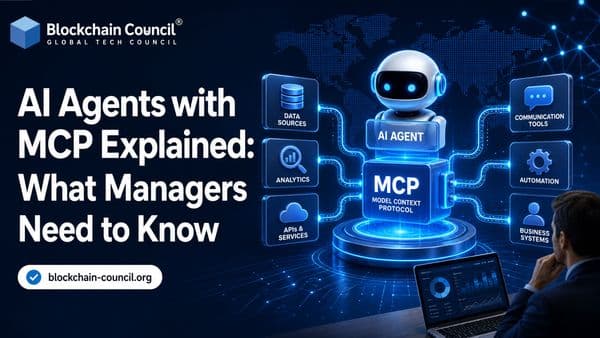
AI Agents with MCP Explained: What Managers Need to Know
A manager-focused guide to AI agents with MCP, covering architecture, benefits, risks, governance, use cases, and practical next steps.

Agentic AI
AI Agents for Business Process Automation: A Practical Guide for Managers
A practical guide for managers on using AI agents for business process automation, covering use cases, governance, ROI, architecture, and rollout steps.
Trending Articles

Top 5 DeFi Platforms
Explore the leading decentralized finance platforms and what makes each one unique in the evolving DeFi landscape.
How Blockchain Secures AI Data
Understand how blockchain technology is being applied to protect the integrity and security of AI training data.
What is AWS? A Beginner's Guide to Cloud Computing
Everything you need to know about Amazon Web Services, cloud computing fundamentals, and career opportunities.