

Top AI Agents Manager Skills You Need to Succeed in 2026
 Suyash Raizada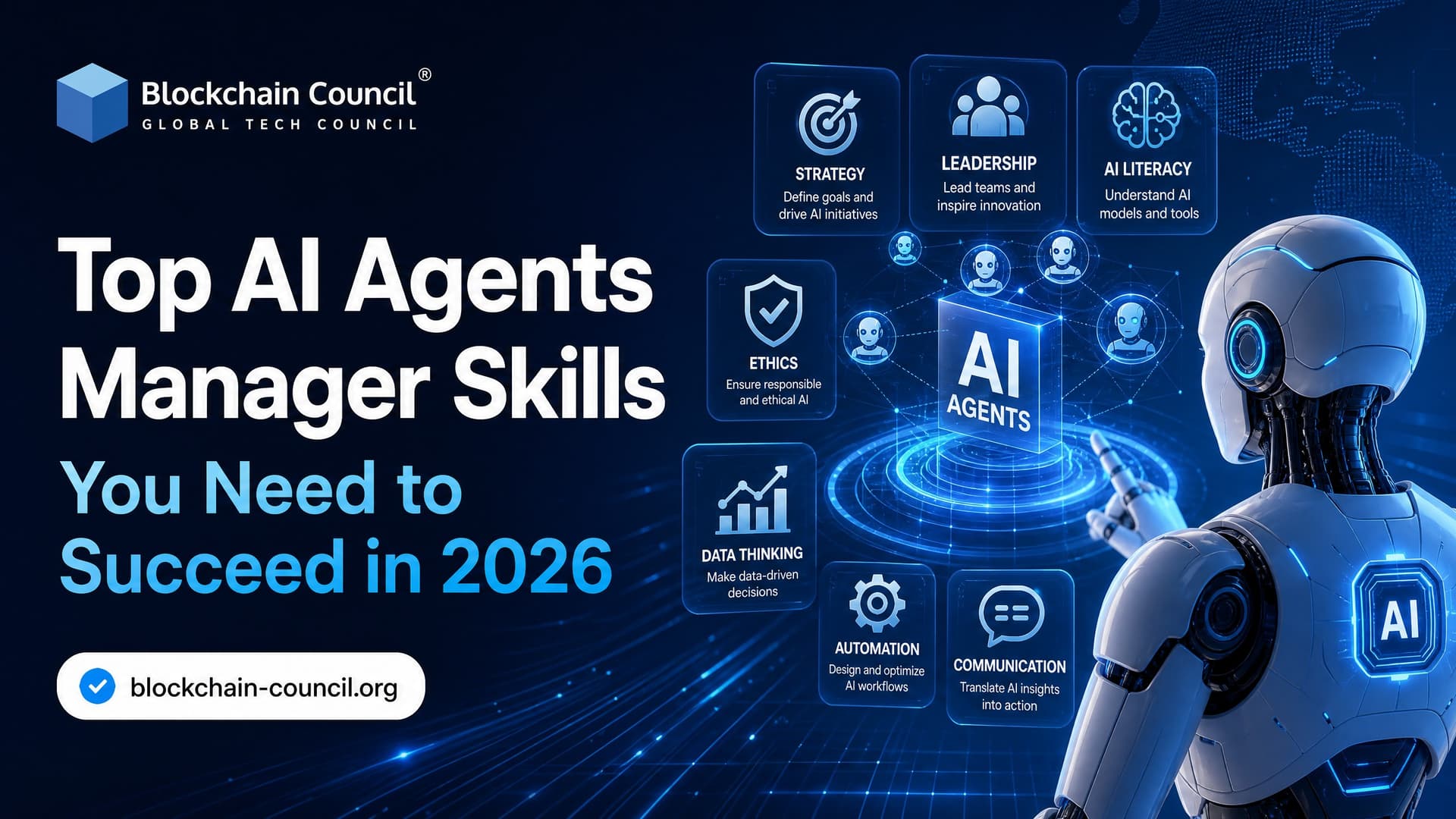
AI agents manager skills are moving from nice-to-have AI literacy into a core management capability. By 2026, many companies are treating agents as digital workers that need onboarding, permissions, performance reviews, escalation rules, and human supervision. If you manage operations, product, HR, compliance, or engineering, you will not just use agents. You may be responsible for what they produce.
The role sits between technology and accountability. You need enough technical fluency to understand orchestration, context windows, tool calls, MCP integrations, and evaluation loops. You also need the judgment to say no when an agent should not make a decision. That second part is where many teams fail.

As organizations integrate AI agents across engineering, operations, and product teams, professionals with a Certified Scrum Master Expert™ background can help coordinate agile delivery, improve cross-functional collaboration, and ensure AI initiatives are implemented with clear governance and measurable outcomes.
Why AI Agents Managers Matter in 2026
Accenture and other enterprise advisors have flagged a clear shift. HR and operations teams are starting to manage AI agents much like they manage people. Agents get assigned roles, monitored for performance, folded into workforce planning, and governed through internal policy.
This is not limited to tech companies. Healthcare systems use agents for patient intake and billing. Customer service teams use them for ticket triage and knowledge retrieval. Engineering teams use coding agents to draft tests, generate documentation, and break large tasks into smaller work items.
The market data backs the shift. Several 2026 industry analyses place agentic AI development and orchestration among the highest-paying AI skills, with mid-level compensation often reported around 170,000 to 220,000 USD. AI governance specialist roles are quoted in a similar range, roughly 205,000 to 225,000 USD. Product leaders are expanding AI investment too, with one widely cited figure showing 76 percent planning to increase AI spending by 2026.
The takeaway is simple. If you can manage agentic AI safely and measurably, you are moving into a high-demand career lane.
1. AI Governance and Responsible AI Literacy
The first skill is not prompting. It is governance.
An AI agents manager has to translate company policy into operational rules an agent can actually follow. That covers data access, privacy limits, human approval points, audit trails, and risk categories. If your organization has a policy that customer financial data cannot be used for model training, your agent workflow must enforce that, not just mention it in a document.
What you need to know
How to map internal AI policy to agent permissions.
When an agent must escalate to a human reviewer.
How to document decisions for audit and compliance teams.
How to spot unfair, unsafe, or privacy-invasive agent behavior.
To be blunt, governance is where agent projects become real. A demo can run with broad permissions. A production agent cannot.
If you want a structured learning path, Blockchain Council programs such as the Certified Agentic AI Expert™ and Certified Artificial Intelligence (AI) Expert™ help build this foundation.
2. Performance Auditing and Agent Evaluation
You cannot manage what you do not measure. AI agents need performance reviews just like human workers, but the metrics look different.
A manager should be able to evaluate output accuracy, hallucination rate, latency, task completion rate, cost per task, compliance incidents, and customer satisfaction. For regulated workflows, you may also need bias checks and human override rates.
Modern agent teams increasingly use evaluator-optimizer patterns, LLM-as-judge methods, and test sets built from real production examples. The rule is simple. Do not test only happy paths. Include messy customer messages, missing fields, contradictory instructions, and prompt injection attempts.
A practical evaluation checklist
Define the expected input and output before the agent is built.
Create pass-fail criteria for accuracy and policy compliance.
Test edge cases separately from normal cases.
Track regressions after prompt, model, or tool changes.
Review a sample of agent decisions manually every week.
One small detail from real deployments: changing temperature from 0.2 to 0.8 can make a support agent sound friendlier, but it can also increase inconsistent tool use. For transactional workflows, keep creativity low unless you have a clear reason to raise it.
3. Workflow Design and Agent Orchestration
Agent orchestration is one of the defining AI agents manager skills for 2026. It is the ability to decide how multiple agents, tools, humans, and systems work together.
Use parallel agents when subtasks do not depend on each other. Use sequential agents when one output determines the next step. Add a coordinator agent when several outputs must be merged and checked. Do not build a swarm because it sounds advanced. Too many agents usually means slower workflows, higher cost, and unclear accountability.
Common orchestration patterns
Sequential workflow: Intake agent collects data, verification agent checks it, billing agent creates an entry.
Parallel workflow: Research agent, compliance agent, and pricing agent work at the same time, then a coordinator compares their results.
Human-in-the-loop workflow: Agent prepares a recommendation, but a person approves any sensitive action.
ReAct-style loop: The agent plans, acts, observes the result, updates state, and continues.
Here is a developer-level gotcha managers should recognize. In OpenAI-style tool calling, if an assistant message includes tool calls, each tool_call_id must receive a matching tool message in the response. Miss that and you may see a 400 error stating that an assistant message with tool_calls must be followed by tool messages responding to each tool_call_id. That is not just an engineering nuisance. It means your workflow state model is broken.
4. Problem Shaping and Context Design
Weak agent systems usually start with weak problem statements. "Build me an HR agent" is not a specification. "Screen resumes against this job description, flag missing qualifications, avoid protected-class inference, and send uncertain cases to a recruiter" is closer.
Problem shaping means turning vague business goals into tasks with clear inputs, outputs, boundaries, and success criteria. Context design means giving the agent the right information at the right time, not dumping a 50-page policy into every prompt.
Include these in every agent brief
Target user and their likely state of mind.
Approved data sources and forbidden data sources.
Examples of good and bad responses.
Escalation triggers.
Known failure modes.
Measurable success criteria.
This is where prompt engineering gets serious. It is not about magic phrasing. It is about information density, constraints, examples, and workflow memory.
5. AI Product Management and Strategy
An AI agents manager needs product sense. Without it, the team may build impressive automations that nobody uses.
Product thinking helps you decide where agents fit in the customer journey, which pain point they solve, and what success actually means. It also forces cost awareness. Token usage, retrieval calls, tool execution, and human review all shape the economics of an agent workflow.
Take a customer support agent that saves two minutes per ticket. At 500,000 tickets per month, that is valuable. The same agent may be unnecessary for a team handling 200 complex enterprise tickets where accuracy matters far more than speed.
Readers moving toward this path can pair agentic AI training with product and strategy learning, including the Certified Generative AI Expert™ and related AI leadership programs.
6. Data, MLOps, and Infrastructure Awareness
You do not need to write every pipeline yourself, but you do need to understand what the engineering team is telling you.
MLOps roles have grown sharply over the last five years because production AI depends on monitoring, data quality, deployment pipelines, versioning, and incident response. Agents add another layer: tools, memory, APIs, permissions, and external systems.
Managers should understand concepts such as retrieval-augmented generation, vector databases, model version changes, rate limits, and the Model Context Protocol, often called MCP. MCP is becoming a common way to connect agents to external tools and data sources. The Agent Skills approach also points toward reusable skills that can move across tools such as Claude Code, Cursor, and Gemini CLI.
The management lesson is direct. Never design an agent workflow without asking where the data comes from, who owns it, how fresh it is, and what happens when an API fails.
7. Prompt Engineering and Interaction Design
Prompt engineering is still a baseline skill, but the 2026 version is broader than writing clever instructions.
You need standards for how agents ask clarifying questions, summarize status, handle uncertainty, and resist malicious instructions. For multi-step work, many teams prepend status summaries to each model call: original goal, completed steps, current step, remaining steps, and open risks. It sounds simple. It works.
Prompt injection defense matters too. If an agent reads emails, web pages, PDFs, or tickets, it may encounter hostile text telling it to ignore previous instructions or reveal confidential data. A manager should require validation layers, allowlisted tools, and clear separation between system instructions and untrusted content.
For learners focused on this skill, the Certified Prompt Engineer™ is a strong fit.
8. Human Leadership, Ethics, and Change Management
The best AI agents managers are not just technical coordinators. They are change leaders.
People worry about agent deployments for good reasons: job redesign, accountability, surveillance, and fairness. You need to explain what agents will do, what they will not do, and how human staff stay in control. You also need to decide when automation is the wrong answer.
Some decisions should not be fully delegated to agents. Hiring rejections, loan denials, medical prioritization, legal advice, and disciplinary action all require careful human oversight. Agents can prepare evidence, summarize options, and flag inconsistencies. They should not become invisible decision-makers.
Skills Roadmap: How to Prepare in 2026
Learn agent fundamentals: Study agent architectures, tool use, memory, planning loops, and orchestration patterns.
Build one small workflow: Start with a support triage agent or a research assistant. Add logging and evaluation from day one.
Add governance: Define permissions, escalation rules, audit logs, and risk categories.
Measure performance: Create a test set with normal cases, edge cases, and adversarial prompts.
Study product economics: Track cost per task, user adoption, latency, and business value.
Formalize your skills: Consider Blockchain Council certifications such as the Certified Agentic AI Expert™, Certified Artificial Intelligence (AI) Expert™, Certified Generative AI Expert™, or Certified Prompt Engineer™ depending on your role.
Your Next Step
To succeed as an AI agents manager in 2026, start with one workflow you understand deeply. Map the human process, define where an agent can help, set the guardrails, and measure the results. Do not chase the most complex multi-agent setup first. Build a reliable single-agent workflow, then add orchestration only when the process proves it needs it.
For professionals moving into agentic AI, the strongest path mixes governance, evaluation, workflow design, product thinking, and prompt engineering. If you want guided training, begin with the Certified Agentic AI Expert™, then add the Certified Prompt Engineer™ or Certified Artificial Intelligence (AI) Expert™ based on whether your role leans technical, strategic, or operational.
As AI agents increasingly support customer engagement, digital services, and business growth alongside technical operations, professionals who complement their AI expertise with a Marketing Certification are better prepared to align intelligent automation with customer needs, market strategy, and measurable business outcomes.
FAQs
1. What are the most important AI Agents Manager skills in 2026?
The most valuable skills include AI strategy, agent orchestration, workflow automation, prompt engineering, AI governance, leadership, business process optimization, data analysis, change management, and performance monitoring. These skills help managers successfully deploy and scale AI agents across organizations.
2. Why are AI Agents Manager skills becoming more important in 2026?
As businesses adopt AI agents for customer service, marketing, software development, HR, and operations, organizations need professionals who can manage AI systems responsibly, ensure governance, and maximize business value while minimizing risks.
3. What technical skills should an AI Agents Manager have?
An AI Agents Manager should understand large language models (LLMs), AI agents, APIs, workflow automation, cloud platforms, prompt engineering, AI orchestration, data security, and system integrations. Deep programming expertise is helpful but not always required.
4. Is prompt engineering an essential skill for AI Agents Managers?
Yes. Prompt engineering helps improve the accuracy, consistency, and reliability of AI-generated responses. Understanding how to design and refine prompts enables managers to optimize AI agent performance across different business use cases.
5. How important is AI governance for AI Agents Managers?
AI governance is one of the most critical skills. Managers must establish policies for responsible AI use, ensure regulatory compliance, manage operational risks, protect sensitive data, and implement human oversight where appropriate.
6. Why is workflow automation a key AI Agents Manager skill?
Workflow automation enables organizations to streamline repetitive business processes. AI Agents Managers design, monitor, and optimize automated workflows that improve productivity, reduce costs, and increase operational efficiency.
7. What leadership skills do AI Agents Managers need?
Successful AI Agents Managers need communication, decision-making, stakeholder management, conflict resolution, strategic thinking, team leadership, and change management skills to guide AI initiatives across technical and business teams.
8. How does project management help AI Agents Managers?
Project management skills help managers plan AI implementations, allocate resources, manage timelines, coordinate teams, mitigate risks, and deliver AI projects that align with business objectives and organizational priorities.
9. Why is business process optimization important for AI Agent Managers?
Understanding business processes allows managers to identify automation opportunities, redesign workflows, eliminate inefficiencies, and ensure AI agents generate measurable improvements in productivity and operational performance.
10. Should AI Agents Managers understand data analytics?
Yes. Data analytics helps managers evaluate AI performance, measure business impact, identify trends, monitor KPIs, and make data-driven decisions to continuously improve AI systems and workflows.
11. How important are communication skills for AI Agents Managers?
Communication is essential because AI Agents Managers regularly collaborate with executives, engineers, product managers, legal teams, and end users. They must explain AI concepts clearly and align stakeholders around implementation goals.
12. What AI platforms should AI Agents Managers learn?
Managers should become familiar with enterprise AI platforms, AI orchestration frameworks, workflow automation tools, cloud AI services, analytics platforms, vector databases, and collaboration software commonly used in AI deployments.
13. Do AI Agents Managers need coding skills?
Coding is not mandatory for every role, but understanding Python, APIs, SQL, JSON, and automation scripts can improve communication with engineering teams and help managers better evaluate technical solutions.
14. How does change management contribute to AI success?
AI adoption often changes existing business processes. AI Agents Managers must lead organizational change by training employees, addressing concerns, encouraging adoption, and ensuring AI integrates smoothly into daily operations.
15. Why is AI security knowledge important in 2026?
AI systems increasingly handle sensitive business and customer data. Managers need to understand cybersecurity principles, access controls, identity management, privacy requirements, and AI security risks to protect enterprise systems.
16. What soft skills help AI Agents Managers succeed?
Critical soft skills include adaptability, problem-solving, critical thinking, collaboration, negotiation, emotional intelligence, time management, creativity, and the ability to lead cross-functional teams during AI transformation projects.
17. How can professionals develop AI Agents Manager skills?
Professionals can build these skills through hands-on AI projects, enterprise AI implementations, online courses, certifications, industry conferences, leadership experience, workflow automation initiatives, and continuous learning about emerging AI technologies.
18. Which certifications are valuable for AI Agents Managers?
Certifications in artificial intelligence, cloud computing, project management (PMP), Agile, Scrum, cybersecurity, AI governance, data analytics, and prompt engineering can strengthen a professional's qualifications and career opportunities.
19. How do AI Agents Managers stay updated with AI trends?
Managers stay informed by following AI research, attending conferences, participating in professional communities, completing advanced training, monitoring regulatory changes, experimenting with new AI platforms, and studying enterprise AI case studies.
20. Why are AI Agents Manager skills critical for future careers?
As AI agents become a core part of business operations, organizations need professionals who can combine technical understanding, strategic leadership, governance, and operational expertise. Developing these skills prepares professionals to lead enterprise AI initiatives, drive innovation, and remain competitive in the rapidly evolving AI job market throughout 2026 and beyond.
Related Articles
View All
Agentic AI
AI Agents Manager vs AI Engineer: Roles, Skills, and Responsibilities
Compare AI Agents Manager vs AI Engineer roles, skills, responsibilities, use cases, and career paths for agentic AI and production LLM systems.

Agentic AI
AI Agents Manager Job Description: Responsibilities, Skills, and Daily Tasks
Learn what an AI Agents Manager does, including responsibilities, daily tasks, skills, metrics, governance duties, and career outlook.

Agentic AI
What Does an AI Agents Manager Do? Roles, Skills, and Career Outlook
Learn what an AI agents manager does, which skills matter, where the role is used, and how to prepare for a career in agentic AI operations.
Trending Articles
The Role of Blockchain in Ethical AI Development
How blockchain technology is being used to promote transparency and accountability in artificial intelligence systems.

Can DeFi 2.0 Bridge the Gap Between Traditional and Decentralized Finance?
The next generation of DeFi protocols aims to connect traditional banking with decentralized finance ecosystems.
How to Install Claude Code
Learn how to install Claude Code on macOS, Linux, and Windows using the native installer, plus verification, authentication, and troubleshooting tips.