

AI Agents Manager vs AI Product Manager: Key Differences Explained
 Suyash Raizada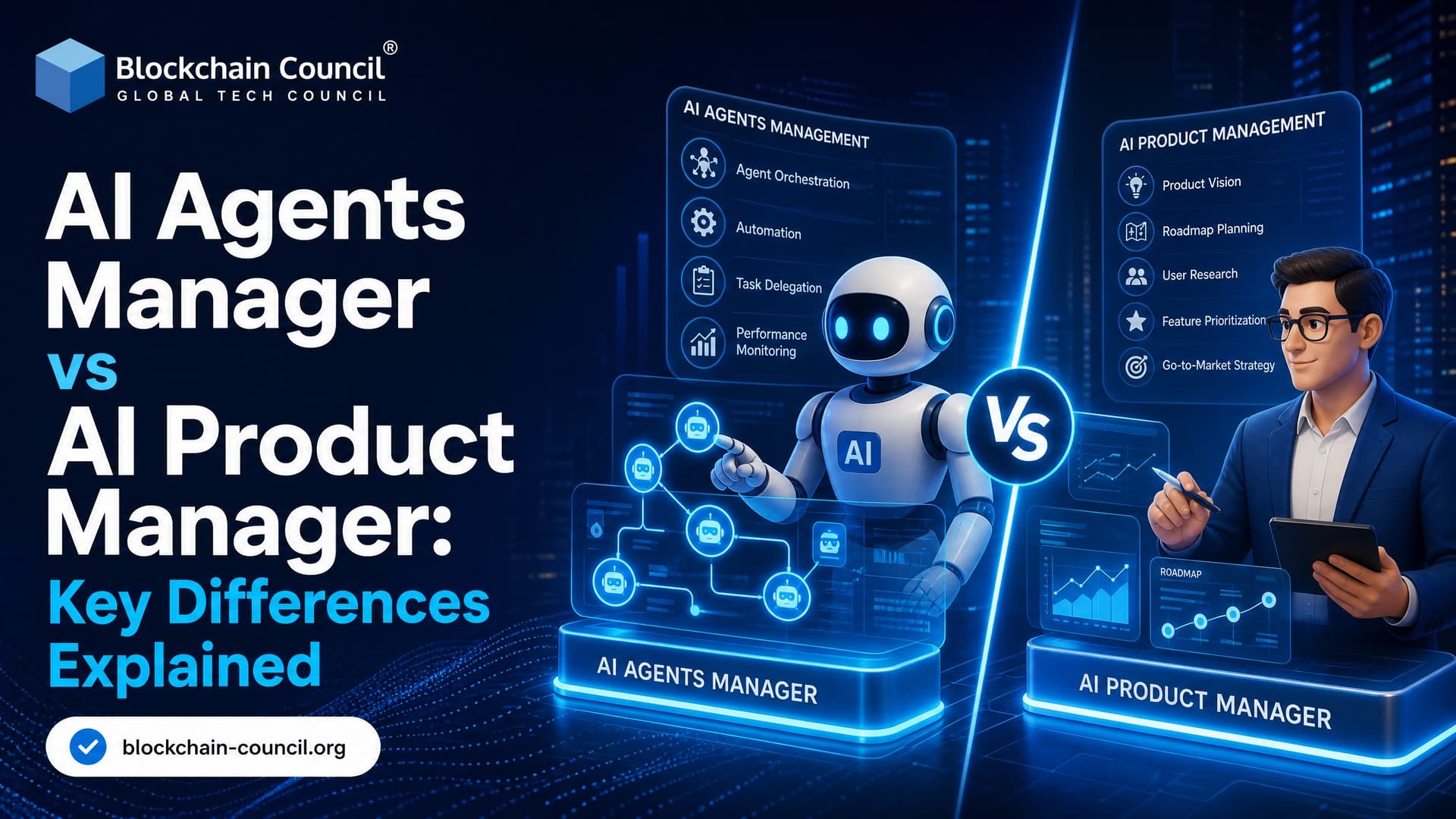
AI Agents Manager vs AI Product Manager is becoming a real career question as companies shift from bolting AI features onto products to running autonomous agents across whole workflows. An AI Product Manager owns AI-enabled products and the measurable user outcomes they produce. An AI Agents Manager, a newer and far less standardized role, owns the design, coordination, monitoring, and governance of autonomous AI agent systems.
The overlap is real. Both roles need product judgment, data fluency, technical confidence, and a sharp eye for risk. The difference is where the risk sits. In AI product management, the question is whether an AI feature solves a customer problem better than a simpler product experience. In AI agent management, the question becomes something harder: should this system be allowed to act, when, with which tools, and under whose approval?

As organizations expand AI initiatives across engineering, product, and operations teams, professionals with a Certified Scrum Master Expert™ background are increasingly helping coordinate cross-functional delivery, manage iterative AI implementations, and ensure autonomous systems are introduced with clear governance and accountability.
What Is an AI Product Manager?
An AI Product Manager is a product manager who defines, builds, launches, and improves products that use artificial intelligence. The product may be a user-facing AI feature such as a recommendation engine or chatbot. It may also be an internal AI platform that helps other teams build model-powered applications.
The role is best understood as a specialized form of product management that adds model behavior, data quality, evaluation, and AI ethics to the usual PM toolkit. You still own the roadmap. You still work with engineering, design, sales, marketing, legal, and customers. But now you also have to understand why a model looks great in offline tests and then behaves poorly in production.
Common responsibilities of an AI Product Manager
Find the right AI use case: Decide whether AI is actually needed, or whether rules, search, analytics, or better UX would solve the problem faster.
Own product and model metrics: Track adoption, retention, revenue, precision, recall, latency, hallucination rate, and user trust signals.
Shape the data strategy: Work with data teams on sources, labeling, quality checks, privacy, and bias monitoring.
Run evaluations: Coordinate offline tests, A/B experiments, red-team reviews, and post-launch monitoring.
Manage AI risk: Define guardrails for privacy, fairness, explainability, consent, and failure handling.
To be blunt, a good AI Product Manager knows when not to use AI. If your support team needs faster access to policy documents, a well-designed search experience may beat a costly generative feature. The PM has to make that call.
What Is an AI Agents Manager?
An AI Agents Manager is responsible for autonomous or semi-autonomous AI agents that monitor information, reason through tasks, call tools, and take action across systems. The title is still emerging. In many companies the work is handled by AI Product Managers, platform PMs, automation leads, or technical product owners.
The function is different from managing a chatbot. A chatbot responds when a person asks something. An agent can wake up on a schedule, scan customer feedback, query analytics, draft a Jira issue, ping a Slack channel, and ask for approval before it changes a roadmap item. That creates value. It also creates new failure modes.
Here is a practical example. When teams build agents with frameworks such as LangChain, a poorly constrained agent can loop through tool calls until it stops with the message Agent stopped due to iteration limit or time limit. That is not just a developer nuisance. It tells you the agent lacked a clear stopping condition, a task boundary, or better context design. An AI Agents Manager has to care about those details, because they hit cost, trust, and operational safety directly.
Common responsibilities of an AI Agents Manager
Design agent architecture: Choose between horizontal agents for broad tasks and vertical agents for domain-specific workflows.
Define agent roles: Set clear jobs for research agents, feedback synthesis agents, data analyst agents, documentation agents, and executive assistant agents.
Orchestrate multi-agent workflows: Decide how agents hand work to each other and where humans must review output.
Connect tools safely: Integrate agents with Jira, Notion, Slack, CRMs, analytics platforms, data warehouses, or internal APIs.
Measure autonomy: Track task success rate, intervention frequency, error incidents, time saved, and decision quality.
Govern agent behavior: Define permissions, escalation rules, audit logs, and approval gates before agents can act.
Successfully managing autonomous AI systems requires more than understanding large language models. Many professionals strengthen their expertise in agent orchestration, governance, memory management, and production deployment through a Certified Agentic AI Expert™ program before leading enterprise-scale agent initiatives.
AI Agents Manager vs AI Product Manager: Core Differences
Aspect | AI Product Manager | AI Agents Manager |
|---|---|---|
Main focus | AI-powered products, platforms, and customer experiences | Autonomous agents and multi-agent systems across workflows |
Primary outcome | User value, business growth, model performance, trust | Task automation quality, safe autonomy, operational impact |
Technical center | Model selection, evaluation, data pipelines, product integration | Tool calling, agent orchestration, memory, context, permissions |
Autonomy level | AI acts inside designed product flows | Agents may act across systems with limited supervision |
Risk profile | Wrong prediction, biased output, poor UX, privacy issues | Wrong action, tool misuse, data exposure, runaway workflows |
The simplest distinction: an AI Product Manager asks, what product should we build with AI? An AI Agents Manager asks, what work can we safely delegate to AI agents?
Metrics: What Each Role Measures
AI Product Manager metrics
AI Product Managers balance traditional product metrics with model metrics. You may track conversion, daily active users, churn, average revenue per user, customer satisfaction, and support deflection. Alongside those, you need model-specific measures such as precision, recall, latency, grounding quality, hallucination frequency, and escalation rate.
This is where many new AI PMs trip. A model can have strong offline accuracy and still fail the product. If a fraud model catches more suspicious transactions but delays legitimate payments for high-value customers, the product result may be unacceptable. Your metric set has to reflect the user experience, not just the model score.
AI Agents Manager metrics
Agent metrics look more operational. Early reports from teams running agents in product workflows suggest AI tools can cut repetitive product management work by 50 to 60 percent, with roadmap and feedback processing agents saving meaningful hours per sprint. Treat these figures as directional, not guaranteed. Your own numbers will depend on how narrow and well-governed the task is.
Useful agent metrics include:
Task completion rate
Human intervention frequency
Incorrect action rate
Cost per completed workflow
Tool-call failure rate
Time saved per sprint
Percentage of outputs accepted without edits
Number of incidents, escalations, or permission violations
Watch cost closely. A vertical agent with rich context, retrieval, and multiple tool calls may be more accurate, but it can also be too expensive for low-value tasks. Use simpler automation where the stakes are low.
Skills Needed for Each Career Path
Skills for AI Product Managers
Product discovery and roadmap planning
Basic machine learning literacy, including training vs inference
Experiment design and A/B testing
Data quality and labeling awareness
Model evaluation and monitoring
AI ethics, privacy, bias, and explainability
Clear communication with engineers, data scientists, executives, and customers
If this is your path, build a small AI feature end to end. Create a feedback classifier, define success metrics, test it on messy real comments, then write the product decision memo. That exercise teaches more than ten trend reports.
Skills for AI Agents Managers
Agent workflow design
Tool integration and API thinking
Context engineering and retrieval-augmented generation basics
Multi-agent coordination patterns
Access control, auditability, and human approval design
Operational analytics and productivity measurement
Incident response for autonomous systems
For agent work, practice with a narrow workflow first. Build an agent that summarizes support tickets and drafts backlog candidates, but do not let it create tickets automatically on day one. Add human review. Then measure acceptance rate, editing time, and false positives.
Real-World Use Cases
Where AI Product Managers add value
Personalized recommendations in an ecommerce platform
AI copilots inside SaaS products
Fraud detection workflows in fintech
Internal model evaluation platforms for engineering teams
Customer support assistants with strict escalation policies
Where AI Agents Managers add value
A competitive analyst agent that monitors competitor releases and pricing pages
A feedback synthesis agent that clusters comments from surveys, reviews, and support logs
A roadmap agent that drafts prioritization notes from usage data and customer pain points
A documentation agent that updates release notes after engineering milestones
A data analyst agent that checks dashboards and flags anomalies
Industry forecasts point to a fast rise in enterprise software that ships with built-in AI agents by 2028, along with a growing share of routine work decisions made autonomously by those systems. If that direction holds, companies will need clear owners for agent behavior, not just builders.
Which Role Should You Choose?
Choose AI Product Manager if you enjoy customer discovery, product strategy, UX trade-offs, business metrics, and deciding how AI should improve a product. This is the better path if you want to own a product line or move toward product leadership.
Choose AI Agents Manager if you are drawn to systems design, workflow automation, tool permissions, monitoring, and operational governance. This path fits people who like building internal AI capability and making autonomous systems safe enough to run at scale.
There is a strong middle path too. Many AI Product Managers will end up managing agents inside their products or teams. In larger enterprises, a dedicated AI Agent Platform PM or AI Agents Manager may own cross-functional agent infrastructure, guardrails, and standards.
How Blockchain Council Certifications Fit In
If you are building credibility for either track, structured learning helps. Look at certifications such as the Certified Agentic AI Expert™, the Certified Artificial Intelligence (AI) Expert™, and the Certified Generative AI Expert™. For product professionals, pair a certification with hands-on portfolio work: one AI feature, one agent workflow, and one governance checklist.
Do not stop at theory. Pick a workflow this week. Map the user, the data, the tools, the failure modes, and the approval points. If your goal is AI product leadership, build the product case. If your goal is agent management, build the operating model and test it with a constrained agent before you give it real permissions.
As AI-powered products and autonomous agents increasingly influence customer experiences, digital services, and business growth, professionals who complement their technical expertise with a Marketing Certification are better positioned to align AI initiatives with customer needs, market strategy, and measurable business outcomes.
FAQs
1. What is the difference between an AI Agents Manager and an AI Product Manager?
An AI Agents Manager is responsible for deploying, managing, governing, and optimizing AI agents within business operations. An AI Product Manager focuses on defining the product vision, roadmap, customer requirements, and market strategy for AI-powered products and features.
2. What does an AI Agents Manager do?
An AI Agents Manager oversees the lifecycle of AI agents, including implementation, workflow automation, governance, performance monitoring, compliance, and continuous optimization to ensure AI systems deliver measurable business value.
3. What does an AI Product Manager do?
An AI Product Manager identifies customer needs, prioritizes AI features, creates product roadmaps, coordinates with engineering teams, and ensures AI-powered products solve real user problems while meeting business objectives.
4. Which role is more business-focused: AI Agents Manager or AI Product Manager?
Both roles are business-oriented, but their focus differs. AI Product Managers concentrate on building successful AI products for customers, while AI Agents Managers focus on managing AI agents that improve internal operations, productivity, and business workflows.
5. What skills are required for an AI Agents Manager?
AI Agents Managers need expertise in AI strategy, workflow automation, AI governance, risk management, project leadership, business process optimization, performance measurement, and cross-functional collaboration.
6. What skills should an AI Product Manager have?
AI Product Managers require product strategy, market research, customer discovery, roadmap planning, stakeholder management, data analysis, Agile methodologies, AI fundamentals, and strong communication skills.
7. How do AI Agents Managers and AI Product Managers work together?
AI Product Managers define product goals and customer requirements, while AI Agents Managers implement and optimize AI agents that support product operations, customer service, internal workflows, or AI-driven business processes.
8. Which role requires more technical knowledge?
Both roles benefit from understanding AI technologies, but neither typically requires the deep technical expertise expected of an AI Engineer. AI Agents Managers often need stronger knowledge of AI workflows, automation, and governance, while AI Product Managers focus more on product strategy and user needs.
9. Who is responsible for AI governance?
AI Agents Managers usually take the lead on AI governance by establishing policies, ensuring compliance, monitoring AI performance, and managing operational risks. AI Product Managers support governance by incorporating responsible AI principles into product planning and development.
10. Which role focuses more on customer experience?
AI Product Managers primarily focus on customer experience by creating products that solve user problems. AI Agents Managers focus on improving operational efficiency and ensuring AI agents deliver reliable, secure, and effective outcomes for users and employees.
11. Can one person perform both roles?
Yes. In startups or small businesses, one professional may manage both AI products and AI agents. In larger organizations, these roles are usually separated because each requires specialized responsibilities and strategic focus.
12. Which industries hire AI Agents Managers and AI Product Managers?
Healthcare, finance, retail, software, manufacturing, telecommunications, education, logistics, legal services, and e-commerce are among the industries actively hiring both roles to support AI adoption and innovation.
13. What tools do AI Agents Managers commonly use?
AI Agents Managers often work with AI orchestration platforms, workflow automation tools, analytics dashboards, project management software, governance solutions, and enterprise AI platforms to monitor and optimize AI operations.
14. What tools do AI Product Managers use?
AI Product Managers typically use product management tools such as Jira, Confluence, Productboard, Figma, analytics platforms, customer feedback tools, roadmap software, and collaboration platforms to manage product development.
15. Which role is responsible for measuring AI success?
AI Product Managers measure success using customer adoption, user engagement, retention, revenue, and product KPIs. AI Agents Managers focus on operational metrics such as automation rates, workflow efficiency, response accuracy, productivity improvements, and cost savings.
16. Which role has greater involvement in AI deployment?
AI Agents Managers are directly involved in deploying, configuring, monitoring, and maintaining AI agents. AI Product Managers typically oversee product releases and coordinate with engineering teams but are less involved in day-to-day operational management.
17. Can an AI Product Manager transition into an AI Agents Manager role?
Yes. AI Product Managers can transition by gaining experience in AI operations, workflow automation, governance, enterprise AI platforms, and operational performance management. Their product strategy background provides a strong foundation for managing AI initiatives.
18. What are the biggest challenges for AI Agents Managers and AI Product Managers?
AI Agents Managers often deal with governance, scalability, compliance, workflow optimization, and AI performance monitoring. AI Product Managers typically focus on balancing customer needs, technical feasibility, market competition, product prioritization, and business growth.
19. Which career has higher demand?
Demand for both roles is increasing as organizations adopt AI. AI Product Managers are in demand for developing AI-powered products, while AI Agents Managers are becoming increasingly important for managing enterprise AI systems, automation, and operational governance.
20. Which career is better: AI Agents Manager or AI Product Manager?
The right career depends on your interests. If you enjoy leading AI operations, managing intelligent workflows, governance, and enterprise automation, AI Agents Manager may be the better choice. If you prefer defining product strategy, understanding customer needs, and launching AI-powered products, AI Product Manager is likely the better fit. As AI adoption accelerates, both careers are expected to play critical roles in shaping the future of AI-driven businesses.
Related Articles
View All
Agentic AI
AI Agents with MCP Explained: What Managers Need to Know
A manager-focused guide to AI agents with MCP, covering architecture, benefits, risks, governance, use cases, and practical next steps.

Agentic AI
AI Agents Manager vs AI Engineer: Roles, Skills, and Responsibilities
Compare AI Agents Manager vs AI Engineer roles, skills, responsibilities, use cases, and career paths for agentic AI and production LLM systems.

Agentic AI
AI Agents Manager Interview Questions and Answers for Job Seekers
Prepare for AI Agents Manager interviews with practical questions, model answers, architecture tips, RAG guidance, evals, security, and governance advice.
Trending Articles
How Blockchain Secures AI Data
Understand how blockchain technology is being applied to protect the integrity and security of AI training data.
What is AWS? A Beginner's Guide to Cloud Computing
Everything you need to know about Amazon Web Services, cloud computing fundamentals, and career opportunities.
Claude AI Tools for Productivity
Discover Claude AI tools for productivity to streamline tasks, manage workflows, and improve efficiency.