

Agentic AI Tools and Architecture FAQs: LLM Agents, RAG, Memory, Planning, and Multi-Agent Systems Explained

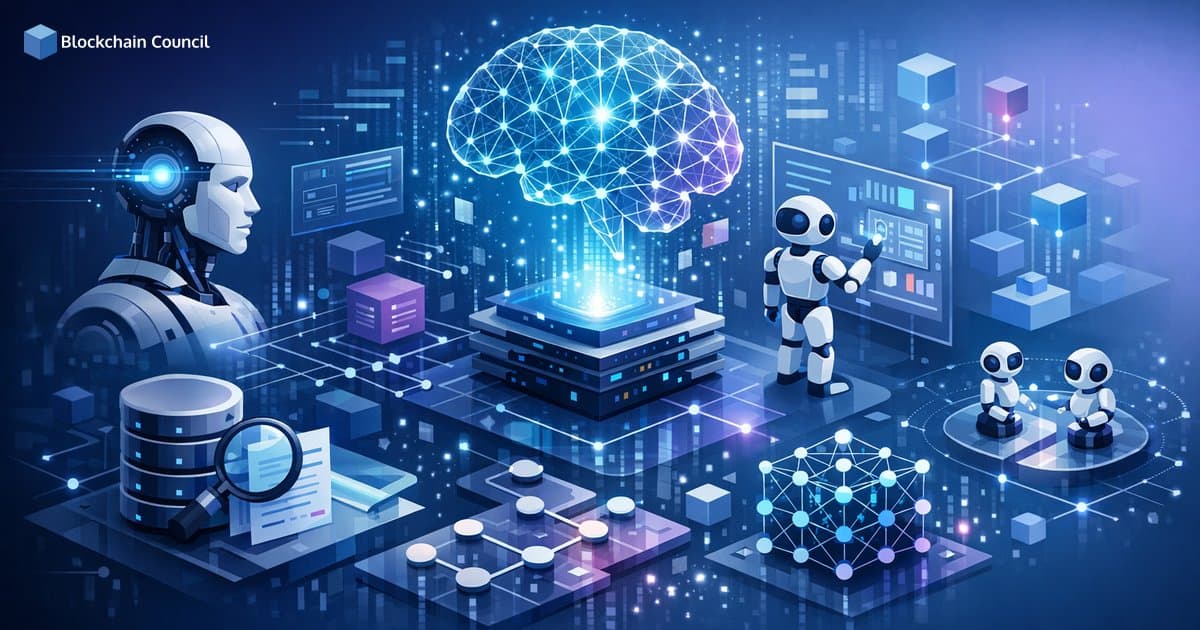
Agentic AI tools and architecture are quickly becoming the practical blueprint for moving from chat-based experimentation to reliable, auditable AI that can execute workflows. Instead of generating text in isolation, agentic systems combine LLM reasoning with tool use, retrieval, memory, and orchestration so agents can pursue goals across multiple steps while remaining governed and observable.
This FAQ-style guide explains the core building blocks behind LLM agents, RAG, memory, planning, and multi-agent systems, along with the enterprise patterns emerging from industry research at organizations such as IBM and Bain and Company, and recent agent architecture surveys published on arXiv.

1) What is agentic AI and how is it different from standard LLMs?
Agentic AI refers to systems where AI agents use an LLM plus tools, memory, and control logic to autonomously pursue goals rather than answer a single prompt. IBM describes agentic architecture as a structure that shapes the workflow so agents can plan, act, use tools, and reflect with minimal human oversight.
Key differences compared to a standard LLM chat experience:
- Goal-driven behavior: Agents maintain objectives across steps, adapt plans, and work toward defined outcomes.
- Tool and data integration: Agents can call search engines, APIs, databases, code execution environments, ticketing systems, and blockchain transaction flows to complete tasks.
- Memory and state: Agentic systems externalize state into short-term and long-term memory, often via vector databases or structured stores.
- Control and orchestration: A controller or orchestrator manages retries, branching, parallelism, timeouts, and escalation - all of which are essential in production workflows.
Conceptually, agentic systems resemble human agency models in cognitive science: intentionality (setting goals), forethought (planning), self-reactiveness (executing and adjusting), and self-reflectiveness (critiquing results). This mapping is frequently referenced in agent architecture literature that addresses planning and reflection loops.
2) What are the main architectural layers of an agentic AI platform?
Across enterprise guidance, agentic AI tools and architecture commonly converge on a layered stack. Bain and Company describes a three-layer platform model that many vendors now echo.
Application and orchestration layer
This layer serves as the command center for multi-step workflows. It typically provides:
- Workflow control flow: branching, retries, parallel tasks, and timeouts
- Identity, entitlements, and policy enforcement
- Registries for agents and tool capabilities
- Runtime services and auditability hooks
Analytics and insight layer
Enterprise adoption depends on visibility. This layer captures:
- Metrics, logs, and traces for agent runs
- Prompts, tool calls, intermediate states, and outputs
- Reasoning-path traceability for debugging and compliance reviews
Data and knowledge layer
This layer unifies governed access to:
- Relational data (SQL warehouses, operational databases)
- Vector stores for semantic retrieval
- Graph stores for relationship-heavy domains such as fraud detection and identity management
Security, governance, and auditability should be cross-cutting concerns embedded across all layers. Enterprise security sources consistently emphasize that agent actionability increases blast radius, so least-privilege access and strong controls must be designed in from day one.
3) What are LLM agents and how do they work?
An LLM agent is an AI agent whose core reasoning engine is a large language model, augmented with tools, memory, and control logic so it can interact with its environment over multiple steps. A common runtime loop looks like this:
- Perceive: read user input, environment state, memory, and tool outputs
- Think: decide the next step, select tools, and propose a plan
- Act: call tools, update memory, and produce outputs
- Repeat: until the goal is completed or interrupted by guardrails or a human checkpoint
In practice, organizations deploy different agent patterns:
- Vertical agents: specialized in one workflow such as claims handling or account reconciliation.
- Horizontal agents: generalists that use many tools across domains, such as an enterprise assistant.
- Hybrid systems: a supervisor agent coordinates multiple vertical expert agents.
4) What is RAG and how is it used in agentic systems?
Retrieval-Augmented Generation (RAG) retrieves relevant documents or facts from external sources and injects them into the LLM prompt so the model can generate more grounded outputs. Agent architecture surveys and enterprise platform guides highlight RAG as a default capability for production agents because it reduces reliance on stale training data.
In agentic systems, RAG is used for:
- Knowledge extension: obtaining fresh, verifiable context for answers and plans.
- Enterprise data access: retrieving internal policies, tickets, code, documentation, and operational records under access controls.
- Verification steps: checking a claim against a trusted repository before the agent takes an action.
Common RAG variants in production:
- Structured RAG: combines SQL or graph queries with semantic retrieval.
- Tool-augmented RAG: the agent selects the appropriate retrieval tool first, then queries it.
- Context protocols: Model Context Protocol (MCP) is emerging as a standard approach for exposing tools and data sources to agents.
For blockchain and Web3 applications, RAG increasingly targets on-chain data, smart contract repositories, and protocol documentation - enabling agents that can answer protocol-specific questions and monitor events across networks.
5) How is memory implemented in LLM agents?
Memory is how agentic AI tools and architecture move beyond a single chat window. Most systems separate short-term memory from long-term memory.
Short-term memory
This is the current context window and working state: recent messages, tool outputs, and task scratchpads. It supports coherence within a single session but is bounded by context length limits.
Long-term memory
Long-term memory is stored outside the model, typically in:
- Vector databases such as Milvus, Pinecone, pgvector, or Elasticsearch with vector features
- Relational databases and key-value stores
- Knowledge graphs for entity relationships and provenance tracking
Many implementations also distinguish:
- Episodic memory: time-stamped interactions and events
- Semantic memory: generalized facts extracted from documents or prior episodes
Memory management requires governance. Enterprises must handle PII, retention policies, tenant isolation, and right-to-be-forgotten requirements. Performance is equally important because retrieval quality degrades when memory grows without summarization, filtering, and relevance tuning.
6) What is planning in agentic AI, and what methods are used?
Planning decomposes a high-level goal into an ordered sequence of actions and tool calls. Planning quality correlates with higher completion rates, fewer failed tool calls, and reduced hallucinations because the agent is structured to verify intermediate results.
Common planning methods include:
- Prompt-level planning: the LLM outputs a numbered plan, then executes it step by step.
- ReAct-style loops: interleave reasoning and acting in cycles - thought, action, observation, then revision.
- Search-based planning: tree-of-thought exploration or related search variants that evaluate multiple branches before committing.
- Hierarchical planning: supervisor agents break goals into sub-goals and delegate to worker agents.
- Learning-based planners: reinforcement or imitation learning to improve decision policies, though many production systems still rely on prompting due to cost and data constraints.
7) What are multi-agent systems and why are they important?
Multi-agent systems deploy multiple agents that cooperate or specialize to solve complex tasks. They are valuable because enterprise work is naturally modular: one agent can retrieve facts, another can write code, another can validate compliance, and a supervisor can coordinate the combined result.
Typical multi-agent patterns:
- Supervisor-worker: a manager agent delegates to specialist agents covering areas such as legal, security, data, and engineering.
- Swarm or peer-to-peer: agents collaborate with limited central control, sometimes using voting or consensus mechanisms on outputs.
- Negotiation and coordination: agents allocate tasks among themselves, inspired by distributed AI planning approaches.
High-value use cases include software engineering pipelines (code generation, review, testing, deployment), security operations (triage, investigation, response), and blockchain scenarios such as governance assistants and cross-chain monitoring agents.
8) What are the biggest risks and controls practitioners should prioritize?
Because agentic systems take real actions, risk management must be explicit and systematic:
- Safety and control: enforce least privilege, require approvals for high-risk actions, and define clear escalation paths.
- Prompt injection: treat retrieved content as untrusted, validate and sanitize sources, and use strict tool schemas.
- Reliability: constrain outputs with schemas where possible, build workflow test suites, and support execution replay for debugging.
- Governance and compliance: implement role-based access control, data catalogs, lineage tracking, and policy-as-code.
- Cost and latency: optimize with caching, batching, asynchronous execution, and smaller specialized models for sub-tasks.
Conclusion: a practical mental model for agentic AI tools and architecture
The clearest way to reason about agentic AI tools and architecture is to separate platform layers from agent internals. At the platform level, orchestration, insight, and governed data access are becoming standard requirements. At the agent level, the repeatable pattern is LLM plus tools, RAG, memory, planning, reflection, and guardrails.
For professionals building real deployments, the most effective approach is rarely maximum autonomy. It is controlled autonomy: narrow scopes, explicit permissions, auditable execution traces, and strong verification loops. Modern agent systems increasingly span generative AI, cybersecurity, and blockchain development - making cross-domain expertise a meaningful advantage for practitioners in this space.
Related Articles
View All
Agentic AI
Multi-Agent AI & Autonomous Systems: The Future of Agentic AI
Explore multi-agent AI and autonomous systems: how agent teams use roles, communication, and delegation to automate business work, plus the security risks and the open question of whether agents could lead to AGI.

Agentic AI
AI Agent Orchestration Guide: Coordinating Tools, Tasks, and Multi-Agent Systems
A practical guide to AI agent orchestration, covering tools, task routing, shared state, governance, platforms, and multi-agent system patterns.

Agentic AI
Agentic AI Architecture Patterns: Single-Agent, Supervisor-Agent, and Hierarchical Systems
Learn agentic AI architecture patterns: single-agent, supervisor-agent, and hierarchical systems, with use cases, trade-offs, and a practical selection guide.
Trending Articles

Top 5 DeFi Platforms
Explore the leading decentralized finance platforms and what makes each one unique in the evolving DeFi landscape.
What is AWS? A Beginner's Guide to Cloud Computing
Everything you need to know about Amazon Web Services, cloud computing fundamentals, and career opportunities.
Claude AI Tools for Productivity
Discover Claude AI tools for productivity to streamline tasks, manage workflows, and improve efficiency.