

AI Agents in DAOs: Governance, Risks, and Real Use Cases
 Suyash Raizada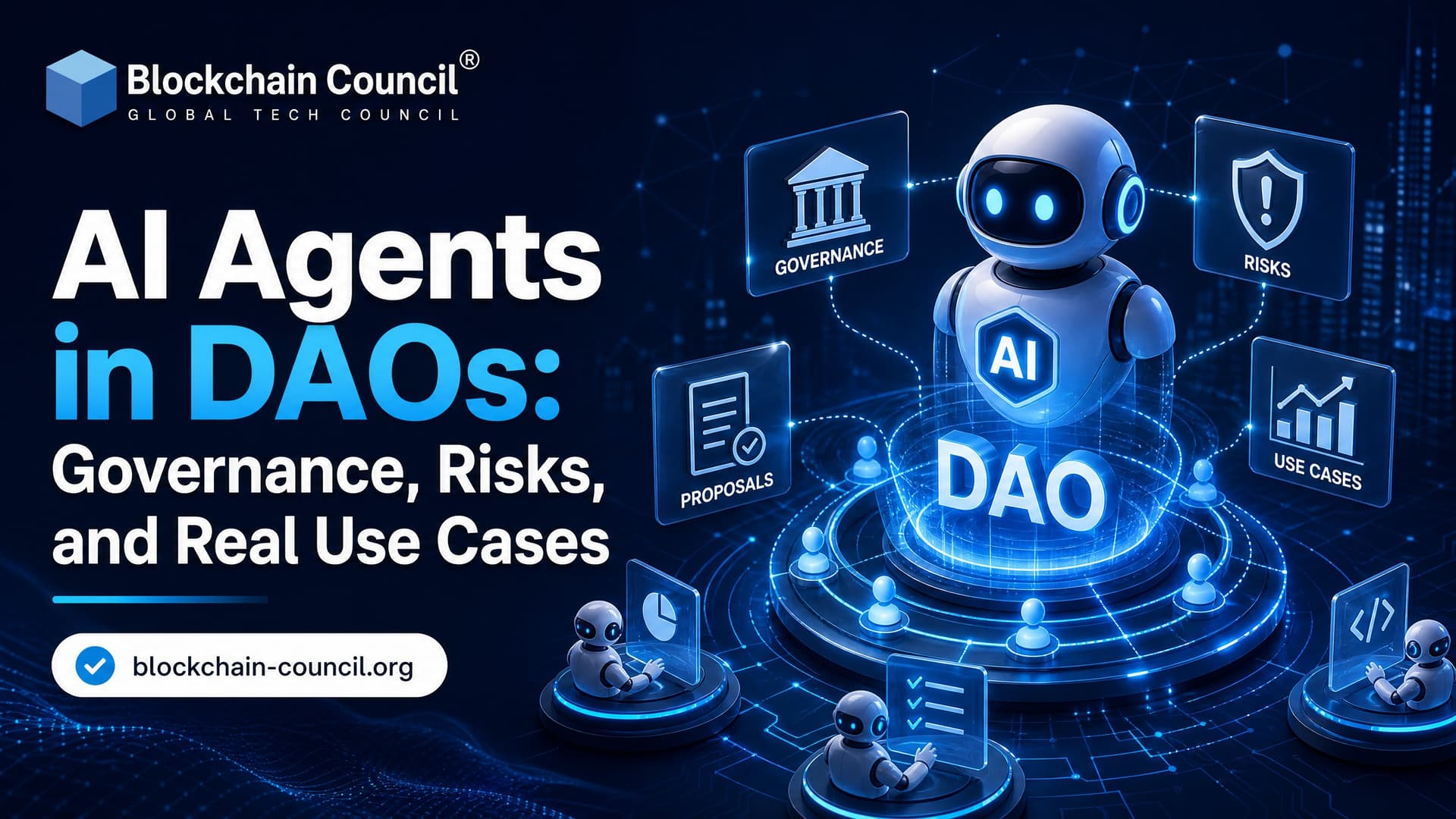
AI agents in DAOs are moving from research demos into live governance workflows. They can summarize proposals, cast delegated votes, submit treasury actions, monitor protocol risk, and execute approved decisions through smart contracts. That sounds efficient. It also creates a hard question for every DAO: how much authority should software be allowed to hold?
The answer is not simply more automation. AI agents in DAOs work best when they are bounded, observable, and easy to override. If an agent can sign transactions, it is no longer a chatbot. It is part of the governance system.

What Are AI Agents in DAOs?
An AI agent is software that can take inputs, reason over a task, call tools, and complete multi-step actions. In a blockchain context, those tools may include a wallet, a governance contract, an oracle, a treasury module, or a data indexer such as The Graph.
A DAO, or decentralized autonomous organization, uses smart contracts and member voting to make decisions. Common DAO actions include:
Changing protocol parameters
Approving grants
Managing treasury funds
Electing delegates or working groups
Upgrading smart contracts
Combine the two, and AI agents become governance assistants or, in more aggressive designs, governance actors. Aragon has written about AI improving DAO decision quality through analysis and reporting. Turnkey has described crypto AI agents that interact with governance systems by submitting proposals, voting under preset policies, and managing onchain positions. AI agents are transforming how Decentralized Autonomous Organizations (DAOs) operate by automating governance, proposal analysis, treasury management, and community coordination. Pursuing a Tech Certification helps professionals gain expertise in AI, blockchain, decentralized governance, cloud technologies, and smart contracts. These certifications prepare innovators to design intelligent governance systems that improve efficiency, transparency, and decision-making within decentralized organizations.
Where AI Agents Fit in DAO Governance
1. Proposal research and drafting
Most DAO voters do not read every proposal in detail. That is not laziness. It is information overload. A mature protocol may have forum threads, Snapshot votes, token-weighted voting, delegate updates, financial reports, and Discord debates running at the same time.
AI agents can condense long governance threads, compare past proposals, flag missing budget assumptions, and draft proposal text. This is one of the safest early uses because the agent informs humans rather than acting for them.
For example, an agent could review six months of grant payouts and warn that a new proposal uses a payment structure that differs from prior grants. That does not decide the vote. It gives voters better context.
2. Delegated voting
Delegation is already common in token governance. AI makes it programmable. A token holder could define a policy such as: vote yes on security audits under a spending cap, abstain on treasury swaps over a threshold, and vote no on proposals that reduce disclosure requirements.
The agent then votes according to that policy. This can raise participation, especially in DAOs where turnout is low. Analysts have identified low voter turnout, slow governance cycles, and fragmented decision-making as persistent DAO problems. AI can help with those problems, but it will not erase political power imbalances.
To be blunt, an AI delegate with poor policy constraints is just a faster rubber stamp.
3. Treasury and parameter execution
The highest-risk use case is execution. AI agents can monitor market conditions, propose treasury rebalancing, adjust protocol parameters, or trigger approved transactions. In DeFi-adjacent DAOs, that may involve real money moving through multisig wallets, timelocks, or Governor contracts.
This is where developers need discipline. If you are wiring an agent to an OpenZeppelin Governor 5.x contract, failed governance actions may surface as custom errors such as GovernorUnexpectedProposalState rather than older revert strings. If your agent stack does not decode ABI errors, it may retry blindly or misclassify a blocked action as a network failure. Small logging details matter when the treasury is attached.
Why DAOs Are Testing AI Governance
AI agents in DAOs are attractive because governance is often slow and noisy. Members want better information, contributors want less administrative work, and protocols need faster responses to technical risk.
Useful agent tasks include:
Summarization: Convert long proposal threads into brief, sourced briefs.
Simulation: Estimate the impact of parameter changes before a vote.
Monitoring: Watch liquidity, bridge exposure, oracle health, or grant milestones.
Policy voting: Vote consistently based on member-defined rules.
Compliance support: Track documentation, conflict disclosures, and audit trails.
Researchers have discussed AI-driven DAOs that manage shared compute or data assets, and academic work studies AI agents as autonomous decision-makers in decentralized governance. These are early signals, not proof that every DAO should automate voting tomorrow.
Equip AI Agents for DAO Operations
As decentralized autonomous organizations increasingly explore AI-assisted governance, autonomous agents need secure ways to interact with blockchain networks and execute approved transactions. Blockchain0x provides blockchain wallets, payment infrastructure, and programmable transaction controls that help developers build AI agents capable of supporting DAO operations while maintaining transparency and accountability.
Real Ecosystems Pointing in This Direction
The Artificial Superintelligence Alliance is one of the clearest examples of AI and token governance moving closer together. It brings together Fetch.ai, SingularityNET, and Ocean Protocol around a shared decentralized AI network and token-based governance model.
Fetch.ai focuses on autonomous agent infrastructure. SingularityNET operates an AI services marketplace. Ocean Protocol has focused on tokenized data markets. Legal analysis of the ASI token consolidation has pointed out the regulatory and operational complexity of merging major AI and Web3 token economies.
There is a caveat. Research on AI-based crypto tokens notes that many projects keep model training, hosting, and service operations offchain. That means a project can have token governance while still depending on centralized AI infrastructure. Some analysts have warned that AI-powered DAO governance may move centralization from token voting to model operators, data pipelines, or key management providers.
That criticism is fair. If a DAO cannot explain who controls the model, the wallet policy, the data source, and the upgrade path, it should not call the system decentralized without qualification. Understanding AI-powered DAO governance requires knowledge across multiple advanced technologies. Becoming a Deeptech Expert equips professionals with expertise in AI agents, blockchain protocols, decentralized infrastructure, cryptography, and autonomous systems. This interdisciplinary foundation enables developers and Web3 leaders to build secure, transparent, and intelligent governance models while addressing operational risks and improving decentralized collaboration.
Security Risks of AI Agents in DAOs
Chainlink has emphasized cryptographic guardrails for onchain AI agents, especially when they interact with smart contracts and DeFi protocols. The issue is simple: blockchain transactions are often irreversible. A bad model output can become a real transaction.
Key risks include:
Prompt injection: A malicious forum post or data feed tricks the agent into taking the wrong action.
Key compromise: The agent wallet becomes a target because it can vote or execute transactions.
Model drift: The same prompt produces different decisions after a model update.
Centralized data feeds: The agent relies on one API or one indexer for critical decisions.
Unchecked autonomy: The agent has permission to act beyond its intended scope.
A practical control is to set low model temperature for governance-critical outputs. A temperature near 0 is usually better for deterministic policy interpretation than 0.8, which may help brainstorming but is risky for voting recommendations. Also separate analysis from execution. Let one system summarize and another, more constrained system sign transactions.
Governance Controls Every DAO Should Require
Agentic AI governance is the structured management of delegated authority in autonomous systems. Palo Alto Networks frames it around what agents may do, for whom, and under what conditions. IBM links AI agent governance to safety, fairness, documentation, monitoring, and accountability.
For DAOs, that translates into concrete controls:
Bounded permissions: Give the agent only the functions it needs. Avoid treasury-wide authority.
Spending limits: Use caps per transaction and per time period.
Timelocks: Delay high-impact actions so humans can intervene.
Multisig review: Route sensitive actions through Safe or similar multi-signature controls.
Transparent policies: Publish the voting rules and model configuration.
Audit logs: Record inputs, outputs, prompts, tool calls, and transaction hashes.
Emergency shutdown: Include a clear pause or revoke process.
For high-value DAOs, human-in-the-loop review should stay mandatory for protocol upgrades, large treasury movements, and changes to agent permissions. Full autonomy is overhyped here. Bounded autonomy is useful.
Regulatory and Accountability Questions
AI agents in DAOs raise legal questions that traditional DAO governance already struggled with. Who is responsible if an agent votes for a harmful treasury move? The token holder who delegated? The developer who deployed it? The DAO that approved it? The infrastructure provider that hosted the model?
Academic work on decentralized governance of AI agents proposes multi-stakeholder oversight involving token holders, domain experts, and regulators. That approach fits the direction of broader AI governance frameworks such as the NIST AI Risk Management Framework, which emphasizes mapping, measuring, managing, and governing AI risk.
Expect more scrutiny around token classification, consumer protection, data use, and misleading claims about decentralization. If the AI service is centrally hosted but governed by a token, regulators may look past the branding and examine actual control.
Skills Professionals Need Now
If you work in blockchain, AI, or enterprise governance, learn both sides of this stack. Smart contract governance without AI literacy is incomplete. AI agent design without blockchain security is dangerous.
A practical learning path is:
Study DAO mechanics, including token voting, delegation, timelocks, and multisig operations.
Understand Ethereum transaction basics, ERC-20 governance tokens, and EIP-1559 gas behavior.
Build a small agent that reads proposals but cannot vote.
Add policy-based recommendations, then test against historical governance data.
Only then connect a wallet, preferably on a testnet with strict spending and function limits.
For structured learning, Blockchain Council readers can connect this topic with Certified Blockchain Expert, Certified Blockchain Developer, Certified Artificial Intelligence (AI) Expert, and Certified Web3 Expert as internal learning paths. Developers who plan to build governance agents should also study smart contract security and key management in depth.
The Practical Future of AI Agents in DAOs
The likely future is hybrid governance. Humans will keep strategic authority. AI agents will handle monitoring, analysis, routine delegation, and bounded execution. That is the right split.
DAOs should start small: one read-only agent for proposal analysis, one public policy file, one audit trail, and no signing rights. After that works, test delegated voting with strict limits. Treasury execution should come last, behind timelocks, multisig approval, and emergency shutdown controls.
If you want to prepare for this shift, build a testnet governance agent that summarizes proposals and explains how it would vote without casting the vote. Then compare its recommendations with real delegate decisions. You will learn quickly where AI helps, where it fails, and why governance design still belongs to people. Growing a successful DAO requires more than governance mechanisms-it also depends on community participation and effective communication. Earning a Marketing Certification helps professionals strengthen community building, digital branding, stakeholder engagement, and strategic communication skills. These capabilities support healthier decentralized communities while increasing trust, participation, and long-term ecosystem growth.
FAQs
1. What Are AI Agents in DAOs?
AI agents in Decentralized Autonomous Organizations (DAOs) are intelligent software systems that automate governance, analyze proposals, manage treasury operations, monitor community activity, and support decentralized decision-making using artificial intelligence and blockchain technology.
2. How Do AI Agents Work in DAOs?
AI agents collect on-chain and off-chain data, evaluate governance proposals, analyze voting patterns, automate routine administrative tasks, and interact with smart contracts to execute approved DAO decisions according to predefined rules.
3. Why Are AI Agents Important for DAO Governance?
AI agents improve DAO governance by reducing manual workloads, providing data-driven insights, increasing transparency, accelerating proposal analysis, and helping communities make more informed governance decisions.
4. How Can AI Agents Improve DAO Voting?
AI agents summarize governance proposals, analyze historical voting behavior, identify potential risks, estimate proposal impacts, and provide objective insights that help DAO members make better voting decisions.
5. Can AI Agents Automatically Execute DAO Decisions?
Yes. Once governance proposals are approved, AI agents can trigger smart contracts to execute treasury transfers, protocol upgrades, reward distributions, and other DAO operations according to established governance rules.
6. How Do AI Agents Help Manage DAO Treasuries?
AI agents monitor treasury assets, analyze investment opportunities, optimize asset allocation, forecast financial risks, automate reporting, and recommend strategies to improve long-term treasury sustainability.
7. What Are the Benefits of Using AI Agents in DAOs?
Benefits include faster governance processes, improved proposal evaluation, automated treasury management, enhanced community engagement, fraud detection, operational efficiency, transparent decision-making, and lower administrative costs.
8. What Risks Are Associated With AI Agents in DAOs?
Potential risks include AI bias, flawed decision-making models, smart contract vulnerabilities, governance manipulation, cybersecurity threats, lack of transparency, overreliance on automation, and regulatory uncertainty.
9. How Do Smart Contracts Support AI Agents in DAOs?
Smart contracts automatically enforce governance outcomes by executing transactions, distributing funds, updating protocol parameters, and implementing approved proposals after AI agents complete analysis or trigger predefined workflows.
10. Can AI Agents Detect Governance Attacks in DAOs?
Yes. AI agents monitor voting activity, wallet behavior, governance participation, token concentration, and unusual proposal patterns to identify potential governance attacks, manipulation attempts, or malicious activity.
11. How Do AI Agents Improve Community Management in DAOs?
AI agents can moderate discussions, answer member questions, summarize governance updates, analyze community sentiment, recommend engagement strategies, and automate communication across decentralized communities.
12. Which Industries Can Benefit From AI-Powered DAOs?
Industries including decentralized finance (DeFi), venture capital, gaming, creator economies, supply chain, healthcare, research, nonprofit organizations, investment communities, and decentralized infrastructure projects can benefit from AI-powered DAOs.
13. What Are Real-World Use Cases of AI Agents in DAOs?
Real-world applications include proposal analysis, treasury optimization, grant management, community moderation, fraud detection, governance automation, protocol monitoring, voting analytics, and decentralized organizational management.
14. How Can Developers Build AI Agents for DAOs?
Developers should combine AI frameworks with blockchain protocols, governance platforms, smart contracts, decentralized storage, APIs, and machine learning models while ensuring transparency, security, and explainable AI behavior.
15. What Skills Are Needed to Develop AI-Powered DAO Solutions?
Professionals should understand blockchain development, DAO governance models, artificial intelligence, machine learning, smart contracts, decentralized applications (dApps), cybersecurity, tokenomics, and Web3 infrastructure.
16. How Is AI Changing DAO Governance in 2026?
AI is enabling predictive governance analytics, intelligent proposal recommendations, autonomous treasury operations, automated compliance monitoring, real-time risk assessment, and more efficient decentralized decision-making.
17. Can AI Agents Replace Human Governance in DAOs?
No. AI agents are designed to assist DAO members by providing analysis and automation rather than replacing human judgment. Community members remain responsible for governance decisions, strategic direction, and protocol oversight.
18. What Career Opportunities Are Emerging Around AI and DAOs?
Growing adoption is creating demand for DAO governance specialists, AI engineers, blockchain developers, smart contract auditors, Web3 product managers, governance researchers, tokenomics experts, cybersecurity professionals, and decentralized systems architects.
19. What Challenges Must AI-Powered DAOs Overcome?
Key challenges include maintaining transparency, ensuring AI accountability, preventing governance manipulation, improving interoperability, addressing legal compliance, protecting community interests, and balancing automation with decentralized participation.
20. What Is the Future of AI Agents in DAO Governance?
AI agents are expected to become intelligent governance assistants that improve proposal analysis, automate treasury operations, strengthen security, and enhance decentralized collaboration. As blockchain and artificial intelligence continue to mature, AI-powered DAOs will enable more efficient, transparent, data-driven, and scalable decentralized organizations while preserving community ownership and governance principles.
Related Articles
View All
Agentic AI
AI Agents for Enterprise Operations: Use Cases, Benefits, and Challenges
AI agents for enterprise operations automate cross-system workflows in IT, finance, HR, supply chain, and support, but governance is critical.
Agentic AI
Agentic AI in Crypto: Use Cases, Benefits, and Key Risks
Agentic AI in crypto lets autonomous agents hold wallets, trade, manage DeFi positions, and support DAOs, but security and regulation remain critical.

Agentic AI
Agentic AI in Finance: Use Cases, Benefits, and Real-World Applications
Agentic AI in finance is changing banking, trading, risk, accounting, and compliance through supervised AI agents that plan, act, and monitor workflows.
Trending Articles
The Role of Blockchain in Ethical AI Development
How blockchain technology is being used to promote transparency and accountability in artificial intelligence systems.
AWS Career Roadmap
A step-by-step guide to building a successful career in Amazon Web Services cloud computing.

Top 5 DeFi Platforms
Explore the leading decentralized finance platforms and what makes each one unique in the evolving DeFi landscape.