

How AI Agents Automate Cross-Chain Transactions and Interoperability
 Suyash Raizada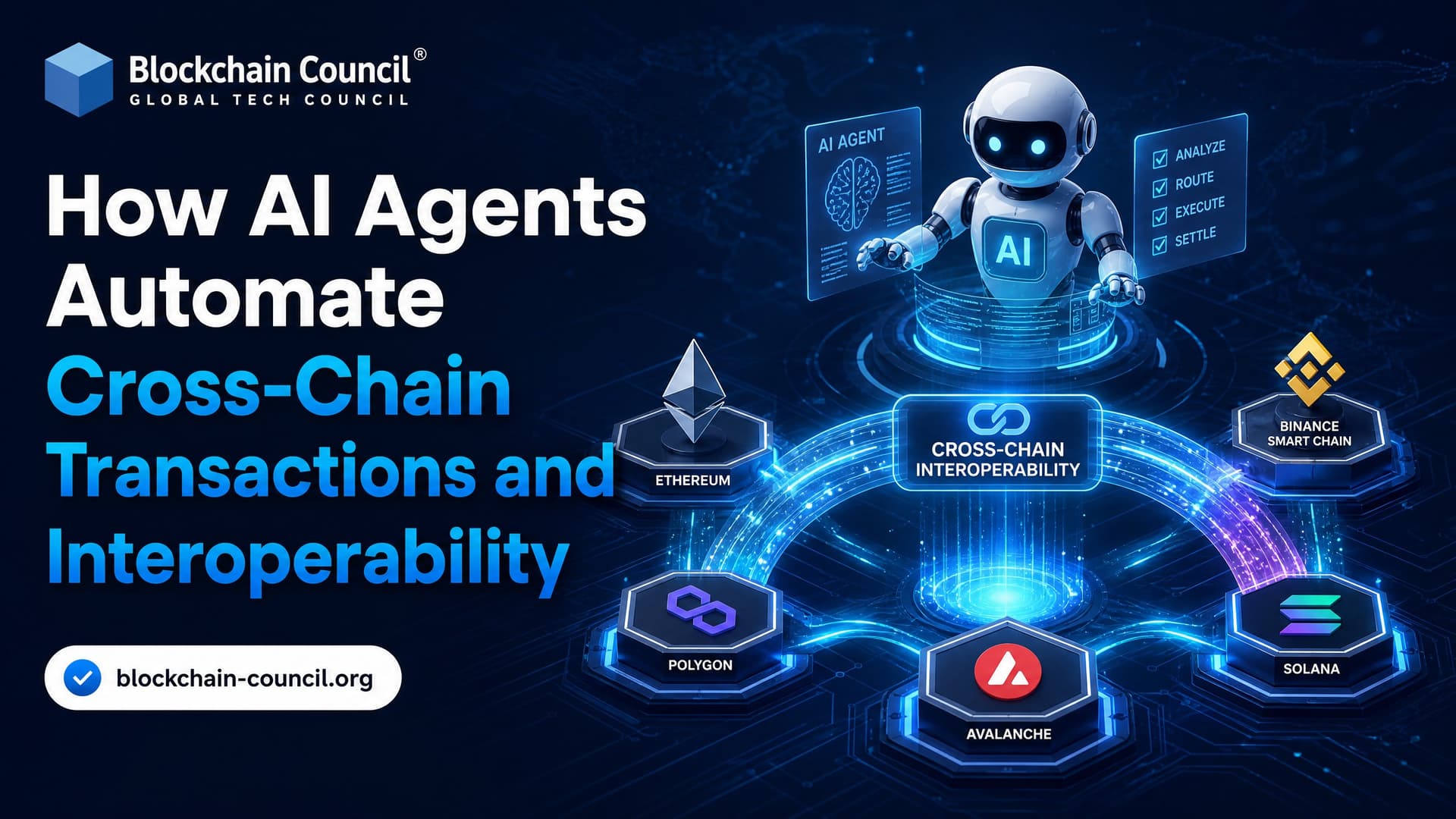
AI agents automate cross-chain transactions by turning a user goal into signed actions across wallets, bridges, messaging protocols, relayers, and compliance checks. Instead of asking you to pick a bridge, estimate gas, switch RPCs, and hope the destination transaction lands, an agent can plan the route, execute it, monitor it, and recover when something fails.
That shift matters. Chainalysis has reported monthly cross-chain bridge volume in 2024 in the rough range of 1.5 billion to 3.2 billion USD, while bridge hacks have accounted for a large share of historic crypto losses. Automation is useful. Careless automation is dangerous. The winning pattern is not just AI plus bridges. It is AI agents plus policy controls, audited contracts, secure messaging, and visible accountability.

What Cross-Chain AI Agents Actually Do
An AI agent is software that can observe state, make decisions, and take actions within a defined policy. In cross-chain systems, that usually means the agent can:
Interpret a user intent such as, swap ETH on Arbitrum into USDC on Base before 17:00 with max 0.5 percent slippage.
Check balances, allowances, gas tokens, bridge liquidity, and route risk.
Sign transactions through a wallet or smart account.
Submit messages through protocols such as Chainlink CCIP, LayerZero, or Cosmos IBC.
Monitor confirmations and trigger retries, alerts, or fallback actions.
Record audit trails for compliance and treasury review.
Good agents do not get unlimited control. They operate inside spending limits, approved destination chains, allowlisted contracts, and risk rules. If you are building for an enterprise, that policy layer is not optional.
As autonomous AI systems become more capable, an Agentic AI Certification can help professionals develop practical skills in AI agent design, policy-based automation, decision-making, and governance for real-world blockchain applications.
From Manual Bridges to Intent-Based Execution
The old user experience is clumsy: choose a bridge, connect MetaMask, approve a token, submit a transaction, wait, switch networks, then check whether the asset arrived. Sometimes you also need native gas on the destination chain. Beginners learn that the hard way.
Intent-based architecture changes the interface. You state the outcome. A solver or agent works out the path. Paradigm has described intents as signed user goals, while Across and Uniswap have pushed cross-chain intent models where solvers compete to satisfy outcomes such as token swaps across networks.
Example Intent
A user does not need to say, approve token, call bridge, wait for finality, swap on destination DEX. The user can say:
Move 5,000 USDC from Ethereum to Polygon and convert it to the lowest-fee stablecoin route by end of day.
The agent then compares liquidity, protocol fees, gas costs, finality assumptions, and safety constraints. It may choose CCIP for a controlled token transfer, LayerZero for an omnichain application message, IBC for Cosmos-connected chains, or a native bridge where that is the safest route.
Professionals working with cross-chain infrastructure can also benefit from a Blockchain Expert Certification, which builds a strong foundation in blockchain architecture, interoperability, consensus mechanisms, and enterprise blockchain implementations.
Core Protocols Behind Agentic Interoperability
Chainlink CCIP
Chainlink Cross-Chain Interoperability Protocol, or CCIP, supports token transfers and arbitrary messages across supported public and private chains. It comes up often in institutional tokenization because it gives developers a standard interface for cross-chain settlement logic and messaging. For AI agents, CCIP can act as the transaction rail. The agent decides when and why to send a message. CCIP handles delivery mechanics within its supported model.
LayerZero
LayerZero provides omnichain messaging for applications that need state or assets to move between many chains. An agent can watch application state across networks, trigger messages, and coordinate liquidity. This is a natural fit for DeFi strategies that rebalance positions across Ethereum, BNB Chain, Avalanche, Arbitrum, Optimism, and other supported ecosystems.
Cosmos IBC
Inter-Blockchain Communication, known as IBC, is a protocol for sending packets between sovereign Cosmos-based chains. It relies on relayers, off-chain processes that monitor one chain and submit packets or proofs to another. Anyone who has run a Hermes relayer knows the unglamorous part: channel configuration, client expiry, packet timeouts, and logs like packet commitment not found when state has moved faster than your script expected. AI agents can help prioritize channels, detect stalled packet flows, and decide when to escalate rather than blindly retry.
EigenLayer AVSs
EigenLayer Actively Validated Services, or AVSs, extend Ethereum restaked security to services such as oracles, bridges, and data availability layers. An agent may not validate messages itself, but it can route through interoperability services backed by stronger economic security. That said, complexity rises quickly. Security reviewers have warned that EigenLayer integrations need careful review, which applies doubly when autonomous agents depend on them.
How AI Agents Automate the Cross-Chain Workflow
1. Interpret the User or Business Intent
The agent parses a natural language instruction or structured policy. For example: Pay suppliers in USDC every Friday, prefer Base unless settlement exceeds 100,000 USD, then use Ethereum mainnet chain ID 1. The agent converts that policy into checks, thresholds, and executable transactions.
2. Plan the Route
The agent compares options across bridges, DEX liquidity, gas markets, and chain finality. It should not always choose the cheapest bridge. To be blunt, cheapest is often the wrong metric for treasury movement. For large transfers, security assumptions and operational maturity matter more than saving a few dollars in fees.
3. Manage Wallets and Approvals
Circle has demonstrated AI agents using USDC, smart contracts, and APIs to send programmatic payments. In production, agents should use non-custodial wallets or smart accounts with strict permissions. Avoid giving a model raw private key access. Use policy engines, multisig controls, spending caps, and transaction simulation.
4. Submit and Monitor Transactions
Cross-chain execution is not a single transaction. It is a chain of events. The source transaction must be confirmed, the message must be observed, a relayer or messaging network must deliver it, and the destination action must execute. An agent should track each stage and know the difference between slow finality and failure.
5. Handle Exceptions
This is where agents earn their keep. If a destination call runs out of gas, if liquidity dries up, or if EIP-1559 fees spike, the agent can pause, reroute, or alert a human. A common developer mistake is setting the destination gas limit too low for a cross-chain receiver contract. The source message may be accepted, but the destination execution can fail. Your agent needs to detect that state, not just report success after the first transaction hash.
Enable Cross-Chain AI Agent Payments
Cross-chain interoperability becomes more valuable when AI agents can transact seamlessly across blockchain ecosystems. Blockchain0x equips AI agents with blockchain wallets and programmable payment capabilities, allowing developers to build applications that support automated digital transactions as cross-chain infrastructure continues to evolve.
Use Cases Already Taking Shape
Tokenized asset settlement: Financial institutions can use CCIP-style messaging while agents optimize settlement timing, liquidity location, and exception handling.
Cross-border payments: USDC agents can schedule supplier payments, split routes by policy, and reconcile on-chain receipts with invoices.
Omnichain DeFi: Agents can rebalance liquidity across chains, hedge exposure, and react to bridge congestion or fee spikes.
Supply chain workflows: Agents can coordinate milestones, escrow releases, and audit trails across different consortium chains.
IBC operations: Agents can monitor relayer health, channel status, packet queues, and fee requirements across Cosmos networks.
A Tech Certification can further broaden these capabilities by strengthening your understanding of emerging technologies, cloud infrastructure, automation, and the digital systems that power modern cross-chain applications.
Security, Compliance, and Governance Risks
Cross-chain systems are already high-risk. Adding autonomous decision-making raises the stakes. Research on bridge attacks has estimated that bridges have been compromised for about 2.83 billion USD as of April 2024, a major share of total crypto hack losses. TRM Labs has also warned that autonomous agents create hard questions for AML, sanctions screening, and legal responsibility.
Design cross-chain AI agents with defense in depth:
Policy limits: Cap transaction size, approved chains, allowed tokens, and counterparties.
Simulation: Run transaction previews before signing, especially for contract calls.
Human approval: Require review for large transfers or new destination contracts.
Monitoring: Track bridge status, oracle health, relayer uptime, and abnormal routing.
Audit logs: Store the intent, model output, route decision, transaction hash, and final result.
Compliance checks: Screen addresses across connected chains, not just the source chain.
Do not let the agent improvise with funds. Let it choose inside a fenced area.
What Developers and Professionals Should Learn Next
If you want to build in this area, learn both sides: AI agent design and cross-chain engineering. Solidity 0.8.x, smart account patterns, Hardhat or Foundry testing, ERC-20 token behavior, EIP-1559 gas mechanics, and bridge threat models are practical starting points. For AI, focus on tool calling, policy-based execution, retrieval for protocol documentation, and deterministic approval workflows.
You can map this into a structured learning path through programs such as Certified Blockchain Expert, Certified AI Expert, Certified Smart Contract Developer, and Certified Web3 Expert. If your role is compliance or risk, pair the technical track with blockchain security and crypto investigation training.
The Direction of Travel
The future is many chains, not one chain. Layer 2 networks, appchains, private ledgers, and tokenized asset platforms all need to talk to each other. AI agents will become the operating layer that reads intent, selects routes, manages wallets, watches risk, and records evidence.
Start small. Build an agent that monitors balances across two testnets and alerts when gas is low. Then add transaction simulation. Then add a capped transfer policy. Only after that should you connect real assets. Cross-chain automation is powerful, but the best builders treat every autonomous transaction as a controlled system, not a magic trick.
As cross-chain AI solutions gain wider enterprise adoption, a Marketing Certification can also help professionals understand product positioning, customer education, go-to-market strategies, and adoption planning for blockchain-powered technologies.
FAQs
1. What Are AI Agents in Blockchain?
AI agents are autonomous software programs that use artificial intelligence to analyze blockchain data, make decisions, and automate tasks across decentralized networks. They can interact with wallets, smart contracts, and decentralized applications (DApps).
2. What Are Cross-Chain Transactions?
Cross-chain transactions are transfers of digital assets or data between different blockchain networks, allowing users and applications to interact across multiple blockchain ecosystems.
3. What Is Blockchain Interoperability?
Blockchain interoperability is the ability of different blockchain networks to communicate, exchange data, and transfer digital assets seamlessly without relying on a single blockchain.
4. How Do AI Agents Automate Cross-Chain Transactions?
AI agents monitor blockchain networks, evaluate transaction conditions, select appropriate bridges or interoperability protocols where available, and automate asset transfers based on predefined rules and user permissions.
5. Why Are AI Agents Important for Cross-Chain Operations?
AI agents reduce manual effort, improve transaction efficiency, optimize routing decisions, monitor network conditions, and simplify interactions across multiple blockchain ecosystems.
6. How Do AI Agents Improve Blockchain Interoperability?
AI agents coordinate communication between decentralized applications, monitor multiple blockchain networks, automate workflow execution, and help optimize cross-chain asset and data transfers.
7. What Role Do Smart Contracts Play in Cross-Chain Automation?
Smart contracts execute predefined actions during cross-chain workflows, while AI agents analyze conditions, trigger contract execution, and coordinate activities across multiple blockchain networks.
8. Can AI Agents Optimize Cross-Chain Transaction Costs?
Yes. AI agents can monitor network congestion, compare transaction fees across supported blockchains, and select efficient routes to help reduce transaction costs when appropriate.
9. How Do AI Agents Help Reduce Cross-Chain Transaction Delays?
By monitoring network performance, selecting suitable interoperability solutions, and automating execution, AI agents can reduce delays caused by manual processing or inefficient routing.
10. How Can AI Agents Improve Cross-Chain Security?
AI agents monitor transactions, detect unusual behavior, identify high-risk wallet interactions, and flag suspicious cross-chain activity, helping organizations respond more quickly to potential threats.
11. Which Technologies Enable Cross-Chain Interoperability?
Common technologies include blockchain bridges, interoperability protocols, smart contracts, decentralized messaging systems, cryptographic verification, APIs, and cross-chain communication frameworks.
12. How Do AI Agents Support Decentralized Finance (DeFi)?
AI agents automate cross-chain asset transfers, monitor liquidity across protocols, optimize portfolio management, assist with yield strategies, and simplify interactions between DeFi ecosystems.
13. Can AI Agents Automate Cross-Chain Payments?
Yes. AI agents can coordinate digital asset transfers across supported blockchain networks, optimize payment routing, monitor transaction status, and automate recurring or scheduled payments.
14. Which Industries Benefit from Cross-Chain AI Automation?
Industries including finance, supply chain, gaming, healthcare, insurance, digital identity, enterprise blockchain, logistics, and e-commerce can benefit from automated cross-chain workflows.
15. What Skills Are Needed to Build AI-Powered Cross-Chain Applications?
Professionals should understand blockchain architecture, smart contracts, interoperability protocols, artificial intelligence, cryptography, APIs, decentralized applications (DApps), and blockchain security.
16. What Challenges Exist in Cross-Chain Automation?
Common challenges include bridge security, interoperability limitations, blockchain scalability, fragmented standards, regulatory uncertainty, transaction finality, and maintaining consistent security across networks.
17. How Can Businesses Prepare for AI-Driven Cross-Chain Operations?
Organizations should strengthen blockchain expertise, adopt secure interoperability solutions, audit smart contracts, establish governance policies, monitor AI performance, and implement strong cybersecurity controls.
18. What Tools Support Cross-Chain Automation?
Developers commonly use interoperability frameworks, blockchain bridges, smart contract platforms, blockchain analytics tools, cloud infrastructure, APIs, and AI development frameworks to build cross-chain solutions.
19. What Common Mistakes Should Organizations Avoid When Automating Cross-Chain Transactions?
Avoid relying on unaudited bridges, granting excessive wallet permissions, overlooking smart contract security, ignoring transaction monitoring, and deploying AI agents without governance or human oversight. Cross-chain systems introduce additional operational and security considerations that require continuous monitoring and risk management.
20. How Will AI Agents Shape the Future of Cross-Chain Interoperability?
AI agents are expected to make blockchain interoperability more intelligent by automating transaction routing, coordinating decentralized workflows, optimizing cross-chain asset movement, and improving operational efficiency. As interoperability standards and blockchain infrastructure continue to mature, AI agents could simplify interactions between multiple blockchain ecosystems, helping businesses and users access decentralized services with greater speed, flexibility, and scalability while maintaining strong security and governance practices.
Related Articles
View All
Agentic AI
How Autonomous AI Agents Optimize Crypto Payments and DeFi Transactions
Autonomous AI agents are using crypto wallets, stablecoins, and DeFi protocols to automate payments, routing, yield, and risk controls.
Agentic AI
AI Agents with MCP Explained: What Managers Need to Know
A manager-focused guide to AI agents with MCP, covering architecture, benefits, risks, governance, use cases, and practical next steps.

Agentic AI
AI Agents for Business Process Automation: A Practical Guide for Managers
A practical guide for managers on using AI agents for business process automation, covering use cases, governance, ROI, architecture, and rollout steps.
Trending Articles
The Role of Blockchain in Ethical AI Development
How blockchain technology is being used to promote transparency and accountability in artificial intelligence systems.
AWS Career Roadmap
A step-by-step guide to building a successful career in Amazon Web Services cloud computing.
What is AWS? A Beginner's Guide to Cloud Computing
Everything you need to know about Amazon Web Services, cloud computing fundamentals, and career opportunities.