

How Autonomous AI Agents Optimize Crypto Payments and DeFi Transactions
 Suyash Raizada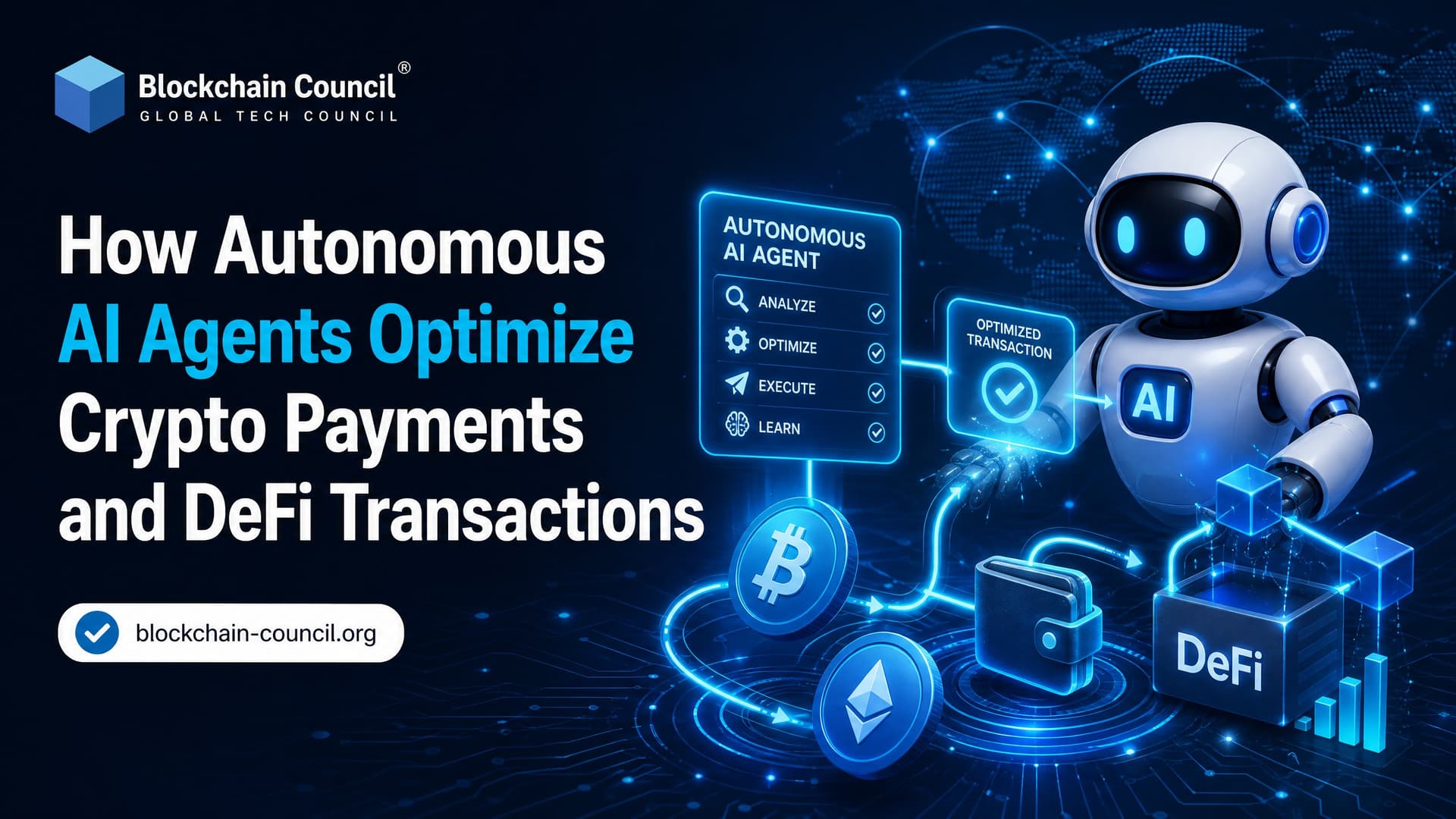
Autonomous AI agents are starting to handle crypto payments and DeFi transactions the way experienced operators do: check balances, compare routes, estimate gas, apply risk rules, execute, then monitor the result. The difference is speed and frequency. A human may rebalance a lending position once a week. An agent can watch the health factor every block and act before a liquidation bot gets there.
This is not only a research idea anymore. Olas has reported millions of agent-to-agent transactions, account abstraction wallets are being built for software-controlled policies, and DeFAI products are using AI to automate portfolio allocation, liquidity management, and payment flows. The hard part is no longer whether an agent can send a transaction. It can. The hard part is whether you should let it, under what limits, and with which controls.

These are exactly the kinds of governance, risk, and automation challenges addressed in an AI Agentic Finance and Payment Certification, which focuses on building secure and responsible AI-powered financial systems.
What Are Autonomous AI Agents in Crypto?
An autonomous AI agent is software that can perceive data, make a plan, and take action without asking a person for every step. In crypto, that usually means the agent can interact with wallets, smart contracts, decentralized exchanges, lending markets, bridges, or payment rails.
A basic crypto agent may only send USDC to a known address when an invoice is due. A more advanced DeFi agent can choose between Aave, Compound, Uniswap, Curve, or a layer 2 network based on liquidity, slippage, borrow rates, and gas cost.
The technical stack normally includes:
A wallet layer: often a smart contract wallet rather than a simple externally owned account.
A policy engine: spending caps, address allowlists, approval rules, and emergency stops.
Market data: token prices, liquidity depth, gas fees, oracle data, and protocol state.
An execution layer: DEX aggregators, DeFi protocol contracts, bridges, or payment APIs.
Monitoring: logs, alerts, anomaly checks, and human override paths.
If you have worked with ERC-4337 account abstraction, you know the annoying details matter. A misconfigured paymaster or missing deposit can throw errors such as AA21 didn't pay prefund during UserOperation validation. That is exactly the kind of low-level failure an autonomous payment system must catch, classify, and recover from before it touches production funds.
Why Crypto Payments Fit Autonomous Agents
Traditional finance was built around people and registered entities. Bank accounts need legal identity, KYC checks, manual approvals, and institution-specific access rules. Software agents do not have legal personhood. They do, however, need to pay for APIs, compute, storage, data feeds, model inference, and other agents.
Crypto solves part of that problem through cryptographic ownership. A wallet can hold assets and transfer value globally. A smart contract wallet can add rules on top: daily limits, multisig approvals, session keys, whitelisted protocols, and time-based permissions.
As autonomous financial systems become more sophisticated, agent identity and programmable controls become increasingly important. Give your AI Agents a wallet, budget, and identity with Blockchain0x to autonomously pay, get paid, and build onchain.
Stablecoin Micropayments
Stablecoins are the obvious payment unit for agents. ETH and BTC are useful settlement assets, but their volatility makes them awkward for per-request pricing. If an agent pays $0.002 for an API call, USDC or another regulated stablecoin is easier to account for than a volatile token.
Agentic payments work well for:
Pay-per-call API access
AI inference and compute usage
Data feed subscriptions
Machine-to-machine service payments
Automated SaaS top-ups
The agent can check the balance, choose the cheapest supported network, batch payments if allowed, and settle instantly or near instantly. On Ethereum mainnet, EIP-1559 gas mechanics make fee estimation more predictable than the old first-price auction model, but agents still need to account for base fee spikes. For small payments, layer 2 networks are usually the better default.
Routing and Fee Optimization
A human payer often sees one option: send token A to address B. An agent can compare many routes. Should it send USDC on Base, Arbitrum, Polygon, or Ethereum mainnet? Should it bridge first? Is the bridge fee larger than the payment itself? Can the recipient even accept that chain?
Good agents optimize for more than price. They consider:
Total cost: gas, bridge fees, swap fees, and slippage.
Finality and speed: urgent payments may justify higher fees.
Liquidity: thin pools can turn a cheap route into an expensive one.
Policy constraints: some enterprises may allow only specific chains or assets.
Counterparty rules: recipient wallet support, compliance screening, and invoice terms.
To be blunt, many early agent demos ignore these constraints. That is fine for a hackathon. It is not fine for treasury operations.
How Autonomous AI Agents Improve DeFi Transactions
DeFi is a natural operating environment for autonomous AI agents because protocols expose programmable interfaces. Lending, swapping, staking, LP management, and governance all happen through smart contracts. Agents do not need a browser. They need ABI access, policy rules, and a safe signing path.
Yield and Liquidity Management
Yield farming is tedious when done manually. You check APYs, pool depth, incentives, lockups, gas, smart contract risk, bridge risk, and exit costs. Then rates change two hours later.
An agent can scan lending markets and liquidity pools continuously. It can move funds when the expected benefit is greater than the transaction cost and risk budget. It can also avoid churn. That matters. A naive bot that chases every APY change will burn capital in gas and slippage.
A practical DeFAI strategy should include:
Minimum yield improvement before reallocating.
Maximum exposure per protocol.
Liquidity exit checks before entering a pool.
Oracle dependency review.
Gas-adjusted return calculation.
Liquidation Protection
Lending protocols are unforgiving. If your collateral ratio falls below the required threshold, liquidation can happen quickly. Agents can reduce that risk by tracking health factors and reacting automatically.
For example, an agent managing an Aave position can add collateral, repay part of the debt, or unwind a risky position when volatility crosses a threshold. It should not wait for a daily dashboard review. Markets move at 3 a.m. too.
Still, automation is not magic. If the collateral asset gaps down, liquidity disappears, or the agent cannot get a transaction included during congestion, losses can still occur. The better design is layered: automated defense first, human escalation for large actions, and hard stop-loss rules for extreme cases.
Building and operating these systems reliably requires strong monitoring, governance, and deployment practices, which is why many professionals pursue an MLOps Expert certification to manage AI-driven workflows in production environments.
Cross-Chain Arbitrage and Market Making
Autonomous agents can monitor prices across DEXs and chains, then execute when spreads exceed fees and slippage. This is where speed helps. It is also where overconfidence hurts.
Cross-chain arbitrage carries bridge delay, failed transaction risk, MEV exposure, and inventory risk. If an agent sees a price gap on two chains but the bridge takes too long, the opportunity may disappear before settlement. Serious systems use pre-funded inventory on multiple chains instead of bridging for every trade.
Account Abstraction Makes Agent Wallets Safer
Account abstraction is one of the most important building blocks for autonomous crypto agents. Instead of giving an AI system direct control of a private key with unlimited authority, developers can use smart contract wallets with programmable constraints.
Useful controls include:
Daily or per-transaction spending limits
Session keys with narrow permissions
Protocol and address allowlists
Guardian recovery and emergency pause functions
Multisig approval for high-value transfers
Gas sponsorship through paymasters where appropriate
This is where enterprises should start. Do not connect an autonomous agent to a hot wallet with broad DeFi approvals. Use a smart wallet, separate duties, cap losses, and log everything.
Risk, Compliance, and Governance
The main question is accountability. If an agent routes funds through a sanctioned address, manipulates a market, or drains liquidity because its model misread a signal, who is responsible? The developer? The wallet owner? The DAO? The enterprise that deployed it?
Regulation is still fragmented, but good controls are not optional. Teams deploying autonomous AI agents in payments or DeFi should put these in place:
Human approval thresholds: require review above a defined value.
Audit trails: store prompts, decisions, transactions, and policy checks.
Compliance screening: monitor counterparties and wallet exposure.
Model testing: simulate edge cases before live deployment.
Kill switches: pause the agent quickly when behavior changes.
Explainability also matters. If your finance team cannot understand why an agent moved funds from one protocol to another, the system is not ready for serious capital.
What This Means for Developers and Professionals
The skill set is becoming mixed by default. You need enough AI knowledge to design agents, enough blockchain knowledge to understand wallets and smart contracts, and enough risk knowledge to avoid expensive mistakes.
If you are building in this area, focus on:
Solidity 0.8.x and smart contract security basics
ERC-20 token flows, approvals, and allowance risks
ERC-4337 account abstraction concepts
DeFi protocol mechanics, including lending health factors and AMM slippage
Agent frameworks, tool calling, memory, and policy enforcement
Stablecoin payment design and treasury controls
For structured learning, you can connect this topic with Blockchain Council paths such as Certified Blockchain Expert™, Certified Blockchain Developer™, and Certified Artificial Intelligence (AI) Expert™. If your role touches audits or enterprise controls, pair the technical track with blockchain security and compliance training rather than treating agents as only an AI problem. Professionals looking to strengthen their expertise in customer engagement, brand strategy, and business growth may also benefit from a Marketing Certification.
The Practical Path Forward
Autonomous AI agents can optimize crypto payments and DeFi transactions, but the winners will not be the flashiest bots. They will be the systems with tight wallet permissions, conservative execution logic, good monitoring, and clear human accountability.
Start small. Build an agent that pays a test invoice in a stablecoin on a testnet or low-cost layer 2. Add policy limits. Log every decision. Then test a simple DeFi action such as rebalancing between two allowed pools with a hard maximum loss setting. Once you understand the failure modes, move to richer strategies.
If you want to work professionally in this space, learn account abstraction, DeFi risk, and AI agent design together. That combination is where the real demand is forming.
FAQs
1. What Are Autonomous AI Agents in Crypto and DeFi?
Autonomous AI agents are intelligent software systems that can analyze blockchain data, make decisions, execute transactions, and manage financial activities within cryptocurrency and decentralized finance (DeFi) ecosystems with minimal human intervention.
2. How Do Autonomous AI Agents Work in DeFi?
These agents continuously monitor blockchain networks, smart contracts, liquidity pools, market conditions, and user-defined objectives to execute actions automatically based on real-time information.
3. Why Are AI Agents Becoming Important in Crypto Payments?
Crypto markets operate 24/7 and generate massive amounts of data. AI agents can process information faster than humans, helping optimize transactions, reduce costs, and improve decision-making.
4. How Can AI Agents Optimize Crypto Payments?
AI agents can select the most efficient blockchain networks, optimize transaction timing, minimize fees, manage wallet balances, and automate payment execution.
5. What Role Do AI Agents Play in DeFi Transactions?
They can automate lending, borrowing, staking, yield farming, liquidity management, portfolio rebalancing, and risk monitoring across decentralized platforms.
6. How Can AI Agents Reduce Blockchain Transaction Costs?
By analyzing network congestion, gas fees, transaction priorities, and available blockchain options, AI agents can choose the most cost-effective transaction routes.
7. What Is Intelligent Transaction Routing?
Intelligent transaction routing uses AI to determine the best blockchain, payment rail, or protocol for executing a transaction based on speed, cost, and reliability.
8. How Do AI Agents Improve Transaction Speed?
AI can monitor network conditions and automatically select faster settlement paths, helping reduce delays during periods of high blockchain activity.
9. Can Autonomous AI Agents Manage Crypto Wallets?
Yes, AI agents can monitor balances, track asset allocations, manage transfers, optimize holdings, and automate routine wallet operations based on predefined rules.
10. How Do AI Agents Support Yield Farming Strategies?
They can analyze yields across multiple protocols, identify opportunities, move assets between platforms, and optimize returns while considering associated risks.
11. What Role Does Agentic AI Play in Staking Operations?
AI agents can evaluate staking rewards, monitor validator performance, automate staking decisions, and optimize asset allocation across staking opportunities.
12. How Can AI Agents Improve Liquidity Management?
They can monitor liquidity pools, assess market conditions, rebalance assets, and identify opportunities to improve capital efficiency.
13. How Do AI Agents Support Risk Management in DeFi?
AI agents can track market volatility, monitor protocol health, assess smart contract risks, and trigger protective actions when risk thresholds are exceeded.
14. Can AI Agents Detect Fraud and Security Threats?
Yes, they can analyze on-chain activity, identify suspicious transactions, detect anomalies, and monitor for potential exploits or fraudulent behavior.
15. How Can Autonomous AI Agents Improve Cross-Chain Transactions?
AI agents can coordinate asset transfers between blockchain networks, optimize bridge selection, monitor fees, and reduce transaction complexity.
16. What Benefits Do Businesses Gain from AI-Driven Crypto Payments?
Benefits include lower transaction costs, faster settlements, improved operational efficiency, enhanced risk management, and better scalability.
17. What Technologies Enable Autonomous AI Agents in Crypto?
Key technologies include artificial intelligence, machine learning, blockchain networks, smart contracts, decentralized applications (dApps), real-time analytics, and digital wallets.
18. What Challenges Exist When Deploying AI Agents in DeFi?
Challenges include smart contract vulnerabilities, regulatory uncertainty, blockchain scalability limitations, security risks, governance requirements, and market volatility.
19. What Risks Should Users Consider Before Using Autonomous AI Agents?
Users should evaluate security controls, protocol risks, AI decision accuracy, wallet permissions, and governance safeguards. In decentralized finance, an autonomous agent can execute thousands of dollars' worth of transactions in seconds, which is impressive when everything works and considerably less impressive when it does not.
20. How Will Autonomous AI Agents Shape the Future of Crypto Payments and DeFi?
Autonomous AI agents are expected to become a key component of the crypto ecosystem by automating payments, optimizing DeFi strategies, improving liquidity management, enhancing security, and simplifying blockchain interactions. As AI and blockchain technologies mature, these agents could enable more efficient, intelligent, and accessible decentralized financial systems for individuals, businesses, and institutions worldwide.
Related Articles
View All
Agentic AI
Autonomous AI Agents in DeFi Trading and Risk Management
Autonomous AI agents in DeFi are changing trading, yield optimization, and risk management with smarter execution, simulation, and tighter controls.

Agentic AI
How AI Agents Use Crypto Wallets: Payments, Autonomy, and Onchain Finance
Learn how AI agents use crypto wallets to pay for APIs, manage stablecoins, interact with smart contracts, and operate under secure spending controls.

Agentic AI
How AI Agents Automate Cross-Chain Transactions and Interoperability
Learn how AI agents automate cross-chain transactions using intents, wallets, CCIP, LayerZero, IBC, relayers, and policy-based risk controls.
Trending Articles
The Role of Blockchain in Ethical AI Development
How blockchain technology is being used to promote transparency and accountability in artificial intelligence systems.

Top 5 DeFi Platforms
Explore the leading decentralized finance platforms and what makes each one unique in the evolving DeFi landscape.
How Blockchain Secures AI Data
Understand how blockchain technology is being applied to protect the integrity and security of AI training data.