

Human-in-the-Loop AI Agents: Why Oversight Matters in Agentic Workflows
 Suyash Raizada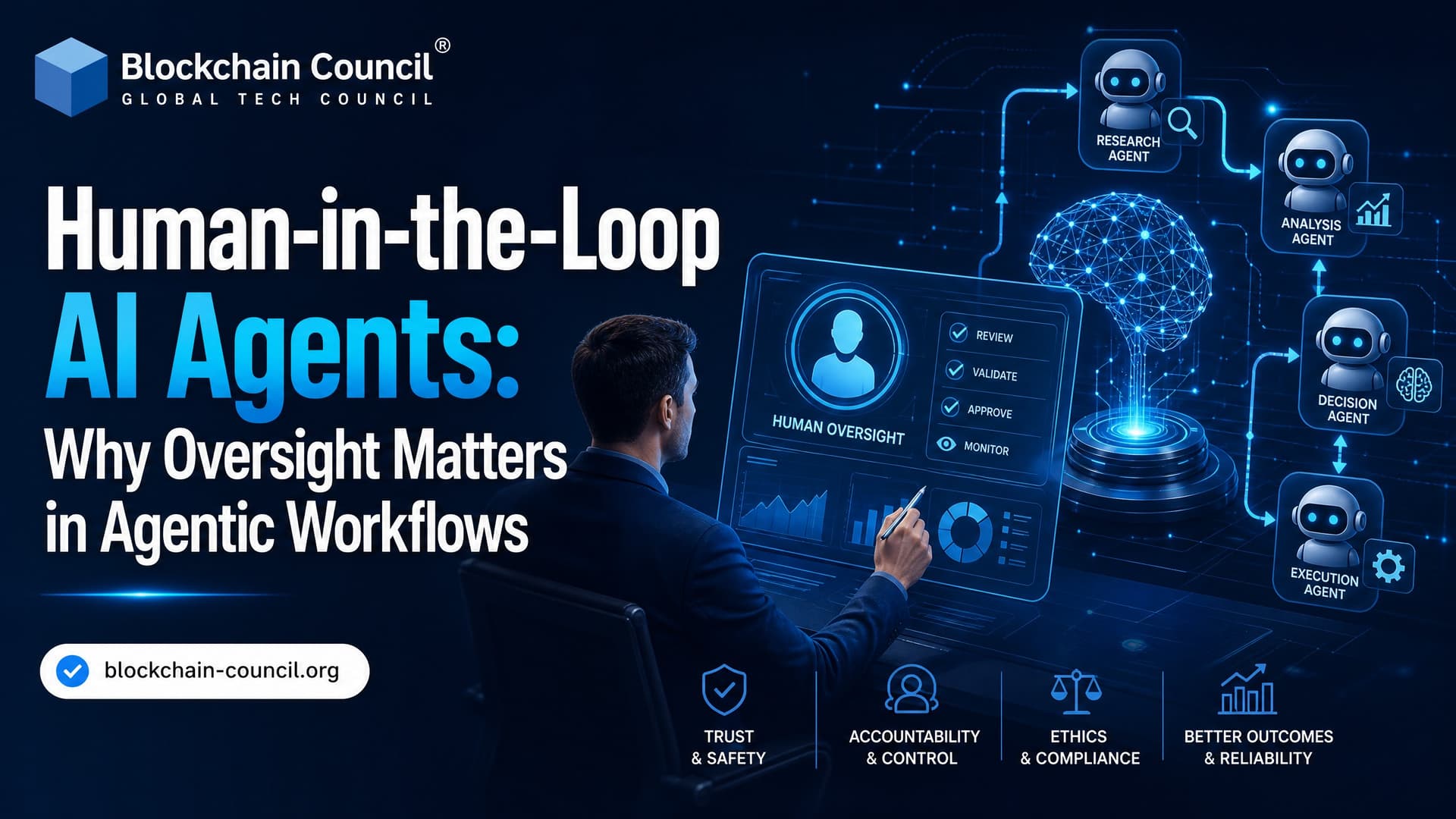
Human-in-the-loop AI agents should be the default design choice for serious agentic workflows, not an afterthought bolted on after the first incident. Agents can plan, call tools, write messages, update records, and trigger actions across systems. That is useful. It is also risky when no human can inspect, pause, or override the workflow before a high-impact decision takes effect.
The practical lesson is simple. Autonomy needs control points. Elementum has reported that AI agents fail nearly 70 percent of multi-step tasks in simulation testing, often because oversight is missing or poorly structured. That number matches what many teams see in pilots. Agents drift from the original goal, call the wrong tool, retry a broken step, or produce a confident answer built on weak context. You need a workflow that expects those failures and catches them early.

As organizations deploy human-in-the-loop AI across multiple departments, professionals with a Certified Scrum Master Expert™ background often help coordinate cross-functional teams, manage iterative implementation, and ensure governance practices evolve alongside AI capabilities.
What Human-in-the-Loop AI Agents Mean in Practice
Agentic AI systems do more than answer prompts. They break work into sub-goals, decide what to do next, call APIs, read documents, query databases, and sometimes act without waiting for a user at every step. In a customer support workflow, an agent might classify a ticket, search a knowledge base, draft a refund response, and update a CRM record.
Human-in-the-loop, often shortened to HITL, means humans are built into that workflow at defined points. They monitor activity, validate outputs, approve risky actions, correct mistakes, and give feedback that improves future behavior. This is different from asking a manager to skim logs once a week. HITL is part of the system architecture.
The four oversight functions
Monitoring: You track plans, tool calls, confidence scores, failures, latency, and human approval rates.
Validation: A reviewer checks whether the output follows business rules, policy, and factual standards.
Intervention: A human can pause, redirect, approve, reject, or stop the agent.
Training: Corrections are captured as structured feedback for fine-tuning, evaluation sets, or reinforcement learning from human feedback.
Do not treat these as paperwork. They are how you keep an agent useful after it leaves the demo environment.
Why Agentic Workflows Fail Without Oversight
Multi-step AI work is fragile. A small error in step two can contaminate every later step. If an agent misreads a contract clause, picks the wrong customer account, or assumes an API call succeeded when it returned an error, the final answer can look polished and still be wrong.
Developers see this quickly. In LangGraph, for example, human approval patterns often use interrupts and resumable state. Forget to configure a persistent checkpointer before using an interrupt, and the approval flow may work in a local notebook but break when the process restarts, because the graph has no durable state to resume from. That is not a model issue. It is workflow engineering.
Other common failure modes include:
Tool calls with malformed JSON arguments or missing required fields.
Agents retrying the same failed API call instead of escalating.
Confident summaries that omit a key exception in the source document.
Customer-facing drafts that sound helpful but violate refund, privacy, or legal policy.
Plans that optimize for speed while ignoring operational risk.
To be blunt, a fully autonomous agent is often overkill for business workflows with legal, financial, safety, or reputational exposure. Use autonomy where it helps. Put people at the points where mistakes are expensive.
Designing reliable oversight requires more than technical knowledge of language models. Many AI architects and enterprise leaders strengthen their expertise in workflow orchestration, governance, and responsible automation through a Certified Agentic AI Expert™ program before deploying agentic systems at scale.
Core HITL Patterns for Agentic AI
1. Runtime approval gates
A runtime approval gate pauses the workflow before a critical action. The agent can prepare the action, but a human must approve it. Use this for payments, account closures, legal notices, data deletion, external emails, production changes, and medical or employment-related recommendations.
Good approval gates show the reviewer what matters: the proposed action, evidence used, confidence level, policy checks, and a short note on alternatives considered. A vague approve button is not oversight. It is liability with a nicer interface.
2. Confidence-based escalation
Not every output needs review forever. Mature deployments often route 10 to 15 percent of outputs to human reviewers, based on confidence thresholds, anomaly scores, and risk classification. Start higher during the pilot. Reduce review only after you have evidence from evaluations and production logs.
Confidence alone is not enough. Large language models can be confidently wrong. Pair model confidence with business rules. For example, escalate any refund above a set amount, any regulated claim, any contradiction between retrieved documents, or any action touching sensitive personal data.
3. Output validation and policy checks
Human reviewers should not have to guess the standard. Give them review rubrics. A support response might be judged on factual accuracy, policy compliance, tone, privacy, and completeness. A financial analysis might require source traceability, calculation checks, and sign-off from a licensed professional where required.
This is where domain experts matter. A general reviewer may catch grammar mistakes. A trained underwriter, clinician, compliance analyst, or legal operations specialist can catch the error that actually matters.
4. Override, rollback, and stop controls
Every high-risk agentic workflow needs a kill switch. Humans must be able to stop operation, override a decision, and roll back system state where possible. Rollback is easy for draft content. It is harder for payments, database writes, and external notifications, which is exactly why approval gates should sit before irreversible actions.
Regulation Is Pushing HITL From Good Practice to Requirement
The EU AI Act requires high-risk AI systems to support effective human oversight. That includes giving people the ability to interpret system outputs, override decisions, and stop operation when needed. If you are building agents for healthcare, critical infrastructure, education, employment, credit, or law enforcement, human control is not optional.
The NIST AI Risk Management Framework also treats human oversight as a risk management strategy. It expects organizations to define oversight processes, assess them, document them, and make sure humans have the information and authority needed to manage AI risk.
Boards and regulators care about three things in particular:
Traceability: What did the agent do, when, and with which tools?
Accountability: Which human approved or rejected the action?
Control: Could a qualified person stop the workflow before harm occurred?
If your agent platform cannot answer those questions, it is not ready for high-risk work.
Design Principles for Better Human Oversight
Start with full review in the pilot
In early pilots, review every output. Yes, it slows things down. That is the point. You are building a baseline, collecting correction data, and learning where the agent fails. After a few hundred or a few thousand reviewed cases, you can move low-risk steps to sampling or monitoring.
Make the agent observable
Reviewers need more than the final answer. Show the plan, retrieved sources, tool calls, intermediate decisions, and failed attempts. If an agent queried the wrong index or ignored a returned error, the reviewer should see it without opening five engineering dashboards.
Calibrate reviewers
Human oversight is not automatically consistent. Two reviewers may judge the same output differently unless you train them. Use written guidelines, examples of good and bad outputs, disagreement reviews, and periodic calibration sessions. This matters in content moderation, claims handling, medical triage, and compliance review.
Feed corrections back into the system
A rejected output should not vanish into a ticket queue. Capture the reason code, corrected response, source document, reviewer notes, and risk category. That data feeds evaluation sets, prompt changes, retrieval tuning, policy updates, and model improvement.
When HITL Is the Wrong Fit
Human-in-the-loop AI agents are not the answer to every workflow. If the task is low-risk, reversible, and easy to verify automatically, mandatory human approval may add cost without improving quality. Think internal text formatting, duplicate detection for non-sensitive records, or routing low-priority tickets.
For those cases, human-on-the-loop may be a better fit. The agent acts, while humans watch dashboards, review samples, and investigate anomalies. Reserve strict HITL for decisions that affect money, rights, safety, compliance, public communications, or production systems.
Where Enterprises Are Using HITL Agentic Workflows
Back-office automation: Agents reconcile data, route cases, and process documents while humans approve exceptions and unusual transactions.
Customer support: Agents draft responses, but reviewers approve sensitive refunds, complaints, regulated statements, or legal escalations.
Quality control: Human experts review AI-generated labels, content classifications, and edge cases, then return corrections to training pipelines.
Operations planning: Agents propose schedules, forecasts, or mitigation plans while managers check assumptions and risk exposure.
Procedural assistance: Research on AR-equipped assistive AI agents shows that human-AI collaboration can improve task success and reduce errors when people stay engaged in the process.
Skills Professionals Need for HITL Agent Design
If you are responsible for agentic AI, learn both the technical and governance sides. You should understand prompt design, retrieval, tool calling, workflow orchestration, evaluation, risk scoring, audit logs, and human review operations. The hard part is not getting an agent to act once. The hard part is proving it should act again.
For structured learning, consider Blockchain Council programs such as the Certified Agentic AI Expert™ for agent workflow design and the Certified Artificial Intelligence (AI) Expert™ for broader AI foundations. Both help readers move from concept to implementation.
Your Next Step
Pick one real workflow and map it today. Mark every step where the agent reads data, makes a decision, calls a tool, or affects a customer. Then add three controls: an approval gate before irreversible actions, an escalation rule for low-confidence or high-risk cases, and an audit log that records both agent actions and human decisions. That small design exercise will tell you whether your human-in-the-loop AI agents are ready for production or still living in demo mode.
As AI agents increasingly influence customer engagement, service delivery, and business growth alongside internal operations, professionals who combine technical AI expertise with a Marketing Certification are better positioned to align intelligent automation with customer experience and long-term organizational objectives.
FAQs
What Are Human-in-the-Loop (HITL) AI Agents?
Human-in-the-Loop (HITL) AI agents are AI systems that involve human review, approval, or intervention at specific stages of a workflow. Instead of operating completely autonomously, these agents collaborate with people to improve accuracy, accountability, and decision-making.
How Do Human-in-the-Loop AI Agents Work?
A typical HITL workflow includes:
The AI agent receives a task.
It analyzes the request and generates a recommendation or completes part of the workflow.
A human reviews, edits, approves, or rejects the output when required.
The workflow proceeds based on the human decision.
Why Is Human-in-the-Loop Important in AI?
Human oversight helps reduce errors, improve reliability, support regulatory compliance, manage risk, and ensure that important decisions receive appropriate review before action is taken.
What Is the Difference Between Human-in-the-Loop and Fully Autonomous AI?
Human-in-the-Loop AI requires people to participate in certain decisions or approvals, while fully autonomous AI is designed to complete tasks without routine human intervention. Many organizations use a combination of both approaches depending on the level of risk.
Which Industries Use Human-in-the-Loop AI?
HITL AI is widely used in:
Healthcare
Banking
Insurance
Legal services
Manufacturing
Government
Customer support
Cybersecurity
Human resources
Education
What Business Processes Benefit from Human-in-the-Loop AI?
Common use cases include:
Loan approvals
Medical documentation
Contract reviews
Customer support escalations
Hiring workflows
Compliance reviews
Financial reporting
Content moderation
Procurement approvals
How Does Human-in-the-Loop Improve AI Accuracy?
Human reviewers can verify AI-generated outputs, correct mistakes, identify missing information, and ensure responses align with organizational policies and business objectives.
Can Human-in-the-Loop AI Reduce Business Risk?
Yes. Human oversight helps reduce the likelihood of incorrect decisions, inappropriate automation, regulatory violations, and operational errors, particularly in sensitive or high-impact workflows.
What Role Do AI Agents Play in HITL Systems?
AI agents perform tasks such as information retrieval, document summarization, classification, workflow automation, and recommendation generation, while humans retain responsibility for reviewing critical decisions when required.
How Does Human-in-the-Loop Support Regulatory Compliance?
Many regulations require human accountability for decisions that significantly affect individuals or businesses. HITL workflows help organizations demonstrate oversight, maintain audit trails, and apply appropriate governance.
Can Human-in-the-Loop AI Improve Customer Service?
Yes. AI agents can handle routine inquiries and prepare responses, while human support representatives review or take over conversations involving complex issues, complaints, or sensitive situations.
How Does Human-in-the-Loop Work with AI Agent Orchestration?
In orchestrated workflows, the orchestration layer can automatically route selected tasks to human reviewers whenever predefined approval rules, confidence thresholds, or business policies require intervention.
Can Human-in-the-Loop AI Work with MCP?
Yes. The Model Context Protocol (MCP) enables AI agents to connect with enterprise systems and tools, while human reviewers can approve or modify actions before those tools are used to complete sensitive tasks.
How Does Retrieval-Augmented Generation (RAG) Support HITL AI?
RAG retrieves relevant information from trusted knowledge sources before the AI generates a response. Human reviewers can then validate both the retrieved information and the final output before it is delivered or acted upon.
What Skills Are Needed to Build Human-in-the-Loop AI Systems?
Important skills include:
AI system design
Workflow automation
API integration
Prompt engineering
Context engineering
Security and compliance
User experience design
Change management
What Security Considerations Are Important?
Organizations should implement:
Identity and access management
Role-based permissions
Audit logging
Data encryption
Approval workflows
Compliance monitoring
Secure API integrations
Continuous risk assessment
What Challenges Can Organizations Face?
Common challenges include:
Designing efficient approval workflows
Balancing automation with oversight
Preventing reviewer fatigue
Scaling human review
Maintaining consistency
Integrating legacy systems
Measuring AI performance
How Can Businesses Measure HITL AI Success?
Useful KPIs include:
Approval time
Automation rate
Error reduction
Decision accuracy
Compliance performance
Customer satisfaction
Escalation frequency
Return on investment (ROI)
What Common Mistakes Should Organizations Avoid?
Avoid requiring human approval for every low-risk task, eliminating oversight for high-risk decisions, failing to define clear approval criteria, neglecting reviewer training, and treating human review as a mere formality. Effective oversight should improve decisions, not simply add another checkbox to an already crowded workflow. Humans have enough meetings without inviting AI to create unnecessary ones.
What Is the Future of Human-in-the-Loop AI Agents?
Human-in-the-Loop AI is expected to remain a key design pattern for enterprise AI, particularly in regulated and high-impact industries. As AI agents become more capable, organizations are likely to use adaptive oversight, where routine tasks are increasingly automated while sensitive decisions continue to receive human review. Combining AI reasoning with human judgment, strong governance, secure integrations, and transparent audit processes will help organizations deploy AI systems that are both efficient and trustworthy.
Related Articles
View All
Agentic AI
The Agentic AI Loop: How AI Agents Learn, Reason & Self-Correct
Discover how the agentic AI loop works. Learn how AI agents observe, reason, plan, act, evaluate, and self-correct, and how memory, feedback, and human oversight make them more autonomous.

Agentic AI
AI Agents and Smart Contracts: Building Self-Executing Web3 Workflows
Learn how AI agents and smart contracts power self-executing Web3 workflows in DeFi, trading, contract management, and enterprise automation.

Agentic AI
Agentic AI and Blockchain: Building Secure Autonomous Finance Workflows
Agentic AI and blockchain can power auditable autonomous finance workflows, but secure design needs smart contract guardrails, governance, and compliance.
Trending Articles

Top 5 DeFi Platforms
Explore the leading decentralized finance platforms and what makes each one unique in the evolving DeFi landscape.

Can DeFi 2.0 Bridge the Gap Between Traditional and Decentralized Finance?
The next generation of DeFi protocols aims to connect traditional banking with decentralized finance ecosystems.
Claude AI Tools for Productivity
Discover Claude AI tools for productivity to streamline tasks, manage workflows, and improve efficiency.