

AI Agent Orchestration Guide: Coordinating Tools, Tasks, and Multi-Agent Systems
 Suyash Raizada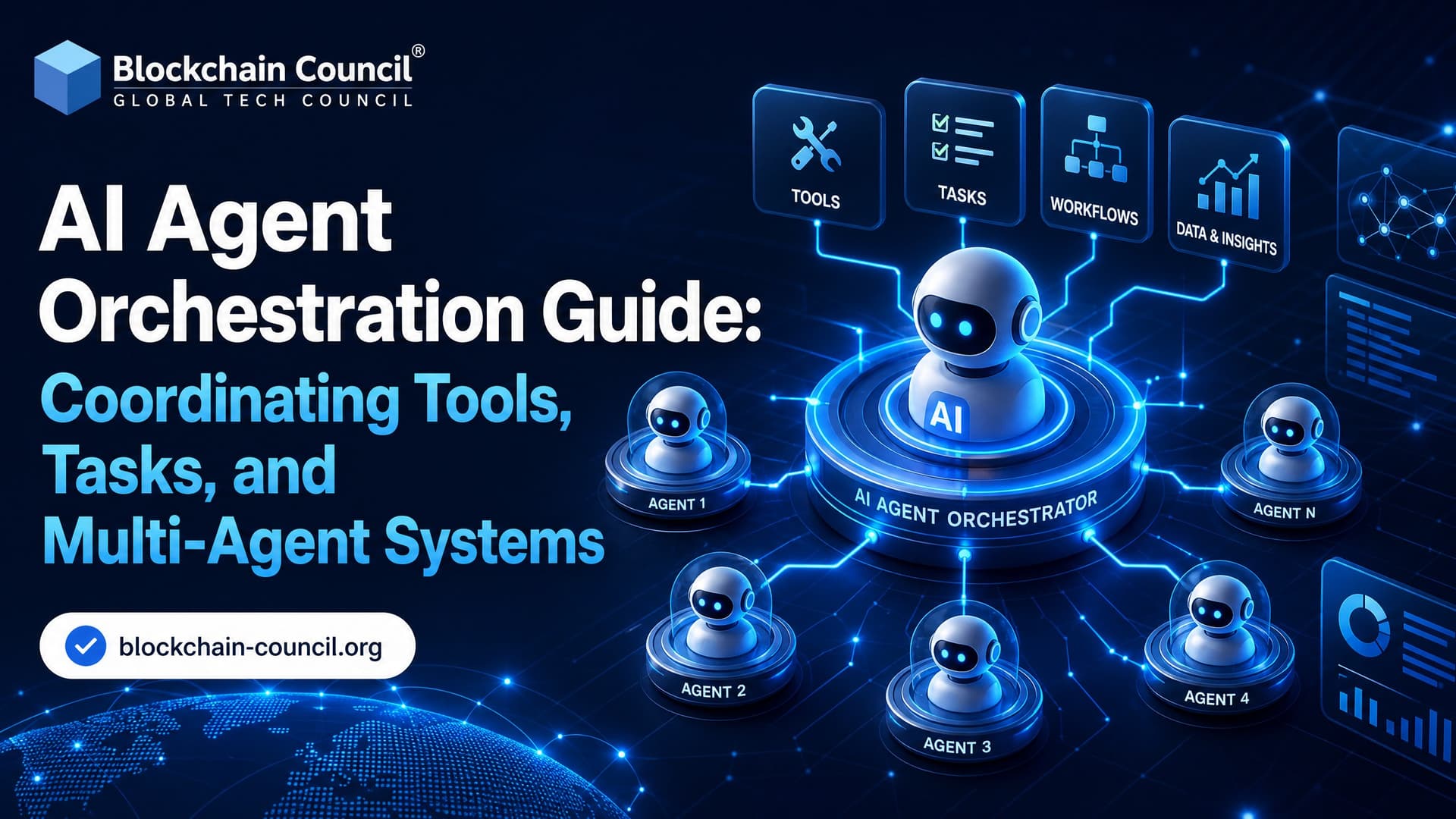
AI agent orchestration is the control layer that coordinates agents, tools, memory, policies, and human review so multi-agent systems can do real work without turning into an expensive science project. If you are building agentic AI for software teams, customer support, enterprise workflows, or Web3 operations, orchestration is where reliability is won or lost.
The shift is already visible. IBM, Snowflake, GitHub, Deloitte, Redis, and MIT Technology Review all point to the same pattern. Teams are moving from single-agent demos to governed systems where many specialized agents plan, call tools, share state, recover from failures, and escalate to people when needed.

As organizations adopt multi-agent AI systems, professionals with project leadership experience often combine orchestration skills with frameworks taught in a Certified Scrum Master Expert™ program to improve collaboration, sprint planning, and cross-functional delivery for AI initiatives.
What Is AI Agent Orchestration?
AI agent orchestration is the process of coordinating multiple AI agents inside one system to reach a shared goal. It is not just automation. A basic automation script follows fixed rules. An orchestrated agent system can break a goal into tasks, assign work to specialized agents, call APIs, track state, check policies, and decide when a human needs to step in.
GitHub compares agent orchestration to a control plane, similar in spirit to what Kubernetes does for containers. That comparison holds up. The orchestrator does not just run agents. It schedules work, manages state, applies access rules, records activity, and contains failures before they spread.
Core Functions of an Agent Orchestration Layer
Task decomposition and sequencing
The orchestrator takes a user goal and breaks it into smaller steps. A software engineering workflow might split into requirements analysis, code generation, unit testing, security review, and pull request creation. Each step can be routed to a different agent.
Shared state and memory
Agents need a common place to read and write context. That state may include the original request, intermediate outputs, tool results, constraints, user preferences, and approval status. Without shared state, agents repeat work or contradict each other.
A practical warning: in LangGraph, beginners often hit the error GraphRecursionError: Recursion limit of 25 reached without hitting a stop condition. It usually means your graph has no clear terminal condition, or your router keeps sending execution back to the same node. This is not a model problem. It is an orchestration design problem.
Tool and API coordination
Modern agents are useful because they can call tools. Databases, CRM systems, web search, code repositories, smart contracts, analytics platforms, ticketing systems, internal APIs. The orchestrator decides which agent can call which tool, under what conditions, and how the result is passed to the next step.
Error handling and fallbacks
Production systems fail. APIs time out. Models return invalid JSON. A tool may serve stale data. Snowflake highlights retries, fallbacks, and failure boundaries as core orchestration duties. Set retry limits. Add backoff. Use simpler fallback agents when complex reasoning breaks. Stop the workflow when the risk is too high.
Governance and human review
Human-in-the-loop is not a temporary training wheel. Deloitte and GitHub both treat it as a permanent feature for high-stakes workflows. Require human approval before agents send money, delete records, deploy code, approve compliance decisions, or contact customers in sensitive cases.
Because orchestration combines AI reasoning, workflow design, governance, and tool integration, many developers and solution architects strengthen these practical skills through a Certified Agentic AI Expert™ program before deploying multi-agent systems in production environments.
Why AI Agent Orchestration Matters in 2025 and 2026
The market is growing, but the failure risk is real. Deloitte estimates the autonomous AI agent market could reach US$8.5 billion by 2026 and US$35 billion by 2030. With better orchestration and risk controls, Deloitte suggests the 2030 figure could rise by 15 percent to 30 percent, possibly reaching US$45 billion.
There is a harsher number too. Deloitte also cites estimates that more than 40 percent of current agentic AI projects could be cancelled by 2027 because of cost, scaling complexity, or unexpected risk. That sounds about right. To be blunt, many pilots work only because nobody has connected them to real systems yet.
Once agents can query customer records, open pull requests, trigger cloud jobs, or touch blockchain infrastructure, orchestration becomes mandatory. You need audit logs. You need role boundaries. You need cost caps. You need a kill switch.
Common AI Agent Orchestration Patterns
Central orchestrator
Most enterprise systems start with a central orchestrator. It receives the request, plans tasks, assigns agents, manages state, and decides the next step. This pattern is easier to debug and govern, which makes it the best starting point for most teams.
Use it when you need predictable workflows, approval gates, and clear ownership. Customer service, DevOps, finance operations, and compliance workflows usually fit this model.
Distributed coordination
Distributed coordination lets agents negotiate or pass tasks among themselves with less central control. It can work for research, simulation, and exploratory problem solving. It is also harder to secure.
Do not start here unless your team already has strong observability, policy enforcement, and test coverage. Distributed agent systems create agent sprawl fast.
Task pipeline
A task pipeline moves work through stages: plan, research, draft, validate, review, execute. Simple and effective. It also maps well to human workflows, which makes approvals easier to insert.
Specialized role agents
MIT Technology Review describes multi-agent coding tools such as Claude Code, where multiple subagents can work on coding, testing, and debugging in parallel. The same idea applies outside software. One agent extracts data, another checks policy, another drafts a response, and another prepares escalation notes.
Platforms and Frameworks to Know
The tooling market is still shifting, but several categories are already clear.
Developer frameworks: OpenAI Agents SDK, Google Agent Development Kit, AutoGen/AG2, LangGraph, and CrewAI give developers lower-level control over agent definitions, routing, tools, and state.
Managed enterprise platforms: Azure AI Foundry Agent Service and Google Vertex AI Agent Builder focus on deployment, security, logging, scaling, and governance.
Conversational orchestration: Rasa is widely used for customer service workflows with routing, escalation, and back-end integrations. Rasa has reported a Deutsche Telekom use case where an agent handled around 50 percent of service desk inquiries independently and reduced human agent load by about 30 percent.
Productivity and research tools: Claude Code, Claude Cowork, Perplexity Computer, and Google DeepMind's Co-Scientist show how orchestration is moving into coding, office work, and scientific research.
My view: if you are a developer building a custom workflow, start with LangGraph or the OpenAI Agents SDK. If you are an enterprise team with strict audit and access needs, start with a managed platform. If your main use case is support automation, evaluate Rasa seriously before building everything from scratch.
Standards: Why MCP Matters
Model Context Protocol, often called MCP, is getting attention because it gives agents a more standard way to connect to tools and data sources. Boomi and GitHub both emphasize open orchestration and cross-platform standards as a way to reduce vendor lock-in.
This matters because enterprises will not run one agent from one vendor forever. You may have a code agent, a security agent, a deployment agent, a data agent, and a compliance agent from different ecosystems. A common protocol for context and tool access makes that setup realistic.
AI Agent Orchestration in Blockchain and Web3
Blockchain and Web3 workflows are a natural fit for orchestration, but only with strict limits. Agents can monitor on-chain events, summarize DAO proposals, flag suspicious wallet behavior, query node APIs, generate smart contract test cases, and coordinate incident response.
They should not freely sign transactions. That is the wrong architecture.
A safer Web3 agent design uses orchestration to separate duties:
A monitoring agent watches contracts and wallets.
An analysis agent checks anomalies against historical activity.
A policy agent compares the case with risk rules.
A reporting agent drafts a human-readable summary.
A human reviewer approves any on-chain action through a wallet or multisig.
For professionals working at this intersection, Blockchain Council's Certified Agentic AI Expert™ and Certified AI Expert™ programs, along with its blockchain-focused certifications, offer useful learning paths. Pair agentic AI knowledge with smart contract security, Web3 architecture, and governance fundamentals.
Best Practices for Building Multi-Agent Systems
Define agent roles tightly. Write down what each agent can do, what it cannot do, and which tools it can access.
Use explicit state. Do not rely only on chat history. Store task status, decisions, tool outputs, and approvals in a structured state object.
Log every tool call. Capture the agent, tool name, input, output, timestamp, cost, and final decision.
Add human checkpoints. Require review for money movement, legal language, customer commitments, production deployments, and sensitive data access.
Test failure paths. Simulate invalid JSON, API timeouts, empty search results, permission errors, and conflicting agent outputs.
Control cost early. Set token budgets, tool rate limits, and maximum loop counts before the pilot reaches real users.
Prefer boring designs first. A central orchestrator with clear routing beats a clever swarm that nobody can debug.
Where AI Agent Orchestration Is Heading
Over the next 12 to 18 months, Deloitte expects more businesses to scale complex agent orchestrations while keeping humans involved. Boomi forecasts automated agent discovery, agent marketplaces, natural language workflow definitions, and industry-specific agent libraries. GitHub expects open, federated orchestration to grow as standards such as MCP mature.
The long-term direction is clear. Agents will become more adaptive, but enterprise systems will demand stronger control. That means better state management, policy engines, observability, cost governance, and approval workflows.
Final Takeaway
AI agent orchestration is the difference between a clever demo and a production system you can trust. Start with one workflow. Give every agent a narrow job. Add shared state, logs, failure boundaries, and human review before you connect high-impact tools.
To build skill here, study agent design, prompt engineering, API-based tool use, and governance patterns. Then build a small orchestrated workflow, such as a research-review-draft pipeline, and extend it only after you can explain every decision the system makes.
Beyond engineering teams, AI agent orchestration is also influencing customer engagement, campaign automation, and personalized digital experiences. Professionals who combine technical AI knowledge with a Marketing Certification are increasingly well positioned to design data-driven customer journeys while working effectively with modern AI-powered business platforms.
FAQs
What Is AI Agent Orchestration?
AI agent orchestration is the process of coordinating multiple AI agents, tools, workflows, and data sources so they can work together to complete complex tasks efficiently, reliably, and with appropriate human oversight.
How Does AI Agent Orchestration Work?
An orchestration layer assigns tasks, manages communication between agents, coordinates tool usage, monitors execution, handles errors, and combines outputs into a final result.
Why Is AI Agent Orchestration Important?
Orchestration enables organizations to automate multi-step workflows, improve productivity, reduce manual effort, increase scalability, and ensure AI systems work together effectively instead of operating in isolation.
What Is the Difference Between an AI Agent and an AI Orchestrator?
An AI agent performs a specific task, such as writing code or analyzing documents. An AI orchestrator manages multiple agents by deciding which agent should perform each task, coordinating execution, and maintaining workflow state.
What Are the Core Components of an AI Agent Orchestration System?
A typical orchestration system includes:
AI agents
Workflow engine
Task planner
Memory
Tool integrations
APIs
Data sources
Monitoring and logging
Human approval workflows
Which Industries Benefit from AI Agent Orchestration?
AI agent orchestration is being adopted across:
Healthcare
Financial services
Manufacturing
Retail
Customer support
Software development
Cybersecurity
Education
Supply chain
Marketing
What Are Common AI Agent Orchestration Use Cases?
Popular use cases include:
Customer service automation
Software development workflows
Document processing
Financial analysis
IT operations
Marketing automation
Research assistance
Business process automation
How Does AI Agent Orchestration Improve Enterprise Workflows?
It helps automate repetitive tasks, distribute work among specialized agents, integrate enterprise systems, reduce bottlenecks, and improve operational consistency.
Can Multiple AI Models Be Orchestrated Together?
Yes. Many orchestration platforms support multiple language models and specialized AI systems, allowing organizations to choose the most suitable model for each task.
What Role Does Memory Play in AI Agent Orchestration?
Memory enables agents to retain context across multiple steps, reference previous actions, maintain conversation history, and support long-running workflows.
How Do AI Agents Communicate with Each Other?
Agents typically exchange structured information through APIs, shared memory, message queues, event-driven systems, or orchestration frameworks that coordinate task execution.
What Is Human-in-the-Loop Orchestration?
Human-in-the-loop orchestration incorporates human review, approval, or intervention at selected stages of a workflow, particularly for high-risk, regulated, or business-critical decisions.
How Does Retrieval-Augmented Generation (RAG) Support AI Agent Orchestration?
RAG allows agents to retrieve relevant information from trusted knowledge sources before generating responses, improving accuracy and reducing reliance on the model's internal knowledge alone.
What Security Considerations Are Important?
Organizations should consider:
Authentication
Authorization
Data encryption
Access controls
Audit logging
Privacy compliance
Secure API management
Prompt injection protection
Which Skills Are Needed to Build AI Agent Orchestration Systems?
Useful skills include:
Python programming
API development
Workflow automation
Prompt engineering
Context engineering
Cloud computing
System architecture
AI governance
What Challenges Do Organizations Face?
Common challenges include:
Workflow complexity
Context management
Tool reliability
Error recovery
Latency
Cost optimization
Security
Model evaluation
Governance
Which Frameworks Support AI Agent Orchestration?
Examples include:
LangGraph
CrewAI
Microsoft AutoGen
LlamaIndex Workflows
Semantic Kernel
Google ADK (Agent Development Kit)
OpenAI Agents SDK
The best framework depends on the application's requirements and deployment environment.
How Can Businesses Measure the Success of AI Agent Orchestration?
Key performance indicators include:
Task completion rate
Workflow accuracy
Response time
Automation rate
Cost savings
User satisfaction
Error rate
Return on investment (ROI)
What Common Mistakes Should Teams Avoid When Implementing AI Agent Orchestration?
Avoid overcomplicating workflows, assigning every task to separate agents without clear justification, neglecting monitoring and governance, ignoring security requirements, skipping human oversight for high-risk decisions, and failing to test workflows under real-world conditions. More agents do not automatically create a smarter system. Sometimes they simply create a larger meeting where software argues with itself.
What Is the Future of AI Agent Orchestration?
AI agent orchestration is expected to become a foundational layer for enterprise AI as organizations automate increasingly complex workflows. Advances in multimodal AI, long-term memory, autonomous planning, tool use, and standardized communication protocols are likely to make orchestrated agent systems more capable and reliable. Organizations that combine robust orchestration frameworks with strong governance, security, and human oversight will be better positioned to deploy scalable, trustworthy AI solutions across business operations.
Related Articles
View All
Agentic AI
Agentic AI Tools and Architecture FAQs: LLM Agents, RAG, Memory, Planning, and Multi-Agent Systems Explained
Learn agentic AI tools and architecture: LLM agents, RAG, memory, planning, and multi-agent systems, plus enterprise layers, controls, and real use cases.
Agentic AI
Multi-Agent AI & Autonomous Systems: The Future of Agentic AI
Explore multi-agent AI and autonomous systems: how agent teams use roles, communication, and delegation to automate business work, plus the security risks and the open question of whether agents could lead to AGI.

Agentic AI
AI Agent Harnesses, Tools & Context: The Infrastructure Behind Autonomous AI
Learn how AI agent harnesses, tools, and context work together. This beginner-friendly guide covers function calling, APIs, context engineering, memory, RAG, guardrails, and agent evaluation.
Trending Articles
The Role of Blockchain in Ethical AI Development
How blockchain technology is being used to promote transparency and accountability in artificial intelligence systems.

Top 5 DeFi Platforms
Explore the leading decentralized finance platforms and what makes each one unique in the evolving DeFi landscape.

Can DeFi 2.0 Bridge the Gap Between Traditional and Decentralized Finance?
The next generation of DeFi protocols aims to connect traditional banking with decentralized finance ecosystems.