

Building and Orchestrating Multi-Agent Systems: A Practical Guide for Certified AI Agents Managers

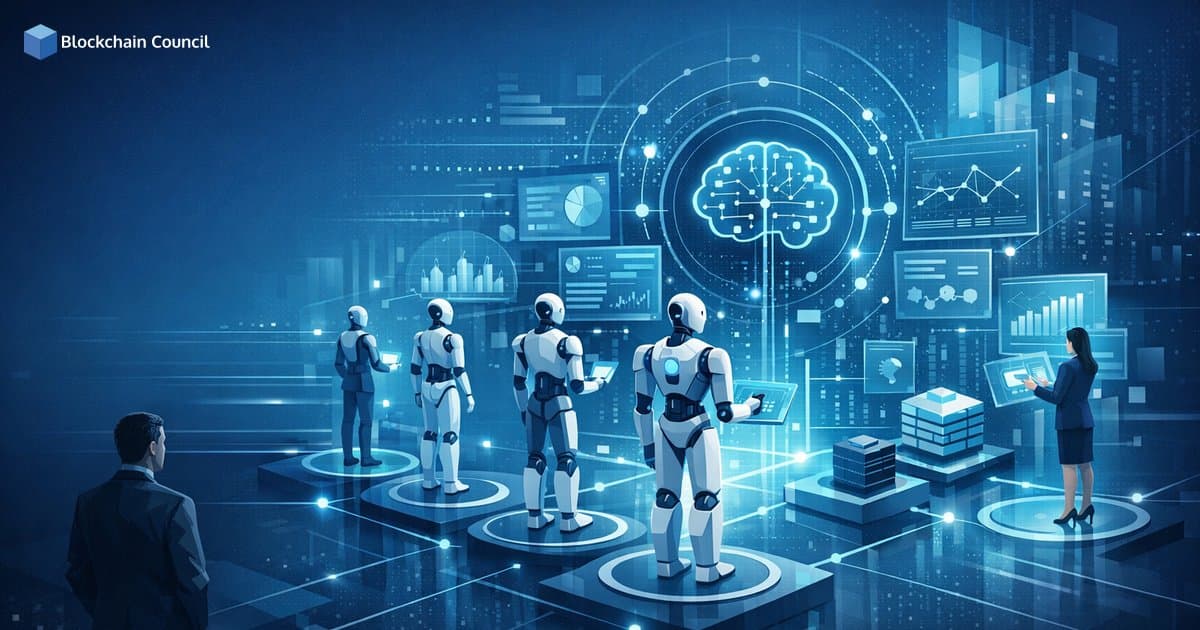
Building and orchestrating multi-agent systems is quickly becoming a core skill for professionals who manage agentic AI in production. As organizations move from simple chatbots to workflow automation, they increasingly need systems where multiple specialized agents collaborate under clear guardrails. For a Certified AI Agents Manager, the priority is not novelty. It is repeatability, safety, observability, and governance across complex, tool-driven workflows.
This practical guide explains when to choose multi-agent over single-agent designs, the core architecture patterns used by major cloud providers, and how to operationalize orchestration for enterprise requirements.

Single-Agent vs. Multi-Agent: A Decision Framework
The most consistent guidance from cloud providers is to start simple. Microsoft's Azure Cloud Adoption Framework recommends beginning with a single-agent system for low to moderate complexity use cases because it is easier to build, cheaper to run, and more predictable to test and monitor. Multi-agent architectures should be introduced only when the constraints demand it.
Start with a Single Agent When
One team owns most logic, tools, and data domains.
The workflow is low to moderate complexity and does not require many independent tool chains.
You need fast iteration and a stable baseline for evaluation covering quality, cost, latency, and failure modes.
Move to Multi-Agent When the Boundaries Are Real
Multi-agent systems add coordination overhead, so the trigger should be clear. A multi-agent system is justified when one or more of these conditions apply:
Security and compliance boundaries: data classification, residency, or regulatory separation requires isolated processing environments. This is a recurring enterprise requirement in finance, healthcare, and public sector deployments.
Multiple teams own different domains: different groups manage separate datasets, services, or business processes and need autonomy to evolve their components independently.
Complex workflows: long-running tasks, multiple tools, multiple data sources, or advanced quality control steps benefit from specialization and modularity.
Planned growth: you expect the system to expand into a suite of capabilities that should be versioned and governed independently.
What Agent Orchestration Actually Means in Production
Agent orchestration is the discipline of coordinating multiple agents so the overall system behaves like a coherent application. Across vendors and frameworks, the orchestrator (or supervisor) typically handles:
Task decomposition: translating a user goal into smaller, discrete tasks.
Routing and delegation: selecting the right specialist agent based on intent, context, and policy.
Shared context and memory: maintaining state, references, and artifacts across steps.
Monitoring and recovery: detecting failures, retrying safely, and escalating to humans when needed.
Policy enforcement: ensuring agents stay within tool scopes, data access rules, and compliance requirements.
The practical distinction between a collection of chatbots and a true multi-agent system lies in the orchestration layer's ability to resolve conflicts, maintain coherent state, and deliver consistent outcomes. Academic work on orchestration identifies the central trade-off as agent autonomy versus system predictability, which is precisely where governance and evaluation become essential.
Reference Patterns from AWS, Microsoft, and Google
Despite ecosystem differences, major cloud providers converge on similar production patterns: a supervisor plus specialists approach, backed by tool access controls and observability.
AWS: Supervisor Agent Plus Domain Agents
AWS guidance for multi-agent orchestration on Amazon Bedrock AgentCore uses a central Supervisor Agent that interprets requests, routes to domain agents, maintains context, and integrates monitoring, authentication, and human escalation. In customer support patterns, specialist agents may include order management, personalization, recommendations, and troubleshooting.
Google: Orchestrator Agent with Quality Loops
Google's Agent Development Kit (ADK) codelabs demonstrate a multi-agent workflow with roles such as Researcher, Judge, Content Builder, and Orchestrator. A notable feature is the use of feedback loops, where a Judge agent evaluates outputs against defined criteria and triggers additional research until requirements are met. ADK also highlights agent-to-agent communication patterns and structured outputs.
Microsoft: Start Single-Agent, Scale with Boundaries
Microsoft's guidance is straightforward: begin with a single agent as the default and transition to multi-agent when boundaries such as compliance separation, multi-team ownership, or growth requirements make modularity necessary.
Core Architecture of a Production Multi-Agent System
For a Certified AI Agents Manager, a multi-agent system should be treated as a software platform, not a prompt experiment. A robust architecture typically includes the following components.
1) Orchestrator or Supervisor Agent
Accepts the goal or user request.
Plans steps and dispatches tasks to appropriate agents.
Aggregates results and validates outputs.
Enforces safety policies and escalation paths.
2) Specialized Worker Agents
Worker agents are optimized for specific responsibilities and toolsets, such as:
Retrieval and RAG agent: knowledge base search, citations, and grounding.
Tooling agent: executes approved actions via APIs, scripts, or workflows.
Analytics agent: queries data, performs analysis, and generates reports.
Domain workflow agents: KYC, order tracking, incident triage, or policy checks.
3) Shared Context, Memory, and Audit Logs
Short-term state: task metadata and conversation history shared across agents.
Long-term memory: vector stores or knowledge graphs for durable organizational knowledge.
Auditability: logs for agent decisions, tool calls, and outputs to support debugging and compliance reviews.
4) Orchestration Runtime and Communication Protocols
The orchestration platform enables agent-to-agent communication, tool invocation, monitoring, and policy enforcement. Google's ecosystem emphasizes protocols such as A2A (Agent-to-Agent) and MCP (Model Context Protocol) to standardize tool access and distributed communication, reducing ad hoc integrations and simplifying governance.
5) Enterprise Integrations and Human-in-the-Loop
Production systems typically integrate with CRM, ERP, ticketing, and database platforms, along with identity and access management controls. Human escalation is a first-class feature in support workflows and regulated environments.
Orchestration Strategies You Can Apply Immediately
Most real-world deployments combine several of these patterns, chosen based on risk tolerance, audit requirements, and workflow variability.
1) Static Workflow Orchestration
Best suited for regulated, auditable processes with known steps. Static workflows are easier to test and certify, but less flexible when requirements change frequently.
2) Dynamic Routing with a Supervisor
The Supervisor selects specialist agents based on intent and context, enabling adaptive behavior. This approach increases the need for guardrails, tool scoping, and robust monitoring.
3) Feedback Loops with Judge or Critic Agents
Evaluation agents assess output quality, request improvements, and enforce structured criteria. Google's course creation pattern illustrates how iterative loops can improve research and synthesis, at the cost of additional compute.
4) Distributed and Federated Agents
Agents may run in separate services or be owned by different teams. Protocol-based communication helps maintain consistency, but governance becomes more complex due to network security requirements, policy alignment, and lifecycle coordination across ownership boundaries.
Security, Compliance, and Governance: The Certified AI Agents Manager Checklist
Multi-agent systems expand the surface area for mistakes. Governance must be designed in from the start, not retrofitted after deployment.
Data Segregation and Least Privilege
Separate agents for different regions or data classifications (for example, EU vs. US data residency).
Per-agent tool scopes and credentials, avoiding broad access that applies all tools to all agents.
Explicit allowlists for sensitive actions such as payments, PII access, and account changes.
Central Policy Enforcement
A Supervisor that enforces corporate rules, legal constraints, and safety filters consistently.
A shared policy and configuration store so changes are applied uniformly and remain auditable.
Audit Trails and Observability
Log every agent hand-off, tool invocation, and final decision.
Track per-agent metrics including latency, error rates, tool failures, and escalation frequency.
Version prompts, tools, and policies with documented rollback plans.
Real-World Use Cases That Fit Multi-Agent Orchestration
Customer Support and Contact Centers
AWS's customer support reference architecture illustrates why multi-agent designs work well in service environments: a Supervisor routes queries to specialist agents and maintains context across steps, with secure authentication and human escalation built in. Similar patterns appear in contact center platforms that combine multi-agent routing, knowledge retrieval, and after-call work automation to reduce handling time and improve consistency.
Content and Course Creation
Google's course creation example demonstrates a reusable pattern: a Researcher gathers information, a Judge validates quality, a Content Builder generates structured materials, and an Orchestrator manages the loop until standards are met. This template applies to any workflow involving research, critique, and synthesis at scale.
Tool Integration via MCP and Standardized Toolboxes
Demonstrations from Google show MCP servers exposing tools to agents and database toolboxes normalizing access across systems such as Cloud SQL. Standard tool interfaces reduce integration cost and make multi-agent systems significantly easier to govern and audit.
Practical Guidance for Implementation and Operations
Baseline with a single agent: measure quality, latency, cost, and top failure modes before splitting responsibilities across multiple agents.
Define agent contracts: specify inputs, outputs, allowed tools, and responsibilities for each agent before building.
Use structured outputs: enforce schemas (for example, with Pydantic-style models) so downstream steps can validate and automate reliably.
Implement evaluation loops: add Judge or Critic agents for high-risk outputs and set clear thresholds for human review.
Operate like a platform: versioning, monitoring, change management, and incident response should be built into the system lifecycle from day one.
Conclusion: Orchestration Is Where Agentic AI Becomes Enterprise-Ready
Building and orchestrating multi-agent systems is not about adding more agents. It is about creating a controlled environment where specialized components collaborate safely, predictably, and measurably. Guidance from Microsoft, AWS, and Google aligns on a practical foundation: start with a single agent, move to multi-agent when boundaries and complexity justify it, and anchor orchestration in supervision, policy enforcement, tool scoping, and auditability.
For a Certified AI Agents Manager, success is defined by outcomes that hold up to enterprise scrutiny: clear agent responsibilities, strong guardrails, reliable evaluation, and the operational maturity to take a system from prototype to production.
Related Articles
View All
Agentic AI
AI Agents for Business Process Automation: A Practical Guide for Managers
A practical guide for managers on using AI agents for business process automation, covering use cases, governance, ROI, architecture, and rollout steps.

Agentic AI
AI Agent Orchestration Guide: Coordinating Tools, Tasks, and Multi-Agent Systems
A practical guide to AI agent orchestration, covering tools, task routing, shared state, governance, platforms, and multi-agent system patterns.

Agentic AI
What Is Agentic AI? A Practical Guide to Autonomous AI Agents
Agentic AI uses autonomous AI agents to plan, use tools, take actions, and adapt in real workflows. Learn core concepts, architecture, use cases, and risks.
Trending Articles
What is AWS? A Beginner's Guide to Cloud Computing
Everything you need to know about Amazon Web Services, cloud computing fundamentals, and career opportunities.
Claude AI Tools for Productivity
Discover Claude AI tools for productivity to streamline tasks, manage workflows, and improve efficiency.
How to Install Claude Code
Learn how to install Claude Code on macOS, Linux, and Windows using the native installer, plus verification, authentication, and troubleshooting tips.