

Managing Multi-Agent AI Systems: Best Practices for Enterprise Leaders
 Suyash Raizada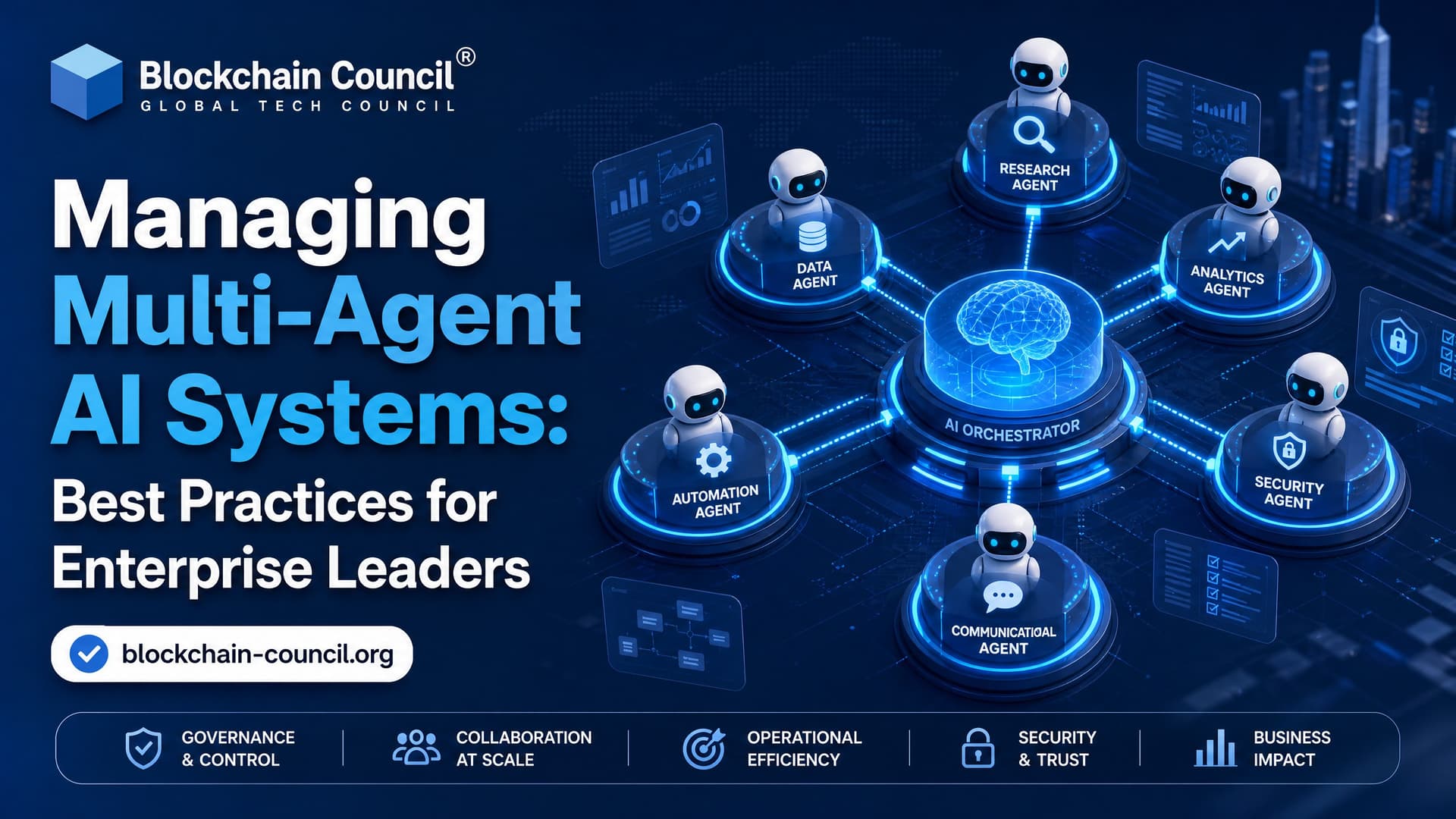
Managing multi-agent AI systems is no longer a research problem for enterprise innovation teams. It is becoming an operating discipline. Once agents start reading tickets, querying Snowflake, updating ServiceNow, checking policy, and asking a human for approval, the hard part is not the model. The hard part is control.
That shift is visible in the market. Databricks and Economist Impact reported in 2024 that about 40 percent of surveyed organizations were already experimenting with or deploying AI agents in business operations. Databricks has also observed that supervisor agents, which coordinate multiple specialized agents, account for roughly 37 percent of agent usage among its customers. The pattern is clear. Enterprises are moving from single copilots to coordinated systems of agents.

As organizations coordinate AI initiatives across engineering, operations, security, and business teams, professionals with a Certified Scrum Master Expert™ background can help structure cross-functional delivery, manage iterative implementation, and keep governance aligned throughout the rollout.
For leaders, this creates a new management question. How do you let agents act across departments without opening security gaps, compliance issues, or workflow chaos?
What Makes Multi-Agent AI Different?
A multi-agent AI system is a group of specialized agents that collaborate to complete a larger task. One agent may retrieve data. Another validates policy. Another drafts a response. A supervisor or orchestrator agent plans the workflow, routes work, and decides when to ask for human input.
This differs from a simple chatbot in three practical ways:
Agents have roles: Each agent should have a defined job, such as invoice validation, knowledge retrieval, or access provisioning.
Agents use tools: They may call APIs, search databases, update CRM records, or trigger workflow actions.
Agents make multi-step decisions: They pursue an objective instead of waiting for a human prompt at every step.
That power comes with risk. A poorly scoped support agent that can both read customer records and issue refunds is not automation. It is an audit finding waiting to happen.
When Multi-Agent AI Is the Right Choice
Do not use a multi-agent system because it sounds advanced. Use it when the work justifies the extra moving parts.
Promethium has reported that production multi-agent deployments for distributed enterprise data often use 4 to 6 specialized agents plus one orchestrator. In its observed deployments, multi-agent designs produced 70 to 90 percent latency improvements and 20 to 35 percent accuracy gains compared with single-agent approaches. The strongest fit was not generic chat. It was data spread across several systems, complex decision logic, and strict timing requirements.
As a rule of thumb, multi-agent AI makes sense when:
Data lives in three or more systems, such as Salesforce, Snowflake, Workday, and ServiceNow.
The process crosses multiple expert domains, such as finance, legal, procurement, and operations.
A single agent would need too many tools and too much context to stay reliable.
Human handoffs are slowing a repeatable process.
You need traceable decisions, not just generated text.
Use a single agent for narrow work: FAQ responses, content drafts, meeting summaries, and simple knowledge search. To be blunt, multi-agent architecture is the wrong choice for a task that one well-tested workflow can handle.
Successfully deploying multi-agent architectures requires more than selecting the right framework. Many AI architects, developers, and enterprise leaders strengthen their understanding of orchestration, governance, and autonomous workflows through a Certified Agentic AI Expert™ program before scaling production deployments.
Core Architecture Patterns Enterprise Leaders Should Understand
1. Supervisor and specialist agents
The supervisor pattern is becoming the default for complex enterprise AI agents. A supervisor agent receives the user goal, creates a plan, assigns tasks to specialists, checks outputs, and decides the next step.
Specialist agents might include:
Data discovery agent: Finds the right source system.
Query agent: Builds and executes approved queries.
Policy agent: Checks whether the planned action complies with internal rules.
Action agent: Updates systems only after approval or confidence checks.
Human escalation agent: Packages the issue for review when risk is too high.
Keep specialists boring. That is a compliment. The best agent is not the one with the biggest prompt. It is the one with the clearest boundary.
2. Tool access by role
Every agent should have its own tool permissions. Do not give the orchestrator unlimited access to every enterprise system. If the procurement policy agent only needs to read vendor policy documents, it should not be able to create purchase orders.
Use least privilege, service identities, and your existing identity and access management controls. Treat agent credentials like privileged application credentials. Rotate them. Monitor them. Remove them when the agent is retired.
3. State, memory, and audit logs
Multi-agent systems need shared state. They also need limits. Persistent memory can help agents avoid repeated questions, but it can also store sensitive information in places nobody intended.
Log these items at minimum:
User request and business context
Agent plan and agent-to-agent messages
Tool calls, inputs, outputs, and timestamps
Model version and prompt version
Human approvals, overrides, and rejections
Final outcome and downstream system changes
A practical detail: if you build with LangGraph, watch for GraphRecursionError: Recursion limit of 25 reached without hitting a stop condition. It usually means your agents are passing work back and forth without a termination rule. In production, that is not just a developer annoyance. It can become runaway cost, repeated API calls, and inconsistent user outcomes.
Governance Best Practices for Managing Multi-Agent AI Systems
Start with the workflow, not the model
Map the full process before you choose tooling. Employee onboarding is a good example. It touches HR, IT, facilities, payroll, security, and sometimes legal. A useful agent system would not just answer questions. It would coordinate account creation, equipment requests, policy acknowledgment, benefits enrollment, and exception handling.
Ask these questions first:
Where does the process start and end?
Which systems hold the required data?
Which decisions are low risk enough for automation?
Where must a human approve?
What evidence will auditors need later?
Define decision rights clearly
Agents should not have vague authority. Write down what each agent can recommend, approve, execute, and escalate.
Take invoice processing as an example:
An extraction agent can read the invoice and identify fields.
A validation agent can compare the invoice with purchase orders.
A risk agent can flag unusual payment details.
A finance approver must approve payment above a set threshold.
An action agent can submit payment only after approval is recorded.
This structure reduces ambiguity. It also helps business teams trust the system, because the agent is not acting like an invisible employee with unknown authority.
Build human oversight into the product
The EU Artificial Intelligence Act, published in the Official Journal of the European Union on 12 July 2024, requires human oversight, risk management, data governance, technical documentation, transparency, and audits for high-risk AI systems. Even if your company sits outside Europe, these requirements are shaping global AI governance expectations.
Human oversight should be meaningful. A manager clicking approve on a dense, unreadable agent trace is not oversight. Give reviewers the plain-English rationale, source references, confidence signals, policy checks, and the exact action being requested.
Measure the system, not just the model
Model accuracy is only one metric. In multi-agent AI, the workflow can fail even when each agent looks accurate in isolation.
Track metrics such as:
End-to-end task success rate
Time to resolution
Human override frequency
Tool call failure rate
Policy violation rate
Escalation quality
Cost per completed workflow
Agent loop or timeout incidents
Test with real workflow cases, synthetic edge cases, and adversarial prompts. Include boring failures too: expired API tokens, missing CRM fields, duplicate employee records, slow database queries, and partial outages. Those are the problems that break enterprise deployments on Monday morning.
Security Controls That Cannot Be Optional
Multi-agent AI connects systems that were often governed separately. That makes security design central, not secondary.
Use least privilege: Give each agent only the permissions needed for its role.
Separate read and write access: Reading a record and changing it should require different permissions.
Require approval for high-impact actions: Payments, terminations, legal submissions, and production changes need human control.
Monitor unusual behavior: Unexpected tool calls, large data pulls, repeated failed actions, and out-of-hours activity should trigger alerts.
Keep an agent inventory: Track owner, purpose, model, tools, data sources, permissions, and deployment status.
If you already run enterprise IAM, security information and event management, and data loss prevention tools, connect agents to that control layer. Do not create a parallel AI security stack that nobody in security operations can see.
Organizational Design: Who Owns the Agents?
Ownership is where many pilots stall. IT owns the platform. Risk owns policy. Business teams own process knowledge. Legal owns regulatory interpretation. Nobody owns the whole agent system unless you assign it.
Create a cross-functional AI operating model with:
Business process owners who define outcomes and exceptions
AI product owners who manage agent lifecycle and backlog
Security and risk teams who define controls and review logs
Domain experts who test agent behavior against real cases
Data owners who approve access and data use
Training matters too. Teams need to learn how to supervise agents, challenge outputs, and report failures. For structured learning, Blockchain Council programs such as the Certified Agentic AI Expert™, Certified Artificial Intelligence (AI) Expert™, and Certified AI Developer™ can help readers build the technical and governance skills that agentic AI demands.
Practical Roadmap for Enterprise Leaders
Pick one cross-functional workflow: Choose a process with measurable pain, such as onboarding, procurement, support resolution, or invoice reconciliation.
Map systems and decisions: Document data sources, approvals, risk points, and exception paths.
Start with 3 to 5 agents: Use clear roles before expanding. Avoid an agent swarm.
Add governance from day one: Log tool calls, define permissions, create approval rules, and document the architecture.
Run shadow mode first: Let agents recommend actions while humans execute them. Compare outcomes.
Move low-risk actions to automation: Automate only where accuracy, oversight, and rollback plans are proven.
Review quarterly: Models, tools, regulations, and workflows change. Maintain your agent system like production software.
Next Step
Start with a workflow inventory this week. Find one process that crosses at least three systems and has clear human approval points. Map it, define candidate agent roles, and identify which actions must stay human controlled. If you are building the skills to lead or implement these systems, use the Certified Agentic AI Expert™ learning path as your next structured step, then pair it with hands-on prototyping using a supervisor-agent architecture.
As multi-agent AI increasingly supports customer engagement, sales operations, and digital business processes alongside technical workflows, professionals who complement their AI expertise with a Marketing Certification are better equipped to connect intelligent automation with measurable business growth and customer experience improvements.
FAQs
1. What are multi-agent AI systems?
Multi-agent AI systems consist of multiple AI agents that work together to solve complex tasks. Each agent is typically assigned a specialized role, such as planning, research, analysis, coding, or decision support, allowing the system to complete workflows more efficiently than a single AI agent.
2. How do multi-agent AI systems work?
Multi-agent AI systems operate by dividing tasks among specialized agents. These agents communicate, exchange information, coordinate actions, and combine their outputs to achieve a common objective while minimizing duplication and improving overall performance.
3. What are the benefits of managing multi-agent AI systems?
Effective management improves scalability, task specialization, collaboration, fault tolerance, operational efficiency, and decision-making. It also helps organizations automate complex business processes while maintaining consistency and reliability.
4. Why are multi-agent AI systems becoming popular?
Businesses increasingly use multi-agent systems because many real-world problems require multiple AI capabilities working together. Instead of relying on one general-purpose model, organizations can assign specialized agents to different stages of a workflow for greater efficiency.
5. What industries can benefit from multi-agent AI systems?
Healthcare, finance, retail, manufacturing, logistics, legal services, education, software development, telecommunications, and customer service can all benefit from multi-agent AI systems by automating processes and improving collaboration.
6. How do AI agents communicate in a multi-agent system?
Agents communicate by exchanging structured information, task updates, requests, and results through defined protocols or orchestration layers. This coordination enables agents to share context and collaborate effectively while completing complex workflows.
7. What is an AI orchestrator in a multi-agent system?
An AI orchestrator is the central coordinator that assigns tasks, manages communication, monitors agent performance, resolves conflicts, and ensures the workflow progresses efficiently. It helps keep specialized agents working toward a shared objective.
8. How do businesses manage multiple AI agents effectively?
Organizations manage multiple AI agents by defining clear responsibilities, implementing governance policies, monitoring performance, maintaining secure communication, establishing escalation procedures, and continuously optimizing workflows based on business needs.
9. What are the biggest challenges of managing multi-agent AI systems?
Common challenges include agent coordination, communication overhead, security, data consistency, resource allocation, governance, scalability, error handling, and maintaining reliable performance across distributed AI workflows.
10. How can multi-agent AI systems improve business workflows?
Multi-agent systems can automate end-to-end business processes such as customer support, document processing, financial analysis, software development, marketing campaigns, and supply chain management by allowing specialized agents to work simultaneously.
11. Are multi-agent AI systems more scalable than single-agent systems?
Yes. Multi-agent systems can distribute workloads across specialized agents, making them more scalable for handling large, complex, or parallel tasks while improving efficiency and reducing processing bottlenecks.
12. How does governance apply to multi-agent AI systems?
Governance ensures that all AI agents follow organizational policies, security standards, privacy requirements, compliance rules, and ethical guidelines. It also defines accountability, audit processes, and human oversight where appropriate.
13. Can multi-agent AI systems improve customer support?
Yes. Different AI agents can manage customer inquiries, retrieve knowledge, analyze sentiment, escalate complex cases, and summarize conversations. This collaborative approach improves response quality, reduces wait times, and enhances customer satisfaction.
14. How do businesses monitor multi-agent AI performance?
Organizations monitor metrics such as response accuracy, task completion rates, workflow efficiency, communication quality, system reliability, latency, security events, and user satisfaction to evaluate overall system performance.
15. What technologies support multi-agent AI management?
Businesses commonly use AI orchestration platforms, workflow automation tools, APIs, message queues, monitoring dashboards, identity and access management, analytics platforms, and governance solutions to coordinate and manage multiple AI agents.
16. How can organizations ensure secure communication between AI agents?
Secure communication involves encrypting data exchanges, implementing authentication and authorization controls, restricting agent permissions, maintaining audit logs, and continuously monitoring interactions for unusual or unauthorized behavior.
17. What role does human oversight play in multi-agent AI systems?
Human oversight remains essential for supervising critical decisions, reviewing high-impact outputs, resolving exceptions, validating AI-generated recommendations, and ensuring the system operates according to business and regulatory requirements.
18. What are the best practices for deploying multi-agent AI systems?
Best practices include defining specialized agent roles, implementing orchestration, establishing governance policies, securing communication channels, testing collaboration scenarios, monitoring system performance, documenting workflows, and continuously optimizing operations.
19. How can businesses measure the success of multi-agent AI systems?
Success can be measured through key performance indicators such as automation rates, response time, operational cost savings, workflow completion speed, customer satisfaction, decision accuracy, system uptime, and overall business productivity improvements.
20. Why are multi-agent AI systems considered the future of enterprise automation?
Multi-agent AI systems enable organizations to solve increasingly complex business challenges by combining specialized AI capabilities into coordinated workflows. As enterprises adopt more advanced automation, these systems offer greater flexibility, scalability, resilience, and efficiency than single-agent approaches, making them a key foundation for the next generation of intelligent business operations.
Related Articles
View All
Agentic AI
AI Agent Security Best Practices for Enterprise Environments
Learn AI agent security best practices for enterprise environments, including identity, least privilege, monitoring, red teaming, and governance.

Agentic AI
AI Agent Platforms Explained: Architecture, Tooling, and Deployment Best Practices for Enterprise Automation
AI agent platforms power enterprise automation by orchestrating LLMs, tools, and workflows with memory, governance, and observability for reliable, secure deployments.
Agentic AI
Multi-Agent AI & Autonomous Systems: The Future of Agentic AI
Explore multi-agent AI and autonomous systems: how agent teams use roles, communication, and delegation to automate business work, plus the security risks and the open question of whether agents could lead to AGI.
Trending Articles
AWS Career Roadmap
A step-by-step guide to building a successful career in Amazon Web Services cloud computing.

Top 5 DeFi Platforms
Explore the leading decentralized finance platforms and what makes each one unique in the evolving DeFi landscape.

Can DeFi 2.0 Bridge the Gap Between Traditional and Decentralized Finance?
The next generation of DeFi protocols aims to connect traditional banking with decentralized finance ecosystems.