

From Web2 to Web3: A Practical Migration Blueprint for Businesses (Wallets, Smart Contracts, and Token Incentives)

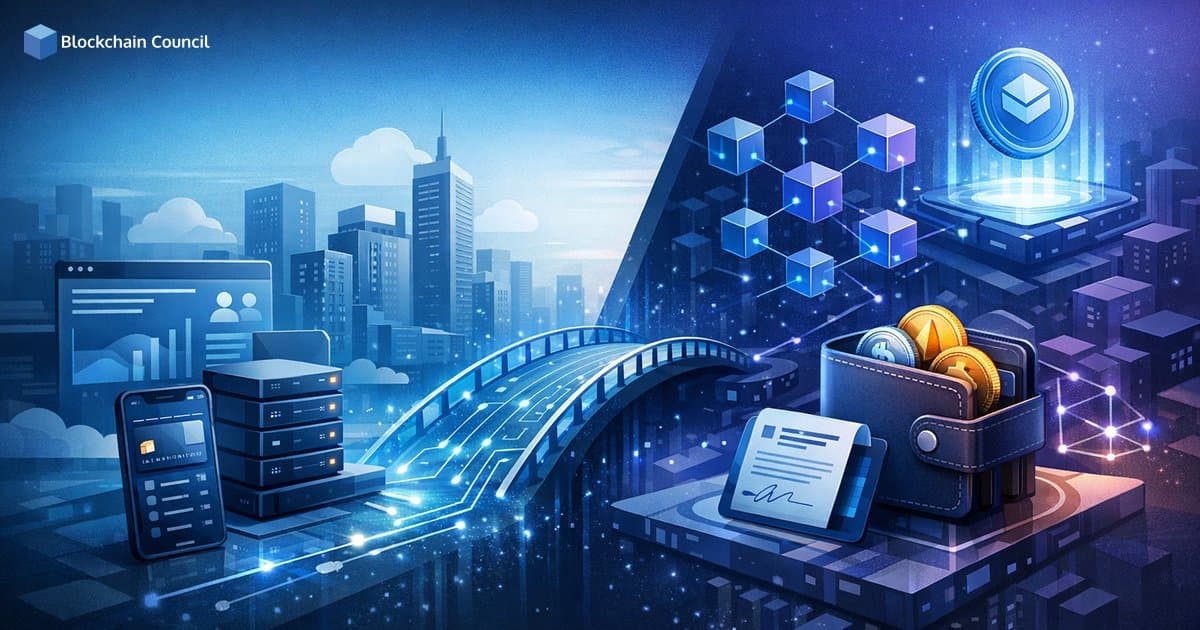
From Web2 to Web3 migration is now a practical, incremental strategy for businesses rather than a full rewrite. Consumer platforms and enterprises are embedding wallets, deploying smart contracts for specific workflows, and adding token incentives to modernize loyalty, identity, and asset ownership. Developer activity has grown materially since 2018, and major ecosystems like Ethereum, Polygon, Solana, BNB Chain, and Base continue to mature, with L2 networks increasingly favored for lower fees and better user experience.
This guide provides a blueprint you can apply to real architectures, focusing on wallets, smart contracts, and token incentives while preserving the Web2 components that still excel at scale, privacy, and compliance.

Why Web2 to Web3 Migration Is Happening Now
Three forces are converging:
- Stronger infrastructure: Rollups and L2s (Optimistic and ZK) reduce costs and improve throughput, making production deployments more viable for high-volume consumer applications.
- Better wallet UX: Account abstraction (including ERC-4337-style patterns on EVM chains) enables embedded smart wallets, social login, recovery options, and gas sponsorship that closely resemble Web2 onboarding flows.
- Proven Web2.5 patterns: Many organizations run hybrid systems where the UI remains Web2-like, but ownership, rewards, or auditability move on-chain. Consumer loyalty experiments and digital collectibles that hide private key complexity for mainstream users are representative examples.
Web2 vs Web3: What Actually Changes in Your Architecture
Identity and Authentication
Web2 identity typically revolves around email, username-password, sessions, and OAuth. Web3 introduces wallet-based identity, where users authenticate by signing messages. Many businesses adopt a dual approach: retain Web2 auth for standard application usage and introduce wallet signing when a user interacts with on-chain features.
State, Logic, and Data Storage
In Web2, application servers write to centralized databases. In Web3, some state and logic moves to smart contracts, which act as shared execution and data layers. Most teams choose a hybrid data strategy:
- On-chain: ownership, balances, critical state transitions, and verifiable events
- Decentralized storage (IPFS, Arweave, Filecoin): media and content with on-chain references such as content identifiers
- Off-chain: personal data and high-volume operational data, retained off-chain for privacy, performance, and regulatory requirements
Incentives
Web2 incentives are centrally managed points and credits. Web3 incentives can be programmable tokens (fungible tokens and NFTs) with rules enforced by smart contracts, potentially enabling transferability and composability across ecosystems.
The Practical Web2 to Web3 Migration Blueprint (8 Phases)
Phase 1: Assessment and Strategy
Start by mapping your current Web2 architecture and classifying what should move on-chain.
- Inventory: auth, profiles, roles, payments, loyalty, content storage, workflows, and third-party integrations.
- Prioritize assets and workflows that benefit from shared truth or multi-party trust, such as tickets, loyalty credentials, in-game items, provenance tracking, royalties, and revenue sharing.
- De-prioritize latency-sensitive systems and highly regulated personal data that should not be immutable on-chain.
Chain and stack selection generally comes down to EVM vs non-EVM and L1 vs L2. EVM chains offer mature tooling and developer familiarity, while non-EVM ecosystems may offer performance advantages but require different languages and integration approaches. For consumer applications, L2 deployment is often chosen to reduce fees and improve UX.
Phase 2: Wallet Strategy and Integration
Wallet UX is often the biggest driver of adoption success. Choose a wallet model based on your user base, compliance posture, and product goals.
- Non-custodial wallets: users control keys (suitable for crypto-native audiences, but higher onboarding friction).
- Custodial or semi-custodial wallets: your business or a provider manages keys (lower friction, but greater compliance and security responsibility).
- Embedded smart wallets with account abstraction: wallets created behind the scenes, linked to email or social login, with recovery methods and gas sponsorship (strong fit for mainstream users).
Implementation checklist:
- Pick wallet infrastructure: integrate a wallet SDK (such as WalletConnect-style connectivity or wallet-as-a-service providers) or build custodial infrastructure with enterprise-grade key management using HSM or MPC.
- Enable wallet-based login: implement message signing flows (such as Sign-In with Ethereum on EVM chains) and map wallet addresses to existing user accounts.
- Design for clarity: show users exactly what they are signing and why; provide a sandbox mode for learning without real funds.
- Optional identity layer: consider Web3 naming systems (ENS-like domains or equivalent) for human-readable identifiers and brand-aligned wallet experiences.
Phase 3: Smart Contract Design and Deployment
Smart contracts are best suited to situations where transparency, automation, or composability create real business value.
Common business-ready use cases:
- Asset issuance: NFTs for membership, tickets, loyalty collectibles, supply chain digital twins, and credentials
- Programmable payments: escrow, conditional payments, royalties, and revenue sharing
- Access control: token-gated features and role-based permissions
Design principles:
- Minimize on-chain complexity: keep only critical state and verification on-chain; push heavy computation off-chain where possible.
- Use proven standards: OpenZeppelin-based ERC-20, ERC-721, and ERC-1155 patterns reduce avoidable security risk.
- Plan governance and upgrades: use multisig-controlled admin actions and well-defined upgrade processes when using proxy patterns.
- Audit before production: conduct internal review plus at least one external audit; consider a bug bounty program.
Deployment approach:
- Test on testnets and in staging with automated tests.
- Audit and remediate findings, then re-test.
- Roll out in stages: internal beta, capped public rollout, then full scale.
- Monitor with on-chain analytics and alerting for anomalous contract interactions.
Phase 4: Token Incentive Design and Implementation
Token incentives can improve retention and participation, but they also introduce economic and regulatory complexity. Keep the product utility clearly separated from any market-driven dynamics.
Token types:
- Fungible tokens: loyalty credits, utility access, and governance in applicable models
- NFTs: memberships, achievements, collectible loyalty, and provenance objects
Design principles that hold up in practice:
- Reward real value creation: verified referrals, quality contributions, curation, or on-time fulfillment.
- Avoid speculation-first loops: overemphasis on token price can damage product-market fit and attract the wrong audience.
- Model tokenomics carefully: supply, issuance schedule, allocations, vesting, and sink mechanisms (burning or utility spend) should be based on realistic growth and usage assumptions.
Regulatory considerations should be addressed early with qualified legal counsel. In the US, token characteristics can trigger securities analysis under the Howey framework. In the EU, MiCA defines categories and obligations for different crypto-asset types. Many businesses reduce regulatory exposure by using non-transferable tokens for reputation signaling, limiting transferability, or keeping rewards off-chain while anchoring only key proofs on-chain.
Phase 5: Data and Infrastructure Migration (Hybrid by Default)
Most successful Web2 to Web3 migration programs retain Web2 where it excels and add Web3 components where trust and portability matter.
- Back up first: export DNS and configurations; back up databases and assets before any migration activity.
- On-chain vs off-chain decisions: keep personal data off-chain to satisfy privacy and right-to-erasure requirements; store large files in decentralized storage and reference them on-chain.
- Use an API gateway: orchestrate Web2 APIs and Web3 JSON-RPC provider calls in one place, with unified auth, rate limiting, and observability.
Phase 6: Compliance, Security, and Risk Management
- Smart contract security: apply secure coding practices, use standard libraries, conduct audits, and implement continuous monitoring.
- Operational security: protect admin privileges with multisig, strict access control, and transaction policies.
- KYC and AML: if you custody assets, facilitate trading, or operate regulated services, integrate KYC providers and transaction monitoring where required by applicable law.
- Data protection: avoid storing personal data on-chain; use pseudonymous identifiers and consent-driven off-chain storage.
Phase 7: UX, Education, and Rollout
Adoption improves when users can start with familiar flows and only encounter Web3 complexity when it is relevant to them.
- Progressive disclosure: introduce wallets, signing, and token features gradually rather than all at once.
- Gas abstraction: sponsor gas or batch actions to minimize user friction.
- Start with low-risk modules: launch loyalty programs, digital passes, or collectibles before migrating core transaction rails.
Phase 8: Monitoring, Optimization, and Scaling
Track metrics that connect on-chain activity to business outcomes:
- Wallet metrics: connected wallets, active wallets, conversion from Web2-only to Web3-enabled users
- On-chain KPIs: transaction counts, success rates, cost per user action
- Incentive KPIs: reward distribution, redemption rates, and correlation with desired behaviors
Optimize by refactoring for gas efficiency, moving high-volume operations to L2s, simplifying transaction flows, and tuning incentives based on observed behavior.
Real-World Patterns You Can Replicate
Loyalty and Engagement (Web2.5)
Starbucks Odyssey demonstrated how NFTs can extend an existing loyalty program while keeping the user experience close to a traditional app. Reddit collectible avatars showed how account-linked wallets can onboard non-crypto-native users into on-chain assets at scale using a familiar Web2 account model.
Provenance and Multi-Party Workflows
Supply chain and provenance initiatives often use tokenized identifiers (commonly NFT-like objects) to track custody changes across stakeholders. Smart contracts can standardize events and transfers between parties that do not fully trust one another, reducing reconciliation overhead.
Skills and Training to Support Web2 to Web3 Migration
Execution requires cross-functional skills across product, engineering, security, and compliance. For team enablement, consider internal training and role-based certification paths covering smart contract development, blockchain architecture, Web3 security, and tokenomics. Building a structured upskilling plan alongside your migration roadmap reduces execution risk and helps teams make informed architectural decisions at each phase.
Conclusion: Treat Web2 to Web3 Migration as a Measured Product and Architecture Upgrade
From Web2 to Web3 migration works best when it is use-case driven and incremental. Start with a wallet strategy that matches your audience, deploy minimal and audited smart contracts where shared truth matters, and design token incentives that reward real value creation while respecting compliance constraints. In most cases, a hybrid Web2.5 architecture is the practical endpoint for the near term: Web2 for scale and privacy, Web3 for ownership, verifiability, and programmable incentives.
A useful next step is to build an industry-specific checklist - whether for SaaS, e-commerce, gaming, or financial services - covering recommended wallet model, chain selection, contract scope, and incentive design tailored to your context.
Related Articles
View All
Web3
AI Payment Bots and Autonomous Wallets: Web3 Commerce Moves to Agentic Payments
AI payment bots and autonomous wallets are enabling agentic Web3 commerce through stablecoins, scoped permissions, and programmable wallet infrastructure.

Web3
Digital Wallets as Identity Hubs: The Future of Web3 Authentication
Digital wallets as identity hubs are reshaping Web3 authentication with DIDs, verifiable credentials, EUDI wallets, and passwordless cryptographic access.

Web3
Web3 Identity vs Traditional Digital Identity: Key Differences Businesses Should Know
Compare Web3 identity vs traditional digital identity, including control, authentication, privacy, compliance, use cases, and adoption risks for businesses.
Trending Articles
The Role of Blockchain in Ethical AI Development
How blockchain technology is being used to promote transparency and accountability in artificial intelligence systems.
AWS Career Roadmap
A step-by-step guide to building a successful career in Amazon Web Services cloud computing.
What is AWS? A Beginner's Guide to Cloud Computing
Everything you need to know about Amazon Web Services, cloud computing fundamentals, and career opportunities.