

AI Oracles for Smart Contracts: Intelligent Real-World Data On-Chain

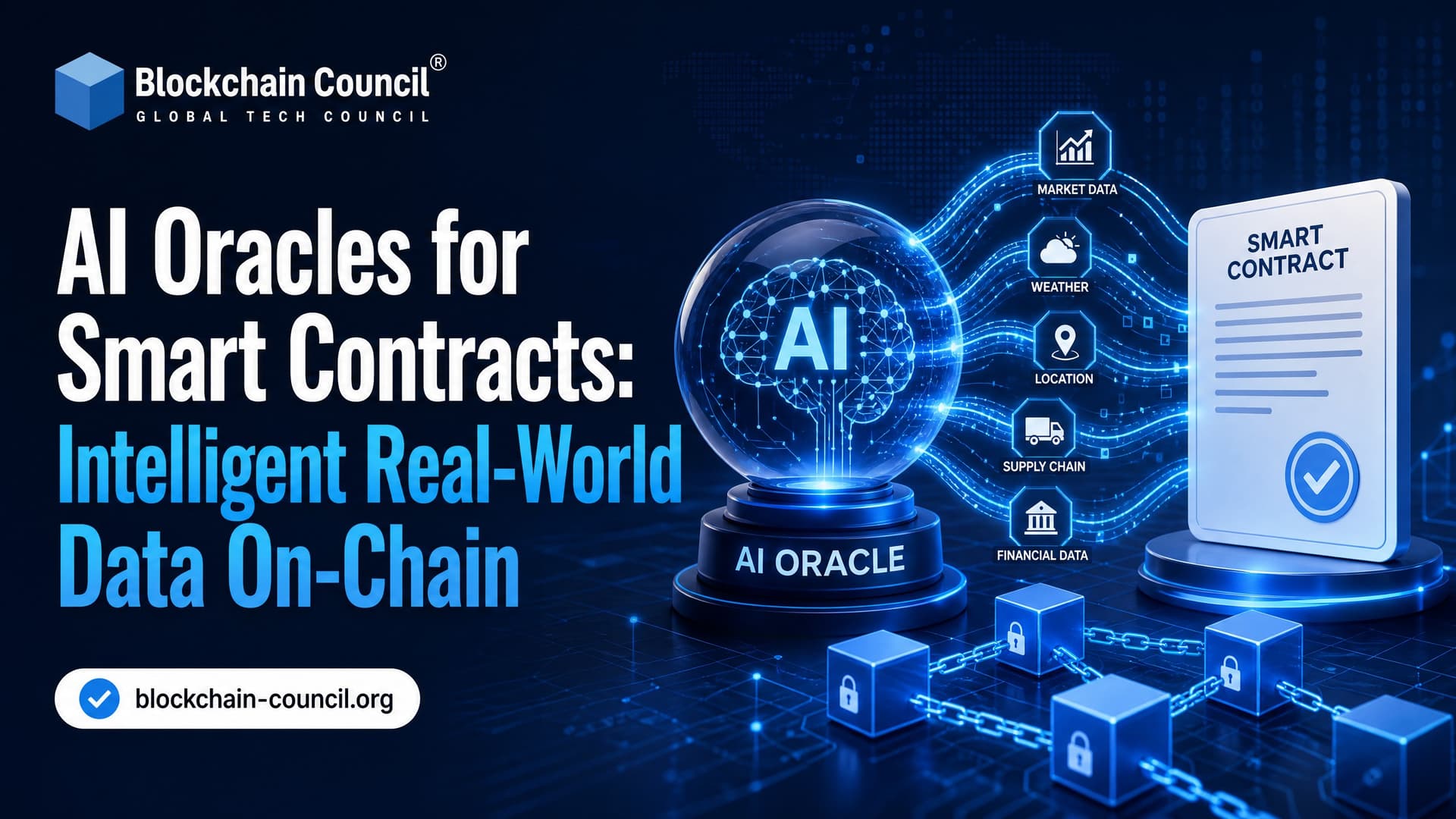
AI oracles for smart contracts are emerging as an important bridge between blockchain automation and intelligent real-world data. Traditional smart contracts are deterministic: they execute predefined logic when specific conditions are met. AI oracles add a new layer by bringing machine learning outputs, risk scores, classifications, predictions, and anomaly signals on-chain so contracts can respond to dynamic environments.
This development matters because smart contracts increasingly support financial markets, supply chains, insurance workflows, tokenized assets, and decentralized governance. Oracles function as core blockchain infrastructure that connects smart contracts to external systems, and AI-enhanced contracts depend on trustworthy off-chain data and secure oracle integrations.

What Are AI Oracles for Smart Contracts?
A blockchain oracle is a service that connects smart contracts with data and systems outside the blockchain. It can provide price feeds, weather data, API responses, IoT sensor readings, identity signals, or payment confirmations. Without oracles, smart contracts cannot directly access external information.
AI oracles extend this model. Instead of simply transmitting data, they process it with artificial intelligence or machine learning before delivering it on-chain. As a result, a smart contract may receive not only a market price, but also a volatility forecast, fraud probability, credit risk score, sentiment analysis, or authenticity result.
How AI Oracles Work
A typical AI oracle pipeline includes four stages:
- Data ingestion: The oracle collects raw data from APIs, market feeds, enterprise systems, IoT devices, documents, or user activity.
- AI processing: Machine learning models clean, classify, aggregate, score, or predict outcomes from that data.
- Validation: The system checks model outputs, data integrity, source reliability, and possible anomalies.
- On-chain delivery: The oracle submits structured outputs to smart contracts, often through decentralized oracle networks.
In practice, this turns the oracle layer into an intelligence layer. Smart contracts can act on higher-level insights rather than raw inputs alone.
Traditional Oracles vs AI Oracles
Traditional oracles are essential for blockchain applications, especially decentralized finance. They usually deliver external facts such as asset prices, interest rates, exchange rates, or event outcomes. AI oracles go further by transforming those facts into decision-ready intelligence.
- Traditional oracle: Sends data such as ETH price, rainfall level, shipment status, or exchange rate.
- AI oracle: Sends interpreted outputs such as predicted volatility, fraud score, delivery delay probability, or asset authenticity classification.
This distinction matters for AI-powered smart contracts, which use machine learning and natural language processing to analyze data, predict outcomes, and make dynamic decisions. Oracles become central because they supply the real-world context that AI-driven logic needs.
Why AI Oracles Matter for Smart Contracts
Smart contracts are powerful because they automate execution. However, they are limited by the quality and relevance of the data they receive. AI oracles help address this by enabling:
- Adaptive decision-making: Contracts can adjust parameters based on changing market or operational conditions.
- Predictive automation: AI models can forecast risks, delays, demand shifts, or pricing movements.
- Improved security monitoring: AI can detect abnormal patterns in oracle feeds, smart contract calls, or transaction flows.
- Context-aware execution: Contracts can react to interpreted events, not just binary data points.
A wider industry view holds that the next generation of smart contract infrastructure will require both reliable data and intelligent processing, supporting more secure, efficient, and accurate smart contracts and blockchain oracles.
Current Developments in AI Oracle Infrastructure
Decentralized Oracle Networks and AI Model Connectivity
Much of the current progress is happening through decentralized oracle networks that connect smart contracts with off-chain APIs, cloud services, and AI models. These networks can link AI models to smart contracts through oracles, enabling use cases in authenticity verification, supply chain management, and security.
Collaborations between oracle providers and cloud infrastructure platforms show how oracle networks integrate with cloud services to make external data and AI capabilities more accessible for smart contracts. In this model, the oracle network acts as both a data delivery mechanism and an AI output delivery layer.
AI for Oracle Security
AI is not only used to create smarter data feeds. It can also strengthen oracle reliability. AI systems can monitor feeds for manipulation, compare multiple sources, detect abnormal values, and flag suspicious transaction behavior. Because AI-powered smart contracts introduce expanded attack surfaces, continuous monitoring and secure oracle integration are essential.
Generative AI and Context-Aware Data Feeds
Generative AI can help convert unstructured information into structured oracle outputs. For example, it may summarize legal documents, classify claim evidence, interpret logistics reports, or extract risk signals from market narratives. This approach brings smarter, real-time, and context-aware data to blockchains.
Real-World Use Cases of AI Oracles
DeFi Risk Management
DeFi protocols already depend on price oracles for lending, collateral, liquidations, and derivatives. AI oracles can add predictive risk layers. A lending protocol could adjust collateral requirements based on predicted volatility. A trading contract could use AI-generated liquidity or slippage forecasts. A treasury strategy could rebalance based on market risk scores.
For professionals building these systems, Blockchain Council programs such as the Certified Smart Contract Developer and Certified Blockchain Developer offer structured learning pathways for understanding oracle design, Solidity, and decentralized application architecture.
Supply Chain and Logistics
Supply chain contracts can use AI oracles to analyze IoT readings, shipment data, weather conditions, demand patterns, and vendor performance. A smart contract could release payment when delivery conditions are verified, while applying AI-based anomaly detection if temperature, routing, or timing data appears suspicious.
Insurance and Fraud Detection
Insurance is a strong fit for AI-enhanced oracles. AI models can evaluate claims, detect fraudulent patterns, assess damage evidence, and estimate payout conditions. The oracle can then submit a structured decision or risk score to a smart contract that automates part of the claims workflow.
DAO Governance and Treasury Management
AI oracles can support decentralized autonomous organizations by analyzing proposal content, market conditions, protocol metrics, and governance sentiment. These insights can help inform treasury rebalancing, parameter changes, or risk alerts. Human oversight remains important, especially when governance decisions affect significant assets.
Real-World Assets and Tokenization
Tokenized real estate, commodities, invoices, and physical assets require reliable external valuation and condition data. AI oracles can help estimate property values, evaluate asset quality, verify provenance, and detect discrepancies in documentation. This is relevant for professionals exploring tokenization through Blockchain Council learning paths in blockchain, Web3, and digital assets.
Key Risks and Challenges
Data Quality and Bias
AI oracle outputs are only as reliable as their data sources and models. Poor training data, biased inputs, or incomplete datasets can lead to incorrect decisions. In DeFi, this may cause mispriced collateral or unfair liquidations. In insurance, it may cause incorrect claim outcomes.
Explainability
Many AI systems are difficult to interpret. Smart contracts, by contrast, are expected to be transparent and auditable. If an AI oracle sends a risk score on-chain, developers and auditors must understand how that score was produced, what data was used, and whether the model can be challenged.
Expanded Attack Surface
AI oracles combine several components: data feeds, model infrastructure, APIs, off-chain computation, validators, and on-chain contracts. Each component introduces possible vulnerabilities. Attackers may manipulate data sources, exploit model weaknesses, or target the oracle delivery mechanism.
Scalability and Cost
AI inference can be computationally expensive, while blockchains have limited throughput and high execution costs. Most AI oracle architectures therefore keep heavy computation off-chain and deliver compact outputs on-chain. Future systems may use cryptographic proofs, decentralized compute networks, or verifiable inference to improve trust.
Regulatory Compliance
AI oracle decisions may affect lending, insurance, healthcare, employment, or financial services. These sectors require compliance, auditability, privacy protection, and governance. Validation of both the smart contract and AI layer is essential as regulatory frameworks evolve.
Best Practices for Building AI Oracles
Teams designing AI oracles for smart contracts should consider the following practices:
- Use multiple data sources to reduce dependency on a single provider.
- Validate model outputs with statistical checks, human review for sensitive workflows, and historical testing.
- Monitor anomalies continuously across data inputs, model behavior, and on-chain transactions.
- Keep critical logic transparent so auditors can understand how oracle outputs influence contract execution.
- Design fail-safe mechanisms such as circuit breakers, rate limits, fallback feeds, and manual governance overrides.
- Separate computation from settlement by performing AI processing off-chain and using the blockchain for verification, execution, and recordkeeping.
The Future of AI Oracles
AI oracles are still early in their development, but their direction is clear. As smart contracts move beyond static automation, they will need intelligent data pipelines that understand context, risk, and probability. AI, machine learning, and IoT are expected to expand oracle capabilities, and oracle networks are increasingly positioned as a way to connect AI model outputs to on-chain applications.
Future AI oracles may support decentralized AI marketplaces, verifiable model inference, real-time risk monitoring, autonomous enterprise workflows, and tokenized real-world asset systems. Industry analysts have projected that a meaningful share of global economic activity could eventually be represented on blockchain, which underlines the importance of secure and intelligent oracle infrastructure.
Conclusion
AI oracles for smart contracts represent a major step in making blockchain applications more adaptive, useful, and connected to real-world complexity. They allow smart contracts to act on predictions, classifications, risk scores, and AI-generated insights rather than simple data points alone.
At the same time, they introduce new challenges around data quality, model bias, explainability, cybersecurity, and compliance. Developers, enterprises, and auditors should treat the AI-oracle layer as critical infrastructure. Professionals who want to build expertise in this field can explore Blockchain Council certifications in smart contracts, blockchain development, AI, and Web3 security as practical learning paths for the next generation of intelligent decentralized systems.
Related Articles
View All
Smart Contracts
Smart Contract Oracles Explained: Connecting Blockchain Apps to Real-World Data
Smart contract oracles connect blockchain apps to real-world data, enabling DeFi, insurance, IoT, gaming, compliance, and secure Web3 automation.

Smart Contracts
Smart Contracts for Real-World Assets (RWA): Tokenization, Compliance, and On-Chain Settlement
Learn how smart contracts for real-world assets (RWA) enable tokenization, compliance-by-design, and on-chain settlement for Treasuries, credit, funds, and real estate.

Smart Contracts
Chainlink and Smart Contracts: How Decentralized Oracles Power Web3 Automation
Learn how Chainlink and smart contracts use decentralized oracles, Automation, VRF, Functions, and data feeds to power event-driven Web3 applications.
Trending Articles
The Role of Blockchain in Ethical AI Development
How blockchain technology is being used to promote transparency and accountability in artificial intelligence systems.
AWS Career Roadmap
A step-by-step guide to building a successful career in Amazon Web Services cloud computing.
Blockchain in Supply Chain Provenance Tracking
Supply chains are under pressure to prove not just efficiency, but also authenticity, sustainability, and fairness. Customers want to know if their coffee really is fair trade, if the diamonds are con