

Oracle Manipulation Attacks: Protecting Smart Contracts from Bad Data
 Suyash Raizada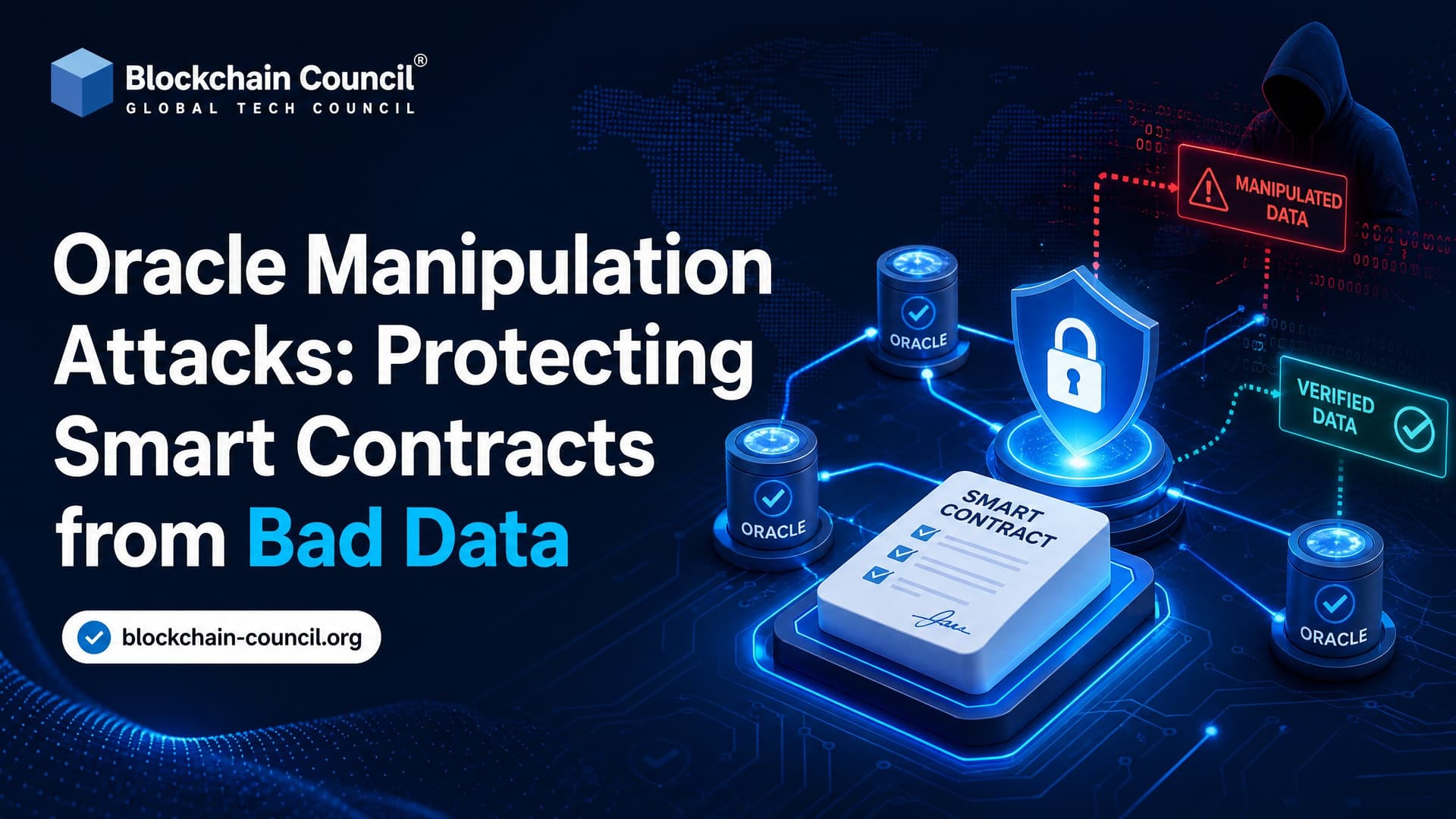
Oracle manipulation attacks happen when a smart contract trusts bad, stale, or biased external data and then executes financial logic as if that data were true. In DeFi, that usually means price data. A lending market, perpetuals exchange, vault, or automated liquidation system can be written perfectly in Solidity and still lose funds if its oracle can be pushed around.
OWASP lists price oracle manipulation as SC03 in its Smart Contract Top 10 for 2026, and that is the right signal. Oracles are not a side feature. They are a security boundary. Treat them like one.

What Is an Oracle Manipulation Attack?
A blockchain oracle supplies information that a smart contract cannot compute by itself. Common examples include token prices, exchange rates, interest benchmarks, weather data, election results, and random values.
An oracle manipulation attack occurs when an attacker makes that data wrong at the exact moment a contract depends on it. The contract may then:
- Allow over-borrowing against inflated collateral
- Liquidate healthy positions after a false price drop
- Execute swaps at prices far away from the real market
- Accept stale data as fresh
- Drain protocol reserves through bad valuation logic
This is why smart contract oracle security is now a core audit area. Reentrancy and access control still matter. But bad data can be just as destructive as bad code.
Why DeFi Oracle Attacks Still Work
Most DeFi oracle attacks exploit a simple gap: the protocol reads a price that an attacker can influence faster than the market can correct it.
The common pattern looks like this:
- The attacker takes a flash loan or uses existing capital.
- They make a large trade in a low-liquidity pool.
- The pool price moves sharply for a short period.
- The oracle reads that distorted price.
- The protocol lets the attacker borrow, swap, or liquidate based on the false value.
- The attacker reverses the trade, repays the loan, and keeps the extracted value.
That last step is what makes flash-loan-based attacks so uncomfortable for builders. The attacker does not need to be rich for long. They only need temporary capital, one weak price source, and a transaction path that lands before your checks catch up.
Notable Oracle Manipulation Incidents
bZx, 2020
The early bZx incidents showed how dangerous it is to trust a thin on-chain market as a price reference. Attackers used flash loans to move DEX prices and then exploited protocol logic that depended on those prices. Security researchers have described these attacks as a turning point for DeFi oracle risk, with one incident causing roughly 350,000 USD in losses.
Mango Markets, 2022
Mango Markets is the case many risk teams still discuss in design reviews. The attacker built a large MNGO position, pushed up the market price, and used the inflated collateral value to borrow assets from the protocol. Reported losses were about 117 million USD. The lesson is blunt. If collateral pricing depends on a thin market, the collateral factor must reflect that risk, or the asset should not be accepted at scale.
KiloEx, 2025
The April 2025 KiloEx incident was reported as a price manipulation exploit with about 7 million USD in losses. The broader point matters more than the exact mechanics. Even after years of public post-mortems, price oracle manipulation keeps reappearing when protocols skip basic defense layers.
Main Types of Oracle Manipulation
Spot Price Manipulation
This is the classic failure mode. A protocol reads the current spot price from a DEX pair, often from a pool with shallow liquidity. The attacker moves the pool price in the same block and immediately calls the target contract.
Do not use raw spot prices from low-liquidity pools for borrowing, liquidations, or large swaps. That design is not aggressive. It is fragile.
Weak Off-Chain Feeds
Off-chain oracles fail too. A centralized API can be compromised. A data provider can misconfigure a feed. Oracle nodes can report delayed values. Transport and aggregation logic can break silently.
Security firms have repeatedly warned that oracle manipulation is often not a single bug. It can come from weak architecture across data collection, signing, aggregation, and delivery.
Stale or Frozen Data
Stale data is underrated as a risk. If ETH trades at 3,000 USD but your contract still accepts a two-hour-old price of 3,300 USD, the contract is wrong even if no one touched the data provider.
Here is a detail that trips up newer Solidity developers. Chainlink-style feeds return fields such as answer and updatedAt through latestRoundData(). If you cast answer to uint256 before checking that it is positive, you have already made the review harder and may introduce dangerous behavior. Check answer > 0, check updatedAt, and reject old values before using the price.
Best Practices for Smart Contract Oracle Security
Use Decentralized Oracle Networks
For most production DeFi systems, a decentralized oracle network is a better starting point than a self-built feed. Chainlink and similar networks aggregate reports from multiple independent nodes and sources, which raises the cost of corruption.
That does not mean you can outsource all risk. You still need protocol-level checks. An oracle can be delayed, misconfigured, or temporarily inconsistent with a specific market your protocol cares about.
Aggregate Multiple Price Sources
Use more than one trusted source where the risk justifies it. Median pricing is often safer than a simple average, because one extreme outlier has less influence.
A good design might compare:
- A decentralized oracle network price
- A TWAP from a deep DEX pool
- A centralized exchange reference used only as a monitoring signal
If those sources diverge sharply, the protocol should not pretend everything is fine.
Prefer TWAP Over Spot Price
A TWAP oracle, or Time-Weighted Average Price oracle, reduces sensitivity to one-block manipulation. Time-weighted pricing shows up as a key defense in guidance from OWASP and multiple audit firms.
Window length matters. A two-minute TWAP on a thin pool may still be cheap to manipulate. A longer window on deep liquidity is harder to attack, but it reacts more slowly during real market crashes. That is the trade-off. For lending, I prefer slower and safer pricing. For execution venues, you may need faster prices, but then position limits and circuit breakers become non-negotiable.
Build Circuit Breaker Smart Contracts
Circuit breaker smart contracts stop sensitive operations when data looks abnormal. This is not elegant, but it saves protocols.
Common circuit breaker rules include:
- Pause borrowing if price changes more than a configured percentage in one update
- Block liquidations when the oracle is stale
- Cap withdrawals or swaps during an anomaly
- Require governance or multisig review before resuming full operations
Be careful with liquidation pauses. If you pause too broadly during a real crash, bad debt can grow. A better pattern is to separate actions: pause new borrowing first, restrict risky swaps next, and handle liquidations with conservative bounds.
Check Freshness, Bounds, and Decimals
Oracle bugs often hide in boring details. Decimals are one of them. USDC commonly uses 6 decimals, many ERC-20 tokens use 18, and Chainlink feeds often use 8 decimals for USD pairs. Mix those without normalization and your price math is broken.
Your contract should verify:
- The price is positive
- The timestamp is recent enough
- The value is within acceptable min and max bounds
- The deviation from the last trusted price is not extreme
- The feed decimals are handled explicitly
Do not bury these checks in a front end or keeper script. Put critical checks on-chain.
Limit Damage Per Block or Transaction
Assume a bad price can slip through. Then ask a hard question. How much can the attacker take before the system reacts?
Set caps for:
- Borrow amount per asset
- Liquidation volume per block
- Swap size against protocol reserves
- Collateral onboarding limits for thinly traded assets
This is especially important for new markets. A token with limited liquidity should not get the same collateral treatment as ETH or USDC.
Oracle Security Checklist for Developers and Auditors
Use this checklist before mainnet deployment:
- Avoid raw DEX spot prices as primary price feeds.
- Use decentralized oracle networks for critical markets.
- Aggregate independent sources where value at risk is high.
- Use TWAPs only when the window and liquidity are defensible.
- Reject stale prices using strict timestamp checks.
- Normalize token and feed decimals in one reviewed library.
- Add deviation limits and circuit breakers.
- Cap exposure per transaction, market, and block.
- Monitor oracle values against external reference markets.
- Audit the full oracle pipeline, not only the consumer contract.
Where Oracle Security Is Heading
Simple oracle-only mega exploits may become less frequent as teams adopt better defaults. By 2025, oracle manipulation was increasingly showing up as part of multi-vector attacks involving governance, MEV, liquidity games, or cross-chain assumptions.
Expect more use of signed data, cryptographic proofs, staking and slashing models for oracle operators, and automated monitoring that adjusts risk parameters in real time. Still, no cryptography fixes a bad market choice. If your protocol values a collateral asset from one illiquid venue, attackers will do the math.
Build the Skill Before You Ship
Oracle manipulation attacks are a design problem, an implementation problem, and an operations problem. You need all three covered before real funds arrive.
If you are building or reviewing DeFi systems, strengthen your foundations in Solidity, threat modeling, and audit workflows. Blockchain Council readers can use this topic as a study path toward the Certified Smart Contract Auditor™, Certified Blockchain Developer™, and Certified DeFi Expert™ programs. Then build a small lending contract, connect a test oracle, and deliberately break it with a manipulated price. You will learn faster from that failure than from another checklist.
Related Articles
View All
Smart Contracts
Flash Loan Attacks: How They Exploit DeFi Smart Contracts
Flash loan attacks use same-transaction borrowing to exploit DeFi smart contracts through oracle manipulation, accounting bugs, governance flaws, and more.

Smart Contracts
Smart Contracts in Healthcare: Secure Data Sharing, Claims, and Consent Management
Smart contracts in healthcare can secure data sharing, automate claims, and manage consent, but adoption remains focused on pilots and targeted systems.

Smart Contracts
AI Oracles for Smart Contracts: Intelligent Real-World Data On-Chain
Explore how AI oracles for smart contracts deliver intelligent real-world data on-chain, enabling adaptive automation, risk scoring, and Web3 innovation.
Trending Articles

Top 5 DeFi Platforms
Explore the leading decentralized finance platforms and what makes each one unique in the evolving DeFi landscape.
What is AWS? A Beginner's Guide to Cloud Computing
Everything you need to know about Amazon Web Services, cloud computing fundamentals, and career opportunities.
Claude AI Tools for Productivity
Discover Claude AI tools for productivity to streamline tasks, manage workflows, and improve efficiency.