

Chainlink and Smart Contracts: How Decentralized Oracles Power Web3 Automation

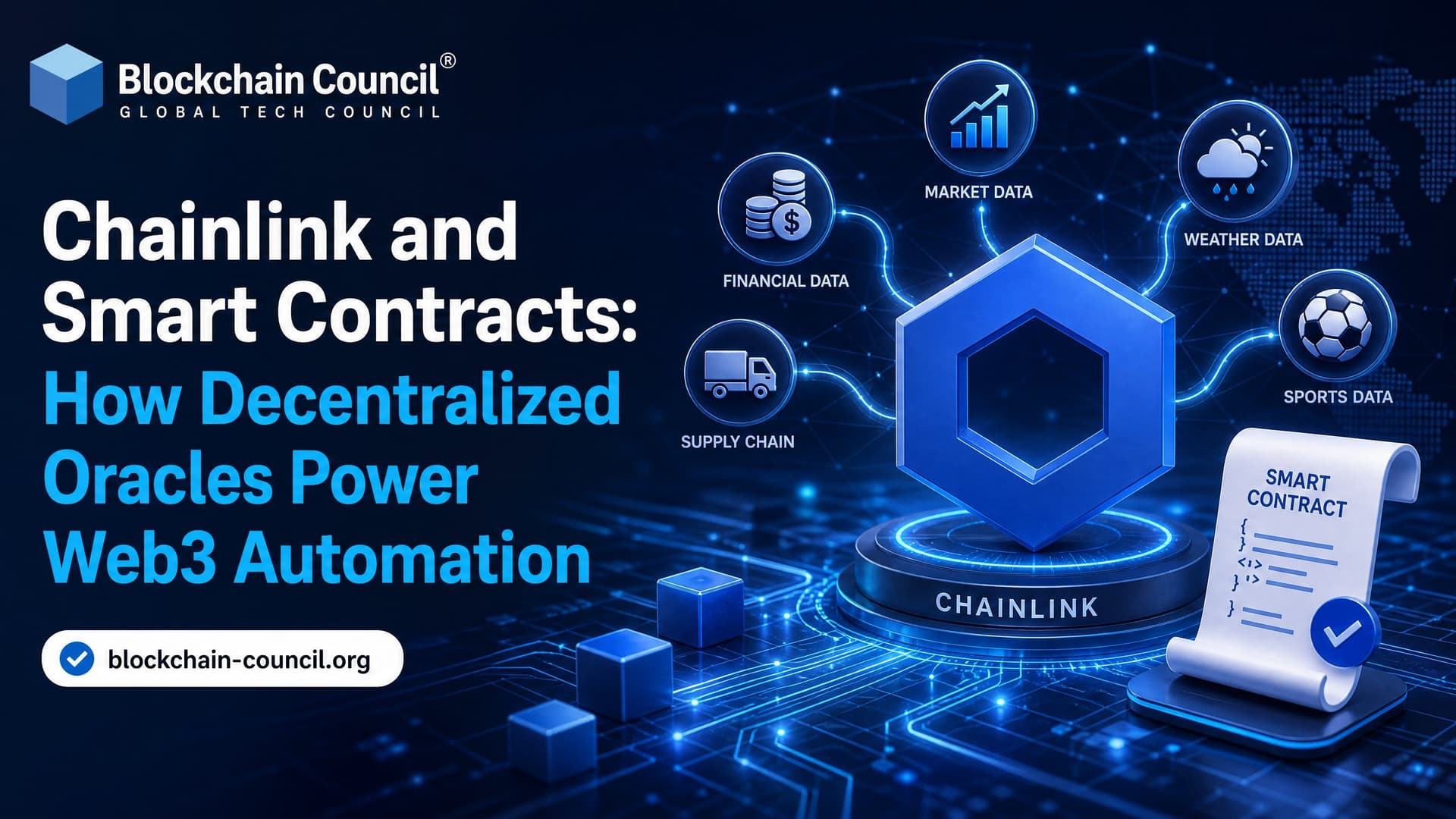
Chainlink and smart contracts solve a basic problem in Web3: blockchains are deterministic, but most useful business logic depends on data that lives outside the chain. Prices move. Flights get delayed. Collateral values change. A smart contract cannot call a weather API or check a bank reserve on its own, so decentralized oracles provide the missing data, computation, and connectivity layer that makes Web3 automation practical.
That matters because a contract that only waits for a user transaction is passive. Add Chainlink Automation, Data Feeds, VRF, Functions, and cross-chain messaging, and the same contract can react to market events, time schedules, off-chain APIs, or states on other networks. Now you are building a hybrid smart contract, not just a Solidity file deployed to Ethereum.

Why Smart Contracts Need Decentralized Oracles
Smart contracts are intentionally isolated. This design protects consensus. Every node must arrive at the same result, so a contract cannot independently fetch a web page, call a private API, or run a heavy computation that might return different answers across nodes.
This creates three recurring gaps:
- Data gap: Contracts need prices, FX rates, weather, identity checks, shipment status, or reserve data.
- Computation gap: Some calculations are too costly or impractical to run fully on-chain, especially when gas is high under EIP-1559 fee mechanics.
- Connectivity gap: Web3 applications often need to interact with Web2 systems, enterprise databases, and other blockchains.
Decentralized oracles fill those gaps by gathering data from multiple sources, validating it through independent nodes, and delivering the result to a smart contract. The key word is decentralized. A single API signer can become a failure point. A decentralized oracle network reduces that risk through aggregation, economic incentives, and node diversity.
What Chainlink Adds to Smart Contract Automation
Chainlink is a decentralized oracle network, often shortened to DON, that connects smart contracts to external data, off-chain computation, APIs, randomness, reserves, and cross-chain messages. Chainlink's own documentation describes this as infrastructure for hybrid smart contracts, meaning applications that combine on-chain code with off-chain services.
The scale is significant. Chainlink's published network metrics report that its services have enabled trillions of dollars in transaction value across many blockchains, with total value secured that ecosystem analyses often place in the tens of billions of dollars. These numbers shift over time, but the direction is clear: oracle infrastructure is no longer a niche developer tool.
Core Chainlink Services Developers Use
- Data Feeds: Decentralized price and market data used by DeFi protocols for lending, derivatives, liquidations, and collateral checks.
- Chainlink Automation: A decentralized execution service that calls contract functions when time-based or condition-based triggers are met.
- Chainlink VRF: Verifiable Random Function for provably fair randomness in games, NFT minting, raffles, and lotteries.
- Proof of Reserve: On-chain verification that off-chain or cross-chain reserves exist, useful for wrapped assets and tokenized real-world assets.
- Chainlink Functions: Serverless access from smart contracts to public APIs and off-chain computation.
- Cross-chain services: Infrastructure such as CCIP for secure cross-chain messaging and token transfer patterns.
Used together, these services turn smart contracts into event-driven systems. You can monitor a condition off-chain, calculate what should happen, then commit only the final action on-chain.
How Chainlink Automation Works
Chainlink Automation, formerly known as Keepers, replaces centralized cron jobs and private bots with a decentralized network of nodes. The basic model is simple:
- You write a smart contract function that checks whether work needs to be done.
- Automation nodes simulate that check off-chain.
- When the condition returns true, a node submits an on-chain transaction.
- The contract executes the target function and changes state.
There are two common trigger types. Time-based automation runs on schedules, such as hourly reward distribution or daily rebalancing. Custom logic automation runs when a condition is met, such as a health factor falling below a threshold or an NFT sale reaching a deadline.
A practical detail: never trust the off-chain check alone. In Chainlink Automation contracts, checkUpkeep is simulated off-chain, while performUpkeep executes on-chain. You should revalidate the condition inside performUpkeep. Beginners often skip this and create a function that can be called even when the condition is no longer true. In production audits, that is an easy finding.
Another small gotcha: Chainlink price feeds commonly return answers with feed-specific decimals, often 8 decimals for USD pairs, not the 18 decimals many ERC-20 developers expect. If you read latestRoundData from AggregatorV3Interface in Solidity 0.8.x and treat every answer like 18 decimals, your liquidation math can be badly wrong. Check decimals(). Always.
From Passive Contracts to Web3 Automation
Traditional smart contracts only run when someone sends a transaction. That makes them reliable, but not proactive. Decentralized oracles change this by adding monitoring and execution around the contract.
With Chainlink and smart contracts, you can build workflows such as:
- A lending protocol that monitors collateral ratios and triggers liquidations when required.
- A staking vault that auto-compounds rewards once the expected gain exceeds gas cost.
- A DAO vesting contract that releases tokens on a fixed schedule without an administrator.
- A game contract that requests Chainlink VRF randomness, then automatically starts the next round.
- An insurance contract that checks weather or flight-delay data and pays claims when terms are met.
The strongest pattern is not automation alone. It is automation plus reliable data. A scheduled call is useful. A scheduled call that also reads a decentralized ETH/USD feed, verifies reserve data, and executes only when risk rules are met is far more useful.
Real-World Use Cases for Chainlink and Smart Contracts
DeFi Risk Management
DeFi protocols rely on Chainlink Data Feeds for pricing assets used in loans, collateral, swaps, and derivatives. Automation adds execution. A lending market can monitor positions and trigger liquidations when collateral falls below required levels. A yield protocol can compound rewards at intervals where the strategy still makes economic sense after gas.
To be blunt, centralized liquidation bots are fast, but they carry operational and trust assumptions. For high-value protocols, decentralized automation is usually the better default. For a small prototype on a testnet, a simple script may be fine.
Gaming and NFT Randomness
Randomness is hard on-chain. Block hashes, timestamps, and validator-controlled inputs can be manipulated under some conditions. Chainlink VRF gives contracts cryptographic proof that random values were generated fairly. Combine VRF with Automation and you can run recurring draws, loot drops, card shuffles, or tournament rounds without a manual operator.
Insurance and Parametric Payouts
Parametric insurance pays when objective conditions are met. Rainfall below a threshold. A flight delayed beyond a fixed time. A hurricane category confirmed by a data source. Chainlink oracles can supply the external data, while Automation can trigger the payout function after the condition is verified.
This is one of the cleaner enterprise use cases because it cuts claims handling. The trade-off is data quality. If the source is weak, the contract is weak. Use multiple data sources where the payout value justifies it.
Tokenized Real-World Assets
Tokenized funds, real estate, commodities, and structured products need more than ERC-20 balances. They need valuations, reserve checks, corporate actions, settlement messages, and compliance signals. Chainlink Proof of Reserve and cross-chain infrastructure can help connect those off-chain events to on-chain assets.
Institutional interest is visible. Swift connects more than 11,000 financial institutions, and DTCC processes settlement activity at a scale measured in the hundreds of trillions of dollars each year. Chainlink has run capital markets experiments involving these kinds of institutions, which shows why oracle security is becoming a board-level infrastructure topic, not just a developer preference.
Where Off-Chain Computation Fits
Chainlink Automation and Off-chain Reporting, known as OCR, push automation beyond simple triggers. Oracle nodes can perform computation off-chain, reach consensus, and post the result on-chain. Chainlink has described large gas savings for some complex workflows because the expensive work happens outside the base chain.
This does not mean everything should move off-chain. Keep asset custody, final settlement, and critical permission checks on-chain. Move monitoring, data aggregation, and heavy calculations off-chain when you can verify the output and the cost savings are meaningful.
Security Considerations Before You Build
Oracles reduce one class of risk and introduce another. Design carefully.
- Revalidate state: Conditions checked off-chain must be checked again in the on-chain function.
- Handle stale data: Price feeds include timestamps. Reject old data where freshness matters.
- Check decimals: Feed decimals are not always 18. Read the feed metadata.
- Plan failure modes: Decide what happens if a feed pauses, gas spikes, or an automation job runs late.
- Avoid over-automation: Some governance actions should still require timelocks and human review.
If you are preparing for a smart contract role, these are the details that separate a working developer from someone who only passed a tutorial. They also show up in technical interviews and certification assessments.
Skills to Learn Next
If you want to build with Chainlink and smart contracts, start with Solidity 0.8.x, ERC-20 and ERC-721 standards, gas mechanics, oracle design, and smart contract testing in Hardhat or Foundry. Then deploy a small project that uses a Chainlink price feed and Automation on a supported testnet.
For structured learning, consider Blockchain Council's Certified Smart Contract Developer™ if you want hands-on contract development, Certified Blockchain Developer™ for broader protocol and dApp engineering, or Certified Web3 Expert™ if your role includes architecture, product, or enterprise adoption. Your next practical step: build an automated vault or raffle contract, test the unhappy paths, and document exactly how the oracle data changes contract behavior.
Related Articles
View All
Smart Contracts
AI and Smart Contracts: How Artificial Intelligence Is Transforming Web3 Automation
AI and smart contracts are turning Web3 automation into adaptive systems for DeFi, DAOs, insurance, gaming, and enterprise workflows.

Smart Contracts
Multi-Signature Smart Contracts: How Multisig Wallets Improve Web3 Security
Learn how multi-signature smart contracts and multisig wallets reduce single-key risk, protect DAO treasuries, and strengthen Web3 security.

Smart Contracts
The History of Smart Contracts: From Nick Szabo to Ethereum and Web3
Explore the history of smart contracts from Nick Szabo's 1990s concept to Bitcoin scripts, Ethereum, DeFi, NFTs, DAOs, and Web3 infrastructure.
Trending Articles
The Role of Blockchain in Ethical AI Development
How blockchain technology is being used to promote transparency and accountability in artificial intelligence systems.
How to Install Claude Code
Learn how to install Claude Code on macOS, Linux, and Windows using the native installer, plus verification, authentication, and troubleshooting tips.
Blockchain in Supply Chain Provenance Tracking
Supply chains are under pressure to prove not just efficiency, but also authenticity, sustainability, and fairness. Customers want to know if their coffee really is fair trade, if the diamonds are con