

Smart Contract Oracles Explained: Connecting Blockchain Apps to Real-World Data

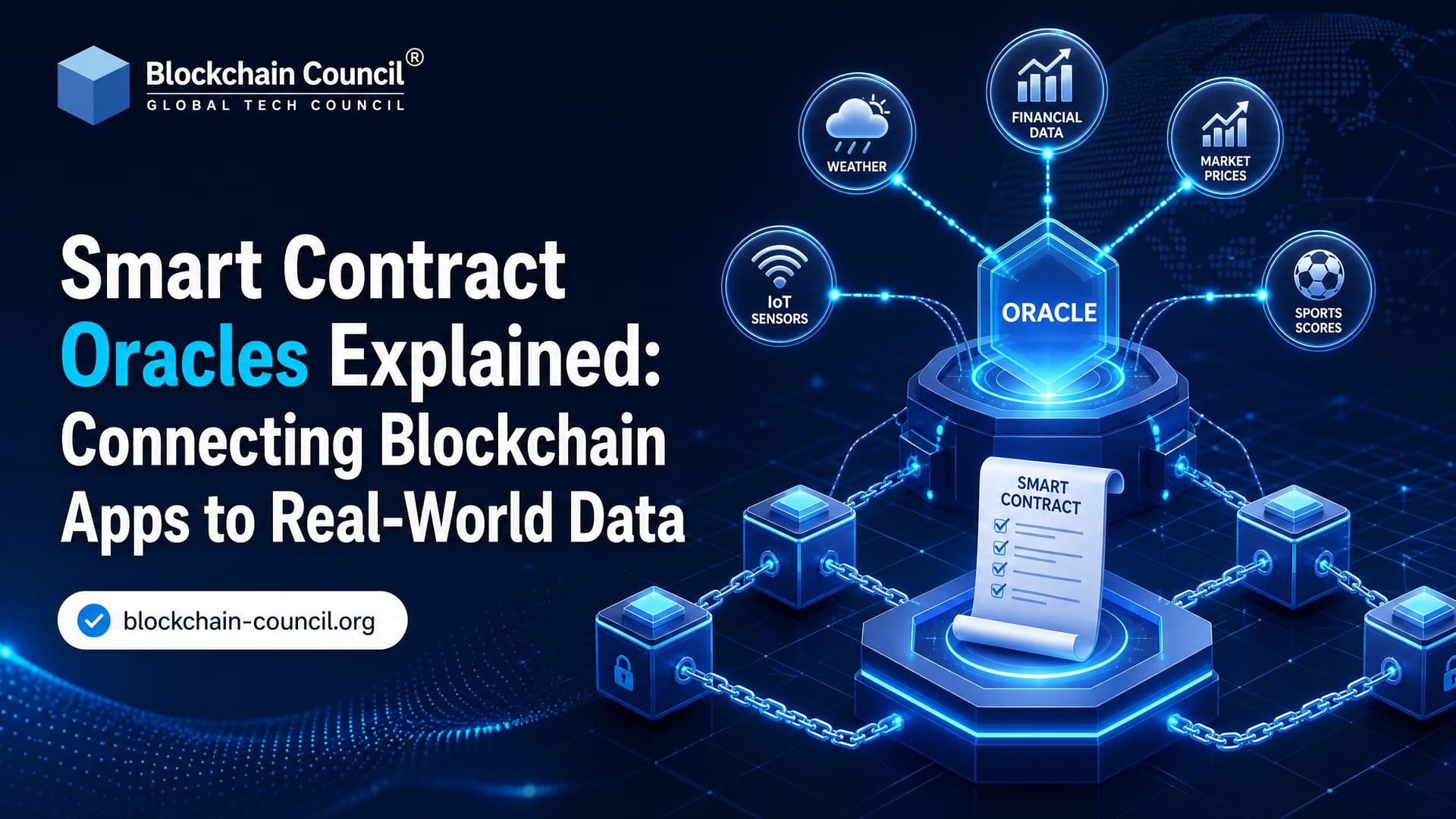
Smart contract oracles are the data layer that lets blockchain applications respond to real-world data: asset prices, weather, shipment status, identity checks, sports results, and events in external systems. Without oracles, a smart contract can only read what already exists on its own blockchain. That is safe and deterministic. It is also limiting.
Think of an oracle as a controlled bridge. It fetches offchain data, checks it against defined rules, and delivers it to a smart contract in a format the contract can process. Chainlink, Band Protocol, API3, UMA, and Witnet are among the better-known oracle projects. Each makes different assumptions about data sourcing, node operation, governance, and verification.

Why Smart Contracts Need Oracles
Blockchains are deterministic by design. Every node must reach the same result when it executes the same transaction. That is why smart contracts cannot simply call a normal web API during execution. If one node receives a different API response, or the API is down for one validator but not another, consensus breaks.
Smart contract oracles solve this by moving the messy external lookup outside the consensus-critical path. The oracle network retrieves the data, signs or aggregates it, and posts the result onchain. The smart contract reads that posted value like any other onchain state.
That single pattern opens up a wide set of applications:
- DeFi lending: collateral values, liquidation thresholds, stablecoin pegs, and synthetic asset prices.
- Insurance: weather data, flight delay information, disaster reports, and verified health events.
- Supply chain: shipment location, temperature readings, RFID events, and compliance attestations.
- Gaming and NFTs: verifiable randomness, tournament outcomes, and dynamic NFT metadata.
- Compliance: KYC status, identity attributes, and offchain governance results.
Bad data is expensive. Security reports across the Web3 sector have linked oracle weaknesses and price manipulation to hundreds of millions of dollars in DeFi losses since 2020. The figure matters because it shows that oracle design is not an academic topic. It is a production risk.
How Smart Contract Oracles Work
A typical oracle flow has four parts:
- Request or trigger: A smart contract or offchain service asks for data, or a scheduled oracle job runs automatically.
- Data collection: Nodes query APIs, exchanges, databases, sensors, or other blockchains.
- Validation and aggregation: The oracle checks for outliers, combines multiple sources, and applies rules such as median pricing.
- Onchain delivery: The final value is written to a blockchain contract that other contracts can read.
In Solidity 0.8.x, developers often read Chainlink-style price feeds through the AggregatorV3Interface and call latestRoundData(). That function returns fields including answer, updatedAt, and answeredInRound. Here is the detail that trips up many beginners: price feed decimals are not always 18. Many USD feeds use 8 decimals. If you multiply that value as if it had 18 decimals, your collateral math is wrong by a huge factor.
Another production habit: always check staleness. If updatedAt is too old, revert before using the price. I have seen teams add a guard such as require(block.timestamp - updatedAt <= maxDelay, "stale price") after testnet demos worked fine but mainnet risk reviews flagged the missing check. Small line. Big difference.
Types of Blockchain Oracles
Inbound and Outbound Oracles
Inbound oracles bring external information onto a blockchain. A lending protocol reading the ETH/USD price is using an inbound oracle.
Outbound oracles send smart contract events or instructions to external systems. A contract could emit an event after payment is confirmed, and an oracle service could then call a logistics API to release a shipment.
Software and Hardware Oracles
Software oracles connect to online systems such as market data APIs, Web2 platforms, centralized databases, or other blockchains. Most DeFi price feeds fall into this category.
Hardware oracles connect physical-world devices to smart contracts. Examples include IoT temperature sensors in cold-chain logistics, RFID tags in warehouses, and machine telemetry in industrial settings. These are harder to secure because the device itself can be tampered with. You need device identity, secure signing, calibration checks, and often human audit trails.
Centralized and Decentralized Oracles
A centralized oracle depends on one data provider or one operating entity. It is simple and cheap, but it creates a single point of failure. If the provider is wrong, offline, or compromised, dependent contracts inherit that failure.
A decentralized oracle network, often called a DON, uses multiple independent nodes and data sources. Instead of trusting one API response, the network aggregates several responses and publishes a result. Leading oracle networks report high availability targets, commonly around 99.9 percent uptime. Uptime alone is not enough. You also need good source diversity, update frequency, economic incentives, and clear fallback logic.
Where Oracles Are Used Today
DeFi Price Feeds
DeFi is the most visible oracle market. Lending protocols use price feeds to decide how much a user can borrow and when collateral should be liquidated. Stablecoins and synthetic assets use exchange rates to maintain pegs and settle redemptions. Derivatives contracts need settlement prices that reflect external markets.
Thin liquidity is the danger zone. If an oracle reads prices from a small pool, an attacker can use a flash loan to move that market briefly, force the oracle to report a distorted price, and drain value from a protocol. That is why serious protocols prefer oracle designs that aggregate multiple venues and avoid relying on a single decentralized exchange pool.
Insurance and Risk Automation
Parametric insurance is a clean oracle use case. Instead of filing a claim and waiting for manual review, the policy pays when a measurable condition is met. Rainfall below a threshold. A flight delayed by a defined number of minutes. A hurricane category reported by an approved source.
The trade-off is accuracy versus simplicity. Parametric contracts are fast, but they can create basis risk. A farmer may suffer crop damage even if the weather station nearest the farm does not cross the payout threshold. Oracle source selection becomes a business decision, not just a technical one.
Supply Chain and IoT
Supply chain oracles connect goods, sensors, and enterprise systems to onchain records. A smart contract might release payment when a container reaches a port and the temperature log proves the shipment stayed within range.
Do not oversell this. A blockchain record does not magically prove a physical fact. It proves that a signed device or system reported a fact. If the sensor is poorly placed or the RFID tag is swapped, the onchain record can still be clean and wrong. Hardware oracle projects need operational controls, not only cryptography.
NFTs, Gaming, and Randomness
Games and NFT applications use oracles for randomness and external event updates. Randomness is especially sensitive. Using block.timestamp or blockhash for valuable rewards is a bad idea because validators and searchers can sometimes influence or exploit weak randomness patterns. Use verifiable randomness services when outcomes have economic value.
Oracle Security Risks You Should Design Around
Oracle risk usually falls into a few buckets:
- Data manipulation: attackers influence the source data before it reaches the oracle.
- Centralized failure: one provider outage or compromise breaks dependent contracts.
- Stale updates: contracts act on old values during market volatility.
- Latency: delayed updates create unfair liquidations or settlement errors.
- Bad assumptions: developers mishandle decimals, units, time zones, or confidence intervals.
Practical mitigation starts with boring checks. Use multiple sources. Define a maximum data age. Add circuit breakers for extreme movements. Pause high-risk functions when feeds fail. Test with forked mainnet data, not only mocks. In Hardhat or Foundry tests, simulate a stale oracle and a zero price. If your protocol still lets borrowing continue, fix it before audit.
How to Choose an Oracle Design
Pick the oracle architecture based on risk, not fashion.
- Use a mature decentralized price feed for high-value DeFi markets. This is the default choice for lending, stablecoins, and derivatives.
- Use a centralized oracle only when the trust boundary is already centralized, such as a private enterprise workflow with a known data owner.
- Use hardware oracles carefully when physical events matter. Budget for device security, maintenance, and audits.
- Use verifiable randomness for games, raffles, and NFT mint traits where users can gain financially.
- Avoid custom oracle code unless your team can monitor, operate, and secure it every day.
To be blunt, most teams should not build their own oracle network. They should integrate a proven one, document the trust assumptions, and spend engineering time on validation logic around the feed.
The Future of Smart Contract Oracles
Oracle networks are moving beyond simple data feeds. Current technical roadmaps and ecosystem documentation point toward cross-chain messaging, offchain computation, compliance attestations, privacy-preserving data checks, and AI-assisted anomaly detection.
AI-powered oracles are interesting, but they are also easy to overstate. A model can flag suspicious data patterns, cluster signals, or summarize large data streams. It should not be treated as truth by itself. If an AI oracle cannot explain source quality, confidence, and failure modes, it is not ready for high-value settlement.
Cross-chain oracles may matter even more. As liquidity spreads across Ethereum, layer 2 networks, appchains, and non-EVM chains, applications need shared state and reliable messages. Oracle networks are becoming part data layer, part interoperability layer, and part computation layer.
Learning Path for Developers and Professionals
If you are building blockchain applications, learn oracle design alongside Solidity, token standards such as ERC-20 and ERC-721, and EIP-1559 gas mechanics. For structured study, consider Blockchain Council programs such as the Certified Smart Contract Developer™, Certified Blockchain Developer™, and Certified Blockchain Expert™. Security-focused learners should also connect oracle topics with smart contract auditing and DeFi risk management.
Your next step is practical: build a small Solidity contract that reads a live testnet price feed, checks decimals, rejects stale data, and emits an event when a threshold is crossed. Then write tests for the failure cases. That exercise teaches more about smart contract oracles than any diagram can.
Related Articles
View All
Smart Contracts
AI Oracles for Smart Contracts: Intelligent Real-World Data On-Chain
Explore how AI oracles for smart contracts deliver intelligent real-world data on-chain, enabling adaptive automation, risk scoring, and Web3 innovation.
Smart Contracts
Smart Contract Vulnerabilities and Exploitation Patterns: Lessons from Real-World Blockchain Breaches
Summary: Smart contracts are integral to blockchain applications but can have flaws like reentrancy, integer overflow, and logic bugs. Attackers exploit these vulnerabilities to gain unauthorized access, causing breaches. Preventing exploits involves secure development practices and rigorous…

Smart Contracts
Smart Contract Certification Guide: How to Validate Your Blockchain Skills
Learn how smart contract certification validates blockchain skills, which developer or auditor path to choose, and how to prove expertise with real projects.
Trending Articles
The Role of Blockchain in Ethical AI Development
How blockchain technology is being used to promote transparency and accountability in artificial intelligence systems.
How Blockchain Secures AI Data
Understand how blockchain technology is being applied to protect the integrity and security of AI training data.
What is AWS? A Beginner's Guide to Cloud Computing
Everything you need to know about Amazon Web Services, cloud computing fundamentals, and career opportunities.