

Smart Contracts for Tokenization: Turning Real-World Assets into Digital Tokens

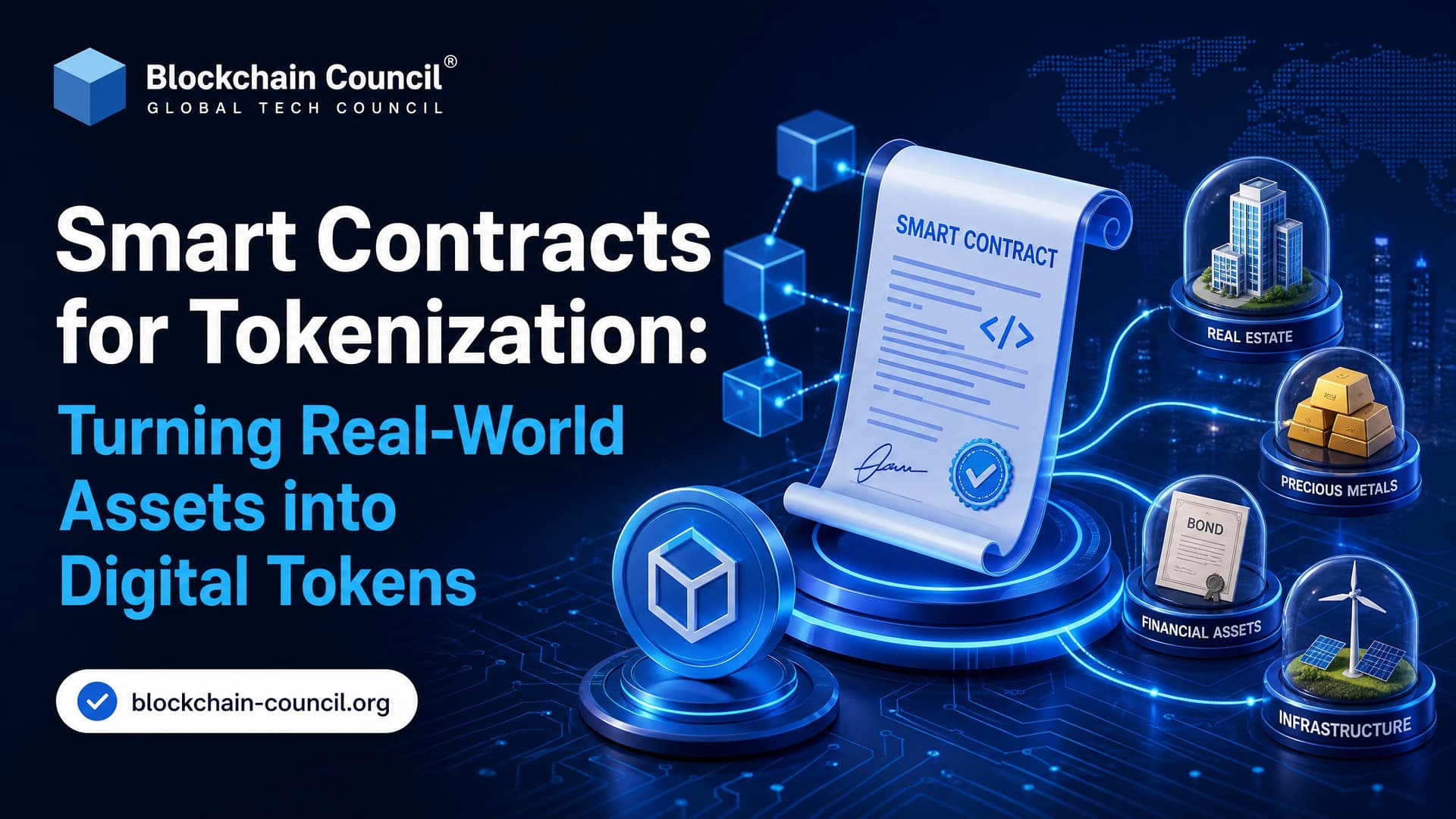
Smart contracts for tokenization are the technical rules that turn real-world assets into programmable digital tokens. They do much more than create a token symbol. A well-designed tokenization contract defines who can own the token, when it can move, how income is paid, how redemptions work, and what happens when an investor fails a compliance check.
That distinction matters. Tokenization is not just putting a building, bond, invoice, or gold bar on-chain. The token must represent enforceable economic rights, usually through a legal structure such as a fund, trust, or special purpose vehicle. The smart contract then becomes the execution layer for those rights.

What Smart Contracts for Tokenization Actually Do
Real-world asset tokenization converts rights in a tangible or intangible asset into blockchain-based tokens. Common examples include Treasuries, private credit, real estate, commodities, fund shares, cash equivalents, artwork, and intellectual property.
In production RWA systems, smart contracts usually handle five core jobs:
- Issuance: Mint tokens after subscription, asset acquisition, or fund allocation.
- Transfer control: Block transfers to wallets that are not approved, sanctioned, or eligible.
- Compliance: Check KYC, AML, investor category, lock-up periods, and jurisdiction rules.
- Settlement: Move token ownership and payment in a single transaction where the design allows it.
- Lifecycle events: Process redemptions, coupon payments, distributions, voting, and burn events.
Think of the smart contract as a policy engine with money attached. If the investor is not whitelisted, the transfer should fail. If a coupon date arrives, token holders should receive the correct distribution. If tokens are redeemed, supply should shrink and the audit trail should stay visible.
Why RWA Tokenization Is Moving From Pilots to Production
The market is no longer only a lab experiment. Coinbase's 2025 Crypto Market Outlook reported that tokenized real-world assets grew more than 60 percent to 13.5 billion dollars by December 2024. Later data from rwa.xyz showed public-chain tokenized RWAs continuing to climb well past that figure, up from roughly 7.8 billion dollars at the start of 2025.
Forecasts vary, but they point in the same direction. McKinsey has projected a tokenized asset market of around 2 trillion dollars by 2030. Other legal and industry analyses have discussed even larger long-term figures, with some scenarios reaching tens of trillions of dollars over the next decade.
Those numbers deserve a careful reading. Not every tokenized asset is liquid. Not every token holder has the same legal claim. And no smart contract removes credit risk from a loan or vacancy risk from a property. Still, the direction is clear. Financial institutions are using smart contracts to reduce manual processing, tighten compliance, and shorten settlement cycles.
Where Tokenization Is Gaining Traction
The strongest early categories are assets that already have clear financial workflows.
- Private credit: Tokenized private credit sits among the largest categories, measured in the tens of billions of dollars.
- United States Treasuries: Tokenized Treasuries have grown into a multi-billion-dollar segment and now act as a practical bridge between traditional fixed income and on-chain settlement.
- Real estate: Tokenized real estate has gained ground through fractional ownership models, though the amounts remain smaller than credit and Treasuries.
- Gold: Tokenized gold is commonly estimated between 1.2 and 1.5 billion dollars, with tokens representing claims on vault-stored metal.
Treasuries and money market style products are the cleanest starting point. They have familiar custody, pricing, and redemption processes. Real estate is attractive, but harder. Property title, local law, maintenance, rent collection, and taxes do not magically become simpler because a token exists.
Smart Contract Architecture for Tokenized Assets
A serious RWA platform is usually not one contract. It is a stack. At minimum, you will see contracts for token issuance, identity, compliance, settlement, and governance.
Asset Registration Layer
This layer links the on-chain token to the off-chain asset record. It may reference a legal agreement, custodian, SPV, fund document, or asset identifier. The hard part is not storing a hash. The hard part is making sure the legal document and the token holder's rights actually match.
Token Layer
This is where ERC-20 style fungible tokens, ERC-721 NFTs, ERC-1155 multi-token contracts, or permissioned security token standards come in. For tokenized Treasuries or fund shares, fungible tokens are common. For unique assets such as artwork or property interests, other models may fit better.
Compliance Layer
This is the layer beginners often underestimate. Regulated assets cannot usually move like meme coins. Transfers may need checks for accredited investor status, country of residence, sanctions lists, holding limits, and lock-up periods.
A practical warning. If you copy an old ERC-20 whitelist tutorial built with OpenZeppelin Contracts 4.x into OpenZeppelin Contracts 5.x, it may fail because the old _beforeTokenTransfer hook was removed. In 5.x, transfer logic is routed through _update. That small version change has broken many quick prototypes.
Settlement and Cash Flow Layer
Smart contracts can distribute coupons, rental income, fund dividends, or redemption proceeds to token holders. For some assets, they also use oracle inputs such as net asset value or pricing data. Oracles are powerful, but they are also a risk point. Bad data can produce bad settlement.
Governance Layer
Governance contracts can support investor voting, amendments, corporate actions, and administrative controls. In institutional settings, admin keys need strict controls. A single hot wallet with upgrade power is not acceptable for high-value assets.
ERC-3643 and Identity-Based Compliance
ERC-3643 is one of the most important standards in permissioned tokenization because it embeds identity checks into token transfers. Instead of assuming that every wallet can receive the token, the transfer calls identity and compliance contracts first.
In this model:
- Investors complete verification before they receive tokens.
- Identity contracts store relevant status, such as jurisdiction or investor type.
- Each transfer checks whether both sender and receiver satisfy the rules.
- Failed checks stop the transaction before ownership changes.
Industry reporting has pointed to tens of billions of dollars in tokenized assets using this standard across many jurisdictions. That scale shows why compliance-by-design is becoming a serious institutional requirement rather than a nice extra.
Real-World Use Cases
Tokenized Treasuries and Bonds
Tokenized Treasuries work well because the underlying asset is familiar, liquid, and custody-friendly. Smart contracts can manage subscriptions, investor eligibility, coupon handling, and redemptions. The benefit is operational: faster settlement, clearer records, and easier integration with stablecoin-based payment rails.
Private Credit
Protocols such as Centrifuge and Maple have shown how credit products can be represented on-chain while still depending on legal agreements and borrower obligations off-chain. The smart contract can manage investor participation and payment flows, but it cannot force a borrower to pay. Legal recourse still matters.
Tokenized Funds
Asset managers are increasingly testing or launching tokenized fund shares. WisdomTree has described smart contracts as a way to systematize multi-step financial processes, including investor eligibility checks and identity credential sharing. This is one of the more realistic institutional use cases because funds already operate through defined rules, administrators, and transfer agents.
Real Estate and Commodities
Real estate tokenization can lower minimum investment sizes and automate rent distribution, but it needs strong off-chain administration. Commodities such as gold require trusted vaulting, audits, insurance, and redemption procedures. The token is only as credible as the custody arrangement behind it.
Benefits of Smart Contract-Based Tokenization
- Fractional ownership: Large assets can be split into smaller units, opening access to investors with lower ticket sizes.
- Faster settlement: Token transfers and payment can occur in the same transaction or within far shorter cycles than traditional systems.
- Transparent audit trails: On-chain records make transfers and state changes easier to verify.
- Programmable compliance: Rules can be enforced at every transfer instead of checked manually after the fact.
- DeFi composability: Some RWAs can be used in lending or collateral systems, if regulation and risk controls allow it.
Risks You Should Not Ignore
Smart contracts improve process integrity, but they do not fix weak assets. To be blunt, a bad loan tokenized on a blockchain is still a bad loan.
- Legal enforceability: Courts must recognize the holder's rights for the token to have real force.
- Custody risk: The off-chain asset must exist, be protected, and be independently verified.
- Oracle risk: NAV, interest rates, and asset prices depend on reliable data sources.
- Contract bugs: Flawed minting, upgrade, or transfer logic can damage investor trust quickly.
- Regulatory fragmentation: Cross-border offerings face different securities, tax, and investor protection rules.
SEC Commissioner Mark Uyeda has publicly discussed tokenization's potential to improve liquidity, reduce intermediation delays, lower costs, and streamline compliance. The regulatory direction is positive in many markets, including formal activity in the European Union, but clarity is still uneven across jurisdictions.
What Developers and Professionals Should Learn Next
If you are building in this area, start with Solidity 0.8.x, ERC-20, ERC-721, ERC-1155, OpenZeppelin Contracts, Hardhat or Foundry, wallet flows, and upgradeable contract patterns. Then study permissioned token standards, especially ERC-3643, because regulated tokenization is mostly about controlled transfer logic.
For a structured learning path, Blockchain Council's Certified Smart Contract Developer™ suits developers who want to design and audit contract logic. Professionals evaluating tokenization strategy may also pair it with Certified Blockchain Expert™ or Certified Blockchain Developer™ to strengthen their understanding of blockchain architecture, consensus, wallets, token standards, and enterprise use cases.
Your next practical step: design a small permissioned ERC-20 prototype with a whitelist, minting role, redemption function, and transfer restriction tests. Run the tests until failed transfers revert for the right reason. That exercise teaches more about smart contracts for tokenization than reading another market forecast.
Related Articles
View All
Smart Contracts
Smart Contracts for Real-World Assets (RWA): Tokenization, Compliance, and On-Chain Settlement
Learn how smart contracts for real-world assets (RWA) enable tokenization, compliance-by-design, and on-chain settlement for Treasuries, credit, funds, and real estate.

Smart Contracts
Smart Contracts in Gaming: Play-to-Earn Assets, Rewards, and In-Game Economies
Learn how smart contracts power play-to-earn gaming assets, rewards, NFT ownership, marketplaces, DAOs, and in-game economies.

Smart Contracts
Smart Contracts in Real Estate: Tokenization, Escrow, and Property Transfers
Smart contracts in real estate automate tokenization, escrow, and property transfers while improving cost, speed, compliance, and title transparency.
Trending Articles
The Role of Blockchain in Ethical AI Development
How blockchain technology is being used to promote transparency and accountability in artificial intelligence systems.

Top 5 DeFi Platforms
Explore the leading decentralized finance platforms and what makes each one unique in the evolving DeFi landscape.
How Blockchain Secures AI Data
Understand how blockchain technology is being applied to protect the integrity and security of AI training data.