

What Is the Quantum Fourier Transform? Concepts and Applications

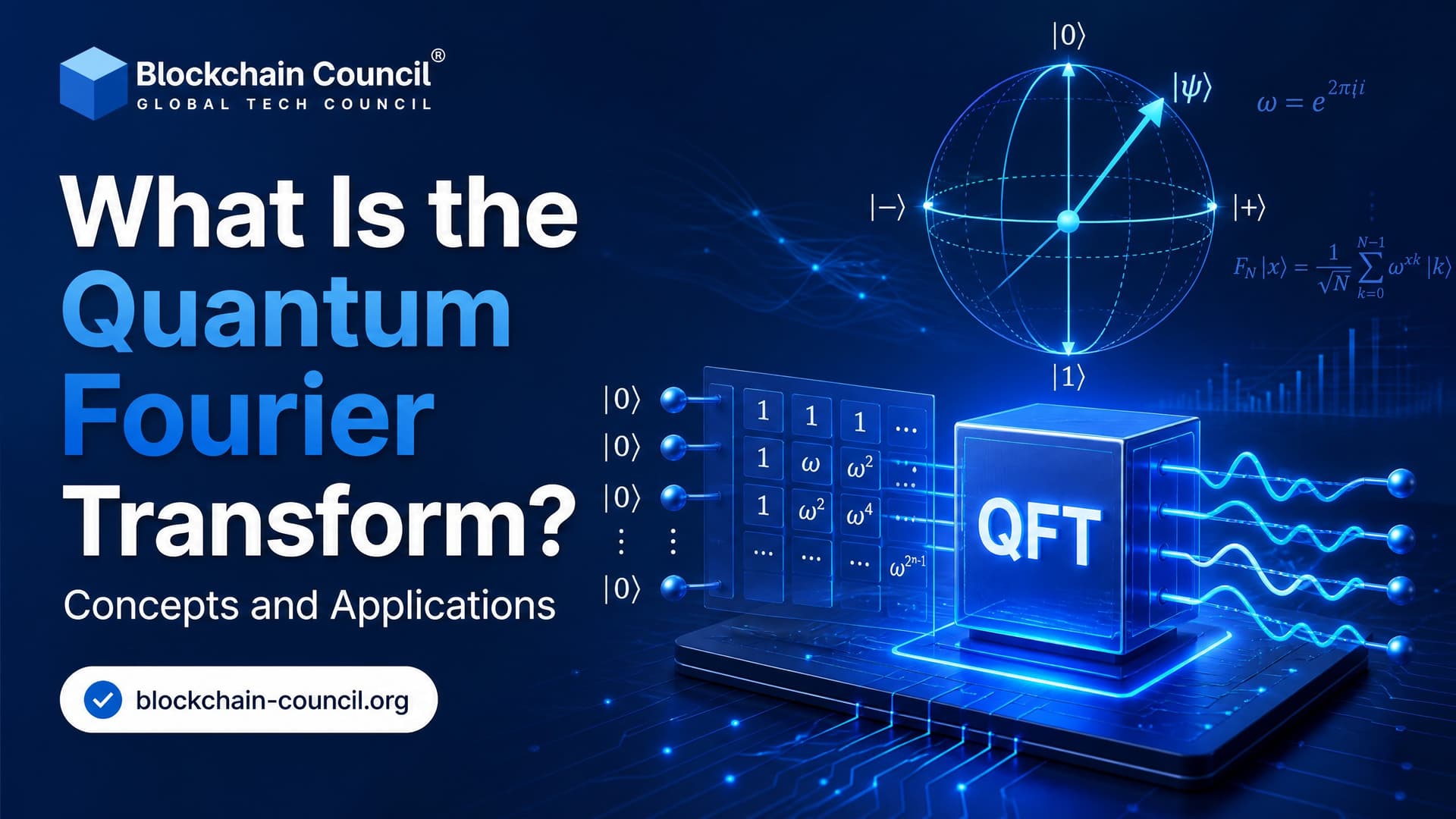
The quantum Fourier transform, often shortened to QFT, is the quantum version of the discrete Fourier transform. Instead of transforming a classical signal into frequencies, it transforms the probability amplitudes of a quantum state. That small wording change matters. In practice, the QFT is the reason algorithms such as Shor's factoring algorithm and quantum phase estimation can extract hidden periods and phases with striking efficiency.
If you are learning quantum computing for software development, cryptography, simulation, or risk planning, QFT is not optional background. It is one of the core circuit patterns you will see again and again.

What Is the Quantum Fourier Transform?
Classical Fourier analysis breaks a signal into frequency components. Engineers use it in audio processing, communications, medical imaging, and physics. The quantum Fourier transform does something mathematically similar, but the input is a quantum state.
For an n-qubit register, the computational basis represents integers from 0 to N - 1, where N = 2n. The QFT maps a basis state |x> to a superposition:
QFT|x> = 1 / sqrt(N) sum from k = 0 to N - 1 of exp(2 pi i xk / N)|k>
That formula is the discrete Fourier transform applied to quantum amplitudes. The operation is unitary, so it can be implemented by a quantum circuit and reversed by an inverse QFT.
Here is the practical intuition. QFT turns periodic structure in amplitudes into sharp measurement patterns. When the state hides a period, eigenphase, or subgroup structure, QFT helps make that structure measurable.
How a QFT Circuit Works
A standard QFT circuit uses three ingredients:
- Hadamard gates to place qubits into balanced superpositions.
- Controlled phase rotations to add phase relationships between qubits.
- Swap gates at the end to reverse qubit order.
The order reversal is a common beginner trap. In Qiskit, many textbook QFT circuits include final swaps, while some hand-built circuits skip them and interpret the output bits in reverse order. If your phase estimation result looks bit-reversed, this is usually the first thing to check. I have watched people debug the math for an hour when the fix was simply the missing swaps.
The exact QFT on n qubits can be built with O(n2) elementary gates. That is compact compared with applying a naive classical discrete Fourier transform over N = 2n values, which scales as O(N2). This comparison needs care, though. QFT does not hand you all Fourier coefficients as a classical list. Measurement returns samples. The speedup appears only when the quantum algorithm is designed so that sampling reveals the desired structure.
Inverse QFT
The inverse QFT, or IQFT, runs the QFT circuit backward with conjugated phase rotations. It has the same asymptotic cost. You see it most often in quantum phase estimation, where the phase is first encoded across a control register and then converted into readable binary digits by the IQFT.
Approximate QFT
Exact QFT uses many small controlled rotations. On noisy hardware, those tiny rotations may cost more fidelity than they are worth. Approximate QFT drops very small angle rotations and keeps the larger phase interactions.
This can reduce circuit depth substantially, often to near-linear depth for useful error bounds. The trade-off is precision. For near-term devices, approximate QFT is often the right engineering choice. For fault-tolerant cryptanalysis, exactness and error correction matter far more.
Why QFT Matters in Quantum Algorithms
QFT is rarely the whole algorithm. It is the frequency extraction step inside a larger procedure. That distinction is important. You do not use QFT to speed up ordinary audio processing on its own. You use it when amplitudes encode algebraic or spectral information that a quantum computer can expose through interference.
Shor's Algorithm and Public-Key Cryptography
Shor's algorithm is the best-known QFT application. It factors integers and solves discrete logarithms in polynomial time on a sufficiently large fault-tolerant quantum computer. The algorithm reduces factoring to period finding. QFT extracts the period from a superposition of modular exponentiation values.
This is why RSA, Diffie-Hellman, and elliptic curve cryptography are considered vulnerable to large-scale quantum computers. The threat is not a generic quantum speedup. It is a very specific chain: modular arithmetic, period finding, QFT, and continued fractions.
For security teams, QFT is part of the technical basis for post-quantum cryptography migration. The U.S. National Institute of Standards and Technology has already published post-quantum standards, including ML-KEM (FIPS 203) and ML-DSA (FIPS 204), reflecting the long-term risk from algorithms in the Shor family.
Hidden Subgroup Problems
The hidden subgroup problem asks you to identify a subgroup when a function is constant on its cosets and distinct on different cosets. That sounds abstract, but it captures factoring and discrete logarithms in finite abelian groups.
QFT over finite abelian groups reveals subgroup structure from quantum superpositions. This is one reason the QFT is treated as a core primitive in quantum algorithm theory, not just a neat circuit exercise.
Quantum Phase Estimation
Quantum phase estimation, or QPE, estimates the eigenphase of a unitary operator U. The algorithm applies controlled powers of U, such as U1, U2, U4, and so on, then uses inverse QFT to convert phase information into a binary estimate.
QPE sits inside many high-value quantum algorithms. It is used for eigenvalue estimation, Hamiltonian simulation, amplitude estimation, and parts of linear systems algorithms. If Shor's algorithm is the famous face of QFT, QPE is the workhorse.
HHL, Quantum Counting, and Linear Algebra
The Harrow-Hassidim-Lloyd algorithm, usually called HHL, uses phase estimation to estimate eigenvalues of a matrix represented through Hamiltonian simulation. QFT is part of that eigenvalue extraction step.
HHL can offer exponential scaling advantages in problem dimension under strict assumptions: sparse matrices, good conditioning, efficient state preparation, and a useful quantum output state. To be blunt, it is not a drop-in replacement for NumPy. But as a subroutine in quantum simulation, optimization research, and scientific computing, it remains important.
Quantum counting also uses phase estimation, this time applied to Grover-style operators, to estimate how many marked solutions exist. Again, QFT appears as the phase-to-bits conversion stage.
Applications of the Quantum Fourier Transform
Cryptanalysis
QFT-powered period finding is the foundation of quantum attacks on number-theoretic cryptography. Enterprises should understand this not because tomorrow's laptop will factor RSA-2048, but because cryptographic migrations take years. Inventorying your public-key dependencies is a practical step you can take now.
Quantum Simulation and Materials Science
In physics and chemistry, many problems are spectral: energies, eigenstates, response functions, and dynamics. QFT-based phase estimation can help estimate energy levels of molecular and material systems. This is one of the clearest long-term paths to useful fault-tolerant quantum computing.
Larger QFT circuits are also starting to appear on real hardware rather than only in simulators. Progress like this does not mean industrial quantum advantage has arrived. It does show that QFT circuits are moving beyond toy demonstrations.
Quantum Machine Learning and Data Processing
QFT is also being studied for feature extraction, spectral filtering, and data compression in quantum machine learning workflows. The strongest claims are usually for subroutines, not end-to-end training pipelines. Be skeptical of broad claims that QFT will speed up every machine learning task. The credible view is narrower: when data is available in a quantum-accessible form and the task depends on spectral structure, QFT can be powerful.
Finance, Risk, and Monte Carlo Methods
Quantum finance research often uses phase estimation and amplitude estimation for derivative pricing, risk analysis, and Monte Carlo-style estimation. Since these routines rely on QFT or QFT-like transforms, finance teams tracking quantum roadmaps should understand the primitive even if production deployments are still research-grade.
Earth Observation and High-Dimensional Sensing
Remote sensing data often includes large spectral cubes, inverse problems, and pattern recognition tasks. Research on quantum approaches to Earth observation places QFT inside pipelines for phase estimation, quantum counting, linear systems, and quantum machine learning. This area is early, but the fit is reasonable. High-dimensional structured data is exactly where spectral methods often matter.
What QFT Does Not Do
QFT is powerful, but it is often misunderstood. Keep these limits in mind:
- It does not output a full classical Fourier spectrum in one measurement. You get samples, not an array of all coefficients.
- It does not automatically replace the FFT. For standard classical signal processing, the fast Fourier transform is still the practical tool.
- It needs the right encoding. Loading arbitrary classical data into amplitudes can erase the theoretical speedup.
- Hardware noise matters. Controlled rotations and circuit depth can degrade results on NISQ devices.
This is the mature way to think about QFT. It is not magic Fourier acceleration. It is a precise tool for extracting hidden periodic and phase information from quantum states.
How Developers Can Start Learning QFT
If you want hands-on understanding, build a three-qubit QFT circuit in Qiskit, Cirq, or PennyLane. Then remove the final swaps and inspect how the bit order changes. Next, implement inverse QFT inside a basic phase estimation circuit for a known phase gate. Small experiments teach the concept faster than reading ten diagrams.
For a structured path, consider Blockchain Council's Certified Quantum Computing Expert™ program as a next step. If your role touches security strategy, pair QFT study with post-quantum cryptography fundamentals. Developers working across Web3 infrastructure may also connect these ideas with Blockchain Council resources on blockchain security and cryptography, since quantum risk directly affects key management and signature schemes.
Final Takeaway
The quantum Fourier transform is a compact mathematical operation with outsized algorithmic value. It powers period finding in Shor's algorithm, phase extraction in QPE, and key subroutines in simulation, linear algebra, counting, and emerging quantum data workflows.
Your next step: implement QFT and inverse QFT on four qubits, test both exact and approximate versions, and watch how phase information turns into measurable bit strings. That single exercise will make Shor's algorithm and quantum phase estimation much less mysterious.
Related Articles
View All
Quantum Computing
Top Applications of Quantum Computing in the Real World
Explore the top real-world applications of quantum computing, from drug discovery and finance to cybersecurity, logistics, AI, and energy systems.

Quantum Computing
What Is Quantum Machine Learning? Concepts, Models, and Use Cases
Quantum machine learning combines quantum circuits with classical ML workflows for specialized tasks such as optimization, kernels, anomaly detection, and simulation.

Quantum Computing
How Quantum Computing Could Transform Artificial Intelligence
Quantum computing could reshape AI through faster optimization, richer feature spaces, better sampling, and hybrid quantum-classical learning.
Trending Articles
The Role of Blockchain in Ethical AI Development
How blockchain technology is being used to promote transparency and accountability in artificial intelligence systems.
What is AWS? A Beginner's Guide to Cloud Computing
Everything you need to know about Amazon Web Services, cloud computing fundamentals, and career opportunities.
Claude AI Tools for Productivity
Discover Claude AI tools for productivity to streamline tasks, manage workflows, and improve efficiency.